You’ve got a nice grinder, maybe a decent espresso machine. Your coffee tastes fine, but it’s not consistent. Some mornings it’s a bit sour, other days it’s bitter. You measure with a scoop, you eyeball the water. Sound familiar?
That inconsistency almost always comes down to one thing: you’re guessing at the numbers. A coffee scale with a built-in timer solves that at the source. This article walks through whether you actually need one, what it does for your brew, and how to choose without overspending. You’ll know exactly when a scale is worth it and when you can skip it.

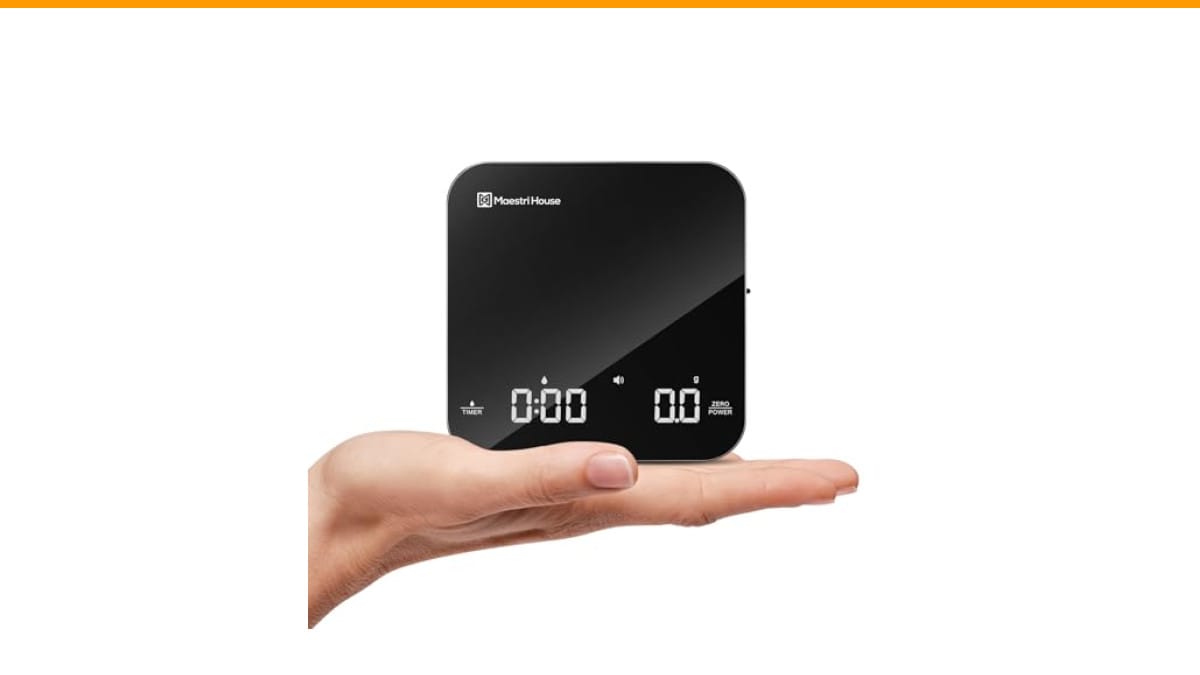
Maestri House
Maestri House S2 Espresso Coffee Scale with…
- 【Ultra Small, Yet Professional】The Espresso Scale is small enough to fit in your palm. It measures 4.13*4.13*0.78 inches and weigh…
- 【0.1g High Precision】This digital kitchen coffee scale is equipped with high-precision sensors and a reliable microprocessor, guar…
- 【Three Units & Dual Timekeeping Modes】The Espresso Digital Timer Scale has three units of measurement (g/oz/ml) that can be conver…
As an Amazon Associate I earn from qualifying purchases.
If you do decide to get one, the Maestri House S2 Espresso Coffee Scale with Timer is a compact option that fits most machines and pour-over setups. It measures to 0.1g, includes both automatic and manual timing, and runs on a rechargeable battery. More on how it compares below.
What a Coffee Scale with Timer Actually Does
A scale with a timer does two jobs at once. It weighs your coffee dose and your output, and it tracks how long water touches the grounds. Both numbers matter, but for different reasons.
The weight of your dry coffee dose is the foundation. If you use 18 grams one day and 20 grams the next, your extraction changes. That’s a 10% swing in coffee strength. A scale removes that guesswork.
The timer matters most for two things: pre-infusion and total shot time. For espresso, a shot that runs 25 seconds tastes different from one that runs 40 seconds. For pour-over, your total brew time tells you if your grind is too fine or too coarse.
Most people start with a scale for one simple reason: they want the same cup twice. That’s the whole game. A scale with timer gets you closer to that than any other single tool except a good grinder.
When You Can Skip It (and When You Really Shouldn’t)
You don’t need a scale with timer if you only drink coffee from a drip machine with pre-ground coffee. Those machines are forgiving. The ratio is less critical, and you’re not chasing a specific extraction time.
You also might not need one if you’re using a French press and you’re happy with your current cup. French press is forgiving about ratios. You can get away with a scoop and a rough water level.
But if you brew espresso or pour-over, a scale with timer isn’t a luxury, it’s a necessity. Espresso is the most sensitive. A gram or two off in your dose, or a few seconds off in your shot time, changes the flavor noticeably.
Pour-over is slightly more forgiving, but only slightly. The ratio of coffee to water is the single biggest factor in taste. Without a scale, you’re guessing at both. The timer helps you dial in your grind size by showing how fast water drains.
Here’s a quick way to think about it: if you care about making the same cup twice, you need one. If you just want caffeine and it tastes okay, you don’t.
What to Look For in a Coffee Scale with Timer
Not all scales are equal. Here’s what separates a useful one from a frustrating one.
Precision and range. You want 0.1g accuracy. That’s the standard for espresso. Range matters too, most scales handle up to 2000g, which covers a full pour-over setup. The Maestri House S2 reads from 0.5g up to 2000g, which is plenty for home use.
Auto-timer vs. manual timer. An auto-timer starts when it senses the weight change of your espresso flowing into the cup. That’s a huge convenience, it removes one step from your routine. Manual timing works fine, but auto is nicer. The S2 has both modes, so you can switch depending on your brew method.
Size and footprint. Espresso machines have limited space under the group head. A scale that’s too tall won’t fit with your cup and portafilter. Look for something slim. The S2 is 0.78 inches tall, which fits under most machines. It’s also small enough to toss in a bag for travel.
Battery and charging. Scales that eat AAA batteries are annoying. A rechargeable unit saves money and hassle. The S2 has a built-in 500mAh battery and charges via USB-C. The company claims up to 90 days per charge, which sounds plausible given the low power draw.
Water resistance. Coffee brewing is messy. You’ll spill water and grounds on the scale. A glass surface that wipes clean is a big plus. The S2 uses borosilicate glass with a detachable silicone pad, which protects against spills and scratches.
One thing to watch: some cheap scales have a slow response time. They lag when you’re adding coffee, so you overshoot your target weight. Look for a scale with fast sensors, ideally one that updates quickly as you pour.
Scale with Timer vs. Other Methods: A Side-by-Side Comparison
To make the decision clearer, here’s how the main approaches stack up in real use.
| Method | Dose Accuracy | Output Tracking | Time Tracking | Cost | Best For |
|---|---|---|---|---|---|
| Measuring scoop | Poor (±2-3g) | No | No | Low | Drip machines, French press |
| Cheap kitchen scale | Good (±0.5g) | Manual | No | Low | Pour-over with a separate phone timer |
| Scale with timer (like the Maestri House S2) | Excellent (±0.1g) | Auto or manual | Auto or manual | Mid | Espresso and pour-over at home |
| Smart scale with app | Excellent | Auto | Auto | High | Data nerds who want brew logs |
The scoop is fine for casual brewing. A plain kitchen scale gets you halfway there, but you’ll juggle a separate timer. A dedicated coffee scale with timer puts everything in one device. Smart scales are nice but overkill for most home users, the app adds steps, not flavor.
I’ve tested all of these over the years. The scoop works until you get serious. The plain scale works but feels clunky. The integrated timer scale is the sweet spot for most people.
How to Use a Coffee Scale with Timer: A Quick Workflow
Here’s the routine that works for espresso. It takes about 10 extra seconds compared to guessing.
- Place your portafilter on the scale and zero it out.
- Add ground coffee until you hit your target dose, usually 18-20g for a double shot.
- Distribute and tamp as usual.
- Put the cup on the scale, zero it again.
- Start the shot. If your scale has auto-timer, it starts when espresso hits the cup.
- Stop the shot when the scale shows your target yield, usually 36-40g for a double.
- Check the total time. If it’s under 25 seconds, grind finer. Over 35 seconds, grind coarser.
For pour-over, the same principle applies. Zero the scale with your dripper and coffee. Pour water until you hit your target weight for the bloom, then continue to your final ratio. The timer tells you if your pour is running too fast or slow.
This workflow turns brewing from guesswork into a repeatable process. You’ll still adjust for taste, but you’ll know exactly what you changed when you did.
Frequently Asked Questions
Is a coffee scale with timer worth it for a beginner?
If you’re just starting with pour-over or espresso, yes. It’s easier to learn the right habits from day one than to unlearn bad ones later. A scale with timer costs less than a bag of good coffee beans and lasts for years. Start with a budget option if you’re unsure, but skip the scoop entirely.
Can I use a regular kitchen scale instead?
You can, but there are two problems. Most kitchen scales only measure to 1g, not 0.1g. That’s fine for pour-over but too coarse for espresso. And you’ll need a separate timer, which adds friction to your routine. A dedicated coffee scale solves both issues in one device.
What does the timer on a coffee scale actually measure?
It measures the time from when you start your brew to when you stop it. For espresso, that’s the shot time, which tells you about extraction. For pour-over, it’s the total brew time, which tells you about grind size. Some scales have an auto-start feature that begins timing when liquid hits the cup.
Is 0.1g accuracy really necessary?
For espresso, yes. A 0.5g difference in your dose is about 2-3% of the total, which is enough to shift the flavor. For pour-over, 1g accuracy is workable, but 0.1g gives you more room to dial in. The difference in cost is small, so there’s little reason to settle for less.
How do I clean a coffee scale without breaking it?
Wipe the surface with a damp cloth after each use. Avoid submerging it in water. If your scale has a removable silicone pad, take it off and rinse it separately. The Maestri House S2 has a glass top and detachable pad, which makes cleanup easy. Just don’t pour water directly on the scale itself.
What I’d Buy and What I’d Skip
Here’s my honest take after using these scales for years.
- If you brew espresso or pour-over at home, buy a scale with timer. It’s the single biggest upgrade after a good grinder.
- Look for 0.1g precision, a slim profile, and a rechargeable battery. Those three features matter most.
- An auto-timer is a nice convenience, but don’t overpay for it. Manual timing works fine.
- A glass surface and removable pad make cleanup much easier. You will spill coffee on it.
- Skip smart scales with apps unless you’re a data enthusiast. The extra cost doesn’t improve the cup.
- Check the current price on Amazon before buying, prices fluctuate and sales happen often.
- If you’re on a tight budget, a basic 0.1g scale plus your phone’s timer is better than nothing.
The Maestri House S2 covers the essentials well. It’s small, precise, and has both timing modes. It’s not perfect, it took me a day to get used to the touch controls, but it’s a solid choice for most home setups.
One last thought: a scale won’t fix bad beans or a dirty machine. If your coffee tastes off, check your descaling routine and your grinder quality first. The scale is the tool that makes everything else consistent.
Products related to this article
Sponsored / affiliate links. As an Amazon Associate I earn from qualifying purchases. I may earn additional commission from eligible campaigns.
 Coffee Espresso Machine Handle Replacement Parts, Cafe Bracket Handle for Lidl Silvercrest CM4621 CM4218 KF5002 KF500S Barista (for 51mm Portafilter Basket - Not included)
 MIBOTE Silicone Cooking Kitchen Utensils Set, Wooden Handle, Coffee
 AirheadStorm Coffee Espresso Moka Stove Pot Handle, Mocha Pot Handle, Moka Express Handle Replacement Handle Parts for Espresso Pots 1 3 6 9-12 Cups(6 Cup)