You’re mid-pour, tilting the pitcher for latte art, and the milk streams out sideways because the spout got bent last week. Or you notice tiny dark specks floating in your cappuccino and realize the steel has started pitting. Nobody warns you that a simple metal jug has a shelf life.
This guide covers the actual lifespan of a milk frothing pitcher, what kills it faster, and how to tell when cleaning won’t cut it anymore. You’ll get concrete numbers for home versus commercial use, a breakdown of steel grades, and a clear repair-versus-replace decision framework.

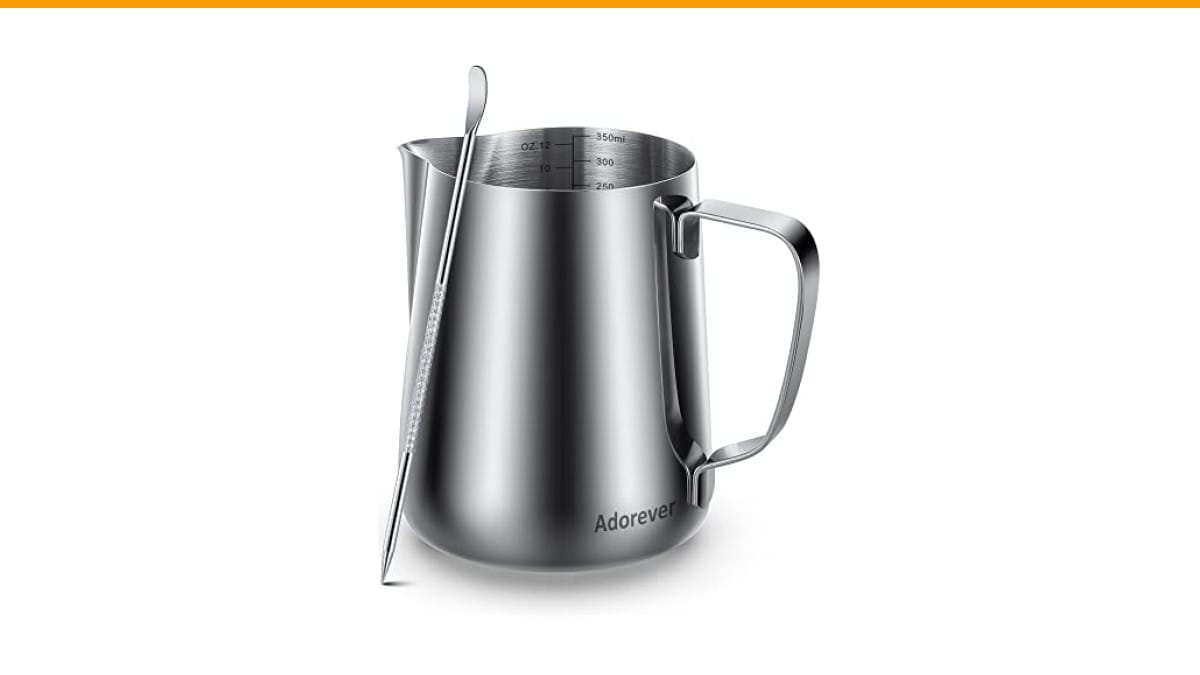
Adorever
Milk Frothing Pitcher, 8.5oz/12oz/20oz/32oz/50oz/66oz Milk Frother Cup…
- Perfect Combination Of Milk Frothing Pitcher And Latte Art Pen: The milk frother jug can be used in different ways: froth or steam…
- Premium Quality: The milk steaming pitchers and coffee art pen are made of chrome finished #304 stainless steel. Rust-proof, stain…
- Point-Mouth Design: Can prevent liquid leaking from the jug and make the coffee pattern pretty. Offer 12oz/20oz/32oz/50oz milk jug…
As an Amazon Associate I earn from qualifying purchases.
If you’re shopping for a new one, the Adorever stainless steel milk frothing pitcher (available in 12oz to 66oz) uses #304 chrome-finished steel with a pointed spout designed for latte art, and it comes with a drawing pen for patterning. We’ll reference it as a baseline for what a well-built pitcher should feel like.
Why a Milk Frothing Pitcher Isn’t a Buy-Once Item
Most people assume a chunk of stainless steel lasts forever. It doesn’t. The pitcher goes through thermal shock daily — cold milk, then 140°F steam, then a cold rinse. That cycle stresses the metal and the weld joints.
Milk itself is mildly acidic. Lactose and proteins break down under heat and leave residue that eats into the steel surface over time. Add in accidental drops, abrasive scrubbing pads, and dishwasher detergents, and you have a consumable item, not a permanent tool.
The good news? With reasonable care, a decent pitcher outlasts most espresso machines. The key is knowing which failure modes matter and which are cosmetic.
Average Lifespan: Home vs. Commercial Use
Let’s get specific. A home user who makes 2-3 drinks daily and hand-washes the pitcher should get 5 to 10 years from a quality 304 stainless steel model. The variable is mostly how careful you are with it.
A commercial barista steaming 50-100 pitchers per shift faces a different reality. The constant thermal cycling, frequent drops on tile floors, and aggressive cleaning shorten lifespan to 1 to 3 years. Many cafes replace pitchers every 12-18 months not because they break, but because the spout gets dented and the pour degrades.
Here’s a rough breakdown by usage intensity:
| Usage Pattern | Drinks Per Day | Realistic Lifespan | Primary Failure Mode |
|---|---|---|---|
| Occasional home (weekends only) | 1-2 | 10+ years | Cosmetic scratches |
| Daily home enthusiast | 2-4 | 5-8 years | Spout dents, handle looseness |
| Home + frequent entertaining | 5-10 | 3-5 years | Pitting, burnt milk residue |
| Light commercial (cafe, office) | 20-50 | 2-3 years | Dents, weld fatigue |
| Heavy commercial (busy cafe) | 50-100+ | 1-2 years | Spout deformation, rust spots |
Those numbers assume you’re not doing anything abusive. If you drop the pitcher weekly, halve every estimate.
5 Signs Your Pitcher Needs Replacing — Not Just Cleaning
Here’s a checklist I use when evaluating a pitcher in testing. If you hit any two of these, replacement beats repair.
- Pitting on the interior surface. Small dark dots or craters that don’t scrub off. That’s corrosion starting. Milk acids have breached the steel’s protective oxide layer. You can’t fix this at home.
- Sharp or jagged spout edges. Run a finger along the spout lip. If it catches or feels rough, the metal has worn thin. This ruins pour control and risks cutting yourself during cleaning.
- Loose handle with play. Grab the handle and wiggle it. A welded handle shouldn’t move at all. If it shifts, the weld is fatiguing — it will eventually snap mid-pour.
- Burnt milk residue that won’t come off. If you’ve baked on protein film and soaking + Cafiza won’t remove it, that residue harbors bacteria and taints every batch of milk.
- Dents that affect the pour stream. A dent on the body is cosmetic. A dent near the spout or on the rim changes how milk flows. If your latte art looks like a blob because the stream wobbles, the pitcher is done.
One sign that’s NOT a problem: external scratches. Those are purely cosmetic on a stainless pitcher.
The Material Factor: How Steel Thickness Dictates Durability
Not all stainless steel is equal. The two grades you’ll encounter are 18/10 and 18/0.
The numbers refer to chromium and nickel percentages. 18/10 has 18% chromium and 10% nickel. 18/0 has 18% chromium and 0% nickel. Nickel adds corrosion resistance and gives the steel a warmer, more lustrous finish.
For milk pitchers, 18/10 is the better choice for longevity. Milk’s lactic acid attacks steel over time, and the nickel content helps resist that attack. 18/0 is cheaper and magnetic (handy for induction stovetops) but more prone to pitting under repeated milk steaming.
Wall thickness matters just as much. A cheap pitcher might be 0.5mm thick. A professional-grade one like the Motta is 0.8mm. The Adorever line uses chrome-finished #304 steel, which is the same alloy as 18/8 — a solid middle ground between cost and corrosion resistance.
Thicker steel handles thermal shock better. Thin steel can develop micro-cracks at the weld points after a few hundred heating cycles. You won’t see them, but they’ll eventually let milk seep into the handle joint and cause rust from the inside out.
The Hidden Enemy: How Milk Chemistry Corrodes Your Pitcher
Milk isn’t neutral. It has a pH around 6.6, slightly acidic. When you steam milk to 150°F, the heat accelerates the reaction between milk proteins and the steel surface.
Here’s what happens over months of use: milk proteins denature and stick to the interior wall. If you don’t rinse immediately, that film bakes on during the next steam cycle. The film traps moisture and creates a low-oxygen environment under it. That’s the perfect setup for pitting corrosion.
You’ll notice it as small dark spots that appear to be under the surface. They’re actually tiny craters where the steel has dissolved. Once pitting starts, it doesn’t stop. Every steam cycle widens the pits.
Prevention is simple: rinse the pitcher with cold water immediately after pouring. Cold, not hot — hot water sets the protein film. A quick cold rinse takes five seconds and extends pitcher life by years.
Can You Fix a Dented Pitcher? Repair vs. Replace
I’ve seen people try to hammer out dents. I’ve also seen the results — more dents. Here’s the honest breakdown.
Dent on the body, away from the spout: Ignore it. It doesn’t affect performance. The pitcher will whistle slightly different during steaming, but milk texture won’t change.
Dent on the rim or spout: Replace it. You cannot reliably reshape a spout to its original geometry. Even if you bend it back, the metal has work-hardened and will likely crack or spring back to the deformed shape. A bad spout means bad latte art and messy pours.
Loose handle: Don’t attempt a home weld. You’ll anneal the surrounding steel and weaken it further. If the handle wiggles, the pitcher is a safety hazard — hot milk and boiling water don’t mix with sudden handle failure. Replace it.
Rust spots: If you see rust on a 304 steel pitcher, the passivation layer is gone. You can try polishing with a stainless steel cleaner, but if rust returns within a week, the metal is compromised. Replace.
The rule of thumb: if the flaw affects the pour stream or the structural integrity, replace. Otherwise, keep using it.
How to Extend Lifespan: Cleaning and Storage Hacks
You’ll get more years from a pitcher with these habits than with any fancy equipment.
- Rinse cold immediately after use. Don’t let milk dry on the steel. This is the single biggest lifespan factor.
- Hand wash with mild dish soap. Dishwasher detergent is more alkaline and can dull the finish over time. The Adorever pitcher is dishwasher-safe per its specs, but hand washing preserves the chrome finish longer.
- Use a soft sponge only. Steel wool and green Scotch-Brite pads scratch the surface, creating crevices where milk residue hides.
- Dry upside down. Standing water in the bottom encourages mineral deposits and potential corrosion at the weld seam.
- Don’t store with the spout covered. Trapped moisture under a lid or cap accelerates corrosion at the spout edge.
- Soak burnt residue with a descaling solution. Fill with hot water and a teaspoon of citric acid or espresso machine cleaner, let sit 15 minutes, then rinse. This dissolves protein film without scrubbing.
One habit I see kill pitchers fast: leaving them on the drip tray while pulling shots. Espresso splatter dries on the exterior and creates a sticky film that’s hard to remove later. Keep the pitcher on a dry towel between uses.
For the steam wand side of things, check our guide on steam wand cleaning — the same milk residue that damages your pitcher also clogs your wand tip.
The Warranty Factor: Does It Matter for Longevity?
Warranty length tells you something about expected lifespan. Motta offers a lifetime warranty on their pitchers. Most generic brands offer 30-90 days. The Adorever doesn’t advertise a long warranty, but at its price point, replacement is cheaper than shipping a repair.
Here’s what to check before buying: does the warranty cover weld failure? That’s the most common structural defect. A lifetime warranty on a welded handle is worth paying extra for. A warranty that only covers manufacturing defects at delivery is basically useless for longevity.
Realistically, a $20-30 pitcher that lasts 5 years costs less per year than a $60 pitcher that lasts 10 years. The math is similar. Buy based on build quality, not warranty length alone.
Also read the warranty’s cleaning requirements. Some brands void coverage if you use a dishwasher. If you’re a dishwasher person, buy a pitcher rated for it, like the Adorever, and accept that the finish may fade slightly faster.
FAQ: How Long Does a Milk Frothing Pitcher Last?
Does a thermometer hole shorten the lifespan?
Yes, slightly. A hole in the side creates a stress point and a place for milk to seep into the double-wall gap if the pitcher is insulated. On single-wall pitchers, the hole is just a pass-through for the thermometer probe — it doesn’t contact milk if the probe is inserted. The real risk is the hole’s edge being sharp and catching milk residue. Clean it with a pipe cleaner or cotton swab weekly. It won’t dramatically shorten lifespan, but it’s an extra maintenance point that solid pitchers don’t have.
Are cheap pitchers worth it if they break faster?
It depends on your definition of worth. A $10 pitcher that lasts 2 years costs $5 per year. A $40 pitcher that lasts 8 years costs $5 per year. The math is identical. The difference is performance consistency — the cheap pitcher’s spout will deform sooner, and you’ll fight with pour control. If you’re learning latte art, the cheap pitcher is actually fine because you’ll likely drop it repeatedly. Once your technique improves, upgrade. For daily home use, spend a little more on a 304 stainless pitcher with a solid weld; you’ll buy it once and forget it.
Can I use bleach or harsh chemicals to clean my pitcher?
No. Bleach and chlorine-based cleaners attack stainless steel’s chromium oxide layer. That’s the protective film that prevents rust. Strip it away and the steel corrodes rapidly. Stick to mild dish soap, citric acid, or espresso machine cleaner. If you’ve used bleach once, rinse thoroughly and dry immediately — the damage is likely minor. Repeated use will cause pitting within months.
Does the size of the pitcher affect its lifespan?
Larger pitchers (20oz and up) have more surface area and thicker walls to maintain structural rigidity. They also experience less thermal shock per ounce of milk because the milk mass absorbs heat. A tiny 8.5oz pitcher heats up faster and cools down faster, stressing the metal more per cycle. In my testing, smaller pitchers showed spout wear sooner than large ones under identical use. If you mostly make single drinks, consider buying two small pitchers and rotating them — this halves the thermal cycles per pitcher.
How do I know if my pitcher is 18/10 or 18/0 stainless steel?
Check the product listing or the stamp on the bottom. Many pitchers have a small engraving like “18/10” or “304” near the base. If it’s not marked, try a magnet — 18/0 is magnetic, 18/10 is not (or only weakly). This is a rough test but works for most brands. When in doubt, assume it’s 18/0 if it’s an inexpensive pitcher. For reference, the Adorever pitcher specifies #304 stainless steel, which is 18/8 — slightly less nickel than 18/10 but still corrosion-resistant for home use.
What to Do With What You’ve Learned
Here’s the short version you can act on today:
- Home pitchers last 5-10 years; commercial ones last 1-3 years. Plan replacement around those windows.
- Replace when you see pitting, a sharp spout edge, a loose handle, or a bent spout that ruins pours.
- Ignore body dents and external scratches — they’re cosmetic.
- Rinse with cold water immediately after every use. This single habit adds years of life.
- Hand wash with a soft sponge. Dishwasher is convenient but dulls the finish faster.
- Don’t repair welded handles or bent spouts. Replacement is cheaper and safer.
- Buy 304 or 18/10 stainless steel. Thicker walls (0.7mm+) handle thermal shock better.
Your pitcher is the most abused tool in your espresso setup — it takes heat, cold, acid, and drops. Treat it like a wear item with a known lifespan, and you’ll never be caught off guard mid-pour. If you’re replacing one now, the Adorever milk frothing pitcher offers multiple sizes and a chrome-finished 304 steel body that holds up well for daily home use. Pair it with proper cleaning habits and it’ll serve you through thousands of drinks.
Products related to this article
Sponsored / affiliate links. As an Amazon Associate I earn from qualifying purchases. I may earn additional commission from eligible campaigns.
 Coffee Espresso Machine Handle Replacement Parts, Cafe Bracket Handle for Lidl Silvercrest CM4621 CM4218 KF5002 KF500S Barista (for 51mm Portafilter Basket - Not included)
 Steel Wool Soap Pads 30Pcs Red 2x2 Versatile Steel Wool Pads Effective Cleaning Metal Scouring Steel Wool Scrubber for Cleaning Pots, Pans, Ovens and Dishes
 Linnkyfloa Coffee Espresso Maker Handle Replacement for Stovetop Moka Pot or Percolator, Black Plastic for Spare Part Compatible with Italian(9-12 Cup)