Use this calculator to convert beverage mass and TDS into extraction yield. Enter the dry dose, finished beverage mass, and TDS, then the result updates automatically.
How is this calculated?
Press Calculate to see the math with your numbers.
Understanding extraction yield formula and targets
Use an extraction yield calculator to convert beverage mass and TDS into extraction yield: EY = beverage mass × TDS ÷ dry dose, and many brews land around 18–22%. Bad readings push you toward weak, sour, or harsh coffee and can hide grind, ratio, or recipe errors. This guide shows the formula, the usual target ranges by brew method, and the measurement mistakes that skew the result.
What extraction yield means
Extraction yield is the percentage of dry coffee mass that ends up dissolved in the beverage. It is a mass-balance number, so it tells you how much of the dose moved into the cup, not how intense the cup tastes by itself. Read it alongside strength and recipe.
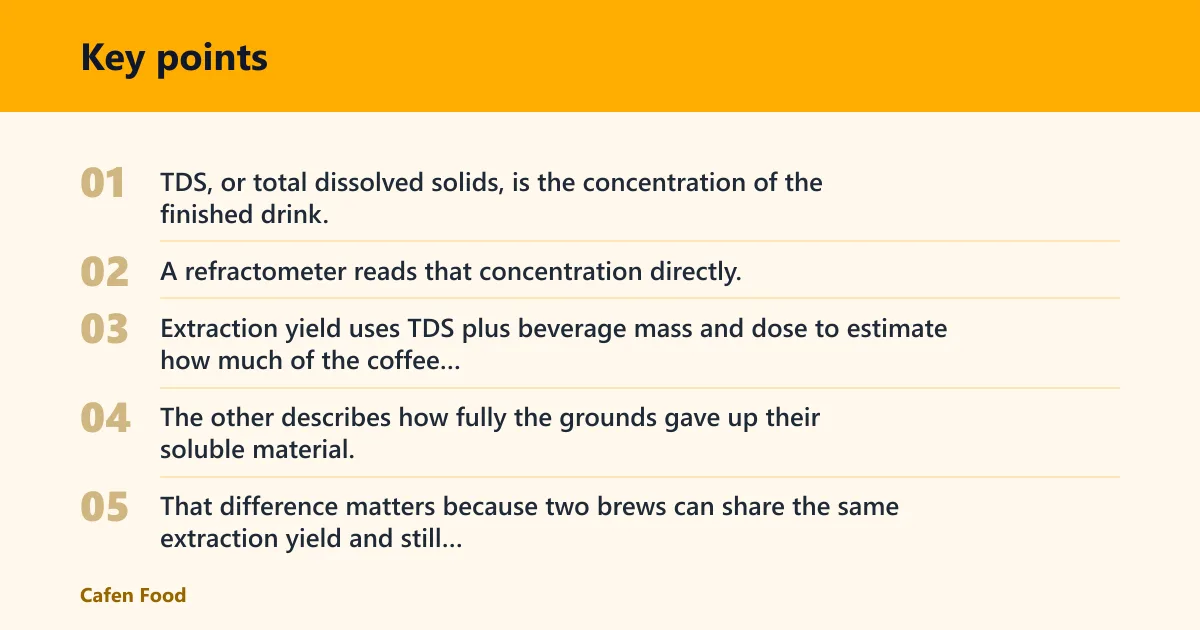
TDS, or total dissolved solids, is the concentration of the finished drink. A refractometer reads that concentration directly. Extraction yield uses TDS plus beverage mass and dose to estimate how much of the coffee was extracted. One number describes strength. The other describes how fully the grounds gave up their soluble material.
That difference matters because two brews can share the same extraction yield and still taste different if their brew ratio differs. A concentrated espresso can land in a low TDS band and still extract well. A long filter brew can read lower in strength while still sitting in a normal extraction range.
The coffee formula most calculators use is simple: EY = beverage mass × TDS ÷ dose. A common calculator page also writes the same relationship as beverage mass times TDS divided by dose, and another formula version states EY = EW / OW × 100. For coffee, the input you care about is the dry dose in grams, the finished beverage mass, and the TDS reading.
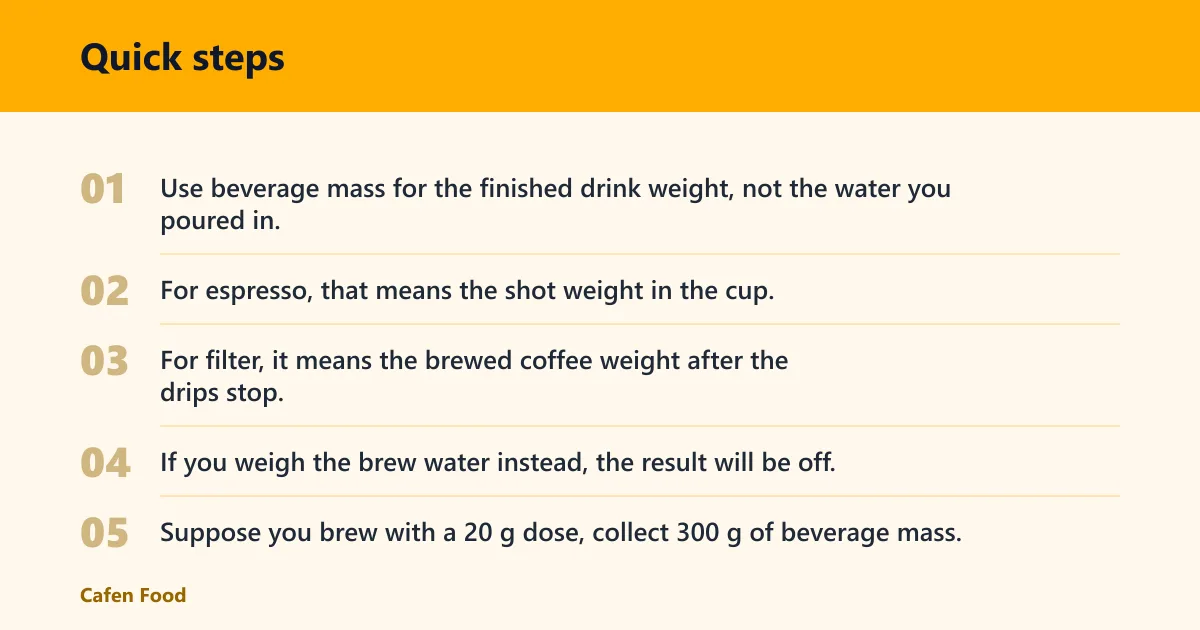
Use beverage mass for the finished drink weight, not the water you poured in. For espresso, that means the shot weight in the cup. For filter, it means the brewed coffee weight after the drips stop. If you weigh the brew water instead, the result will be off.
Worked example
Suppose you brew with a 20 g dose, collect 300 g of beverage mass, and measure 1.35 percent TDS. Multiply 300 by 1.35 to get 405, then divide by 20. The extraction yield is about 20.25 percent. That sits inside the common 18–22 percent reference band.
Here is the same example compared side by side so the math error is obvious:
| Calculation | What you enter | Result |
|---|---|---|
| Correct calculation | 20 g dose, 300 g beverage mass, 1.35% TDS | 300 × 1.35 ÷ 20 = 20.25% EY |
| Incorrect calculation using water volume | 20 g dose, 1,000 g brew water, 1.35% TDS | 1,000 × 1.35 ÷ 20 = 67.50% EY |
The second result is wrong because it uses poured water instead of finished beverage mass. The absorbed water never reaches the cup, so brew water volume is not the number the formula needs.
How to calculate without a calculator
You can estimate extraction yield when you do not have a refractometer by using brew ratio, strength, and taste as a rough guide, but it will not be precise. If the cup tastes balanced and your recipe is known, you can compare it against method norms and the expected beverage mass. That is a fallback, not a measurement.
A common first-timer mistake is to enter the brew water volume instead of the actual collected espresso mass. Picture a batch brew where you pour 1,000 g of water but only collect 900 g in the server. The 100 g retained in the bed changes the math, and the yield estimate will drift if you use the wrong mass.
What you need to measure
You need three things for a proper calculation: dry dose, beverage mass, and TDS. Dose is the dry coffee mass before brewing, usually measured in grams. Beverage mass is the finished drink weight. TDS comes from a refractometer.
Accurate mass matters because small weighing errors change the answer quickly. A 1 g mistake in dose or beverage mass is small in the cup, but it can still shift the percentage. Keep the scale level, tare correctly, and weigh the brewed coffee, not the spent grounds container.
Refractometer and TDS
TDS is usually read with a refractometer. Some consumer options include models from Atago, VST, and DiFluid. The point is accuracy. Guessing from taste alone cannot separate strength from extraction, and a refractometer gives you a direct concentration reading that the formula can use.
Cooling the sample and mixing it well matter. Hot liquid can distort a reading, and an unmixed sample may not represent the whole brew. Filter carryover, foam, and crema can also make the sample behave differently from the cup as a whole.
Coffee extraction decision table
| Symptom or taste | Likely numeric pattern | Next adjustment |
|---|---|---|
| Espresso tastes sharp, thin, and finishes fast | Low EY with low or mid TDS; often paired with fast shot time | Grind finer, slow the shot, or raise dose slightly if basket capacity allows |
| Espresso tastes harsh, dry, and overlong | High EY with very high TDS, or uneven EY from channeling | Grind coarser, reduce agitation, and check puck prep before lowering yield |
| Pour over tastes sour and watery | Low EY with low TDS; ratio may also be too lean | Grind finer, extend contact time, or increase brew strength with a smaller ratio |
| Pour over tastes hollow but not bitter | Normal-looking EY with weak TDS | Keep extraction similar and raise strength by changing the brew ratio, not just grind |
| AeroPress tastes bright but lacks depth | Mid EY with low TDS, often from a short brew or a large dilution | Increase steep time, tighten grind, or reduce bypass water |
| Batch brew tastes flat in a large urn | EY may look normal while TDS drops as the batch stretches out | Check brew ratio, slurry mixing, and bed depth before changing grind |
| French press tastes muddy and dry | EY can run high, but solids and fines complicate the reading | Coarsen the grind, settle longer, and sample from a cleaner portion |
| Cold brew tastes smooth but weak | Low TDS with moderate EY because the drink is often diluted | Increase coffee concentration or reduce dilution before chasing a higher yield |
| When the number lies: crema | Espresso TDS can read artificially high if crema is not handled consistently | Stir or standardize the sample before reading, then compare like for like |
| When the number lies: retained water | Wrong beverage mass if brew water absorbed by grounds is ignored | Weigh the finished beverage, not the poured water, and note retention |
| When the number lies: stale calibration | TDS drifts if the refractometer is not zeroed properly | Calibrate with clean water before readings and recheck if the device sits unused |
| When the number lies: wet grounds | Dose basis becomes fuzzy if the dry dose was not measured before brewing | Use the pre-brew dry dose only; do not substitute wet slurry mass |
What is a normal extraction yield?
A common reference point is 18–22 percent extraction yield. The SCA brewing framework and later primary research on coffee extraction both treat extraction and strength as separate measurements, which is why the common target band is only a guide. It is not a pass-or-fail test. A cup can taste good outside the range, and a cup inside the range can still taste off.
Method matters. Espresso is often discussed with TDS around 8–12 percent, while pour over is commonly listed around 1.20–1.45 percent TDS. Filter coffee target extraction is often cited at 19–22 percent. Those numbers are not interchangeable because brew ratio and beverage strength change by method.
Standards-based brewing guidance and peer-reviewed coffee solubility work both point to the same practical takeaway: measure extraction yield with mass and concentration, then interpret it in the context of the brew method and cup strength. That is more reliable than trying to judge extraction from taste alone.
Say your espresso lands at 9 percent TDS and 20 percent EY. That is not a conflict. The shot can still be strong in the cup because espresso uses a small beverage mass. The lower beverage mass is part of the method, not proof that the extraction is wrong.
Why taste and the number disagree
Taste can disagree with the reading when extraction is uneven. Channeling is the common example: some coffee gets overwashed while other parts barely extract. The average number may look normal, but the cup still tastes sour, thin, or hollow because the brew is not uniform.
Brew ratio also changes what you taste. A smaller ratio makes the cup stronger at the same extraction yield. A larger ratio can make the cup taste lighter even when extraction is fine. That is why TDS alone does not tell the whole story, and yield alone does not either.
Suppose a pour over measures 20 percent EY but tastes sour. Check grind distribution, bed leveling, and pouring pattern before chasing a lower number. If water shot through one side of the bed, the average extraction can hide an uneven cup. The fix is often better distribution, not more extraction.
How to adjust the next brew
Raise extraction when the cup tastes sour, thin, or abruptly sharp. The usual moves are finer grind, more contact time, slightly hotter water, or more agitation. On filter methods, a small grind change often moves EY more than a large recipe change.
Lower extraction when the cup tastes bitter, dry, or hollow after a long finish. The usual moves are coarser grind, less agitation, cooler water, or a shorter contact time. In espresso, a puck prep fix may matter more than a ratio change if the shot is channeling.
Adjust strength without changing extraction much by changing brew ratio. More water lowers TDS and makes the cup taste lighter. Less water raises TDS and makes the cup taste stronger. That is how two brews can share a similar extraction yield but taste very different.
- Measure the dry dose before brewing.
- Weigh the finished beverage, not the pour water.
- Read TDS from a cooled, mixed sample.
- Calculate EY from beverage mass, TDS, and dose.
- Compare the result with the method target and the taste in the cup.
- If the cup and number disagree, check uneven extraction, then check recipe strength.
Frequently asked questions
What is extraction yield?
Extraction yield is the percentage of the dry coffee dose that dissolved into the beverage. It helps you judge brew efficiency and quality, but it does not replace taste. A cup can read in range and still be underwhelming if the extraction is uneven or the brew ratio is wrong.
How do I calculate extraction yield from TDS?
Use beverage mass × TDS ÷ dose. Measure the dry dose in grams, weigh the finished drink, and get TDS from a refractometer. If the TDS is 1.35 percent, the beverage mass is 300 g, and the dose is 20 g, the yield is 20.25 percent.
What is the extraction yield formula for coffee?
A common calculator formula is EY = beverage mass × TDS ÷ dose. The same idea with mass terms written as EY = EW / OW × 100. For coffee, the practical version uses the dry dose, the finished beverage mass, and the TDS reading.
What is a normal extraction yield for brewed coffee?
A common reference range is 18–22 percent extraction yield. That band is often used for brewed coffee, but it is not a universal pass or fail line. Method, ratio, and taste all matter, so a good cup outside that band is still possible.
Why does my coffee taste sour if extraction yield looks normal?
The cup may be unevenly extracted. Channeling, poor distribution, or a fast bypass can leave part of the coffee under-extracted even if the average yield looks fine. Check grind consistency, water path, and agitation first. Also compare the brew ratio, because a weak cup can taste sour even at a normal yield.
Do I need a refractometer to calculate extraction yield?
For a real calculation, yes. A refractometer measures TDS, and TDS is the input that turns dose and beverage mass into extraction yield. Without it, you can only estimate from recipe, mass, and taste. That estimate is useful for direction, but it is not a precise reading.
What is the difference between TDS and extraction yield?
TDS measures concentration in the finished drink. Extraction yield measures how much of the dry coffee dissolved into that drink. A concentrated espresso can have a high TDS and a modest yield, while a larger filter brew can have a lower TDS and a similar yield.
How does espresso extraction yield calculator work?
An espresso calculator uses dose, shot weight, and TDS. You enter the dry coffee dose, the beverage mass in the cup, and the refractometer reading. The result helps you compare the shot against espresso norms, where TDS is often discussed around 8–12 percent and extraction is still judged against the broader coffee target range.
How do I calculate extraction yield without a calculator?
You can estimate by checking the brew ratio, comparing the cup to method targets, and judging whether the brew tastes sour, balanced, or bitter. That helps with quick adjustments, but it does not replace a refractometer-based calculation. If the goal is a repeatable number, you need the TDS reading.
Products related to this article
Sponsored / affiliate links. As an Amazon Associate I earn from qualifying purchases. I may earn additional commission from eligible campaigns.
 Wooden Coffee Mixing Spoons, 3PCS Long Handle Wooden Mixing Spoon, Cooking Long Handle Tasting Spoons for Kitchen Soup Coffee Cocktail Honey Mixing Stirring
 HouseGem Large Candle Warmer Plate - Coffee Cup Mug Warmer for Desk, Candle Melter, Electric Mug Heater for Beverages, Milk & Tea, Coffee Accessories Ideal Gifts Keep Cup Warm (Black)
 Quick Heating Cup Warmer, Three Temperature Settings, Splashproof and Portable, for Coffee, Milk, Lightweight ABS Material