You’ve just finished dialing in a perfect pour-over. The grind looked consistent, the bloom was even, and the cup tasted like a café in Portland. Then you notice it: the handle feels loose. The burrs sound a little rough. A tiny metal fleck appears in your grounds. That’s the moment you start wondering how long this thing will actually hold up.
It’s a fair question, and the honest answer is more complicated than a single number. A $25 blade grinder from a big-box store might die in 18 months. A well-made steel burr grinder could outlive your marriage. Most hand grinders fall somewhere in between, and the difference comes down to three things: what the burrs are made of, how the body is built, and how you treat it. This guide walks through each factor so you know exactly what to expect from your grinder—and when to stop nursing it and buy a new one.

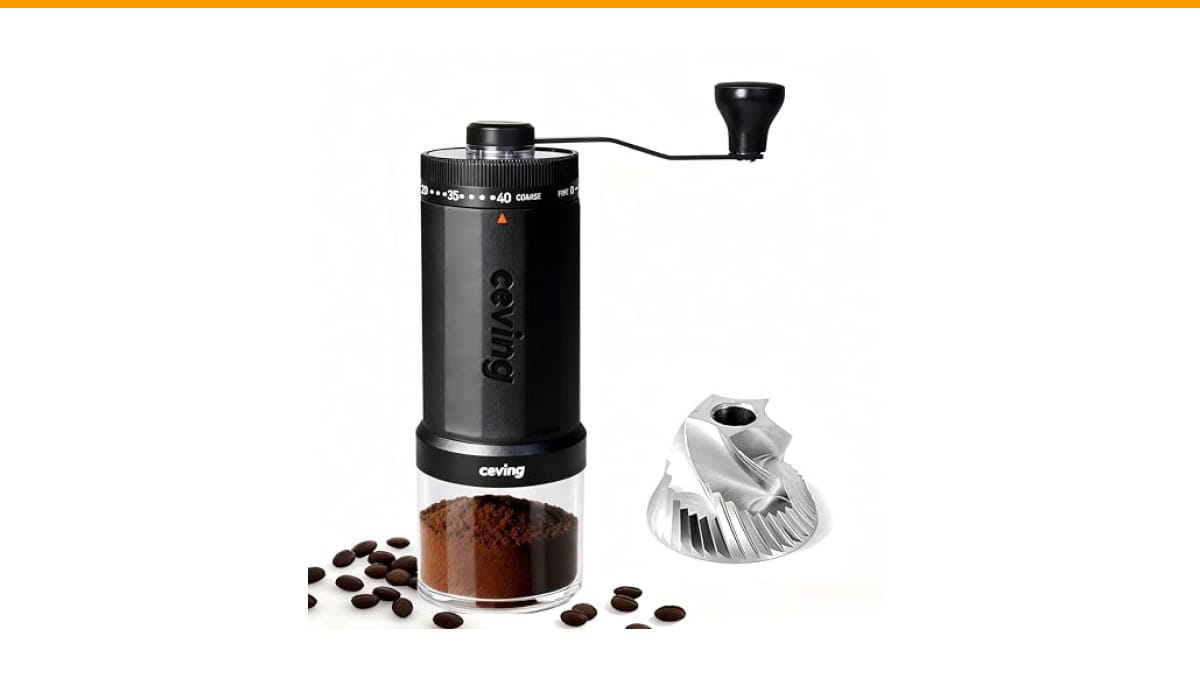
CEVING
CEVING World's First 60g Large Capacity Manual…
- Tired of small batches? Meet the world's first manual grinder with a massive 60g capacity—Hold twice the beans of the standard gri…
- 40 EXTERNAL SETTINGS - DIAL IN PERFECT BREWS INSTANTLY. Our external click-ring delivers 40 precise settings—effortlessly switch f…
- MASTER-LEVEL PRECISION - LAB-ACCURATE GRINDS, BARISTA-APPROVED FLAVOR. Each click adjusts by just 0.05mm—the finest difference det…
As an Amazon Associate I earn from qualifying purchases.
If you’re in the market right now, the Check Price on Amazon is worth a look. It uses CNC steel burrs and a metal body, which puts it in the category of grinders designed for years of daily use rather than seasonal camping trips. We’ll get into why that matters below.
The Short Answer: How Many Years Should You Expect?
Here are the realistic lifespan ranges based on price and build quality. These assume normal home use—one to three grind sessions per day—and basic cleaning.
| Price Tier | Typical Materials | Expected Lifespan | What Usually Fails First |
|---|---|---|---|
| Budget ($20–$50) | Ceramic burrs, plastic body, plastic crank | 1–3 years | Crank axle strips, burr alignment drifts, plastic cracks |
| Mid-Range ($50–$150) | Steel or ceramic burrs, aluminum body, metal crank | 5–10 years | Burrs dull (especially with oily beans), catch cup threads wear |
| Premium ($150+) | Hardened steel burrs, full metal construction, replaceable parts | 15+ years, often a lifetime | Rarely anything—occasional burr replacement after a decade |
Those ranges assume you’re not abusing the grinder. Drop it on a concrete floor repeatedly and even a premium model will develop alignment issues. Treat a budget grinder gently and it might stretch to five years. The numbers are a guide, not a guarantee.
The biggest gap between tiers isn’t the burrs—it’s the rest of the machine. Cheap grinders fail at the axle, the crank handle, or the plastic threads that hold the catch cup. Premium grinders fail at nothing, because every part is either metal or easily replaceable.
So if you want a grinder that you’ll hand down to your kids, skip the budget tier and look for one with replaceable burrs and a metal body. That’s the buy-it-for-life argument in a nutshell.
The 3 Biggest Factors That Determine Lifespan
Burr Material: Ceramic vs. Steel
Ceramic burrs are hard and stay sharp longer than cheap steel. They’re also brittle. Drop the grinder and a ceramic burr can chip, which ruins grind consistency permanently. Ceramic burrs also struggle with very hard, light-roast beans—they can stall or produce uneven grounds.
Steel burrs, especially hardened CNC-machined ones, are tougher. They handle any bean you throw at them, from brittle light roasts to oily dark roasts. They dull faster than ceramic in theory, but in practice a good steel burr will outlast the rest of the grinder. When it finally dulls after years of use, you can often replace just the burr set.
My take: steel is the better choice for longevity, provided the grinder’s other components are also metal. A steel burr in a plastic body is still a fragile grinder.
Build Quality and Price Tiers
The price tiers above reflect real differences in materials and tolerances. A $30 grinder uses a plastic drive shaft that connects the handle to the burrs. That shaft is the weak link—twist it too hard on a dense bean and it strips. Once that happens, the handle spins freely and the grinder is dead.
Mid-range grinders use metal shafts and gears, so they survive the occasional over-torque. The burrs themselves are usually good for 5,000 to 10,000 grind sessions. If you grind twice a day, that’s roughly 7 to 14 years. The catch cup threads and the rubber gasket around the shaft are the parts that wear out first on these models.
Premium grinders take it further. They use stainless steel or titanium-coated burrs, dual bearings to keep the shaft aligned, and full metal bodies. Many offer replaceable burrs and gaskets, meaning a $200 grinder can functionally last forever if you’re willing to swap parts every decade or so.
The catch: you pay for that longevity upfront. If you’re not sure you’ll still be making pour-overs in ten years, a mid-range grinder is the smarter buy.
Your Grinding Habits (Frequency and Bean Type)
Frequency matters, but not as much as you’d think. A hand grinder used three times a day will wear out faster than one used once a week—that’s obvious. What’s less obvious is how much bean type affects wear.
Dark-roasted, oily beans are the enemy. The oils coat the burrs and the interior chamber, creating a sticky film that traps coffee dust. That gunk adds friction, which accelerates wear on the axle and bearings. It also makes the grind setting drift over time, so your espresso shots start pulling faster even though you didn’t change anything.
Light roasts are harder physically but cleaner. They don’t leave the same oily residue, so the grinder stays mechanically sound longer. The burrs themselves will dull slightly faster from the harder beans, but the difference is small.
If you drink mostly dark roasts, plan to clean your grinder more often. That leads right into the next section, because maintenance is the single biggest lever you control.
Maintenance: The #1 Way to Double Your Grinder’s Life
You can’t stop wear, but you can slow it way down. A grinder that gets cleaned monthly will outlast an identical grinder that never gets opened up. It’s not even close.
The 5-Minute Weekly Clean
Once a week, run a few grams of dry rice or commercial grinder cleaner through the burrs. This pulls out the oils and stale coffee dust that accumulate between grinds. Then wipe the catch cup and the burr chamber with a dry cloth. That’s it—five minutes, no disassembly.
This simple habit prevents the gunk buildup that causes burr drag and axle strain. It also keeps your grind size consistent, because a clean burr set produces a uniform particle size every time.
For a deeper clean, check out our step-by-step grinder cleaning guide—it covers the full process with photos.
The Annual Deep Clean and Re-Greasing
Once a year, take the grinder apart. Remove the burrs, the crank, and the shaft. Brush off all the coffee residue with a stiff brush. Wipe the threads on the adjustment ring and the shaft with a dry cloth. Then apply a tiny amount of food-grade grease to the shaft and the threads—just enough to coat them, not enough to drip.
This annual service addresses the two most common failure points: seized threads and a dry shaft that grinds against its housing. A $5 tube of food-grade grease plus twenty minutes of work can add years to the grinder’s life.
If you’re grinding daily, do this every six months instead. The extra effort is worth it, especially if you use oily dark roasts.
Signs Your Grinder Is Dying (And When to Repair vs. Replace)
Grinders don’t just stop working one day. They give you warnings. Here’s what to look for and what each symptom means.
- Handle feels loose or wobbly: The crank axle or its bearing is wearing. If it’s just a loose screw, tighten it. If the axle itself has play, you’re looking at a repair that might cost more than a new budget grinder.
- Grind size drifts over time: The adjustment ring is slipping or the burrs are dull. Try re-setting the grind and locking it in. If it drifts again within a week, the threads are stripped—replace the grinder.
- Metal flecks in your grounds: This is the death knell. Burrs are grinding against each other, and metal is flaking off into your coffee. Stop using it immediately and replace the burrs or the whole unit.
- Burrs feel rough when you turn the handle: Could be a chipped ceramic burr or a bent shaft. Open it up and inspect. A chipped burr is not repairable—replace it.
- Crank handle snaps: If the handle is plastic or pot metal, this is common. On a premium grinder, you can often buy a replacement handle. On a budget grinder, it’s not worth it.
- Metal body and metal crank. No plastic in the load-bearing parts. Plastic threads and shafts are the #1 cause of premature death.
- Replaceable burrs. This is non-negotiable for a buy-it-for-life purchase. Check if the manufacturer sells burr sets separately.
- Dual bearings on the shaft. One bearing at the top and one at the bottom keeps the shaft perfectly aligned. Single-bearing grinders develop wobble over time.
- Warranty of at least 2 years, ideally 5+. A long warranty signals the manufacturer expects the grinder to last. A lifetime warranty is the gold standard.
- Steel burrs over ceramic. Steel is more forgiving of drops and hard beans. Ceramic is fine in a budget grinder, but steel is better for longevity.
- External adjustment ring. Internal adjustments require disassembly to change settings, which means more wear on the threads. External rings are easier to clean and maintain.
- Budget grinders ($20–$50) last 1–3 years. Treat them as disposable.
- Mid-range grinders ($50–$150) last 5–10 years with basic care. This is the sweet spot for most home users.
- Premium grinders ($150+) can last decades if they have replaceable burrs and a metal body.
- Clean weekly with dry rice, deep clean annually, and re-grease the shaft to double the lifespan.
- Replace a grinder when the axle strips or burrs chip. Repair it when the gasket wears or the burrs dull.
- Oily dark roasts accelerate wear—clean more often if that’s your daily driver.
- Look for steel burrs, dual bearings, and a long warranty when buying for longevity.
Here’s a simple decision tree. If the grinder is under $50 and the failure is in the body, axle, or threads, replace it. The repair parts plus shipping will cost more than a new grinder. If the grinder is over $100 and the failure is a worn gasket, loose screw, or dull burr, repair it. Those parts are cheap and the grinder’s other components are still good.
The gray zone is a $50–$100 grinder with a stripped axle. You can sometimes find replacement axles, but they’re not always in stock. If you can’t find the part within a week, buy a new grinder.
How to Buy a Grinder That Lasts a Lifetime
If you’re shopping with longevity in mind, here’s the checklist I use when evaluating any manual grinder.
The CEVING 60g grinder checks most of these boxes. It has a steel burr set, an external 40-click adjustment ring, and a lightweight aluminum body at 416g. The 60g capacity means you can grind a full French press batch without stopping to refill, which is a practical bonus for daily use.
One honest caveat: no grinder is truly indestructible. Even the best ones need occasional care. But a well-built steel-burr grinder with replaceable parts is the closest thing to a lifetime purchase in the coffee world.
FAQ: Quick Answers on Grinder Longevity
How often should I replace the burrs on my manual grinder?
Most home users get 5,000 to 10,000 grind sessions before burrs dull noticeably. At two grinds per day, that’s 7 to 14 years. You’ll notice the signs—slower grinding, more fines, and a less consistent particle size. When that happens, check if replacement burrs are available for your model.
Does grinding espresso wear out a hand grinder faster than pour-over?
Yes, slightly. Espresso requires a fine grind, which means more revolutions and more force per gram of coffee. The burrs work harder and the shaft sees more torque. It’s not a dramatic difference, but if you only make espresso, expect to replace burrs at the lower end of that range.
Can I use my manual grinder for oily dark roasts?
You can, but you’ll need to clean it more often. The oils create a sticky residue that builds up on the burrs and inside the chamber. Clean it weekly with dry rice or grinder cleaner, and do a deep clean every three months instead of annually. If you skip the cleaning, the grinder will slow down and the grind quality will drop within a few weeks.
Is a ceramic burr grinder a bad investment?
Not necessarily. Ceramic burrs stay sharp for a long time and are fine for light to medium roasts. The problem is brittleness—a drop can chip them, and a chipped burr ruins grind consistency. If you’re careful and don’t travel with your grinder, a ceramic model can last 5+ years. Just know that a chip means replacement, not repair.
What’s the most common reason a manual grinder stops working?
Stripped threads on the adjustment mechanism or the crank axle. It happens when you force the handle on a dense bean or when the grinder is full and you push too hard. The fix is either a replacement axle (if available) or a new grinder. This is why dual bearings and metal shafts matter so much—they prevent the stripping in the first place.
The Bottom Line
Buy the best grinder you can afford, clean it regularly, and don’t force the handle. That’s the whole secret.
A manual grinder is a simple machine. It has one moving part doing the work, and you control the force. Respect that, maintain it, and it will return the favor for years. When it finally gives up, you’ll know exactly why—and you’ll know exactly what to buy next.
Products related to this article
Sponsored / affiliate links. As an Amazon Associate I earn from qualifying purchases. I may earn additional commission from eligible campaigns.