Use a V60 ratio calculator to set coffee and water fast: start at 1:16 for a cleaner cup, 1:15 for more strength, and 1:17 for a lighter brew; then adjust grind before changing the ratio. Bad ratios waste beans and leave you with sour, bitter, weak, or stalled brews. This guide shows exact dose-to-water amounts, brew yield, bloom water, and the first fix for each cup problem.
How is this calculated?
Press Calculate to see the math with your numbers.
How V60 ratios control cup strength

- Measures coffee in 0.1g increments
- Built-in timer helps track brew time
- Tare function makes weighing easier
A V60 ratio calculator answers a simple question: if you choose a coffee dose, how much water should you use, and what cup strength should you expect? It measures coffee-to-water by weight, not by volume. It also separates input water, absorbed water, and final beverage yield, so the numbers line up at the scale.
A lower second number means stronger coffee. 1:15 is stronger than 1:16, and 1:13 is much stronger still. Ratio changes strength first. Grind size, water temperature, and pour control have a bigger effect on extraction.
What the calculator measures
The calculator is about three quantities: coffee dose, brew water added, and the drink you actually pour into the cup. Some water stays in the grounds, so your final beverage yield will be lower than the water you pour in. That gap is why weighing matters.
Grams are the most useful unit here. Milliliters are close enough for water in everyday use, but tablespoons and cups are only rough approximations. A scale with 0.1 g resolution gives better repeatability, especially for single-cup brews.
| Target cup | Coffee | Water added | Typical brew yield | Ratio |
|---|---|---|---|---|
| Light, cleaner cup | 15 g | 255 g | About 225-235 g | 1:17 |
| Balanced starting point | 15 g | 240 g | About 210-220 g | 1:16 |
| Stronger cup | 15 g | 225 g | About 195-205 g | 1:15 |
| Very concentrated | 15 g | 195 g | About 165-175 g | 1:13 |
What is the best V60 ratio for one cup?
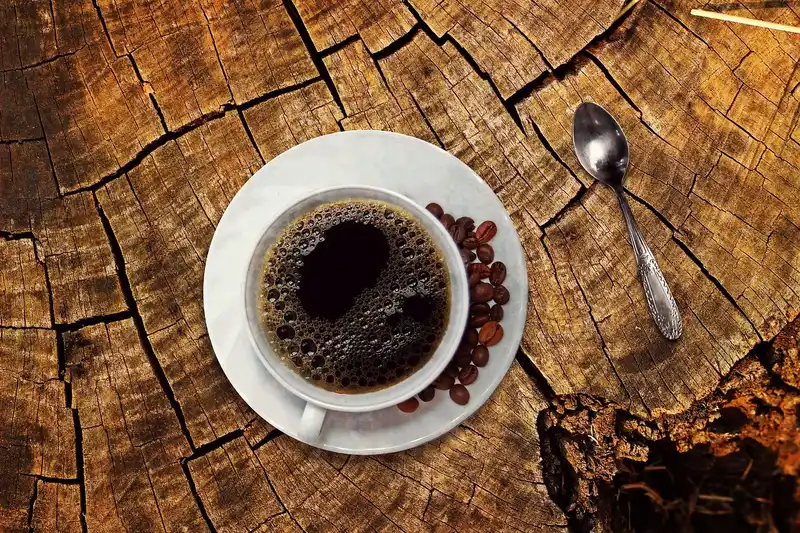
For one cup, 1:16 is the most useful starting point. It is a common everyday V60 ratio, and it gives a balanced base that is easy to tune. If you want more punch, move to 1:15. If the cup feels too dense or heavy, move to 1:17.
For a typical 15 g dose, 1:16 means 240 g water. That is the quick answer many calculators give because it fits a broad range of beans and brew styles. For a lighter, more tea-like result, add 15 g more water at the same dose and use 1:17.
How strength changes at 1:15, 1:16, 1:17, and 1:13
1:15 produces the strongest cup of the common range. 1:16 is a middle ground. 1:17 lowers strength slightly and usually reads as lighter on the palate. 1:13 is a much tighter ratio and is best treated as a concentrated recipe, not a standard daily V60 target.
Ratio does not fix every taste problem. A sour cup can still come from a coarse grind or a short brew time, even at 1:16. A bitter cup can still happen at 1:17 if the grind is too fine or the water is too hot.
How do you calculate V60 water?
Multiply your coffee dose by the ratio number. If you use 18 g coffee at 1:16, the water is 288 g. To work backward, divide your target water by the ratio number. If you want 240 g water at 1:16, use 15 g coffee.
A scale makes this easy. Tablespoons and scoops are too loose for repeatable V60 ratios, especially when you want to compare one change at a time. If the dose moves around, the brew will too.
- Weigh your coffee in grams.
- Choose a ratio such as 1:16.
- Multiply dose by the ratio to get water.
- Set bloom water at about 2x to 2.5x the coffee dose.
- Pour the remaining water in the planned schedule.
From coffee grams to water grams
Here are direct examples. 12 g coffee at 1:15 uses 180 g water. 20 g coffee at 1:16 uses 320 g water. 25 g coffee at 1:17 uses 425 g water. These are water weights, not volume guesses.
From target yield back to dose
If you want a specific final beverage size, remember that the yield is smaller than the water you add. Grounds absorb water, so a 240 g brew water dose will not leave 240 g in the cup. Use the calculator to set dose from the water target first, then tune the recipe from there.
V60 sizes and brew targets
V60 drippers are commonly labeled 01, 02, and 03. The V60-01 suits single cups. The V60-02 covers 1 to 4 cups and is often used for the common everyday range, with some guides placing it at roughly 400 ml maximum. The V60-03 is for larger batches.
Do not assume the same pour schedule works unchanged across all three. Smaller drippers need tighter pour control and less total water. Larger batches tolerate more water, but the brew can slow if the grind is too fine or the bed depth gets too high.
Brew time targets by recipe style
Simple V60 recipes usually target about 2:00-2:30 brew time. Classic V60 recipes usually land around 2:30-3:00 brew time. 4:6 style recipes usually run about 3:00-3:30. If the brew is much faster or much slower than that, change grind first before you change the ratio.
Say your V60-01 brew with 12 g coffee finishes in 1:45 and tastes sharp. That points more toward grind and flow than ratio. Coarser water math will not fix a too-fast drawdown.
Bloom, pours, and water temperature
The bloom is the first pour. Use about 2x to 2.5x the coffee dose in bloom water, then wait 30-45 seconds before the main pours. That pause lets the grounds release gas and wet out evenly before the rest of the brew begins.
For water temperature, a practical V60 range is about 93-96 C / 200-205 F. Use the cooler end for darker roasts and the hotter end for lighter roasts. Temperature changes extraction, so keep it separate from ratio when you troubleshoot.
Simple, classic, and 4:6 pour schedules
A simple recipe uses bloom plus 1 main pour. A classic recipe uses bloom plus 3 pours. A Tetsu Kasuya 4:6 method uses 5 pours. The more pours you use, the more control you have over timing and flavor balance, but the more you need to keep the flow consistent.
For a common 15 g and 240 g setup, a simple schedule may fit the brew into a short total time, while a classic schedule gives more room to adjust sweetness and balance. A 4:6 recipe stretches the process and is better when you want a slower, more segmented pour pattern.
Not taring between V60 pours. That keeps the water count consistent and makes the schedule easier to repeat.
Bloom water and timing
For 15 g coffee, bloom water is usually about 30-38 g. For 20 g coffee, bloom water is usually about 40-50 g. The exact amount matters less than staying in the 2x to 2.5x range and keeping the bloom around 30-45 seconds.
A common first-timer mistake is pouring too little bloom water, then trying to fix dry pockets with a hard main pour. That can drive uneven extraction. A steadier bloom gives the bed time to settle before the main pour.
Should you change grind or ratio first?
Change grind first in most cases. Sour, fast, or thin brews usually need a finer grind before a stronger ratio. Bitter, slow, or muddy brews usually need a coarser grind before a weaker ratio. Ratio is the strength lever; grind is the extraction lever.
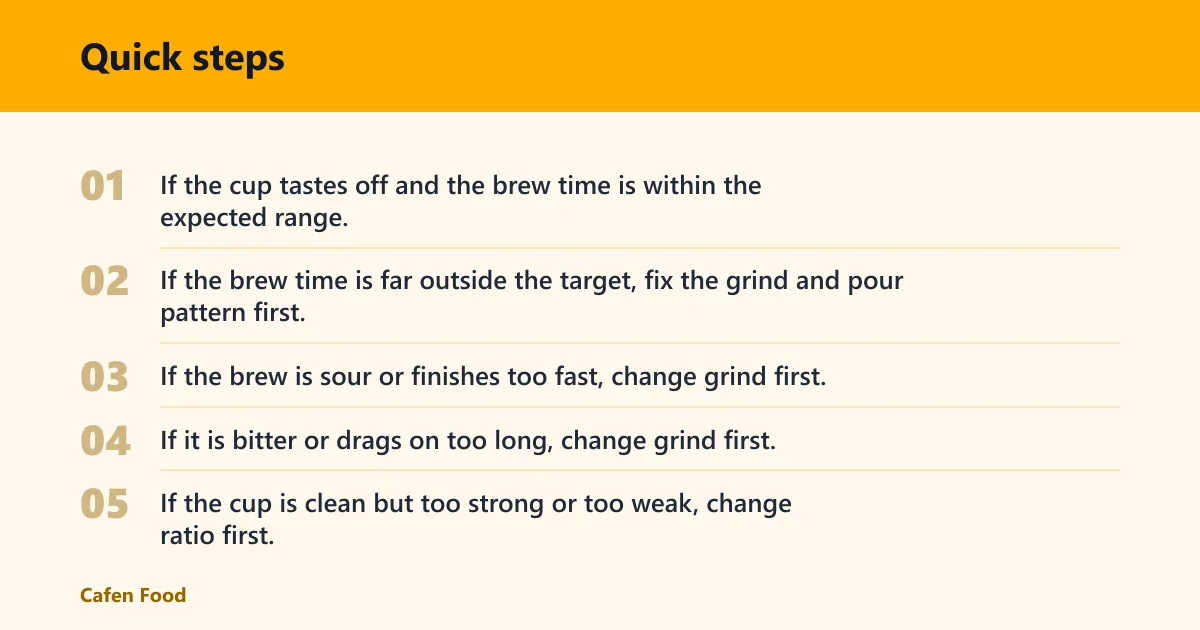
If the cup tastes off and the brew time is within the expected range, then ratio can be your second adjustment. If the brew time is far outside the target, fix the grind and pour pattern first.
| Symptom | Likely cause | Ratio change | Grind change | Water-temp change | Keep pour schedule unchanged? |
|---|---|---|---|---|---|
| Sour, sharp, thin | Under-extraction or fast drawdown | Stay at 1:16 or move to 1:15 | Finer | Hotter end of 93-96 C | Yes, if timing is still close |
| Bitter, dry, harsh | Over-extraction or slow drawdown | Stay at 1:16 or move to 1:17 | Coarser | Cooler end of 93-96 C | Yes, if flow is the main issue |
| Weak, hollow | Too much water for the dose | Move from 1:17 toward 1:16 or 1:15 | Usually unchanged first | Usually unchanged first | Yes |
| Slow, muddy | Too fine, too much fines, or clogged bed | Ratio is not the first fix | Coarser | Usually unchanged first | No, simplify the pours |
| Hot V60 | Heat carried too far for the roast | Keep ratio steady first | Small adjustment only if needed | Move cooler for darker roasts | Usually yes |
| Iced V60 | Dilution after brewing | Increase concentrate strength | Often slightly finer | Use standard hot brew water | Yes, with split-water setup |
| Single-cup V60-01 | Small bed and fast flow | 1:16 is a strong starting point | Often slightly finer than batch | Use roast-based temperature | Yes, but keep pours tighter |
| Batch V60-02 | More water, deeper bed | 1:16 remains the default start | May need a touch coarser | Use roast-based temperature | Usually yes, with slower pours |
Which variable to change first?
If the brew is sour or finishes too fast, change grind first. If it is bitter or drags on too long, change grind first. If the cup is clean but too strong or too weak, change ratio first. That order keeps the problem isolated.
Suppose a 15 g V60-02 brew at 1:16 tastes flat and finishes in 2:05. The first correction is finer grind, not a radical ratio shift. If the same cup is still thin after a grind change, then move from 1:16 to 1:15.
Iced V60 ratio calculator
Yes, you can use a ratio calculator for iced V60. The key is to plan for dilution from ice. A simple path is to brew a stronger hot concentrate, then pour it over measured ice, or to split the total water between brew water and bypass water after extraction.
Because the ice melts into the final drink, the hot brew should be stronger than your normal cup. If you brew at a standard 1:16 and then add a lot of ice, the result can taste thin. For iced V60, a more concentrated ratio is often the better starting point.
Split-water iced calculations
Use the calculator in two parts. First, set the brew water for extraction. Second, account for ice as part of the final beverage weight. If you want a 300 g finished iced drink, you might brew a concentrate and let the ice supply some of the final mass.
One common approach is to brew part of the water over coffee and hold back the rest as bypass water after brewing. That keeps strength under control while still giving you the final serving size you want.
Keeping strength after ice dilution
For iced V60, start stronger than your hot recipe. A 1:15 or 1:13 concentrate can make sense if the final drink includes a large ice load. Keep the bloom and brew timing consistent, then adjust the post-brew dilution until the cup tastes right.
Frequently asked questions
How much coffee do I need for a V60 02?
For a V60-02, 15 g coffee with 240 g water is a strong default. The V60-02 is commonly used for 1 to 4 cups, so you can scale up from that base while keeping the same ratio. Use a scale so the dose stays exact.
What is a good V60 ratio for a balanced cup?
1:16 is the most common balanced starting point. It is the quick answer many brewers use when they want a clean cup without pushing strength too high or too low. From there, a small shift to 1:15 or 1:17 fine-tunes the result.
How do I calculate V60 water from coffee grams?
Multiply coffee grams by the ratio number. For example, 18 g coffee at 1:16 needs 288 g water. If you want to work backward from water, divide the water target by the ratio number to get the coffee dose.
Should I use 1:15, 1:16, or 1:17 for V60?
Use 1:16 if you want the safest starting point. Use 1:15 if you want more strength and body. Use 1:17 if you want a lighter, more open cup. Ratio changes strength first, so do not use it as the main fix for sour or bitter extraction.
What changes first if my V60 tastes sour or bitter?
Change grind first. Sour and fast brews usually need a finer grind. Bitter and slow brews usually need a coarser grind. Keep the ratio stable until the brew time and flow are closer to target, then adjust ratio only if you still want a different strength.
How much bloom water should I use for V60?
Use about 2x to 2.5x the coffee dose in bloom water. For 15 g coffee, that is about 30-38 g. Keep the bloom for 30-45 seconds before the main pours. That gives the grounds time to wet out and release gas.
Can I make an iced V60 with a ratio calculator?
Yes. Use the calculator to set a stronger brew, then account for ice as part of the final drink. A split-water or bypass approach works well because it lets you control both extraction and final strength. Do not use the same dilution plan you would use for a hot cup.
Do I need a scale for a V60 ratio calculator?
Yes. A scale is the right tool for V60 ratio work because the method depends on grams, not spoonfuls. A 0.1 g scale is even better for repeatability. Without weighing, it is hard to keep dose, bloom, and final yield consistent from brew to brew.
Products related to this article
Sponsored / affiliate links. As an Amazon Associate I earn from qualifying purchases. I may earn additional commission from eligible campaigns.
 Quick Heating Cup Warmer, Three Temperature Settings, Splashproof and Portable, for Coffee, Milk, Lightweight ABS Material
 Coffee Mug Warmer & You are Awesome Mug Set, Electric Cup Warmer for Desk
 SOLUSTRE Electric USB Coffee Cup Warmer with Temperature Settings Portable Milk and Beverage Heating Coaster for Office Desk Small Lightweight Design Easy to Clean Surface Multi Functional