A coffee appliance electricity calculator should use active-brew minutes and standby hours: cost = [(brew watts × brew hours) + (standby watts × standby hours)] ÷ 1000 × your rate. Skip standby, and you can miss much of the real cost. This guide gives the formula, the inputs, and a few quick examples.
How is this calculated?
Press Calculate to see the math with your numbers.
How to estimate coffee machine energy use
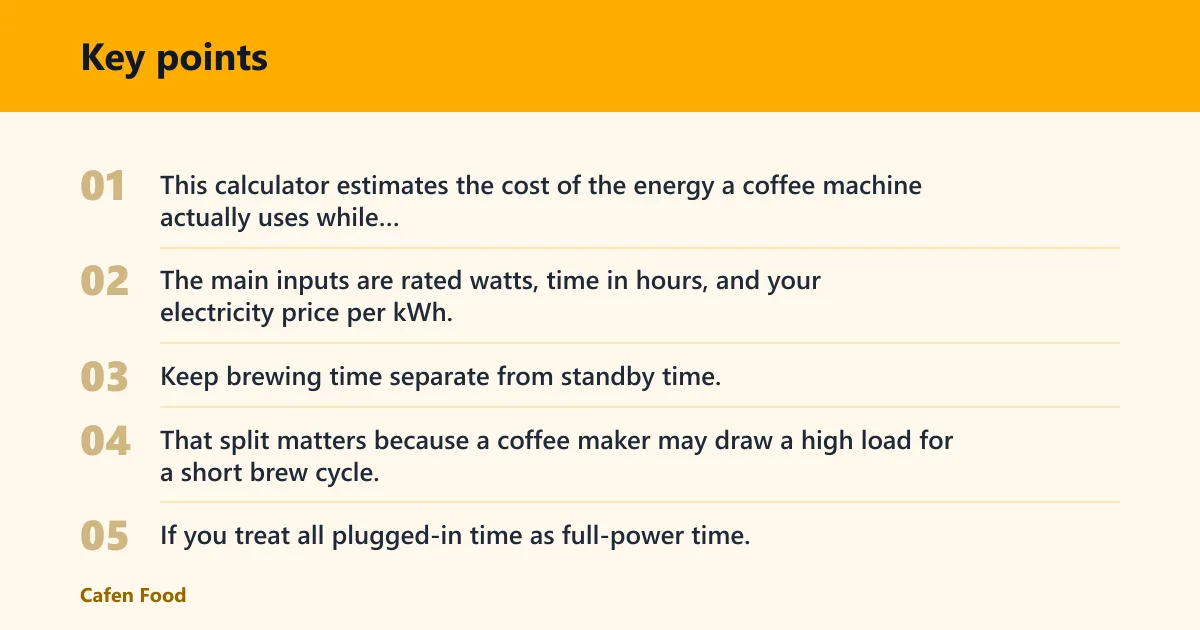

This calculator estimates the cost of the energy a coffee machine actually uses while heating water, brewing, warming, and idling. The main inputs are rated watts, time in hours, and your electricity price per kWh. Keep brewing time separate from standby time.
That split matters because a coffee maker may draw a high load for a short brew cycle, then a much smaller load while it sits ready. If you treat all plugged-in time as full-power time, the estimate can run far above reality. If you ignore keep-warm time, the estimate can run low.
What the calculator estimates
A good coffee appliance electricity calculator should return cost per cup, per day, per month, and per year. It should also let you split use into active brewing minutes and standby hours. That gives you a more honest result than a single “hours plugged in” input.
Inputs you need: watts, hours, and price per kWh
You need three inputs: the appliance’s watt rating, the number of hours it actively heats or brews, and the electricity rate in dollars per kWh. The rate is the billing unit on a utility bill. The formula converts watts into kilowatt-hours, then multiplies by price. The U.S. Department of Energy uses the same watt-to-kWh conversion in its energy-use guidance, and ENERGY STAR follows the same approach for appliance energy comparisons.
Why brew time and standby time must be separate
A coffee machine draws the most power while heating water. Brew time is the main driver for espresso and drip cycles, but standby time can matter more when a warming plate or boiler keeps cycling after the brew ends. Auto-off settings can cut that second part sharply.
Use watts ÷ 1,000 × hours × price per kWh. First convert watts to kilowatts, then multiply by the hours used, then multiply by your tariff. If a machine uses separate brewing and standby periods, calculate each part on its own and add them together. Utility guides from major providers use the same structure for estimating appliance operating cost.
The watts-to-kWh formula
The conversion is simple: watt-hours divided by 1,000 equals kilowatt-hours. So a 900 W machine running for 20 minutes uses 0.3 kWh during that heating period, before you apply the electricity rate. The calculator should do that step behind the scenes.
How to turn kWh into dollars
Once you have kWh, multiply by your rate per kWh. If your rate is $0.16 per kWh, then 0.3 kWh costs $0.048. Rounded to cents, that is about 5 cents for that heating period. Monthly and yearly output follow the same method.
Common input mistakes
Do not use “hours plugged in” as if the machine drew rated power the whole time. Do not enter only brew time if the warmer stays on for an extra hour. And do not assume the nameplate watts equal the measured draw in every cycle, because thermostats switch power on and off.
- Find the appliance’s rated watts on the label.
- Estimate active brewing or heating minutes.
- Estimate standby or keep-warm hours.
- Enter your electricity rate per kWh.
- Calculate brew energy and standby energy separately.
- Add the two results for daily, monthly, and yearly cost.
Coffee maker wattage and use
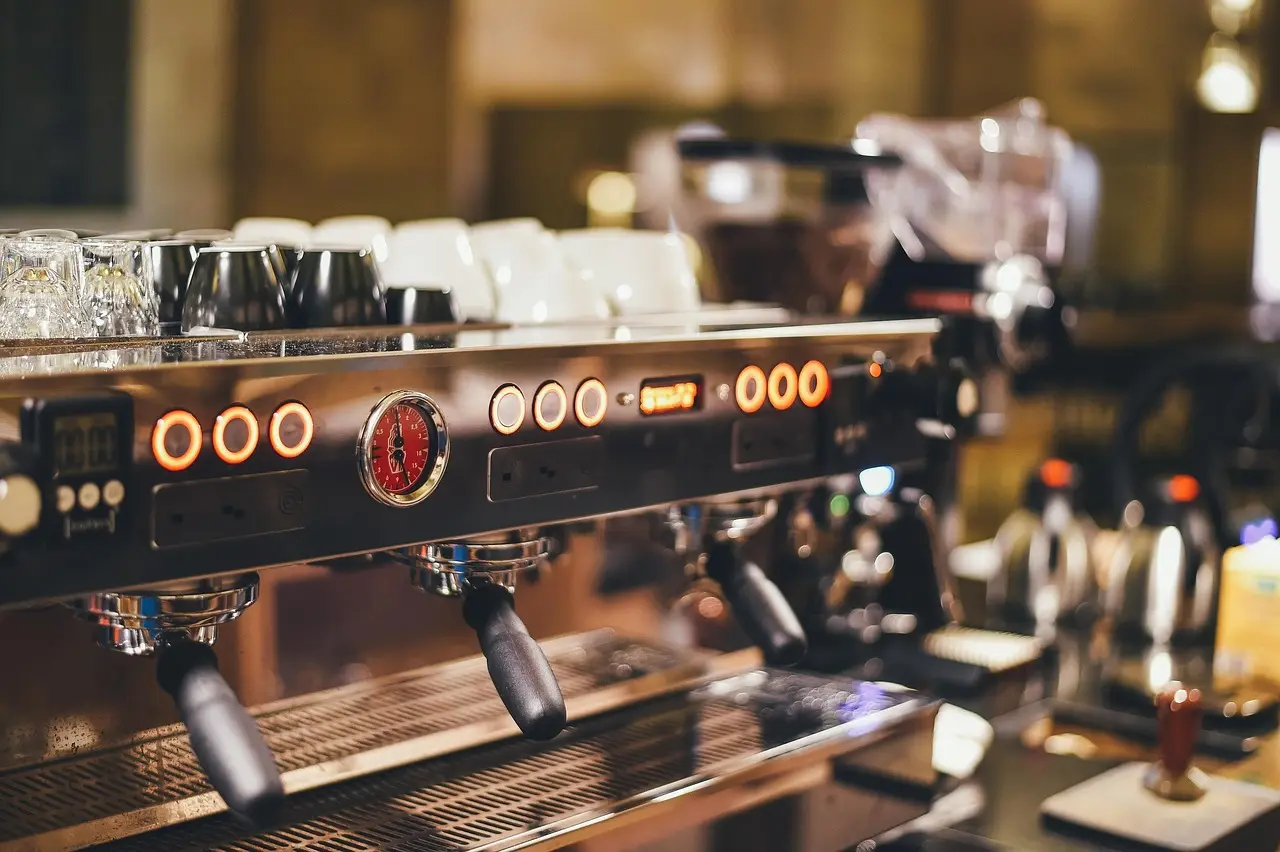
Coffee maker wattage depends on the machine type and the heating task. A coffee maker may use 300 to 600 watts for 2 cups, while a larger coffee maker may use 1000 to 1500 watts for 8-10 cups. For a compact system, an espresso machine can pull higher wattage for a shorter burst, while a small drip example helps show how a lower-watt machine can still add up when the warmer stays on. One estimate uses 800 watts to make 4 cups in 10 minutes.
Those figures are starting points, not a universal rule. Drip machines often need enough power to heat a larger water volume quickly. Espresso machines push a short, intense heating cycle. Pod machines usually sit between those patterns, with smaller water loads and shorter brew times.
Typical wattage ranges by machine type
The same machine can also behave differently across the day. A drip brewer may have a strong heating burst at the start, then a lower keep-warm load. An espresso machine may heat fast, then cycle boiler temperature. A pod brewer may finish quickly and shut off sooner.
| Machine type | Active brew watts | Active brew time | Standby watts | Standby time | Cost per cup | Cost per day | Cost per month | Cost per year | Standby share |
|---|---|---|---|---|---|---|---|---|---|
| Small drip, 2 cups | 450 W | 10 min | 1 W | 23.5 h | $0.014 | $0.016 | $0.48 | $5.86 | 78% |
| Standard drip, 4 cups | 800 W | 10 min | 1 W | 23.5 h | $0.022 | $0.026 | $0.77 | $9.38 | 53% |
| Espresso, 1 cup | 1200 W | 15 min | 1 W | 23.75 h | $0.031 | $0.038 | $1.13 | $13.78 | 32% |
Heating load for drip, espresso, and pod machines
Drip machines usually show the strongest link between brew size and total energy because they heat a larger water volume. Espresso machines draw more power per minute, but the cycle is shorter. Pod machines often sit in the middle, with shorter brew times and less water to heat.
Standby matters too. A modern coffee maker adds about one watt of power beyond brewing. That extra draw equals 24 watt-hours a day and 8.76 kilowatt-hours a year. On some machines, the keep-warm period can cost more than the brew itself if the warmer stays on for hours.
Why the label wattage is only a starting point
The power rating label gives rated watts, not always measured draw. That label is useful because it is easy to find, but thermostats and heating cycles mean the real draw can rise and fall during use. A label that says 1200 W does not mean 1200 W every minute.
Say your drip machine lists 1000 W on the label, but the warm plate cycles off after brewing. If you count the whole afternoon as 1000 W load, the result will overshoot the real cost. If you use the 10-minute brew period plus a short keep-warm period, the estimate lands closer to use.
Red flags in wattage labels
- A label lists only “max” watts but the machine cycles on and off during brewing.
- The wattage on the box is different from the nameplate on the appliance.
- The warmer or boiler keeps running long after the brew cycle ends.
- The machine has an auto-off timer, which means standby time is not the same as plugged-in time.
- The product page shows a range, not a single watt number, which often means the active draw changes by mode.
A common failure case is a brewer labeled at 1,000 W that was modeled as a full-hour, full-power load. In a drip setup with a 10-minute brew and brief warm hold, that assumption can push the estimate more than 20% too high because it ignores the fact that the heater is not drawing nameplate power the entire time.
Electricity rate and kWh costs
Your electricity rate is the biggest price input after usage time. It is the number on your bill that tells you what one kWh costs. Since utility tariffs vary by state, city, and plan, two homes with the same coffee machine can pay different running costs.
How to find your price per kWh
Check the supply section of your electric bill or the rate page from your utility. Use the all-in price per kWh if possible, since that is the figure the calculator needs. If your bill shows tiered pricing, choose the rate that matches the part of the bill that covers the extra use.
Why local utility rates vary
Rates vary because utilities set different tariffs and because some plans add delivery charges, time-based pricing, or seasonal changes. A coffee machine on a low tariff may cost much less per month than the same machine on a high tariff, even when the brew routine is identical.
What default rate to use if you do not know yours
If you do not know your rate, a reasonable placeholder is the example rate of $0.16 per kWh. Use that only as a stand-in, then replace it with your bill when you have it. The point is to avoid guessing with no rate at all.
Coffee machine electricity cost examples
These examples use active brewing plus standby so the result reflects real use rather than plugged-in time alone. They also show cost per cup, per day, per month, and per year. The same machine can look inexpensive on a short brew cycle and much more costly when the warmer stays on.
Three machine types
The examples below use a small drip machine, a standard drip machine, and an espresso machine. Each one has a different brew time and standby pattern. The table also shows how much of the cost comes from brewing versus standby, which is the part many calculators miss.
| Machine type | Electricity rate | Active brewing cost per cup | Standby cost per cup | Total cost per cup | Daily cost | Monthly cost | Yearly cost | Most of the cost comes from |
|---|---|---|---|---|---|---|---|---|
| Small drip, 2 cups | $0.12/kWh | $0.009 | $0.005 | $0.014 | $0.016 | $0.48 | $5.86 | Standby |
| Standard drip, 4 cups | $0.16/kWh | $0.017 | $0.005 | $0.022 | $0.026 | $0.77 | $9.38 | Brewing |
| Espresso, 1 cup | $0.24/kWh | $0.027 | $0.004 | $0.031 | $0.038 | $1.13 | $13.78 | Brewing |
In the small drip example, standby is the larger share because the brew cycle is short. In the standard drip and espresso examples, heating uses more of the total because the machine spends more energy bringing water up to temperature. That difference is why machine type matters.
Picture a 4-cup drip brewer that runs for 10 minutes each morning and then keeps a hot plate on for 30 minutes. The brew cycle is only part of the bill. If the warming plate stays on longer than the brew itself, the “idle” cost can become the main cost driver.
How cost per cup, day, month, and year are connected
Cost per cup is simply the cost for one brewing session and its matching standby period. Daily cost is that number multiplied by how many brew sessions happen in a day. Monthly and yearly costs scale from the daily total, so frequency matters as much as wattage.
One coffee machine calculator starts with 1,200 W and 0.25 hours a day. The same structure works in dollars once you apply your own rate and usage pattern.
Coffee machine standby cost
Standby mode can add a steady cost even when the machine is not actively brewing. A warming plate or boiler can keep using power while the machine waits for the next cup. On some machines, auto-off makes the biggest difference in the total monthly cost.
Warming plate effect
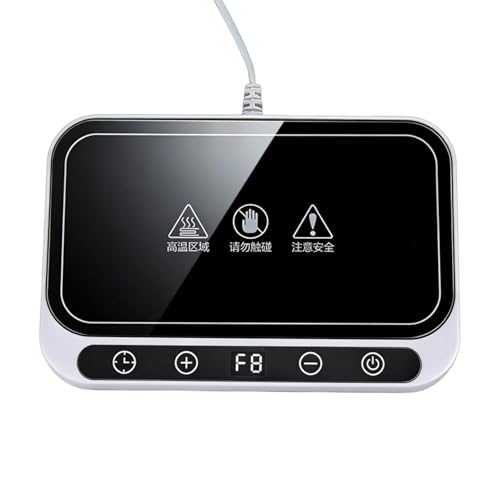
A warming plate is an extra consumption layer after brewing. It keeps coffee hot, but it also keeps drawing energy after the water has already been heated. If the plate stays on for a long time, that load can matter more than the short brew burst.
Idle draw and boiler temperature maintenance
Some machines keep a boiler warm in standby so the next cup starts faster. That idle draw is smaller than active brewing, but it runs longer. This is why a calculator should separate active watts from standby watts instead of assuming one flat number for the whole day.
How auto-off changes total cost
Auto-off cuts the hours spent in standby mode. If a brewer shuts down a few minutes after brewing, the standby line in the calculator shrinks fast. That change matters most on machines with a warming plate or long boiler warm-up behavior.
How to read the power rating label
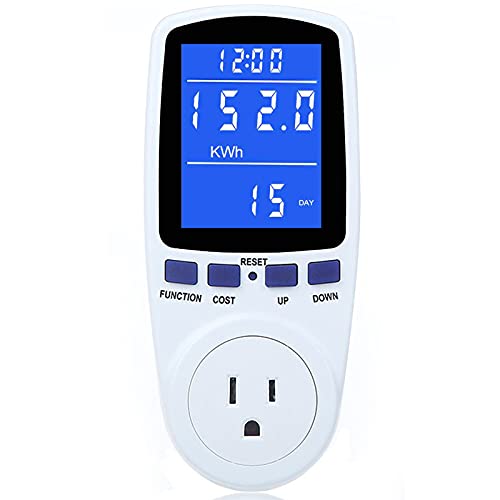
The label on the appliance gives you rated watts, which is the first number to enter into a calculator. It is the cleanest input for a first estimate. For a tighter estimate, compare that label with measured draw from a smart plug or power meter.
Rated watts vs measured draw
Rated watts show the nameplate figure, while measured draw shows what the machine actually pulls during a specific cycle. The two can differ because heating elements cycle on and off. That is why the label is useful, but not perfect, for cost planning.
When smart plug data helps
Smart plug data helps when you want a real daily average instead of a label-only estimate. It can show whether the warmer stays on long after the brew. It can also reveal whether the machine spends more time idling than heating, which changes the result a lot.
Accuracy limits for calculators
A calculator is only as accurate as the input you give it. If you enter the wrong rate, or if you use the full plugged-in time as full-power time, the result will be off. If the machine cycles heat, a single watt rating can overstate or understate true use.
How to lower coffee appliance power use
Start with the biggest lever: shorten keep-warm time. Then brew only what you need and use auto-off if the machine has it. If you are comparing new machines, lower-draw models with shorter warm-up or faster shutdown can cost less to run.
Shorten keep-warm time
If the warmer has an off setting, use it as soon as the coffee is poured. A shorter warm-plate window cuts standby energy directly. That is often the easiest way to reduce running cost without changing the brew method.
Brew only what you need
Brewing a full pot when you only want two cups wastes both water-heating energy and keep-warm time. Smaller batches reduce the brew energy and may also reduce how long the machine stays active afterward. For many households, that is the cleanest change.
Choose auto-off or lower-draw machines
Auto-off matters because it limits standby hours. A machine that drops out of keep-warm mode quickly can cost less over a month than a larger unit that sits hot all afternoon. If you are comparing appliances, check both the rated watts and the off delay.
Frequently asked questions
How do I calculate the electric cost of a coffee appliance?
Use watts ÷ 1,000 × hours × price per kWh. If the machine has separate brew and standby periods, calculate each one on its own and add them together.
How do I compute the power consumption of a coffee machine?
Convert the machine’s watts into kilowatt-hours by dividing by 1,000 and multiplying by the number of hours used. Include brew time and standby time separately.
How much electricity does a coffee maker use per hour?
It depends on the machine type and mode.
How much does a coffee machine cost to run per month?
Monthly cost depends on brew size, standby time, and your utility rate. A machine that only brews briefly can cost little, but a warm plate or boiler that stays on longer can raise the monthly bill.
Do warming plates and standby mode change coffee machine electricity usage?
Yes. A warming plate adds extra consumption after brewing, and standby mode adds a smaller but longer-running load. For some machines, that idle energy can be a major share of the bill.
Should I use rated watts or measured watts for my calculator?
Use rated watts for a quick estimate and measured watts for tighter accuracy. The label is fine for a first pass, but measured draw is better when the machine cycles or stays warm for long periods.
Products related to this article
Sponsored / affiliate links. As an Amazon Associate I earn from qualifying purchases. I may earn additional commission from eligible campaigns.