Use 1:15 for stronger Chemex coffee, 1:16 for balanced, and 1:17 for lighter brews; for example, 30 g coffee to 450–510 g water. Too much water makes it thin, while too little leaves it bitter and uneven. This guide turns cup count, strength, and brew time into one Chemex ratio calculator you can use for any batch size.
How is this calculated?
Press Calculate to see the math with your numbers.
Chemex ratio calculator basics
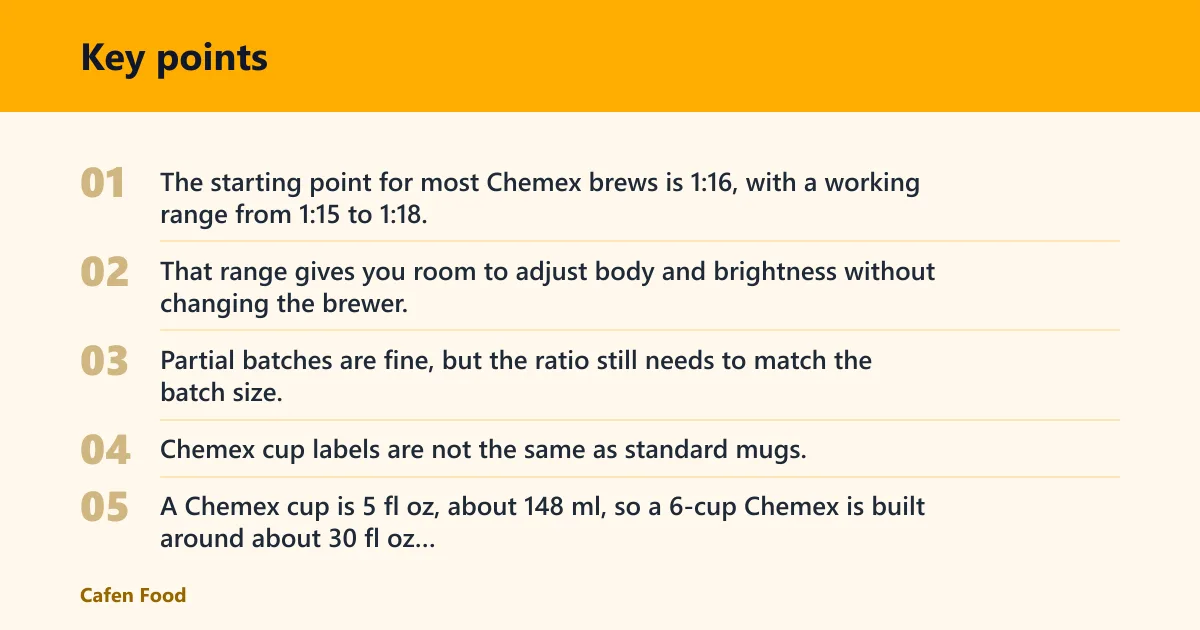


The starting point for most Chemex brews is 1:16, with a working range from 1:15 to 1:18. That range gives you room to adjust body and brightness without changing the brewer, the filter, or the pour pattern. Partial batches are fine, but the ratio still needs to match the batch size.
What the 5 fl oz Chemex cup label means
Chemex cup labels are not the same as standard mugs. A Chemex cup is 5 fl oz, about 148 ml, so a 6-cup Chemex is built around about 30 fl oz total capacity, not six 8-ounce mugs. That mismatch is where many ratio errors start.
If you plan by mug size, the recipe usually looks too weak. If you plan by Chemex cup size, the dose and water line make more sense, especially for partial batches in the 3-cup, 6-cup, 8-cup, and 10-cup brewers.
The starting 1:16 ratio and the usable range
Use 1:16 as the default starting ratio for most Chemex brews. Move toward 1:15 if you want a fuller, rounder cup, and toward 1:17 if you want a lighter, more delicate cup. A common guide also places the broader working range at 1:15 to 1:18, which gives enough room for roast level and personal preference.
One published example for a 6-cup Chemex uses 56 grams coffee with 888 ml water, which lands very close to 1:16. That is a useful anchor, but not a rule that replaces dose, grind, and drawdown adjustments.
How strength changes the ratio
Strength changes with the ratio before it changes with anything else. A lower ratio such as 1:15 uses more coffee per gram of water and gives a heavier cup. A higher ratio such as 1:17 spreads the same coffee over more water and produces a lighter cup with more open acidity.
Suppose you brew a 6-cup Chemex and want a rounder cup for milk. Start at 1:15 rather than stretching the brew with extra water after the pour. That keeps the extraction path more predictable.
How much coffee do I need for a 6-cup Chemex?
For a 6-cup Chemex, a practical starting dose is 56 g coffee at about 1:16, using water measured separately from the bloom. That dose fits the common 6-cup example and works well for a standard batch when you want a balanced cup without pushing extraction too hard.
3-cup starting dose
A 3-cup Chemex is best treated as a small batch, not a novelty size. Start at about 19 g coffee at 1:16, then use bloom water equal to about twice the coffee dose. That gives you a brew that stays in range without overfilling the cone.
6-cup starting dose
For 6 cups, start at about 56 g coffee at 1:16. That puts the brew near the commonly cited 6-cup example of 56 g coffee with 888 ml water. If the cup tastes weak, adjust the ratio before changing everything else.
8-cup and 10-cup starting doses
An 8-cup Chemex usually starts at about 75 g coffee at 1:16, while a 10-cup often starts near 94 g. Those are calculator-style starting points, not fixed rules. The thicker filter and larger slurry can slow drawdown, so time matters as much as dose.
| Chemex size | Coffee dose at 1:16 | Bloom water | Target brew time | First adjustment if off |
|---|---|---|---|---|
| 3-cup | 19 g | 38 g | 3:30 to 4:30 | Sour: finer grind or slightly hotter water; weak: slightly more coffee |
| 6-cup | 56 g | 112 g | 4:00 to 5:00 | Bitter: coarser grind; weak: move toward 1:15 |
| 8-cup | 75 g | 150 g | 4:30 to 5:30 | Stalls: coarser grind; sour: finer grind |
| 10-cup | 94 g | 188 g | 4:30 to 5:30 | Weak: reduce ratio to 1:15; bitter: reduce grind fines |
Chemex size ratio
Use this table as the decision layer of the calculator. It ties batch size to dose, bloom water, time, and the first fix if the cup tastes sour, bitter, weak, or stalls. Brew time matters because the thick Chemex paper slows drawdown.
3-cup brew: dose, bloom water, and target time
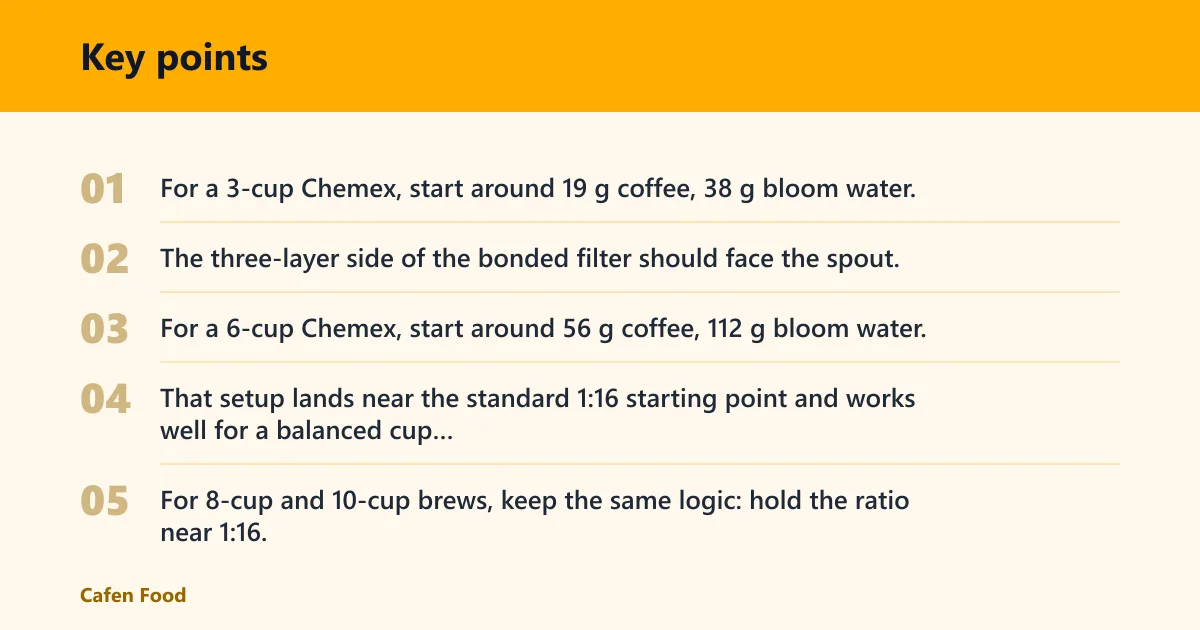
For a 3-cup Chemex, start around 19 g coffee, 38 g bloom water, and a total brew time near 3:30 to 4:30. The three-layer side of the bonded filter should face the spout, and the paper should be rinsed before brewing.
6-cup brew: dose, bloom water, and target time
For a 6-cup Chemex, start around 56 g coffee, 112 g bloom water, and 4:00 to 5:00 total brew time. That setup lands near the standard 1:16 starting point and works well for a balanced cup in a medium-sized batch.
8-cup and 10-cup brew targets
For 8-cup and 10-cup brews, keep the same logic: hold the ratio near 1:16, measure bloom water separately, and expect a slightly longer drawdown because the slurry is larger. The table target of 4:30 to 5:30 is a useful center for those bigger batches.
First adjustment for sour, bitter, weak, or stalled cups
If the cup tastes sour, the first fix is usually a finer grind or slightly hotter water. If it tastes bitter, go coarser first. If it tastes weak, use a lower ratio such as 1:15. If it stalls, move coarser before changing the dose.
A common first-timer mistake is using a 10-cup Chemex with a 6-cup dose and expecting the same strength. The cup can taste thin even when the pour time looks normal, because the ratio is off before the brew even starts.
What is the best Chemex ratio?
1:16 is the best default starting ratio for most Chemex brews. It balances body, brightness, and repeatability without pushing the brew too far in either direction. From there, move toward 1:15 for more weight or 1:17 for a lighter cup.
Choose 1:16 as the default starting point
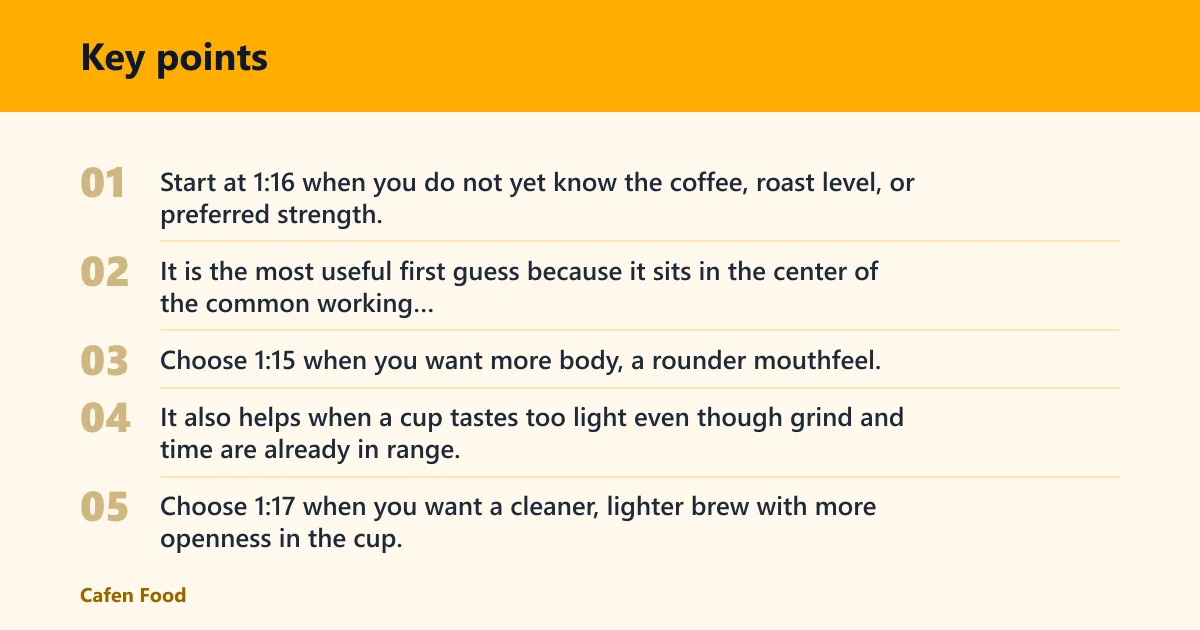
Start at 1:16 when you do not yet know the coffee, roast level, or preferred strength. It is the most useful first guess because it sits in the center of the common working range and matches the standard ratio many guides use for Chemex.
Choose 1:15 for a fuller cup
Choose 1:15 when you want more body, a rounder mouthfeel, or a brew that stands up better to milk. It also helps when a cup tastes too light even though grind and time are already in range.
Choose 1:17 for a lighter cup
Choose 1:17 when you want a cleaner, lighter brew with more openness in the cup. That can suit brighter coffees and lighter roast styles, especially when you want the filter clarity to stay obvious without becoming thin.
How much water should you use for the bloom?
Use bloom water at about twice the coffee dose, then keep that water separate from the main brew water. A 30 to 60 second bloom helps grounds degas before the rest of the pour. It is measured separately, so it should not be confused with the total water ratio.
Why bloom water is about 2x the coffee dose
Bloom water at 2x the coffee dose is enough to wet the grounds evenly and let trapped gas escape. Brewculator uses that same 2x bloom approach, and it is a practical starting point for Chemex because the thick filter slows the later drawdown.
Bloom time and degassing
Bloom for 30 to 60 seconds. That pause lets carbon dioxide move out of the grounds, which improves wetting and helps the later pours stay even. If the bed still looks dry after the bloom, the grinder may be too coarse or the first pour may have been too light.
Keeping bloom water separate from total brew water
Bloom water is part of the process, not the full recipe. If a Chemex recipe calls for 888 ml total water, that total still includes the bloom. The bloom itself is simply the first measured portion, usually about 2x the dose, before the main pours begin.
Grind size and water temperature for Chemex
Use a medium-coarse grind, closer to coarse sea salt and coarser than a V60 setting. Brew with water at 195 to 205°F, or 93 to 96°C. The cooler end of that range works well for darker roasts, while hotter water can help lighter roasts extract more fully.
Medium-coarse grind target
Medium-coarse is the safe Chemex starting point. Brewculator recommends it, and it fits the thick bonded filter better than a finer pour-over grind. If the brew stalls or turns bitter, the first correction is usually a coarser setting.
195 to 205°F water range
That temperature range gives enough heat for extraction without forcing the coffee into harshness too quickly. Water near 205°F often helps lighter roasts, while 195°F can be a better first try for darker roasts that extract more easily.
Why darker roasts can use slightly cooler water
Darker roasts usually give up flavor faster, so they do not always need the hottest water in the range. Slightly cooler water can keep the cup from turning sharp or woody while the thicker Chemex paper still slows drawdown.
How to pour a Chemex evenly
Rinse the paper filter before brewing, then pour in slow concentric circles. Keep the water off the filter walls, use two to five pulses, and hold the slurry level steady. That pattern helps the bed extract evenly while the thick Chemex paper controls the flow.
- Place the filter with the three-layer side facing the spout.
- Rinse the paper thoroughly to remove paper taste and preheat the brewer.
- Add the ground coffee and level the bed.
- Pour bloom water at about 2x the coffee dose.
- Wait 30 to 60 seconds.
- Pour the remaining water in two to five pulses, using slow concentric circles.
- Avoid pouring on the filter walls.
- Stop when the target water is in and the slurry has drawn down within the time range.
Say your 6-cup Chemex stalls near the end and finishes after 6 minutes. The likely first fix is a coarser grind, because over 6 minutes usually means the grind is too fine. If the cup is also bitter, that supports the same correction.
Frequently asked questions
What is the Chemex coffee to water ratio calculator formula?
The formula is simple: coffee dose equals total brew water divided by the chosen ratio. For example, 888 g water at 1:16 gives 55.5 g coffee, which rounds to 56 g. Then measure bloom water separately at about 2x the coffee dose.
What grind size should I use for Chemex?
Use a medium-coarse grind, closer to coarse sea salt and coarser than a V60 setting. If the brew takes too long, stalls, or tastes bitter, move coarser. If it tastes sour and finishes too fast, move slightly finer and check your pour pattern.
Why does Chemex coffee taste weak or bitter?
Weak coffee usually points to too high a ratio, under-extraction, or a fast pour that never fully wets the bed. Bitter coffee usually points to too fine a grind or an overlong brew. Check the ratio first, then the grind, then the brew time.
How long should a Chemex brew take?
Most Chemex brews land in the 3:30 to 5:30 range, with 4 to 5 minutes a common target. The same source lists 3:30 to 4:00, while another calculator gives 4:30 to 5:30 for a 6-cup brew. Over 6 minutes usually means the grind is too fine.
Products related to this article
Sponsored / affiliate links. As an Amazon Associate I earn from qualifying purchases. I may earn additional commission from eligible campaigns.
 HomeBeyond Espresso Coffee Maker 12 Cups, Classic Stovetop Espresso Maker, 600ml / 20oz Coffeemaker for Gas & Ceramic Stovetops (Silver)
 Coffee Mug Warmer & You are Awesome Mug Set, Electric Cup Warmer for Desk
 SOLUSTRE Electric USB Coffee Cup Warmer with Temperature Settings Portable Milk and Beverage Heating Coaster for Office Desk Small Lightweight Design Easy to Clean Surface Multi Functional