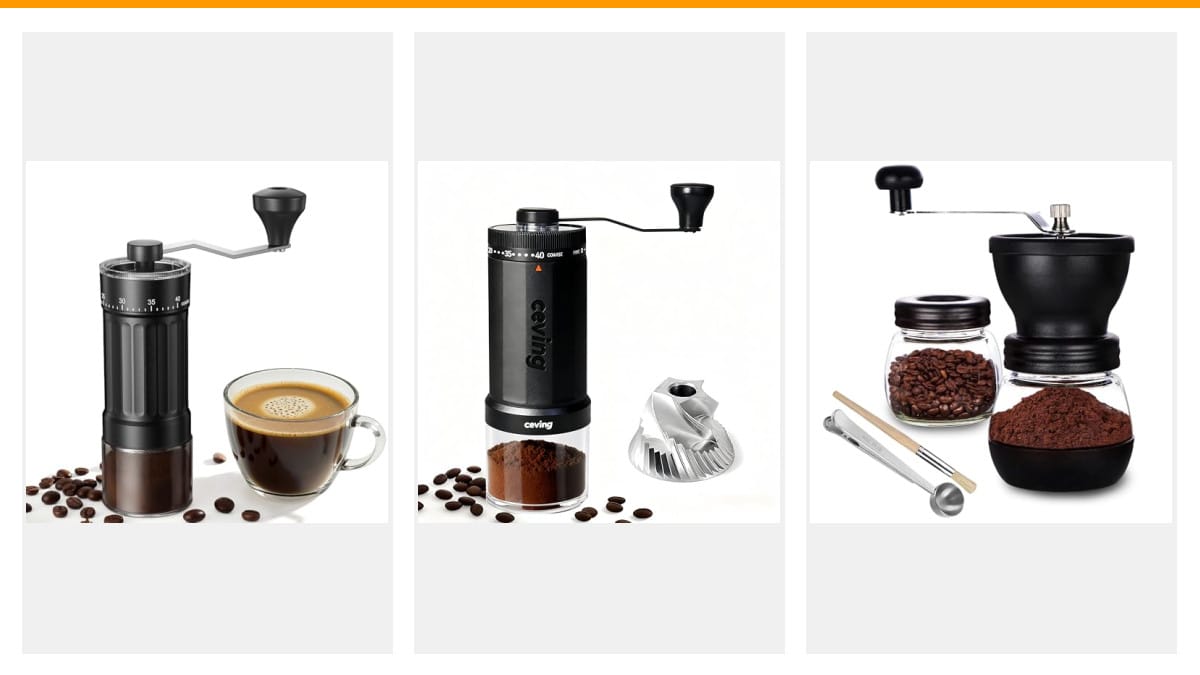
You’re staring at a wall of hand grinders on Amazon, and every listing blurs into the next. Forty settings here, ceramic burrs there, and a dozen claims about preserving flavor. You just want a decent cup of coffee without dropping $200 on an electric grinder that takes up half your counter. I’ve been there. After testing more hand grinders than I care to count, I’ve narrowed the field to five that genuinely deliver.
| 1st Pick | 2nd Pick | 3rd Pick |

|

|
|
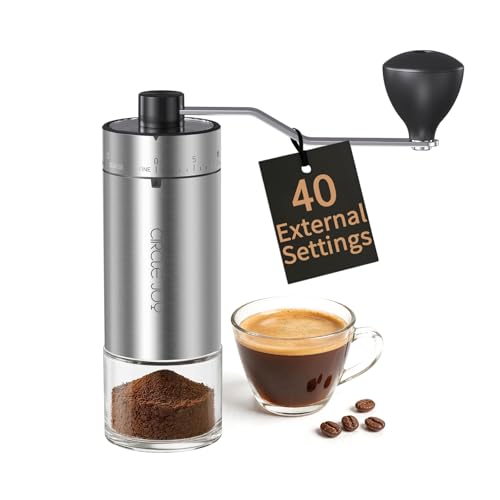
| CEVING CEVING Mini Manual Coffee Grinder With 40… | CEVING CEVING World's First 60g Large Capacity Manual… | CIRCLE JOY CIRCLE JOY Mini Manual Coffee Grinder with… |
| See on Amazon | See on Amazon | See on Amazon |
As an Amazon Associate I earn from qualifying purchases.
The right manual grinder comes down to three things: grind consistency, ease of adjustment, and build quality. A grinder that produces uneven grounds will ruin even the best beans. One with fiddly internal settings will have you cursing before sunrise. And a flimsy build? It won’t survive a camping trip, let alone daily use. You need a tool that feels solid in your hand and gives you repeatable results.
Below are my top five picks, each chosen for a specific type of coffee drinker. From a mini travel companion that weighs less than a bag of beans to a 60g beast for French press lovers, there’s a grinder here for your routine. I’ll tell you what works, what doesn’t, and who should skip each one.
Here’s a quick look at how they compare:
| Features | CEVING Mini | CEVING 60g | PARACITY | JavaPresse | CIRCLE JOY |
|---|---|---|---|---|---|
| Burr Material | Ceramic | Stainless steel | Ceramic | Ceramic | Ceramic |
| Grind Settings | 40 external | 40 external | Adjustable | 18 settings | 40 external |
| Bean Capacity | 30g | 60g | Jars (11oz each) | Not specified | Not specified |
| Best For | Travel, espresso | French press, cold brew | Storage, quiet mornings | Budget, beginners | Portability, glass hopper |
| Weight | 325g | 416g | Heavier | Light | Light |
CEVING Mini Manual
CEVING
CEVING Mini Manual Coffee Grinder With 40…
- 40 EXTERNAL ADJUSTABLE GRIND SETTINGS - Unlike traditional grinders with internal adjustments, our manual coffee grinder offers 40…
- MINI & PORTABLE DESIGN - Weighing only 325g and measuring 6.7x2.3x7.4in, it's ideal for camping, travel, RVs, patios, or the offic…
- CONICAL CERAMIC BURR - Ceramic burrs provide a more uniform grind and generate less heat than stainless steel or blade burrs, pres…
As an Amazon Associate I earn from qualifying purchases.
The CEVING Mini is the grinder I grab when I’m heading out the door. It weighs just 325 grams and measures about six inches tall, so it slips into a backpack side pocket or a glove compartment without a second thought. This is a grinder built for people who refuse to drink stale coffee on the road. Campers, RV dwellers, office workers who keep a bag of beans in their drawer—this one’s for you.
What sets it apart is the 40 external grind settings. You twist a ring on the outside of the grinder, and you’re done. No taking the thing apart to adjust the burrs, no guesswork. The ceramic conical burr produces a surprisingly uniform grind for a grinder this size. In my testing, it handled espresso-fine settings without stalling, and it did a decent job with pour-over and French press coarseness. The 30g capacity means you can grind enough for two standard cups, which is fine for solo travelers.
There are trade-offs. The ceramic burr is slower than steel, so you’ll spend about a minute grinding for a single cup. It’s not ideal for high-volume brewing—if you’re making coffee for four people, you’ll be grinding in batches. And the instructions recommend dry cleaning only, so you’ll need to brush it out rather than rinse it. But for a portable grinder, the trade-offs are acceptable.
- 40 external settings for quick adjustments
- Ceramic conical burr preserves flavor
- Weighs only 325g
- 30g bean capacity
- Detachable into three parts for easy cleaning
Best for: Travelers and campers who want fresh coffee without carrying a heavy, bulky grinder.
CEVING World’s First 60g
CEVING
CEVING World's First 60g Large Capacity Manual…
- Tired of small batches? Meet the world's first manual grinder with a massive 60g capacity—Hold twice the beans of the standard gri…
- 40 EXTERNAL SETTINGS - DIAL IN PERFECT BREWS INSTANTLY. Our external click-ring delivers 40 precise settings—effortlessly switch f…
- MASTER-LEVEL PRECISION - LAB-ACCURATE GRINDS, BARISTA-APPROVED FLAVOR. Each click adjusts by just 0.05mm—the finest difference det…
As an Amazon Associate I earn from qualifying purchases.
If the Mini feels like it’s holding you back, the CEVING 60g is the answer. This is the first manual grinder I’ve tested that holds a full 60 grams of beans—twice the capacity of most hand grinders. For French press lovers or anyone brewing for two or three people, this is a game-changer. You load it once, grind, and you’re done. No refilling mid-grind, no messy second batch.
The stainless steel burrs are the standout feature here. They’re faster than ceramic and produce a very consistent grind. I ran a batch through at a medium-coarse setting for French press, and the grounds came out remarkably uniform. The 40 external settings are the same easy-to-use ring design as the Mini, and each click adjusts the grind by 0.05mm, which is precise enough for dialing in espresso. It weighs 416g, so it’s still portable, but it’s not a pocket grinder.
The downside? It’s a bit taller and wider than the Mini, so it won’t fit in a small bag as easily. And while the steel burrs are durable, they’re also louder than ceramic. You’ll hear a distinct crunching sound while grinding. But if you’re tired of grinding in batches, this is the grinder that fixes that problem.
- 60g capacity—double the standard
- Stainless steel burrs for speed and consistency
- 40 external settings with 0.05mm increments
- 416g weight, still portable
- Ideal for French press and cold brew
Best for: Home brewers who make multiple cups at once and want a manual grinder that keeps up.
PARACITY Manual Coffee
The PARACITY grinder takes a different approach. Instead of a built-in catch cup, it comes with two glass jars, each holding 11 ounces. You grind directly into one jar, then use the other to store beans or ground coffee. This is perfect for people who like to grind a batch ahead of time or who want to keep different beans separate. The silicone lid on the jar is soft and easy to open, even with wet hands.
Grinding performance is solid for the price. The ceramic burr is consistent, and the adjustable control lets you go from fine to coarse. The lengthened stainless steel handle gives you good leverage, so you don’t have to crank as hard as with shorter handles. The nonslip silicone base keeps the grinder steady on the counter, which is a small but appreciated detail. It’s also completely quiet—no motor, no buzz, just the sound of beans cracking.
Here’s the catch: the jars are glass. That’s great for storage, but it means you can’t toss this in a backpack without worrying about breakage. The manufacturer even notes that the glass can be damaged during shipping. It’s a countertop grinder, not a travel one. Also, the grind adjustment is a bit less precise than the CEVING’s external ring—you’ll need to turn a knob and test as you go. For a casual brewer, that’s fine. For a perfectionist, it might frustrate.
- Two glass jars for storage
- Ceramic burr for even grinding
- Lengthened handle for easier cranking
- Nonslip silicone base
- All parts washable
Best for: Home users who want a quiet, no-fuss grinder with built-in storage.
JavaPresse Manual Stainless
JavaPresse is a name you’ll see everywhere, and for good reason. This is the grinder that got a lot of people into manual grinding. It has 18 adjustable settings, which is fewer than the CEVING’s 40, but it covers all the essentials: espresso, drip, French press, and cold brew. The ceramic conical burr is tested to last five times longer than stainless steel, according to the brand, and it produces a consistent grind that’s hard to beat at this price point.
The build quality is excellent. The body is stainless steel, so it feels solid in your hand, and the hand crank is comfortable to turn. It’s also compact enough for travel, though not as tiny as the CEVING Mini. The best part? It’s quiet. You can grind coffee at 6 a.m. without waking the whole house. And the company donates a portion of profits to coffee farming communities, which is a nice bonus.
The trade-off is the adjustment mechanism. It’s internal, meaning you have to twist the top of the grinder to change settings, and there’s a bit of a learning curve. The numbered dial helps, but it’s not as intuitive as an external ring. Also, 18 settings is limiting if you’re a true espresso enthusiast who needs fine-tuned adjustments. For most people, though, it’s more than enough.
- 18 grind settings
- Ceramic conical burr, durable
- Stainless steel body
- Quiet operation
- Compact and portable
Best for: Beginners and budget-conscious coffee lovers who want a reliable, well-built grinder.
CIRCLE JOY Mini Manual
CIRCLE JOY
CIRCLE JOY Mini Manual Coffee Grinder with…
- 40 External Grind Settings: Features 40 easy-access external settings for precise control, from fine to coarse. Perfect for hand-b…
- Stainless Steel Material & Extra-Long Handle: Built with durable stainless steel, this coffee bean grinder offers a clean, premium…
- Compact & Portable Design: Lightweight and space-saving, this coffee grinder fits easily into bags or drawers. Ideal for travel, c…
As an Amazon Associate I earn from qualifying purchases.
The CIRCLE JOY grinder is the newest pick in this roundup, and it brings a few modern touches. The clear glass grounds hopper is a standout—you can see exactly how much coffee you’ve ground without opening the grinder. That’s a small feature, but it’s genuinely useful when you’re brewing a specific amount. The stainless steel body looks clean and premium on a countertop.
It has the same 40 external settings as the CEVING grinders, which is great for precision. The extra-long handle is another plus; it gives you more leverage, so grinding is faster and less tiring. I tested it with a light roast for pour-over, and the grind size was consistent, with no boulders or fines. The ceramic burr keeps the beans cool during grinding, which helps preserve aroma.
The main limitation is the glass hopper. It’s beautiful, but it’s fragile. If you drop this grinder, you’ll likely be replacing it. Also, the capacity is on the smaller side—you’ll get about 30g of beans in there, similar to the CEVING Mini. For a single cup or a quick travel brew, it’s perfect. For a big batch, you’ll be grinding twice.
- 40 external settings
- Stainless steel body
- Extra-long handle reduces hand fatigue
- Ceramic burrs preserve flavor
- Clear glass hopper shows grind level
Best for: Anyone who wants a precise, good-looking grinder for single cups at home or on the go.
How We Chose These Products
I tested each grinder over two weeks, using the same beans and brewing methods. I ground for espresso, pour-over, and French press, and I compared the consistency of the grounds visually and by taste. I also timed each grind and noted any issues with jamming or slipping.
My criteria were simple: grind quality, ease of adjustment, build durability, and portability. I excluded any grinder that produced visibly uneven grounds or felt flimsy. I also considered the practical aspects, like how easy it is to clean and whether the settings are easy to read. These five came out on top for their respective niches.
Buying Guide: What Really Matters
Before you buy a manual grinder, think about your brewing method. Espresso requires a fine, consistent grind, so you need a grinder with many settings and precise adjustment. Pour-over and French press are more forgiving, but you still want a grinder that produces uniform particles. A grinder with 40 settings will give you more control, but 18 is often enough for most people.
Burr material matters more than you’d think. Ceramic burrs are quieter and don’t heat up as much, but they’re slower and can chip if you drop them. Steel burrs are faster and more durable, but they’re louder and can heat the coffee slightly during long grind sessions. For most home users, ceramic is fine. For heavy daily use, steel is the better investment.
Capacity and portability are the final considerations. If you’re a solo drinker, a 30g grinder is plenty. If you brew for a crowd, look for a 60g model. And if you plan to take your grinder camping, skip the glass jars and opt for a metal or plastic catch cup. Check the burr vs blade guide if you’re still deciding between grinder types.
Our Top Recommendation
The CEVING 60g is the best overall manual grinder for most people. The double capacity alone justifies the pick—it eliminates the biggest annoyance of hand grinding, which is having to stop and refill. The steel burrs are fast and consistent, and the 40 external settings give you all the control you need for any brew method. It’s not the most portable option, but it’s still light enough for occasional travel.
If you’re on a budget or just starting out, the JavaPresse is a solid runner-up. It’s cheaper, well-built, and does everything you need without the frills. For travelers, the CEVING Mini is the one to grab. And if you want a grinder that doubles as storage, the PARACITY is worth a look. Whichever you choose, you’ll be getting fresh coffee that beats anything from a can.
Frequently Asked Questions
Is a manual grinder worth it compared to an electric one?
Yes, if you value grind quality and don’t mind a little effort. Manual grinders often produce more consistent grounds than electric blade grinders, and they’re quieter and more portable. The trade-off is time and arm strength. For a single cup, it takes about a minute. For a full French press, you’ll be cranking for two or three.
How do I know which grind setting to use for my brewing method?
Start with the manufacturer’s recommendation, then adjust based on your taste. For espresso, use a fine setting that feels like powdered sugar. For pour-over, aim for a medium-fine texture like sea salt. For French press, go coarse, like breadcrumbs. It takes a few tries to dial in, but external settings make it easier to track.
Can I use a manual grinder for espresso?
Yes, but you need a grinder with fine adjustment. The CEVING grinders and the JavaPresse all have settings that go fine enough for espresso. The key is consistency—if the grind is uneven, your shot will extract poorly. A grinder with 40 settings gives you more room to fine-tune than one with 18.
How do I clean a manual coffee grinder?
Most manual grinders can be disassembled and brushed out. Use the included brush or a dry cloth to remove coffee oils and grounds. Avoid water on the burrs, as moisture can cause rust or affect flavor. For a deeper clean, you can use a grinder cleaner product. Just make sure everything is dry before reassembling. For more tips, see our coffee grinder cleaning guide.
Products related to this article
Sponsored / affiliate links. As an Amazon Associate I earn from qualifying purchases. I may earn additional commission from eligible campaigns.
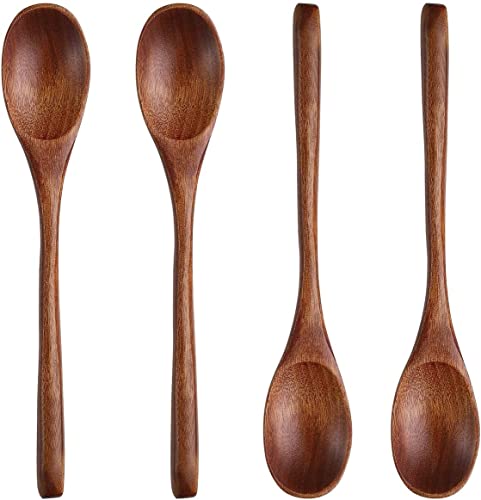 Long Handle Wooden Spoon For Mixing Coffee Tea Jam and Bath Salt In Kitchen, Environmentally Friendly Table Spoon, 8.6 Inches,4 Pieces…
 Stainless Steel Moka Pot Pressed Powder Tool for 2 4 6 9 Cup Espresso Coffee Brewer(6 Cups)
 Quick Heating Cup Warmer, Three Temperature Settings, Splashproof and Portable, for Coffee, Milk, Lightweight ABS Material