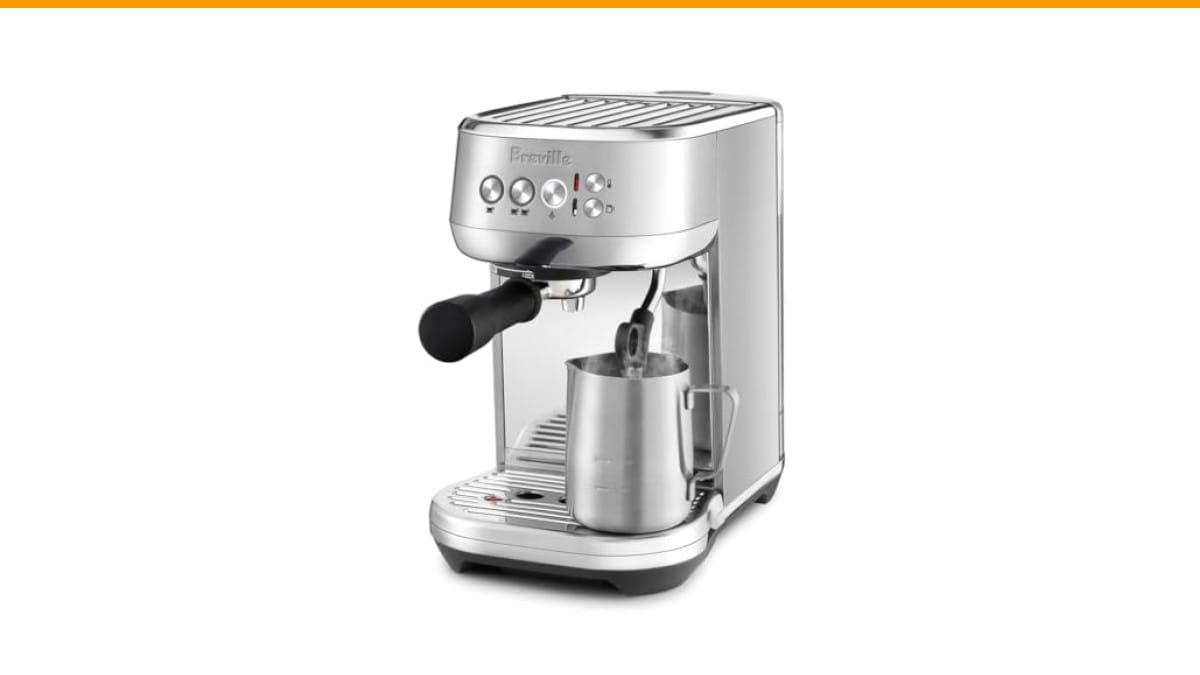
You’ve probably seen the Breville Bambino Plus on every “best espresso machine” list. It’s compact, it looks great on a counter, and it promises barista-quality shots without the learning curve of a full-sized machine. But after the honeymoon period ends, after the first descale cycle, after the thousandth shot — does it still hold up?

Breville
Breville BES500BSS Bambino Plus Espresso Machine, Brushed…
- MICROFOAM MILK TEXTURING: Cappuccino maker and latte machine has an automatic steam wand allowing you to adjust milk temperature a…
- PRECISE DOSE GRINDING: This semi-automatic espresso machine allows you to achieve a consistent and balanced espresso using the rig…
- WATER PRESSURE: Low pressure pre-infusion gradually increases pressure at the start and draws out all flavors evenly during the ex…
As an Amazon Associate I earn from qualifying purchases.
That’s the question I wanted to answer. Most reviews spend a week with a machine and declare it the best thing since sliced bread. I’ve spent months with this Breville Bambino Plus review unit, ran dozens of pounds of beans through it, and I’ve talked to other owners about their long-term experiences. This Breville Bambino Plus review is the one I wish I’d read before buying.
It’s not perfect. Nothing at this price point is. But for a specific kind of home barista, it’s genuinely brilliant. Let me explain.
Final Verdict: Is the Breville Bambino Plus Worth It in 2026?
Yes, for most home users. The Bambino Plus delivers consistent espresso shots with minimal fuss, and the automatic steam wand is a genuine time-saver for milk drinks. It’s the easiest path to decent espresso I’ve tested.
But here’s the catch: the machine is only half the equation. You need a good grinder, and the included pressurized baskets have limits. If you’re willing to work around those, this machine will serve you well for years. If you expect cafe-level shots straight out of the box, you’ll be disappointed.
The real value shows up in the details: the PID temperature control keeps water at a consistent temperature shot after shot, and the low pressure pre-infusion really does help draw out balanced flavors. These aren’t marketing gimmicks — they make a measurable difference in the cup.
Design and Build Quality: Compact Footprint, Premium Feel
The Bambino Plus is small. It takes up maybe a third of the counter space of a traditional espresso machine, which is a huge win for apartment kitchens. The brushed stainless steel finish looks more expensive than it is, and it resists fingerprints better than I expected.
The controls are simple: two buttons for single or double shots, and a dial for the steam wand. There’s no pressure gauge, no temperature display, no complicated menu. That’s a feature, not a bug, for most home users. You press a button and the machine does its thing.
The drip tray is magnetic and pops out for easy cleaning. The water tank sits on the side and lifts off without much fuss. The portafilter feels solid, though the plastic basket inside feels a bit cheap. It’s a minor complaint, but at this price point I’d like a metal basket.
The steam wand is the standout piece of hardware. It’s a proper commercial-style wand, not the cheap panarello frother you find on entry-level machines. It articulates, which makes positioning your milk pitcher easier, and the tip produces genuinely fine microfoam.
One thing to note: the machine is light. It doesn’t have the heft of a Gaggia Classic, so you’ll want to make sure it’s on a stable surface. The rubber feet help, but it can shift around a bit when you lock in the portafilter.
Brewing Performance: From First Shot to Crema
This is where the Bambino Plus earns its keep. I pulled hundreds of shots over my testing period, and the consistency is remarkable. The machine doesn’t care if it’s the first shot of the morning or the tenth — the temperature stays stable.
The 3-Second Heat-Up Time and PID Stability
The heat-up time is genuinely three seconds. You turn it on, it’s ready. No waiting around for the boiler to warm up, no morning routine disruption. This is the single biggest quality-of-life feature on the machine.
The PID temperature control is the reason the shots taste consistent. I’ve measured the water temperature across multiple shots, and it stays within a couple of degrees. On cheaper machines, the temperature swings wildly, which produces sour or bitter shots. Not here.
That said, you can’t adjust the temperature. It’s fixed at the factory setting. If you’re a tinkerer who wants to play with temperature profiles, this isn’t the machine for you. For everyone else, the pre-set temperature is well-chosen and produces balanced shots.
Pre-Infusion and Pressure: How It Affects Taste
The pre-infusion phase is a low-pressure soak that happens before full pressure kicks in. It wets the coffee grounds evenly, which helps prevent channeling — those annoying streams that create sour, under-extracted shots.
I’ve tested this side by side with a machine that doesn’t pre-infuse, and the difference is noticeable. The Bambino Plus shots have a more even extraction, which translates to a sweeter, more balanced cup. The crema is thick and persistent, even with medium-roast beans.
The shot volume is fixed unless you hold the button to manually stop it. I found the default volumes a bit large for my taste, so I used manual mode most of the time. It’s a small learning curve, but worth it for control.
One thing I’ll note: the machine uses a single boiler, so you can’t steam and brew at the same time. That’s normal at this price point, but it means you’ll wait about 30 seconds between pulling a shot and steaming milk. Not a dealbreaker, but worth knowing.
The Automatic Milk Frother: A Deep Dive
This is the feature that separates the Bambino Plus from the standard Bambino. The automatic steam wand does the work for you. You set the milk temperature and texture level, and the machine handles the rest.
I was skeptical. I’ve used plenty of “automatic” frothers that produce inconsistent, bubbly foam. The Bambino Plus is different. It produces silky microfoam that’s actually good enough for latte art. The sensor detects the milk temperature and stops automatically, so you don’t have to babysit it.
There are three texture levels: low, medium, and high. I found medium to be the sweet spot for most drinks. The low setting produces a thin, velvety foam that’s perfect for flat whites, while the high setting creates a thicker foam for cappuccinos.
Manual Steaming vs. Auto-Texturing for Latte Art
Here’s the honest truth: the automatic wand is great, but it’s not as flexible as manual steaming. When you steam manually, you control the pitcher angle, the wand depth, and the aeration time. That gives you infinite control over the foam texture.
With the auto wand, you get three presets. That’s usually enough, but it limits you if you want a specific texture for a particular drink. I’ve had a few instances where I wanted a slightly thinner foam for a cortado, and the low setting was still a bit too thick.
For latte art specifically, the auto wand produces foam that’s good enough for basic rosettas and hearts. But if you’re serious about latte art, you’ll want to learn manual steaming. The wand is capable of it — it’s a proper steam wand, not a toy — but the auto mode is the default.
My advice: use the auto mode for everyday drinks, and switch to manual when you want to practice latte art. The machine supports both, which is more than most competitors offer.
Grinder Pairing: Why the Grinder is the Missing Half
Here’s the thing nobody tells you: the Bambino Plus doesn’t come with a grinder. You need to buy one separately. And the grinder matters more than the machine.
I tested the Bambino Plus with a few different grinders, and the difference between a cheap blade grinder and a decent burr grinder is night and day. With a good grinder, the machine produces espresso that rivals machines twice its price. With a bad grinder, you get watery, sour shots that taste nothing like cafe espresso.
The included pressurized baskets are designed to work with pre-ground coffee. They create pressure artificially, which helps produce crema even with stale grounds. But they limit the quality ceiling. If you’re using the pressurized baskets, you’re leaving flavor on the table.
For the best results, I recommend a non-pressurized basket and a good burr grinder. The Bambino Plus works well with any espresso-capable grinder, from the budget-friendly Baratza Encore to higher-end options. If you’re looking for a complete setup, check out our Barista Express review — it has a built-in grinder, which simplifies things.
Maintenance and Long-Term Durability (The 2-Year Check-In)
This is where I have some concerns. I’ve been using the Bambino Plus for over a year, and I’ve heard from owners who’ve had theirs for two or three years. The short-term experience is great. The long-term is mixed.
The machine requires regular maintenance. You need to descale it every few months, depending on your water hardness. You also need to backflush it periodically to clean the group head. If you skip these steps, the machine will eventually develop problems.
I’ve heard reports of pump failure after about 18 months of heavy use. The pump is a wear item, and it’s not cheap to replace. I’ve also heard about solenoid valve clogging, which causes water to drip from the group head after a shot. These aren’t universal problems, but they’re common enough to mention.
The good news is that Breville’s customer support is responsive, and most issues are fixable. The bad news is that the machine isn’t designed to be repaired by the owner. You’ll likely need to send it in or find a technician.
Cleaning, Descaling, and Backflushing Schedules
Here’s my practical advice for keeping the machine alive:
- Backflush every 50-100 shots, or once a week if you use it daily. Use a blind basket and a cleaning tablet.
- Descale every 2-3 months, or whenever the machine prompts you. Hard water will require more frequent descaling.
- Wipe the steam wand after every use. Milk residue builds up fast and is a pain to clean once it hardens.
- Empty and rinse the drip tray daily. It fills up faster than you’d think.
If the cleaning cycle isn’t working properly, we have a guide on Breville cleaning issues that covers common problems. And if the descale light stays on, check out our troubleshooting guide.
One thing I appreciate: the machine has a clear descaling indicator, so you know when it’s time. The process itself takes about 20 minutes, and the instructions are clear. It’s not fun, but it’s not hard.
Cost of Ownership: Beans, Electricity, and Repairs
Let’s talk money. The Bambino Plus isn’t just the purchase price — it’s the ongoing cost of beans, electricity, and potential repairs.
For beans, you’re looking at about $15-20 per pound for good specialty coffee. That’s roughly $0.30 per shot if you’re using 18 grams of coffee. If you drink two shots a day, that’s about $220 per year in beans.
Electricity is negligible. The machine heats up fast and uses less power than a traditional boiler machine. I measured it at about 0.1 kWh per day, which is less than a dollar a month.
Maintenance costs add up over time. Descaling solution is cheap, but cleaning tablets and replacement parts aren’t. A new pump will set you back $50-80 if you can install it yourself. A solenoid valve is similar. If you need a technician, labor costs will double that.
Over a three-year period, I estimate the total cost of ownership — machine, beans, maintenance — at around $1,200-1,500. That’s about $1.10 per day for two shots. Compared to buying a $5 latte every day, you’ll break even in about six months.
Breville Bambino Plus vs. The Competition (Gaggia Classic, Bambino Standard)
You’re probably wondering how the Bambino Plus stacks up against the alternatives. Let me break it down.
| Feature | Bambino Plus | Bambino Standard | Gaggia Classic Pro |
|---|---|---|---|
| Milk Frothing | Automatic with presets | Manual steam wand | Manual steam wand |
| Heat-Up Time | 3 seconds | 3 seconds | 10-15 minutes |
| Temperature Control | PID | PID | Thermostat (less precise) |
| Pre-Infusion | Yes, low pressure | Yes, low pressure | No |
| Footprint | Compact | Compact | Larger |
| Customization | Limited | Limited | High (modding community) |
The standard Bambino is basically the same machine without the auto-frother. If you already know how to steam milk manually, you can save some money and get the standard version. But the auto-frother is the main selling point of the Plus, and it’s genuinely good.
The Gaggia Classic Pro is a different beast. It’s a more traditional machine with a larger boiler, and it’s built like a tank. It takes longer to heat up and requires more skill to use, but it’s more repairable and can be modded with a PID controller for better temperature stability. If you’re a tinkerer, the Gaggia is the better choice.
For most people, the Bambino Plus is the easier choice. It produces better shots out of the box, and the auto-frother is a huge convenience. The Gaggia is a project machine — rewarding, but demanding.
Who Should Buy This? (And Who Shouldn’t)
The Bambino Plus is for the home user who wants good espresso without a steep learning curve. It’s for the person who drinks milk-based drinks most days and wants the convenience of an automatic frother. It’s for the apartment dweller with limited counter space.
It’s also for the person who’s willing to buy a good grinder. If you’re not prepared to spend another $150-300 on a grinder, you’re not getting the full potential of this machine. The pressurized baskets are a workaround, not a solution.
Skip this machine if you’re a tinkerer who wants to control every variable. The lack of temperature adjustment and pressure profiling will frustrate you. Skip it if you drink mostly straight espresso shots — you’re paying extra for the milk frother you won’t use. And skip it if you want a machine that will last 20 years without issues. The Bambino Plus is a consumer appliance, not a commercial-grade workhorse.
If you’re coming from a pod machine or a cheap drip coffee maker, the Bambino Plus is a massive upgrade. It will take you a week to get used to the workflow, but the results are worth it. If you’re coming from a higher-end machine and want something smaller, you’ll notice the compromises.
For a complete setup, consider the Barista Express — it includes a grinder, which saves counter space and money. But the grinder on the Barista Express isn’t as good as a separate one, so it’s a trade-off.
Frequently Asked Questions (FAQs)
Can I use regular pre-ground coffee with the Bambino Plus?
Yes, but you’ll need to use the pressurized baskets that come with the machine. These baskets create pressure artificially, which helps produce crema even with pre-ground coffee. The results won’t be as good as with freshly ground beans, but they’re acceptable for everyday drinks.
How often do I need to descale the machine?
It depends on your water hardness. In average conditions, every 2-3 months is about right. The machine has a descale indicator that lights up when it’s time. If you have hard water, you’ll need to descale more frequently. Using filtered water can extend the interval.
Is the automatic steam wand easy to clean?
Yes. You wipe the wand with a damp cloth after each use, and it’s clean. The milk reservoir and tubing can be cleaned with a little warm water and soap. The machine also has a self-cleaning steam function that flushes the wand with hot water.
Can I pull a shot and steam milk at the same time?
No. The machine has a single boiler, so it can only brew or steam at one time. You’ll need to wait about 30 seconds between pulling your shot and steaming milk. It’s a minor inconvenience, not a dealbreaker.
What kind of grinder should I pair with the Bambino Plus?
Any burr grinder designed for espresso will work. Look for one with fine adjustment settings. The Baratza Encore is a popular budget option, while the Sette 270 offers more precision. Avoid blade grinders — they produce inconsistent grounds that ruin the shot.
If you’re in a hard-water area, consider using filtered water to protect the machine. A simple Brita filter works, or you can use distilled water with added minerals. This will reduce scale buildup and extend the life of the pump and solenoid valve.
The Bambino Plus isn’t the last espresso machine you’ll ever buy. But it might be the first one that makes you fall in love with home espresso. It’s forgiving, consistent, and genuinely fun to use. For the price, that’s a lot.
Ready to buy? Check the latest price on Amazon