You pull a shot every morning before work. Maybe two on weekends. You never think about the meter spinning until the electric bill arrives, and then you wonder: is that espresso machine quietly eating money? It’s a fair question. Most of us leave machines plugged in, some leave them on, and a few even leave them on all day for convenience.
Here’s the plain truth: a home espresso machine uses somewhere between 0.05 and 0.20 kWh per day for typical use. That translates to roughly $0.01 to $0.06 per day, or about $3 to $20 a year. Compared to the cost of the coffee beans themselves, the electricity is almost noise. But that doesn’t mean you should ignore it. Some habits can double or triple your energy use without improving your shot. This article breaks down the real numbers, the physics behind them, and the simple changes that cut your espresso energy bill by up to 60%.

CASABREWS
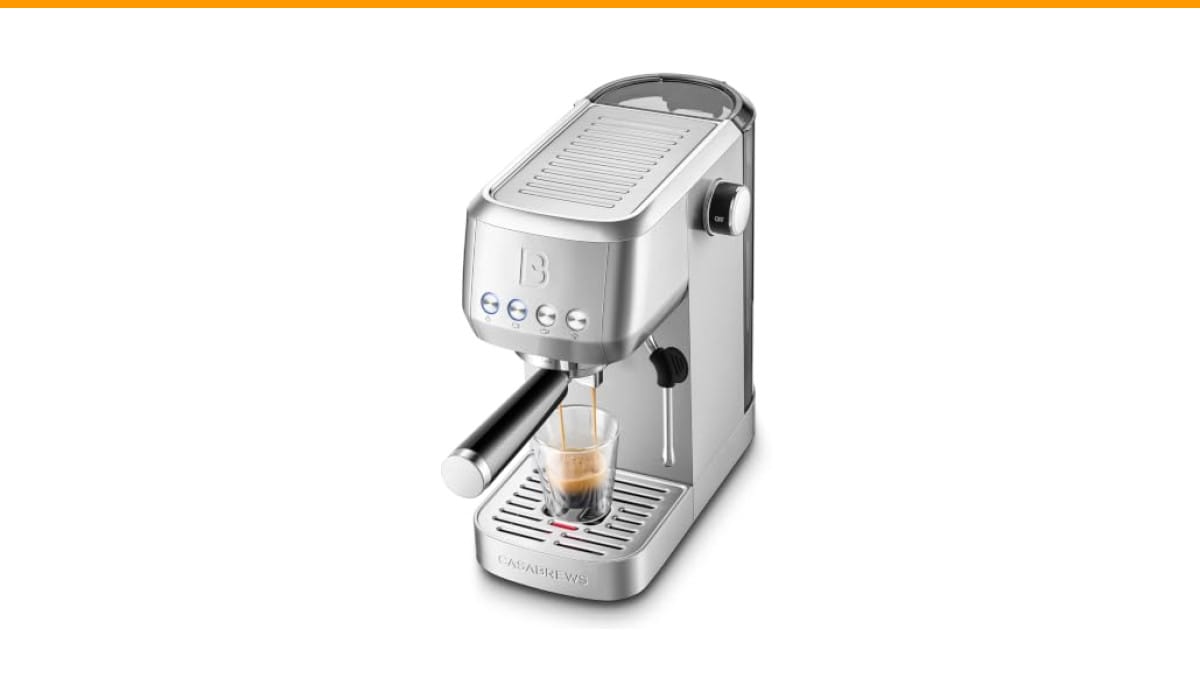
CASABREWS 3700 Essential Stainless Steel Espresso Machine…
- Make Your Favorite Espresso Coffee At Home: The CASABREWS coffee machine with milk frother allows you to prepare all your favorite…
- Professional 20-Bar Pressure System: A semi-Automatic 2-in-1 Espresso Maker with a 20 bar professional pump and a 1350 W powerful…
- Milk Frothing System: Our espresso machine with milk frother has a powerful steam wand that creates a creamy and rich micro-foam m…
As an Amazon Associate I earn from qualifying purchases.
If you’re in the market for a machine that balances power and efficiency, the CASABREWS 3700 Essential Stainless Steel Espresso Machine is a solid option. Its 1350 W heating system is typical for a home machine, and the 20-bar pump gives you pro-level extraction without the energy appetite of a commercial unit. It’s a good reference point for the numbers below.
The Short Answer: Watts, Kilowatts, and Your Bill
Electricity is measured in watts (W) and kilowatt-hours (kWh). A kilowatt-hour is simply 1,000 watts running for one hour. Your utility charges you per kWh, usually between $0.10 and $0.30 depending on where you live. The national average hovers around $0.17 per kWh.
So if your espresso machine draws 1,350 W (like the CASABREWS), running it for one full hour would use 1.35 kWh. But you don’t run it for an hour. You run it for maybe 3 to 5 minutes total per session. That’s 0.07 to 0.11 kWh per session. At $0.17/kWh, that’s about 1 to 2 cents per session.
Even if you pull three shots a day, you’re looking at maybe 0.3 kWh daily. That’s about $1.50 a month. It’s nothing. But the picture changes when you factor in idle time and standby draw, which we’ll get to in a moment.
The Real-World Wattage Breakdown (Brewing vs. Steaming vs. Idle)
You can’t talk about energy without splitting up the phases. Each part of the espresso process draws different power.
- Heating up (initial warm-up): This is the biggest spike. A 1,350 W machine pulls full power for 2 to 4 minutes to heat the boiler or thermoblock. That’s about 0.05 to 0.09 kWh per warm-up. If you leave it on all day, it cycles on and off to maintain temperature, which adds up.
- Brewing (pump + heater): During extraction, the pump draws about 100 W, and the heater may cycle on to maintain temp. Total draw is around 200 to 300 W for the 25–30 seconds of a shot. That’s negligible — about 0.002 kWh per shot.
- Steaming milk: This is the energy hog. The steam wand needs the boiler at a higher temperature, so the heater runs continuously. A 1,350 W machine will draw full power for 30 to 60 seconds of steaming. That’s another 0.01 to 0.02 kWh per session.
- Idle (on but not doing anything): This is where the waste hides. A single boiler machine will cycle the heater on for 10–15 seconds every few minutes to hold temperature. That can draw 0.05 to 0.15 kWh per hour of idle time. Leave it on for 8 hours and you’ve used almost as much as 20 shots.
So the real cost isn’t the shot itself. It’s the warm-up and the idle time. A machine that’s on for two hours a day just to make two shots uses about 0.2 to 0.3 kWh just for idling. That’s triple the energy of the shots themselves.
The Physics of Your Machine: Why Boilers Hog Power
Water has a high specific heat capacity. That’s a fancy way of saying it takes a lot of energy to raise its temperature. Heating 100 ml of water from room temperature (20°C) to brewing temperature (93°C) requires about 30,000 joules. That’s roughly 0.008 kWh. Sounds small, but multiply that by every time the boiler reheats, and it adds up.
Boilers are big chunks of metal with water inside. They take longer to heat up, but they hold temperature better. Thermoblocks are small metal blocks with water channels. They heat up fast, but they lose heat just as fast. So a thermoblock machine might use less energy for a single shot because it only heats the water you need. A boiler machine uses more energy upfront, but if you pull multiple shots in a row, the boiler’s thermal mass keeps it efficient.
Thermoblock vs. Single Boiler vs. Dual Boiler
- Thermoblock: Heats water on demand. No standby draw if you turn it off. Best for occasional users. Energy use per shot is the lowest.
- Single boiler: Heats a small boiler (usually 300–500 ml). Good for one or two shots, but you have to wait for it to heat up each time. Idle draw is moderate.
- Dual boiler: Two boilers — one for brew, one for steam. They heat up fast, but they also lose heat fast. Idle draw is the highest. Only worth it if you’re making multiple milk drinks back to back.
If you’re a single-shot person, a thermoblock machine like the CASABREWS is the most efficient choice. If you host brunch every Sunday and make six lattes, a dual boiler might actually save energy because you’re not reheating between drinks.
The True Cost: Per Shot, Per Day, Per Year
Let’s put real numbers on this. Assume you make two shots a day, each with a 30-second steam for milk. Your machine is a 1,350 W single boiler.
- Warm-up: 3 minutes at 1,350 W = 0.0675 kWh
- Brewing: 30 seconds at 250 W = 0.002 kWh per shot, so 0.004 kWh total
- Steaming: 1 minute at 1,350 W = 0.0225 kWh
- Total per day: ~0.094 kWh
At $0.17/kWh, that’s $0.016 per day. Over a year, that’s $5.84. Add in idle time if you leave it on for an hour after your morning routine, and you’re looking at maybe $10–15 a year. That’s less than the cost of a single bag of specialty beans.
The ‘Cost Per Pound’ Reality Check
Here’s the perspective that changes everything. A pound of good coffee beans costs $15–25. You’ll use about 1.5 to 2 pounds a month if you drink two shots a day. That’s $30–50 a month on beans. Your espresso machine’s electricity is $0.50 a month. That’s less than 2% of your coffee budget.
Even if you leave the machine on all day every day, you might add $5–10 a month. That’s still less than a single latte from the café down the street. The energy cost of espresso is a rounding error. The beans are the real expense.
The Idle Time Trap: Is ‘Always On’ Ever Worth It?
Some people leave their espresso machine on all day for convenience. The argument is that the machine stays at temperature, so you can pull a shot any time without waiting. That’s true, but it’s also expensive.
Let’s do the math. A single boiler machine draws about 50–100 W on average when idling (the heater cycles on and off). Over 8 hours, that’s 0.4 to 0.8 kWh. At $0.17/kWh, that’s $0.07 to $0.14 per day. Over a month, that’s $2–4. Over a year, $24–48. That’s not huge, but it’s avoidable.
But here’s the counterpoint: if you pull a shot every hour, the warm-up energy for each shot is the same as the idle energy for the hour. So there’s a break-even point. If you make more than 8–10 shots a day, leaving it on might be worth it. For the rest of us, turning it off when you’re done is the smarter move.
And there’s a middle ground: a smart plug. You can set it to turn on 10 minutes before your alarm and off 30 minutes after you leave. That way you get the convenience of a warm machine without paying for all-day idle.
The Vampire Draw: Why ‘Off’ Isn’t Always Off
Here’s a sneaky one. Many espresso machines don’t have a true off switch. They have a rocker switch that cuts power to the heating element, but the machine still draws a small amount of power for the clock, the LED lights, or the control board. This is called vampire draw or standby power.
It’s small — usually 1 to 5 watts. But it’s constant. At 3 W average, that’s 0.072 kWh per day, which is about $4.50 a year. Not a lot, but it’s pure waste. If you want to eliminate it, unplug the machine when you’re not using it, or plug it into a power strip with a switch you can flip.
Some machines have a physical power switch that cuts all power. Check yours. If it has a rocker switch that glows, it’s likely still drawing power. The CASABREWS, for example, uses a simple on/off switch, so when it’s off, it’s off. But many higher-end machines with digital displays are the worst offenders.
How to Slash Your Espresso Energy Bill by 60%
You don’t need a new machine to cut your energy use. These habits work on almost any espresso machine.
Smart Plugs and Scheduling
A smart plug costs about $15 and pays for itself in a few months if you have a machine with a high idle draw. Set it to turn on 15 minutes before you wake up and off 30 minutes after you leave. That eliminates idle time entirely. You can also use it to track your machine’s actual power draw with an energy monitoring plug, which is a great way to see where your money goes.
The Descale Efficiency Hack
Scale buildup inside the boiler or thermoblock acts as an insulator. It takes longer to heat the water, so the heater runs longer. A machine that’s overdue for descaling can use 10–20% more energy. Descale every 3–6 months depending on your water hardness. It’s a win-win: better shots, less energy, and a longer machine life. If you’re not sure how, check out our guide on descaling coffee machines.
Another tip: use fresh cold water in the tank, not hot. Hot water from the tap has already been heated once, but the machine will reheat it anyway. Cold water is fine and avoids any risk of stale or metallic tastes.
Espresso vs. Drip vs. Nespresso: The Energy Efficiency Showdown
How does espresso compare to other brewing methods? Let’s put them side by side.
| Method | Typical Power Draw | Energy per Cup (kWh) | Cost per Cup at $0.17/kWh | Notes |
|---|---|---|---|---|
| Espresso (home machine) | 1,200–1,500 W | 0.05–0.10 | $0.008–$0.017 | Includes warm-up. Idle adds more if left on. |
| Drip coffee maker | 800–1,200 W | 0.08–0.12 | $0.014–$0.020 | Heats a full carafe. If you brew less, use a smaller machine. |
| Nespresso (or similar pod machine) | 1,200–1,500 W | 0.03–0.05 | $0.005–$0.009 | Heats water on demand. No idle if you turn it off. |
| French press (electric kettle) | 1,000–1,500 W | 0.03–0.04 | $0.005–$0.007 | Only heats the water you need. Most efficient. |
Espresso isn’t the most efficient, but it’s not the worst either. The real difference is in the beans. A $20 bag of espresso beans gives you about 30 shots, or $0.67 per shot. The electricity for that shot is less than a penny. So the energy efficiency debate is really about environmental impact, not your wallet.
If you’re concerned about carbon footprint, the espresso machine’s energy use is still tiny compared to the coffee’s supply chain (farming, shipping, roasting). But that’s a different article.
Frequently Asked Questions
Does a higher wattage mean a better shot?
No. Wattage only tells you how fast the machine heats up. A 1,500 W machine will reach temperature faster than a 1,000 W one, but the shot quality depends on pump pressure, water temperature stability, and your grind. A machine with a 20-bar pump (like the CASABREWS) will extract better than a cheap 15-bar one, regardless of wattage. Don’t chase wattage. Chase temperature stability.
Should I unplug my machine every night?
If your machine has a physical off switch, no. If it has a digital display or a glowing rocker switch, yes. The vampire draw is small, but unplugging is free and easy. If you use a smart plug, you can schedule it to cut power completely at night and turn on before you wake up.
Does leaving the machine on all day damage it?
It can. Constant heating and cooling cycles stress the boiler and gaskets. The thermal expansion and contraction can lead to leaks over time. Plus, the water in the boiler evaporates and concentrates minerals, which accelerates scale buildup. Turn it off when you’re done. It’s better for the machine and your energy bill.
Is a thermoblock machine more energy-efficient than a boiler?
For a single shot, yes. A thermoblock heats only the water you need, so there’s no wasted energy maintaining a large boiler. For multiple shots in a row, a boiler might be more efficient because it holds temperature and doesn’t need to reheat from scratch each time. If you’re a one-shot-a-day person, thermoblock is the way to go.
Can I use solar power to offset espresso energy?
Yes, and it’s easier than you think. If you have solar panels, run your espresso machine during peak sun hours (10 AM to 2 PM). That’s when your panels produce the most power. If you have a battery, you can charge it during the day and use it for your morning coffee. It’s a small load, so even a modest solar setup can cover it easily. Just make sure your machine is off when the sun goes down.
The Bottom Line: Don’t Sweat the Electricity, Enjoy the Coffee
- The average home espresso machine uses about 0.1 kWh per day for normal use — that’s $0.02 or less.
- Your yearly electricity cost for espresso is roughly $5–15, less than a single bag of beans.
- Idle time is the biggest energy waste. Turn off the machine when you’re done, or use a smart plug to automate it.
- Vampire draw adds a few dollars a year. Unplug or use a switched power strip if you want to eliminate it.
- Descaling every 3–6 months keeps your machine efficient and prevents energy waste from scale buildup.
- Thermoblock machines are best for single-shot users; boilers shine for multiple drinks.
- Compare the cost to beans, not to other appliances. The electricity is a rounding error.
So go ahead, pull that shot. The meter barely notices. Your taste buds will thank you.
Products related to this article
Sponsored / affiliate links. As an Amazon Associate I earn from qualifying purchases. I may earn additional commission from eligible campaigns.
 Coffee Espresso Machine Handle Replacement Parts, Cafe Bracket Handle for Lidl Silvercrest CM4621 CM4218 KF5002 KF500S Barista (for 51mm Portafilter Basket - Not included)
 Quick Heating Cup Warmer, Three Temperature Settings, Splashproof and Portable, for Coffee, Milk, Lightweight ABS Material
 Coffee Mug Warmer & You are Awesome Mug Set, Electric Cup Warmer for Desk