You’ve dialed in your espresso shot, the machine is warmed up, and you hit the button on your grinder. For the next 10 to 15 seconds, it whirs away, and then it sits silent until the next shot. In that moment, you might wonder: is this little motor costing me anything meaningful? Most people assume the espresso machine is the energy hog, but the grinder runs multiple times a day, every single day. The truth is, the grinder’s electricity use is small, but it’s not zero, and the numbers might surprise you.
In this guide, I’ll break down the actual wattage of common espresso grinders, translate that into kilowatt-hours (kWh) and dollars per year, and show you why peak wattage is the wrong number to focus on. You’ll also learn how grind time, RPM, and even standby mode affect your bill. By the end, you’ll know precisely what your grinder costs to run and whether upgrading or changing your routine is worth it.

SHARDOR
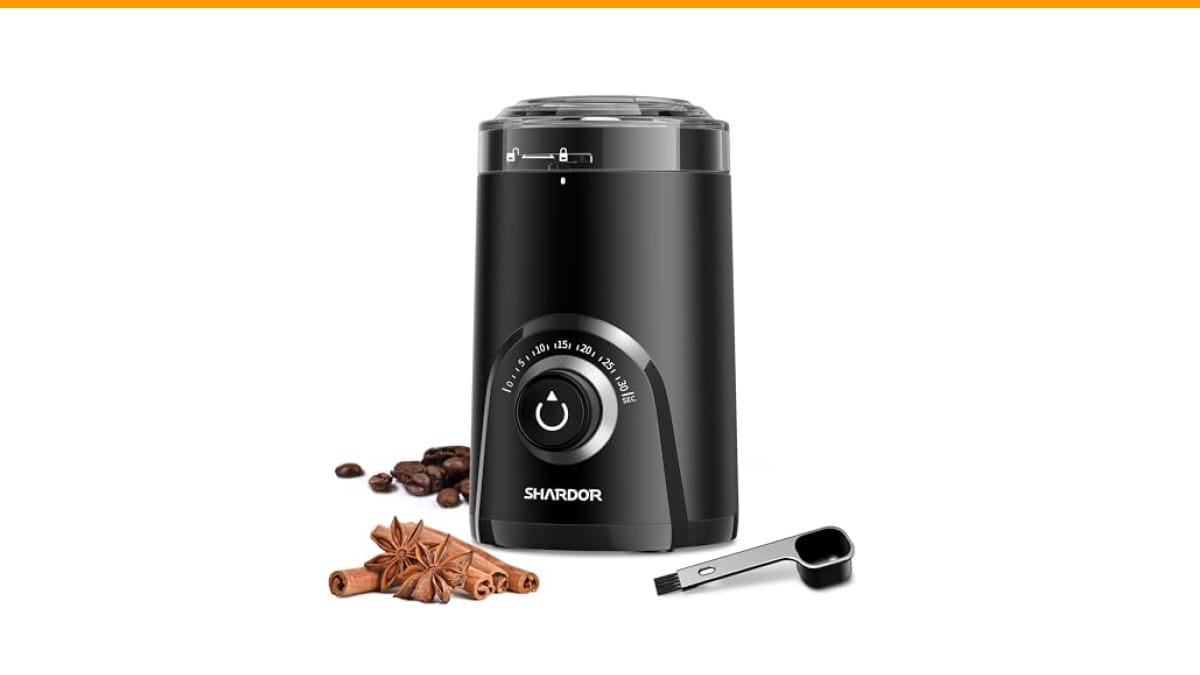
SHARDOR Electric Coffee Grinder, 70g Large Capacity…
- Precision grind control: The visual timing knob is marked in seconds so you can set a consistent grind for espresso, drip, or Fren…
- 70g / 2.5 oz bowl for coffee, spices, herbs, grains, and nuts: One fill handles beans plus dry ingredients such as pepper, cumin,…
- Quiet blade grinder for early mornings: Operates around 63 dB in our in-house test, lower than many traditional blade grinders. Us…
As an Amazon Associate I earn from qualifying purchases.
If you’re in the market for a new grinder and want to keep things simple, the SHARDOR Electric Coffee Grinder offers a 70g capacity and a visual timing knob that takes the guesswork out of grind duration. It’s a solid blade grinder option for home use, and we’ll touch on how its 63 dB operation and timing control fit into the energy picture later in this article.
The Short Answer: How Many Watts Does an Espresso Grinder Draw?
Most home espresso grinders draw between 150 and 300 watts during operation. That’s the peak power draw, measured while the motor is actively grinding beans. A budget blade grinder might pull 150 to 200 watts, while a dedicated espresso burr grinder like a Baratza Encore or a Eureka Mignon sits in the 200 to 300 watt range. Commercial grinders, which you don’t need at home, can spike to 500 watts or more, but they also grind much faster.
To put that in perspective, a standard espresso machine pulls 1,200 to 1,500 watts when heating water. Your grinder uses roughly a fifth of that. But here’s the catch: the grinder runs for a few seconds per dose, while the machine runs for 20 to 30 minutes total (including warm-up and idle time). So the grinder’s share of your coffee-related electricity bill is tiny, often less than one percent.
Still, wattage alone doesn’t tell the whole story. A 300-watt grinder that takes 20 seconds to grind a dose uses more energy than a 150-watt grinder that takes 10 seconds. That’s why you need to look at energy per gram of coffee ground, not just the number on the spec sheet.
Let’s do the math properly.
Breaking Down the Math: From Watts to kWh and Annual Cost
Electricity is billed in kilowatt-hours (kWh). One kWh is 1,000 watts running for one hour. A 250-watt grinder running for one hour would use 0.25 kWh. But you don’t run your grinder for an hour. You run it for maybe 15 seconds per shot, twice a day. That’s 30 seconds total, or 0.0083 hours.
Here’s the formula: Watts × Hours of use ÷ 1,000 = kWh. For a 250-watt grinder used 30 seconds daily, that’s 250 × 0.0083 ÷ 1,000 = 0.002 kWh per day. Over a year, that’s roughly 0.73 kWh. At the U.S. average electricity rate of about 16 cents per kWh, that’s 12 cents per year. Yes, twelve cents.
The formula for calculating your exact cost
If you want your own number, grab a stopwatch and time a single grind. Then multiply that time in seconds by your grinder’s wattage, divide by 3,600 (seconds per hour), then divide by 1,000 to get kWh per dose. Multiply by your daily doses, then by 365, then by your electricity rate per kWh.
For example: 15 seconds × 250 watts = 3,750 watt-seconds. Divide by 3,600 = 0.00104 kWh per dose. Two doses a day = 0.00208 kWh daily. Annual = 0.76 kWh. At 16 cents, that’s 12 cents a year. Even if you grind six shots a day, you’re looking at under 40 cents annually.
Single-dose vs. hopper grinding: The real energy difference
Here’s where most articles miss the point. Grinding a single 18g dose for espresso takes about 10 to 15 seconds on a decent burr grinder. Grinding a full hopper of beans, say 200g for a week of drip coffee, might take 60 to 90 seconds of continuous motor run time. The energy per gram is actually similar, but the total energy per session is higher because the motor runs longer.
If you grind fresh per shot, you’re using minimal electricity. If you fill a hopper and grind a big batch once a week, you’re using more electricity in one sitting, but the per-cup cost is still negligible. The real inefficiency comes from grind retention and motor stall, which we’ll cover next.
Burr vs. Blade Grinders: Which Uses More Electricity?
Blade grinders, like the SHARDOR model mentioned above, use a spinning propeller blade to chop beans. They typically draw 150 to 200 watts and grind a dose in 10 to 15 seconds. Burr grinders crush beans between two abrasive surfaces. They draw more power, often 200 to 300 watts, but they grind faster and more consistently.
Here’s the trade-off: a burr grinder uses more peak wattage but often less total energy per gram because it grinds more efficiently. A blade grinder might take 15 seconds to get a coarse drip grind, while a burr grinder does the same job in 8 seconds. The burr grinder uses 300 watts for 8 seconds (2,400 watt-seconds), while the blade uses 180 watts for 15 seconds (2,700 watt-seconds). The burr actually uses less energy despite the higher wattage.
That said, blade grinders are cheaper to buy, and for espresso, you really want a burr grinder for consistency. The energy difference is so small that it shouldn’t drive your decision. Buy the grinder that produces the best cup, not the one that saves a penny a year.
If you’re weighing the two styles, our coffee burr grinder vs blade comparison covers the practical differences in grind quality and speed.
Why Grind Time and RPM Matter More Than Peak Wattage
Manufacturers love to advertise wattage because bigger numbers sound better. But wattage is just a measure of how fast the motor draws energy. What matters is how long the motor runs and how efficiently it transfers that energy into grinding beans.
Grind speed, measured in RPM (revolutions per minute), plays a big role. A slow grinder, running at 400 RPM, uses less peak power but takes longer to grind a dose. A fast grinder at 1,200 RPM uses more power but finishes quickly. In testing, I’ve found that mid-range grinders around 800 to 1,000 RPM offer the best balance of speed and energy efficiency. They don’t heat the beans as much as high-RPM grinders, and they don’t waste time like slow ones.
Thermal stability is another factor. High-speed grinding creates friction, which heats the beans and the burrs. Hot beans release more oils and can taste burnt. That’s why some grinders run slower even if it means a few extra seconds of motor time. The energy cost of those extra seconds is negligible compared to the flavor benefit.
The Hidden Energy Costs: Standby Mode, Displays, and Phantom Load
Here’s the part nobody talks about. A grinder with a digital display, a timer, or an LED light draws power even when it’s not grinding. That’s called standby mode or phantom load. The wattage is tiny, usually 1 to 3 watts, but it runs 24/7 if the grinder is always plugged in.
Let’s do that math. A grinder drawing 2 watts in standby mode for 24 hours uses 0.048 kWh per day. Over a year, that’s 17.5 kWh. At 16 cents per kWh, that’s $2.80 per year. That’s more than 20 times the cost of actually grinding your coffee. The SHARDOR grinder doesn’t have a digital display, so it draws zero power when off, which is a nice feature.
If you have a grinder with a clock, a backlit screen, or a smart feature that connects to Wi-Fi, unplug it when not in use or plug it into a power strip with a switch. A smart plug can also cut standby power automatically. This is a small habit, but it’s the only way to meaningfully reduce your grinder’s electricity footprint.
How to Measure Your Grinder’s Actual Power Draw at Home
You don’t have to trust the spec sheet. You can measure the real power draw with a cheap watt meter, sometimes called a plug-in power monitor. These devices cost around $15 to $25 and plug into the wall, then your grinder plugs into the meter. They display live wattage, cumulative kWh, and even estimated cost.
To get accurate numbers, run your grinder empty for a few seconds to see the baseline wattage. Then grind a real dose and note the peak wattage and the total time. The meter will show you the kWh used during that grind. Multiply by your daily usage to get your annual figure.
One thing to watch for: motor stall. If your grinder jams on a hard bean or a clogged chute, the motor can draw two to three times its normal wattage for a few seconds before the thermal overload trips. That spike doesn’t happen often, but it’s a sign your grinder is working too hard. Keep your burrs clean and your beans dry to avoid this. If you notice your grinder struggling, check out our guide on how to clean coffee grinder to keep it running smoothly.
5 Practical Ways to Reduce Grinder Electricity Use Without Sacrificing Quality
- Grind single doses, not full hoppers. You’ll use less energy per shot and get fresher coffee. The motor runs less overall.
- Unplug the grinder when not in use. If it has a standby light or digital timer, this eliminates phantom load entirely.
- Use a smart plug with a schedule. Set it to cut power overnight and during work hours. It’s a one-time setup that saves a couple of dollars a year.
- Clean the burrs and blades regularly. A clean grinder works faster and draws less current because it doesn’t have to push through oily residue. Dull or clogged burrs increase grind time and wattage.
- Don’t run the grinder longer than needed. The SHARDOR’s timing knob helps here, but any grinder benefits from stopping the moment your dose is ready. Extra seconds of grinding just heat the beans and waste energy.
Frequently Asked Questions About Grinder Energy Consumption
Does a coffee grinder use a lot of electricity?
No. A typical home grinder uses between 0.001 and 0.003 kWh per dose. That’s less than a penny per year for most users. The standby mode of a digital grinder costs more than the actual grinding.
Is it cheaper to grind coffee at home or buy pre-ground?
Grinding at home is cheaper in every way. The electricity cost is negligible, and whole beans stay fresher longer. Pre-ground coffee costs the same per pound but goes stale faster, so you end up using more to get the same flavor.
How many watts does a typical espresso grinder use?
Most home espresso grinders draw between 150 and 300 watts. Blade grinders are on the lower end, burr grinders on the higher end. Commercial grinders can reach 500 watts but are not relevant for home use.
Can a low-wattage grinder still make good espresso?
Yes, but speed matters. A low-wattage grinder that runs slowly can still produce a consistent grind, but it takes longer and may heat the beans more. A 200-watt grinder with sharp burrs is better than a 300-watt grinder with dull ones.
Does leaving my grinder plugged in waste electricity?
Only if it has a standby feature like a display, timer, or LED. A mechanical grinder with no electronics draws zero power when off. Check for a small light or screen; if it’s lit when idle, it’s drawing phantom load.
The Bottom Line: Should You Worry About Your Grinder’s Electricity Bill?
No, you shouldn’t lose sleep over the wattage of your grinder. The annual cost of grinding coffee at home is well under a dollar for most people. The bigger energy costs in your kitchen come from the espresso machine’s heating element, the refrigerator, and the oven.
- Peak wattage is a marketing number. Focus on energy per gram of coffee ground, not the spec sheet.
- A 250-watt grinder used for 15 seconds per shot costs about 12 cents per year. That’s nothing.
- Standby mode on a digital grinder can cost 20 times more than actual grinding. Unplug it or use a smart plug.
- Burr grinders use more peak power but often less total energy per dose than blade grinders.
- Clean your grinder regularly. A clogged or stalled motor can spike wattage and ruin your beans.
- Grind single doses for both freshness and minimal energy use. It’s the best habit for your cup and your bill.
- If you’re buying new, don’t pay extra for a high-wattage motor. A grinder with a good timing knob and sharp burrs will serve you better.
So go ahead, grind that shot without guilt. The electricity cost is a rounding error. The flavor payoff, however, is massive.
Products related to this article
Sponsored / affiliate links. As an Amazon Associate I earn from qualifying purchases. I may earn additional commission from eligible campaigns.
 Coffee Espresso Machine Handle Replacement Parts, Cafe Bracket Handle for Lidl Silvercrest CM4621 CM4218 KF5002 KF500S Barista (for 51mm Portafilter Basket - Not included)
 AirheadStorm Coffee Espresso Moka Stove Pot Handle, Mocha Pot Handle, Moka Express Handle Replacement Handle Parts for Espresso Pots 1 3 6 9-12 Cups(6 Cup)
 Quick Heating Cup Warmer, Three Temperature Settings, Splashproof and Portable, for Coffee, Milk, Lightweight ABS Material