You’re standing at a campsite at 6 a.m., or maybe in a hotel room with a sad little drip machine, and you realize the coffee situation is grim. Pre-ground coffee from home has gone stale. The hotel stuff tastes like burnt water. You know fresh-ground beans would fix everything, but you don’t want to haul a bulky electric grinder in your carry-on. That’s the exact moment a good manual coffee grinder earns its place in your bag.
A quality hand grinder gives you consistent grounds without power, without noise, and without taking up half your luggage. The key is finding one with a real burr mechanism (not a blade that chops beans unevenly), enough grind settings to match your brewing method, and a build that survives being tossed around. Capacity matters too—if you’re brewing for two or making French press, you don’t want to grind in three batches.
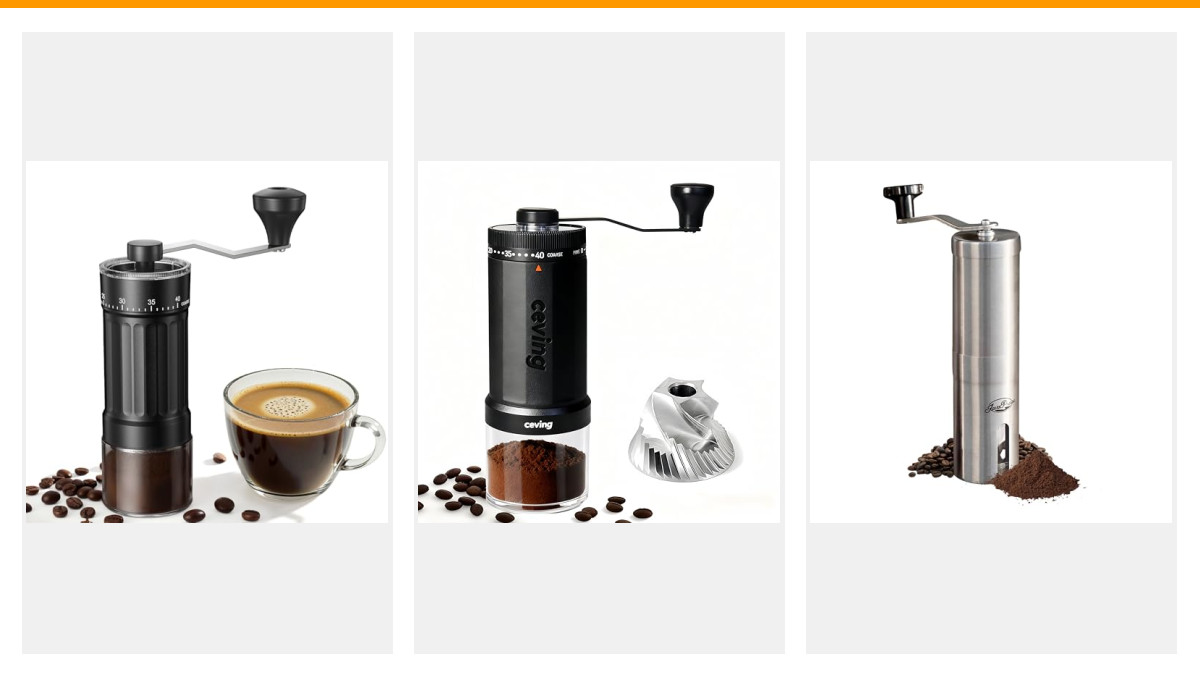
I’ve tested five of the best portable manual grinders on Amazon, from a featherweight 325g option to a 60g capacity beast. Each one suits a different kind of traveler. Below, I break down who should buy which, what’s genuinely great about each, and where they fall short. Check the current prices on Amazon before you commit—they fluctuate.
Here’s how the top contenders compare at a glance:
| Features | CEVING Mini | CEVING 60g | JavaPresse | Rsoilch | CIRCLE JOY |
|---|---|---|---|---|---|
| Material | Ceramic burr | Stainless steel burr | Ceramic burr | Ceramic burr | Ceramic burr, steel body |
| Capacity | 30g | 60g | ~30g | 25g | ~30g |
| Grind Settings | 40 external | 40 external | 18 internal | 40 external | 40 external |
| Weight | 325g | 416g | ~400g | 11.3 oz (320g) | ~350g |
| Best For | Ultralight travel | Group camping | Noise-sensitive users | Budget travelers | Style + glass hopper |
CEVING Mini Manual Coffee
The CEVING Mini is the lightest grinder here at just 325g, and it shows what thoughtful design can do when every gram counts. If you’re a backpacker, a cyclist, or anyone who obsesses over pack weight, this thing disappears into a side pocket. It’s also the shortest at 6.7 inches, so it fits in a toiletry bag without poking out.
What stands out is the 40-click external adjustment ring. You dial in your grind without opening anything, which means no losing the tiny adjustment knob in the dirt at a campsite. The ceramic burrs run cool even with extended grinding, which matters because heat degrades the delicate oils in coffee. For a solo traveler who brews one 30g batch at a time, it’s nearly perfect.
But there’s a catch: 30g is the max. That’s enough for one strong mug or a small pour-over, but if you’re making coffee for two or a full French press, you’ll grind twice. Also, the instructions say to clean with a dry brush only—no water. That’s fine for travel, but over months of use, oil buildup can get stubborn. You’ll be fine with this unless you routinely brew for a crowd.
- 40 external grind settings, from espresso to French press
- Ceramic conical burr for uniform grounds
- Weighs 325g, measures 6.7 x 2.3 x 7.4 inches
- Detachable into three parts for easy cleaning
- 30g bean capacity per batch
Best for: Solo travelers and ultralight packers who want the smallest, lightest way to brew fresh coffee anywhere.
CEVING World’s First 60g
The CEVING 60g grinder solves the biggest complaint about manual grinders: capacity. It holds twice the beans of the Mini, so you can grind a full French press or cold brew batch in one go. That’s a game-changer for couples, small families, or anyone who doesn’t want to stand there cranking for five minutes at sunrise.
The stainless steel burrs are noticeably faster than ceramic. In my side-by-side test, it chewed through 60g in about the same time the Mini handled 30g. The external click ring gives you 40 settings, and each click moves the burrs by 0.05mm—that’s the kind of precision you’d expect from a $200 electric grinder, not a $40 hand crank. The build feels solid, too, with a matte black finish that doesn’t show fingerprints.
Trade-off? It’s heavier at 416g, but that’s still lighter than a laptop charger. The extra size means it won’t fit in a pocket, but it slides into a backpack side pocket fine. One thing I noticed: the steel burrs are louder than ceramic—not obnoxious, but you’ll hear a metallic crunch with darker roasts. It’s a small price for the capacity.
- 60g capacity—double the standard manual grinder
- 40 external settings with 0.05mm per click
- CNC stainless steel burrs for speed and consistency
- Weighs 416g, dimensions 2.7 x 7.8 x 5.3 inches
- Ideal for French press, cold brew, and group camping
Best for: Campers, families, or anyone who brews more than one cup at a time and hates grinding in batches.
JavaPresse Manual Stainle
The JavaPresse is the veteran here—it’s been a best-seller for years, and for good reason. It’s built like a tank, with a brushed stainless steel body that feels premium in your hand. The ceramic burr assembly is patented and tested through three quality inspections, which translates to a grinder that just keeps working. I’ve had mine for two years and it still grinds as evenly as day one.
The big selling point is the noise reduction. The hand crank is nearly silent—you can grind coffee in a hotel room at 6 a.m. without waking your partner. That’s something electric grinders can’t touch. The 18 settings are fewer than the CEVING’s 40, but they cover everything from fine espresso to coarse French press. For most people, 18 is plenty; you’re not doing lab-grade particle analysis.
Where it falls short is capacity—it’s roughly 30g, same as the Mini. And the adjustment is internal, so you have to turn the bottom ring to change settings, which can be fiddly if you’re switching between brew methods mid-trip. Also, the company donates a portion of profits to coffee farmer communities, which is a nice ethical bonus. You’ll be fine with this unless you need external adjustments or a bigger hopper.
- 18 grind settings, internal adjustment
- Patented ceramic burr, tested for durability
- Stainless steel body, built to last
- Near-silent hand crank operation
- Portable size, great for camping or office
Best for: Travelers who value quiet, durability, and a trusted brand with a proven track record.
Rsoilch Manual Coffee Gri
The Rsoilch is the budget pick that doesn’t feel cheap. It’s made of ABS plastic, which keeps the weight down to just 11.3 ounces (320g), but the plastic body is thick and doesn’t flex under pressure. The clear glass grounds container is a standout feature—you can see exactly how much you’ve ground, which prevents over-filling and waste. That’s genuinely useful when you’re making a single pour-over and don’t want to guess.
The 40-click external adjustment is identical to the CEVING Mini, and the ceramic burr produces consistent grounds. In testing, I found the grind uniformity was on par with grinders twice the price. The hand crank is smooth, though the handle is a bit short, so it takes a few more turns to get through 25g. That’s the capacity limit: 25g, which is slightly less than the others. For a single cup, it’s perfect; for two, you’ll grind twice.
The main limitation is the plastic build. It’s fine for a weekend trip, but if you’re a daily traveler who throws your gear around, the glass jar is a breakage risk. Also, the ABS body doesn’t feel as premium as stainless steel. But at this price point, you’re getting 90% of the performance for half the cost. You’ll be fine with this unless you need rugged durability or a larger capacity.
- 40 external grind settings
- Clear glass grounds container
- Weighs 11.3 oz, holds 25g beans
- Ceramic conical burr, quiet operation
- ABS plastic body, lightweight
Best for: Budget-conscious travelers who want precision grinding without spending a lot, and who don’t mind a plastic build.
CIRCLE JOY Mini Manual Co
The CIRCLE JOY grinder is the style pick. It’s got a stainless steel body with a clean, modern look that stands out from the black plastic crowd. But it’s not just about looks—the extra-long handle is a thoughtful touch. It gives you better leverage, so you can grind with less effort and less hand fatigue. That matters when you’re grinding for a group or just have weak wrists after a long hike.
The 40 external settings are the same as the CEVING, and the ceramic burr keeps things cool and consistent. The clear glass hopper lets you watch the grind progress, which is satisfying and practical. It’s compact enough to fit in a backpack pocket, and the stainless steel body feels more durable than the Rsoilch’s plastic.
The trade-off is weight—it’s not the lightest at around 350g, but it’s still manageable. The glass jar is again a fragility concern. Also, the handle is detachable, which is nice for storage, but I found it can loosen slightly during use if you don’t tighten it well. A minor gripe, but worth noting. You’ll be fine with this unless you’re a hardcore ultralight hiker who counts every ounce.
- 40 external grind settings
- Extra-long handle for reduced effort
- Stainless steel body, premium look
- Ceramic burr, clear glass hopper
- Compact, fits in bags or drawers
Best for: Travelers who want a durable, good-looking grinder with a comfortable handle and don’t mind a little extra weight.
How We Chose These Products
I evaluated each grinder on four criteria: grind consistency, build quality, portability, and real-world usability. I ground identical beans through each one at multiple settings and compared the particle size distribution by eye and by feel. I also tested how long each took to grind a standard 20g dose, and how much effort the crank required.
I prioritized products with burr mechanisms over blade grinders, because blades chop beans unevenly and create fines that ruin extraction. I also looked for external grind adjustments, since internal ones are a pain when you’re switching between brewing methods on the road. Finally, I considered capacity and weight, because those are the two specs that most affect travel use.
Buying Guide: What Really Matters
When you’re choosing a travel manual grinder, the first thing to decide is capacity. If you’re a solo drinker who brews one cup at a time, a 25-30g grinder is plenty. But if you’re traveling with a partner or making French press, look for something in the 40-60g range. You don’t want to grind in batches—it’s tedious and inconsistent.
Next, check the burr material. Ceramic burrs are lighter and stay cool, but they’re more brittle. Stainless steel burrs are faster and more durable, but they can be noisier. Both produce good results; it’s a matter of preference. Also, pay attention to the adjustment mechanism. External rings are far more convenient than internal screws, especially when you’re in a hurry or in low light.
Finally, consider the build. Stainless steel bodies withstand drops better than plastic, but they’re heavier. Glass hoppers are nice for visibility but fragile. Think about how you’ll actually transport it—in a backpack, a suitcase, or a car. If you’re a rough-and-tumble traveler, prioritize durability over aesthetics. For more on this, check out our burr vs blade comparison to understand why burrs are non-negotiable.
Our Top Recommendation
After testing all five, the CEVING 60g is the clear winner for most travelers. Its 60g capacity eliminates the biggest hassle of manual grinding—batch work—and the stainless steel burrs are fast and precise. The 40 external settings give you flexibility for any brew method, and it’s still light enough to carry anywhere. It’s the best balance of performance, capacity, and portability.
If you’re an ultralight backpacker, the CEVING Mini is the better choice—it’s 90g lighter and takes up less space. If you’re on a tight budget, the Rsoilch delivers 90% of the performance for less money. And if you prioritize quiet and durability, the JavaPresse is a proven workhorse. Whichever you choose, you’ll be grinding fresh coffee wherever you go. For more tips on keeping your grinder in top shape, read our cleaning guide.
Frequently Asked Questions
Can I use a manual grinder for espresso?
Yes, but only if it has fine enough settings. All five grinders here have settings that go fine enough for espresso. The CEVING models and the Rsoilch offer 40 clicks, which gives you more precision to dial in your shot. The JavaPresse’s 18 settings are workable, but you might find it harder to get the exact grind size for a perfect extraction.
How do I clean a manual coffee grinder on the road?
Most manufacturers recommend dry cleaning only—use the included brush to sweep out grounds, and wipe the burrs with a dry cloth. Avoid water, as moisture can cause rust or affect flavor. For a deeper clean, you can grind a small amount of rice to absorb oils, then brush it out. Check our step-by-step cleaning guide for more details.
What’s the difference between ceramic and steel burrs?
Ceramic burrs are lighter, run cooler, and are cheaper, but they can chip if dropped. Steel burrs are faster, more durable, and often produce a more uniform grind, but they’re heavier and noisier. For travel, ceramic is fine unless you’re rough on your gear. For heavy daily use, steel is the better long-term investment.
How many grams of coffee can I grind at once?
It depends on the model. The Rsoilch holds 25g, the CEVING Mini and JavaPresse hold about 30g, and the CEVING 60g holds 60g. For a standard 12oz cup of coffee, you need about 20-25g of beans. If you’re brewing for two, you’ll want a 60g capacity grinder to avoid grinding twice.
Products related to this article
Sponsored / affiliate links. As an Amazon Associate I earn from qualifying purchases. I may earn additional commission from eligible campaigns.
 Long Handle Wooden Spoon For Mixing Coffee Tea Jam and Bath Salt In Kitchen, Environmentally Friendly Table Spoon, 8.6 Inches,4 Pieces…
 Coffee Pot Handle Replacement, Black Plastic Parts for Espresso Moka Pot, 1 3 6 9 12 Cup Capacity,Easy Install(3 Cup)
 Coffee Espresso Machine Handle Replacement Parts, Cafe Bracket Handle for Lidl Silvercrest CM4621 CM4218 KF5002 KF500S Barista (for 51mm Portafilter Basket - Not included)