People type “coffee cupping set vs coffee tasting set” into Amazon thinking they are choosing between two similar boxes of gear. They are not. One is a laboratory tool for scoring coffee. The other is a sampler pack for drinking different origins at home. I have used both in my own kitchen and in a friend’s specialty lab, and they solve completely different problems. The confusion is understandable, though, because both involve tasting multiple coffees side by side.
| Our Pick | Runner Up |

|

|
| Showroom Coffee Coffee Cupping Set - Complete Professional Kit… | crait Around the World Gourmet Coffee Sampler Gift… |
| See on Amazon | See on Amazon |
As an Amazon Associate I earn from qualifying purchases.
This decision matters if you are a home brewer who wants to compare beans, or if you are training your palate to identify flavor notes. It also matters if you are buying a gift for a coffee obsessive. The short version: the Showroom Coffee Cupping Set is the professional’s choice, but it is currently out of stock. The crait Around the World Gourmet Coffee Sampler is in stock right now and does a different job entirely. One is a toolkit; the other is a tasting flight. Keep reading to see which one fits your situation.
Defining the Terms: Cupping vs. Tasting
Cupping is a formal protocol. The Specialty Coffee Association defines it as a standardized method for evaluating aroma, acidity, body, and aftertaste. You use specific bowls, spoons, and a slurping technique. The goal is to score coffee objectively and find defects.
Tasting is looser. It means brewing coffee and paying attention to what you taste. You might do this with a pour-over, a French press, or even a drip machine. No special spoons required. The crait sampler fits here perfectly: five pre-portioned pouches, each from a different origin, brewed in your regular pot.
So the real question is not which set is better. It is which protocol you actually want to run.
The Core Difference: Purpose and Protocol
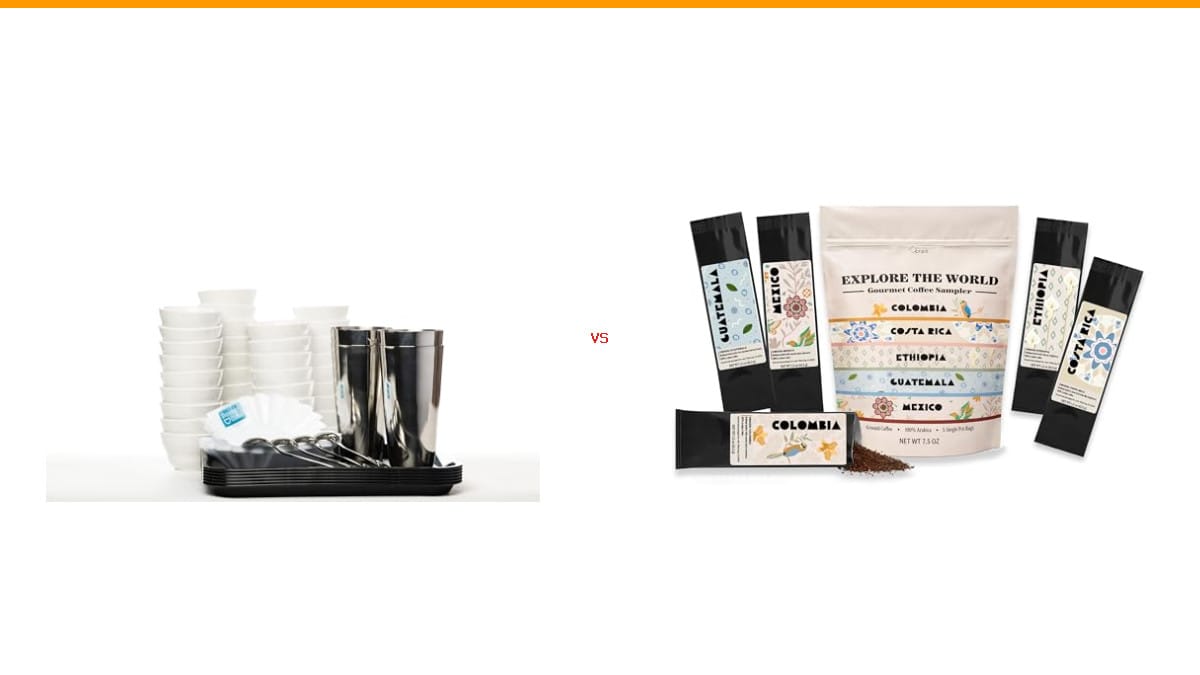
The Showroom Coffee set exists for one reason: to run a cupping session. You get porcelain bowls, deep-bowl spoons, spit cups, bean trays, and a tray that holds six cups. That last part is key. It lets you move from grinder to table without dropping anything. The set for 6 coffees includes 36 cups, 6 table trays, 4 spoons, 4 spit cups, and 6 bean trays. That is enough gear for a small tasting group or a serious solo session.
The crait sampler is about variety, not protocol. Each 1.5-ounce pouch brews one full pot of drip coffee (8–10 cups). The five origins are Guatemala, Ethiopia, Mexico, Colombia, and Costa Rica. You taste them on different days, not side by side in the same session. That changes the comparison completely. You lose the ability to A/B test, but you gain convenience.
If you want to learn how to identify flavor profiles, cupping is the better teacher. If you just want to drink good coffee from different countries, the sampler wins.
Anatomy of a Cupping Set: Essential Tools Explained
Bowls, Spoons, and Rinse Cups
The Showroom set includes porcelain cupping bowls. Porcelain matters because it does not absorb flavors or oils. A plastic cup will hold onto old coffee smells. The deep-bowl spoons are designed for the loud slurp that spreads coffee across your palate. You also get spit cups, which are taller than regular mugs so you can spit without splashing. The bean trays hold the ground coffee before brewing so you can smell the dry aroma.
The rinse cup is a small detail that makes a big difference. In a cupping session, you rinse your spoon between samples to avoid cross-contamination. Without it, you are tasting coffee #3 with residue from coffee #1. The set for 1 coffee includes 6 cups (5 for cupping, 1 for water), so the rinse cup is built into the count.
Grinders, Scales, and Timers
Notice what is not in the Showroom set: a grinder, a scale, or a timer. You need those separately. The protocol requires a consistent grind size and a precise coffee-to-water ratio. If you do not have a good burr grinder, the cupping results will be inconsistent. I used a blade grinder once for a cupping session and it was a mess. The fines extracted too fast and the coarse pieces stayed weak. Check our burr grinder guide if you are unsure which type to get.
You also need a timer to hit the 4-minute steep time. And a scale to measure 8.25 grams of coffee per 150 ml of water. These are standard cupping rules. The set does not include them, so factor that cost into your decision.
Anatomy of a Tasting Set: What’s Included
The crait sampler is simpler. Five pouches, each pre-weighed at 1.5 ounces. No bowls, no spoons, no spit cups. You use your own mug and your own brewer. The beans are 100% Arabica, which is a good baseline for comparing origins. The flavor notes are clearly printed: Guatemala has chocolate, Ethiopia has brightness, Mexico is nutty, Colombia is sweet and nutty, Costa Rica has a wine-like finish.
This set is not designed for sensory evaluation in the formal sense. It is designed for casual exploration. You brew a pot on Monday, taste it, and think about the flavor. Then you brew another on Wednesday. The gap between samples means you are relying on memory, which is less accurate than side-by-side cupping. But for a beginner, it is far less intimidating.
Head-to-Head: Cupping Set vs. Tasting Set
Round 1: Price and Value
The Showroom set costs more because it includes physical tools. The crait sampler is cheaper because it is just coffee. But the Showroom set is out of stock, so price is moot until it returns. Check the current price on Amazon for both before deciding.
Winner: crait, for being in stock and budget-friendly.
Round 2: Ease of Use for Beginners
The crait sampler wins easily. You open a pouch, dump it in the filter, press brew. No learning curve. The Showroom set requires you to learn the cupping protocol first. You need to grind, weigh, pour, steep, break the crust, and slurp. It takes practice.
Winner: crait.
Round 3: Best for Professional Evaluation
If your goal is to score coffee like a Q-Grader, the Showroom set is the only choice. The tools are designed for that exact purpose. The crait sampler cannot do this job. You cannot evaluate defects or compare roast profiles with pre-ground pouches.
Winner: Showroom Coffee.
How to Choose the Right Set for Your Needs
Ask yourself two questions. First, do you want to learn a skill or just drink coffee? If skill, buy the cupping set. If drinking, buy the sampler. Second, do you have the supporting gear? The Showroom set needs a grinder, scale, and timer. The crait sampler needs nothing but a coffee maker.
For home users, the crait sampler is the better entry point. It costs less, requires no extra tools, and introduces you to five origins. Once you figure out which origin you like, you can buy a single-origin bag and start cupping it properly. That is a natural progression.
For someone who already owns a good burr grinder and a scale, the Showroom set is worth waiting for. It will elevate your palate training. But do not buy it as a first step.
Building Your Own Kit on a Budget
If the Showroom set is out of stock and you do not want the sampler, you can build a minimal cupping setup for under $50. You need five small glass or porcelain bowls, a soup spoon, a kitchen scale, and a timer. That is it. The bowls do not need to be cupping-specific. Just make sure they are ceramic or glass, not plastic.
This DIY approach works fine for home practice. The only downside is the lack of a spit cup. I used a mason jar the first time. It worked. If you want to avoid the hassle of cleaning up, the Showroom set’s spit cups are nice, but not essential.
One thing to watch: cross-contamination. Rinse your spoon in hot water between samples. Wipe the spoon dry with a clean cloth. Do not dip the same spoon into two different bowls without rinsing. This is the single most important hygiene rule in cupping. It also applies to your coffee grounds disposal habits, though that is a different kind of mess.
Frequently Asked Questions
Can I use a coffee tasting set for cupping?
No. A tasting set like the crait sampler gives you pre-ground coffee in pouches. Cupping requires freshly ground beans, precise measurement, and a controlled brew time. You can taste the sampler casually, but you cannot run a valid cupping session with it.
Is the Showroom Coffee Cupping Set worth the wait?
If you are serious about palate training, yes. The porcelain bowls and deep spoons are built for the job. But if you just want to explore coffee origins, the crait sampler is available now and does that well. Waiting for a restock is only worth it if you already own a grinder and scale.
How many coffees can I taste with the crait sampler?
Five. Each pouch is a different origin. You can brew them all in one day if you want, but they are portioned for a full pot each. That is a lot of caffeine. Spread them out over a week.
Do I need a Q-Grader certification to use a cupping set?
No. The certification is for professionals, but the tools work for anyone. You will not be scoring coffee for a roastery, but you can still learn to identify acidity, body, and aftertaste. Start with the bitter coffee guide if you are struggling with off-flavors.
The Bottom Line: Tools vs. Beans
The Showroom Coffee Cupping Set and the crait sampler are not competitors. They are different stages of the same hobby. The sampler gets you started with variety. The cupping set gets you serious about evaluation.
If you are buying for yourself and you are new, get the sampler. It is in stock, easy, and enjoyable. If you are buying for a coffee professional or someone who already owns a grinder and scale, wait for the Showroom set. It is the right tool for the job, even if it is not available right now.
My honest advice: buy the sampler now, drink through the five origins, and start building your DIY cupping kit with bowls from your kitchen. By the time the Showroom set is back in stock, you will know exactly which tools you actually need and which ones you can skip.
Products related to this article
Sponsored / affiliate links. As an Amazon Associate I earn from qualifying purchases. I may earn additional commission from eligible campaigns.
 HomeBeyond Espresso Coffee Maker 12 Cups, Classic Stovetop Espresso Maker, 600ml / 20oz Coffeemaker for Gas & Ceramic Stovetops (Silver)
 Stainless Steel Moka Pot Coffee Filter Disc for Espresso Brewing, Coffee Maker Replacement Filter Plate for Home Office Coffee Bar Cafe (FOR 4 Cups)
 3 Piece Wooden Mixing Spoon Set for Cooking, Tea, Coffee, Dessert