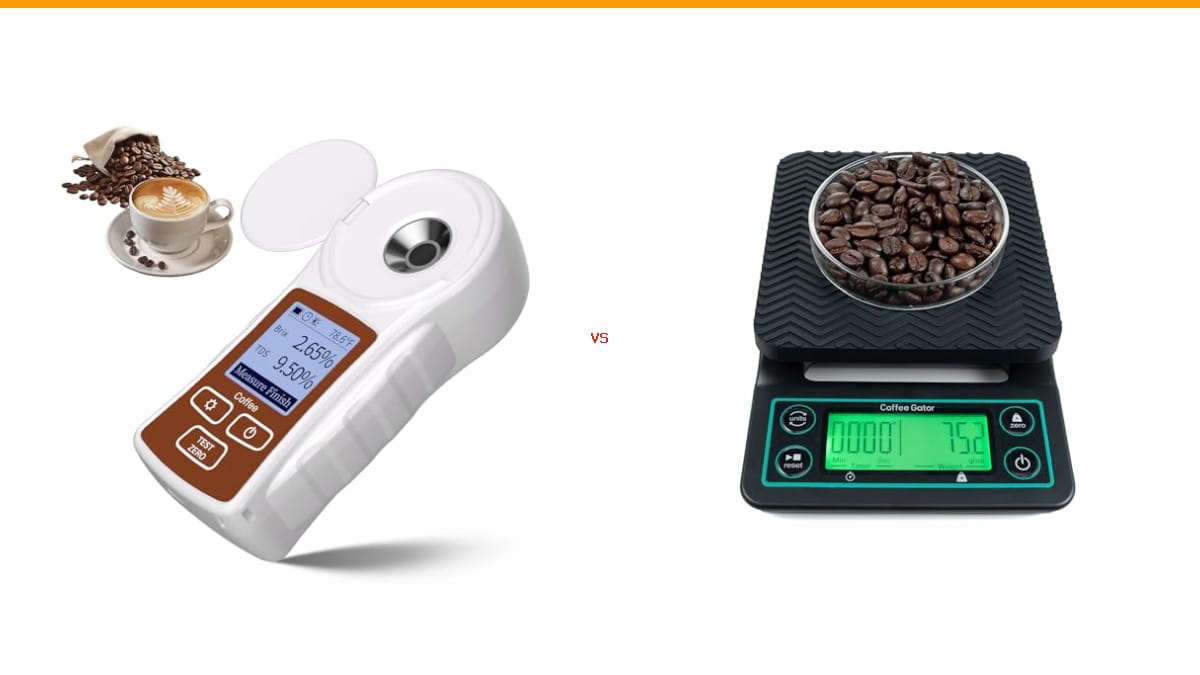
People ask me all the time whether they need a coffee refractometer or a coffee scale. It’s a fair question. Both tools sit on the same shelf in specialty coffee shops, but they do completely different jobs. One measures the beans going in. The other measures the coffee coming out.
| Our Pick | Runner Up |
|

|
| yowexa Professional Coffee TDS Refractometer with ATC for… | Coffee Gator Coffee Gator Coffee Scale 0.1g Precision with… |
| See on Amazon | See on Amazon |
As an Amazon Associate I earn from qualifying purchases.
If you’re a home barista trying to dial in espresso or pour-over, the scale is the obvious starting point. It’s cheaper, easier to use, and solves the most common brewing problems. The refractometer is a deeper investment. It tells you things the scale can’t, like extraction yield and TDS. But it costs more and takes practice.
This comparison walks through what each tool does, what it costs in real terms, and which one you should buy first. I’ve used both for years. The answer depends on your goals, your budget, and how much you hate wasting coffee.
The Core Difference: Measuring Input vs. Output
A coffee scale tracks the input. You weigh beans before grinding, water before pouring, and sometimes the brew as it drips. That gives you a consistent coffee-to-water ratio. It’s the foundation of repeatable coffee.
A coffee refractometer measures the output. You take a few drops of brewed coffee, put them on the prism, and it reads the TDS (total dissolved solids). That tells you how much coffee material actually ended up in your cup. Multiply TDS by brew weight and you get extraction yield — the percentage of coffee solubles pulled from the grounds.
They answer different questions. The scale asks, “Did I use the same amount of coffee and water as last time?” The refractometer asks, “Did I actually extract more flavor from those beans?”
For most home users, the scale matters more early on. It fixes ratio problems. The refractometer matters later, when you’ve dialed in your ratio but still can’t figure out why some shots taste sour and others bitter.
What a Coffee Scale Actually Tells You
The Coffee Gator Coffee Scale is a solid example of the category. It measures up to 3 kg with 0.1g resolution. That’s precise enough for espresso and pour-over. The display is large and backlit, so you can read it in dim kitchen light. It switches between grams, ounces, milliliters, fluid ounces, and pounds. That flexibility helps if you follow recipes from different countries.
The built-in timer is the real workhorse. You start the timer when you start pouring, and the scale shows weight and time together. For pour-over, that means you can hit specific bloom times and pour intervals. For espresso, you can track shot time while watching the yield.
The platform measures 5 by 5 inches. That’s spacious enough for a standard drip kettle or an espresso cup. The grooved surface catches spills, and the waterproof cover pops off for cleaning. It runs on batteries and shuts off automatically after inactivity.
I’ve used this scale for months. It feels solid, responds quickly, and the timer is accurate. The 0.1g resolution is enough for any home brewing. You won’t need more precision than that unless you’re weighing individual coffee beans for a competition.
The Limits of Weight-Based Brewing
Here’s the thing about scales: they only measure what you put in, not what comes out. Two shots with the same weight and time can taste completely different. Grind size, water temperature, and bean freshness all affect extraction. The scale can’t see any of that.
You can use yield as a rough proxy for extraction. If you pull a 1:2 ratio in 30 seconds, you assume the extraction is in the right ballpark. But that’s an assumption. A 1:2 ratio can be underextracted, overextracted, or perfect depending on the bean and the grind.
Weight-based brewing gets you consistent, but not necessarily correct. That’s where the refractometer comes in.
What a Coffee Refractometer Actually Tells You
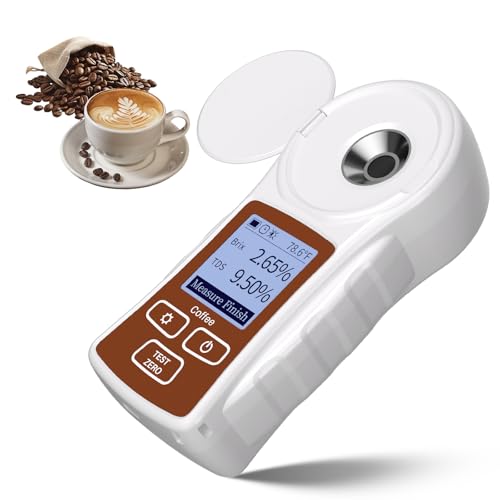
The yowexa Professional Coffee TDS Refractometer is a good example of the current generation. It measures TDS in a range of 0 to 22 percent, and Brix from 0 to 25 percent. Accuracy is plus or minus 0.2 percent. It reads in about two seconds. It also has built-in automatic temperature compensation (ATC), so the readings stay stable even if your coffee is hot or cold.
Calibration is one-touch. You press the ZERO button with distilled water on the prism, and it resets. That’s much easier than older models where you had to turn a screw with a tiny screwdriver. The lid covers the prism when not in use, which protects it from dust and scratches.
The sensor is faster than standard models. In my testing, it gave consistent readings across multiple drops of the same brew. That consistency matters because a refractometer that drifts between readings is useless.
The main downside is the learning curve. You need to know what TDS numbers mean and what target range you’re aiming for. The yowexa reads in both TDS and Brix, but most coffee people use TDS. Brix is more common in the food and beverage industry.
Understanding TDS and Extraction Yield
TDS stands for total dissolved solids. It’s the percentage of your brewed coffee that isn’t water. Typical filter coffee runs around 1.2 to 1.5 percent TDS. Espresso runs higher, usually 8 to 12 percent.
Extraction yield is a separate number. You calculate it by multiplying TDS by the brew weight and dividing by the dry coffee dose. For example, if you brew 250 grams of coffee at 1.3 percent TDS, that’s 3.25 grams of dissolved solids. If you used 15 grams of dry coffee, your extraction yield is about 21.7 percent.
Specialty coffee targets an extraction yield between 18 and 22 percent. Below that, coffee tastes sour and underdeveloped. Above that, it tastes bitter and hollow. The refractometer tells you exactly where you land.
That’s the real value. It turns a subjective taste into a number you can act on. If your yield is 16 percent, you know you need to grind finer or extract longer. If it’s 24 percent, you need to back off.
The Cost-Benefit Analysis: Which Pays Off First?
Let’s talk money. A good coffee scale like the Coffee Gator runs around $20 to $30. A refractometer like the yowexa runs $50 to $100. That’s a significant difference for a home barista.
But the real cost isn’t the hardware. It’s the coffee you waste while dialing in. Every shot you pull and throw away costs you beans. If you drink one espresso per day and you waste two shots while dialing in, that’s about 36 grams of coffee per day. Over a month, that’s over a kilogram of beans.
At $15 per pound for specialty coffee, that’s roughly $30 a month in wasted coffee. A scale helps you be consistent, which reduces waste. A refractometer helps you dial in faster, which reduces waste even more.
The Payback Period Calculation
Let’s do the math. Say you buy a $25 scale. If it saves you from wasting one shot per day, that’s about 18 grams of coffee. At $0.30 per shot, you save about $9 per month. The scale pays for itself in under three months.
Now say you buy a $75 refractometer. It helps you dial in a new bag of beans in one shot instead of three. That saves you two shots per bag. If you go through one bag per week, that’s eight shots saved per month. At $0.30 per shot, you save about $2.40 per month. The refractometer would take over two years to pay for itself.
That math changes if you brew for multiple people or if you’re a perfectionist who throws away a lot of coffee. But for a typical home user, the scale pays off much faster.
The Decision Matrix: Choose Based on Your Goals
Here’s a simple scoring system. Rate yourself on a scale of 1 to 5 for each goal. Then multiply by the weight of that goal for your situation.
- Goal 1: Consistency. You want the same cup every morning. A scale gives you that. A refractometer helps you verify it, but the scale is the tool that maintains it.
- Goal 2: Dialing in new beans. You buy different origins and want to nail each one. A refractometer shines here because it tells you when you hit the sweet spot.
- Goal 3: Cost-saving. You want to waste less coffee. The scale is the cheaper, faster way to reduce waste.
- Goal 4: Education. You want to understand extraction chemistry. The refractometer is the only way to see the numbers.
- Goal 5: Taste improvement. You think your coffee tastes good but want it better. The refractometer gives you objective feedback.
If you score high on consistency and cost-saving, buy the scale first. If you score high on education and taste improvement, consider the refractometer. Most people should start with the scale.
The Pro Workflow: Using Both Together for Maximum Control
The best approach isn’t either/or. It’s both — but in the right order. Start with the scale to lock in your ratio and brew time. Once that’s consistent, use the refractometer to check your extraction yield.
Here’s the workflow I recommend:
- Weigh your dry coffee dose with the scale.
- Weigh your water as you pour, hitting your target ratio.
- Brew and record the final yield.
- Take a small sample of the brewed coffee and measure TDS with the refractometer.
- Calculate extraction yield using the formula: (TDS x brew weight) / dry dose.
- Adjust grind size or ratio based on the yield.
That process gives you full control. The scale handles the input. The refractometer verifies the output. Together, they turn coffee brewing from guesswork into a repeatable system.
If you’re dealing with a stubborn machine or a grinder that won’t cooperate, check out our guides on fixing button issues and troubleshooting brew problems. Those issues often mimic extraction problems, and a refractometer won’t help if your machine isn’t working right.
Frequently Asked Questions
Can a coffee scale replace a refractometer?
No. A scale measures weight, not dissolved solids. You can estimate extraction yield from weight and time, but that’s a guess. The refractometer gives you the actual number. If you want to know your extraction percentage, you need a refractometer.
How often do I need to calibrate a coffee refractometer?
Most digital refractometers, including the yowexa, need calibration with distilled water before each use. The one-touch ZERO button makes it a five-second job. If you use it daily, calibrate daily. If you use it weekly, calibrate each time. It takes less time than heating your water.
Is a 0.1g scale precise enough for espresso?
Yes. 0.1g resolution is the standard for home espresso. You can weigh a single dose of 18 grams with accuracy. Professional scales go to 0.01g, but that’s overkill for a home setup. The Coffee Gator scale handles espresso, pour-over, and French press without issue.
Do I need both tools if I’m a beginner?
No. Start with the scale. Learn to brew consistent ratios and times. Once you can repeat a brew, you’ll know if you need the refractometer. Most home baristas can improve their coffee dramatically with just a scale.
Final Verdict: Which One Should You Buy First?
Buy the coffee scale first. It’s cheaper, easier, and solves the most common brewing problems. The Coffee Gator scale gives you precise measurement, a timer, and a durable build for a modest price. It will improve your coffee immediately.
Add the refractometer later, when you hit the limits of weight-based brewing. If you’re chasing a specific extraction yield or you’re frustrated by inconsistent taste despite consistent ratios, the yowexa refractometer is a capable tool. Its fast sensor and one-touch calibration make it easier than older models.
For the vast majority of home users, the scale is the right first purchase. The refractometer is a worthy upgrade, not a replacement. Use them together and you’ll have the same control as a specialty coffee lab.
Before you decide, check the current price of the Coffee Gator scale and the yowexa refractometer on Amazon. Prices change, but the value they bring is consistent.
Products related to this article
Sponsored / affiliate links. As an Amazon Associate I earn from qualifying purchases. I may earn additional commission from eligible campaigns.