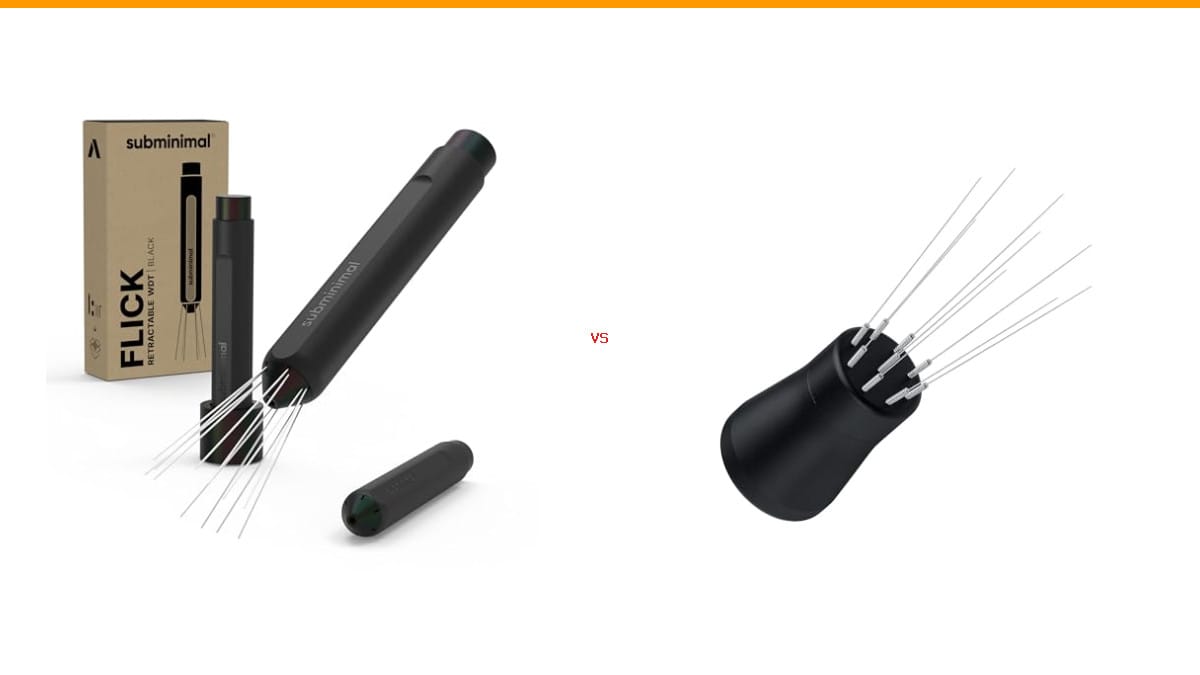
The Short Answer: Which Tool Wins?
After weeks of pulling shots with both, the Normcore V2 is the better buy for most home baristas. It’s cheaper, sturdier, and its fixed 9-prong head delivers consistent results every single time. The Subminimal Flick is clever and fun, but the retractable needle mechanism adds complexity without improving your espresso.
That said, the Flick wins if you have kids around or you’re clumsy with tiny tools. The retractable needles are a genuine safety feature. But for pure puck prep performance, Normcore takes the round.
This decision matters if you’re tired of channeling, uneven extractions, or sour shots. Both tools fix those problems, but they do it differently. Let’s break down the details.
What a WDT Tool Actually Does (And Why It Matters)
A WDT tool (Weiss Distribution Technique) breaks up clumps in your coffee grounds. When you grind coffee, static and the grinder’s burrs create clumps. These clumps cause channeling — water finds the path of least resistance through the puck, leaving parts of your shot under-extracted.
You stir the grounds with thin needles, usually in a circular and zigzag motion. This fluffs the coffee, breaks clumps, and creates a uniform bed. The result is a more even extraction and a sweeter, more balanced shot.
Both the Subminimal Flick and Normcore V2 are WDT tools. They do the same job, but their designs differ significantly.
What a Distributor Does (And Its Hidden Flaw)
People often confuse WDT tools with leveling distributors. A distributor (like a spinny tool with a flat base) only smooths the top 2-3mm of the puck. It doesn’t touch clumps deeper down.
Worse, spinning distributors can actually pack the top layer unevenly. The spinning motion compacts some areas more than others, which can create new channeling. That’s a hidden flaw many baristas discover after buying one.
So when someone asks about an espresso distribution tool vs WDT tool, they’re really comparing a surface-level fix with a full-depth solution.
The Core Difference: Depth vs. Surface
Here’s the key: WDT affects the entire puck depth. You’re stirring all the grounds, not just the top. A distributor only touches the surface. That’s a massive difference in practice.
Test both tools side by side. With the Normcore, I stirred the grounds thoroughly and the puck looked like a fluffy, even bed. With a distributor, the top looked smooth but the bottom still had clumps. The shots reflected that — the WDT shots were more consistent.
Why Surface Leveling Can’t Fix Internal Clumps
Think of it this way: if you have a lumpy cake batter, smoothing the top doesn’t fix the lumps inside. Same with coffee. Surface leveling makes the puck look neat, but water still hits the clumps and channels.
The Normcore’s 9 thin wires (0.3mm) reach deep into the basket. They break up clumps at every level. That’s why WDT is the gold standard for puck prep.
Why Spinning Distributors Can Create New Problems
Spinning distributors are popular because they’re fast. But they compress the top layer unevenly. The edges get more pressure than the center, or vice versa, depending on how you spin. This uneven compaction can actually cause channeling — the opposite of what you want.
I’ve seen it happen. A friend used a spinny distributor and his shots got worse. He switched to WDT and the difference was night and day.
The Grinder Test: Which Tool Do You Need?
Here’s the unique angle: your grinder quality determines which tool you need. If your grinder produces fluffy, clump-free grounds (like a high-end single-doser), you might not need WDT at all. A simple tap on the counter could be enough.
But if you have a grinder that produces clumpy grounds (common in cheaper or older models), WDT is essential. The Normcore or Flick will fix your espresso more than any other upgrade.
I have a mid-range grinder that clumps a bit. The Normcore V2 made a noticeable difference. My shots went from occasionally sour to consistently sweet.
The Hybrid Workflow: Using Both Without Overworking the Puck
Some baristas use both a WDT tool and a distributor. The idea is to WDT first to break clumps, then use a distributor to level the top before tamping. This can work, but you don’t need to overdo it.
If you have a good WDT technique, you can skip the distributor entirely. Just stir, tap the portafilter to settle the grounds, and tamp. That’s my current routine with the Normcore.
If you insist on using both, do WDT first, then use the distributor gently — don’t spin it forcefully. The goal is to level, not compress.
The Buying Order: What to Buy First (And What to Skip)
If you’re on a budget, buy a WDT tool first. It’s the biggest improvement per dollar for most setups. The Normcore V2 is affordable and works great.
Skip the distributor unless you have a specific problem with surface leveling. Most home baristas don’t need it. Save your money for better beans or a grinder upgrade.
If you have a high-end grinder that already fluffs the grounds, you might not need either tool. Test your shots first. If they’re already consistent, don’t fix what isn’t broken.
Common Mistakes That Ruin Your Puck Prep
Even with a great WDT tool, you can mess up. Here are the mistakes I see most:
- Stirring too aggressively — you can create new clumps or aerate the grounds too much.
- Not stirring deep enough — you need to reach the bottom of the basket.
- Skipping the tap after WDT — you need to settle the grounds before tamping.
- Using a distributor on top of a poorly WDT’d puck — it masks the problem, doesn’t fix it.
Take your time. Puck prep is a 10-second step that makes a huge difference.
Subminimal Flick: The Retractable Contender
The Subminimal Flick is the more innovative tool. Its retractable needles are a real safety win. You click a button to deploy the needles, and they retract when you’re done. No exposed needles sitting on your counter.
It also comes with a magnetic base that sticks to your espresso machine or wall. That’s a nice touch for keeping your station tidy. The aluminum base is sturdy, and the tool feels premium in hand.
But the retractable mechanism adds moving parts. After a few weeks of use, I worried about the needles bending or the mechanism wearing out. The Flick includes replacement needles and an Allen key, which is good, but it’s still more to maintain than the Normcore’s simple fixed head.
In testing, the Flick’s needles are thin and effective. The one-click deployment is satisfying, almost like a fidget toy. But the fun factor doesn’t translate to better espresso. It’s just a WDT tool with extra steps.
Normcore V2: The Reliable Workhorse
The Normcore V2 is the opposite of the Flick. It’s simple, fixed, and built like a tank. The anodized aluminum handle feels solid in your hand. The 9 spring wires are thin (0.3mm) and stiff enough to break clumps without bending.
Cleaning is easy — just wipe the wires with a cloth. No retractable mechanism to worry about. The handle has a nice ergonomic shape that gives you a strong grip.
In testing, the Normcore was my daily driver. It’s not flashy, but it works every time. I can stir the grounds in a consistent pattern without thinking about it. The fixed needles mean no deployment step, so my workflow is faster.
The only downside is the exposed needles. You need to store it carefully. The Flick’s retractable design is safer in that regard. But for pure performance, the Normcore wins.
Side-by-Side Comparison
| Feature | Subminimal Flick | Normcore V2 |
|---|---|---|
| Needle Type | Retractable | Fixed 9-prong |
| Needle Thickness | Not specified | 0.3mm spring wires |
| Safety | Retractable needles | Exposed needles |
| Handle Material | Aluminum base | Anodized aluminum CNC |
| Storage | Magnetic base or stand | None included |
| Maintenance | Replacement needles + Allen key | Wipe clean |
| Workflow | One-click deploy | Instant use |
The Differences That Actually Change the Buying Decision
Round 1: Safety — The Flick wins. Retractable needles are a real advantage if you have kids or a cramped counter. The Normcore’s exposed wires are a hazard if left out.
Round 2: Durability — The Normcore wins. Fewer moving parts means fewer things to break. The Flick’s mechanism could wear out over time, and bent needles are a risk.
Round 3: Ease of Use — The Normcore wins. You pick it up and stir. No deployment step, no fumbling. The Flick is fun, but it’s an extra motion.
Round 4: Value — The Normcore wins. It’s simpler and likely cheaper. The Flick’s extra features don’t improve your espresso.
Recommendation by Buyer Situation
For most home baristas: Get the Normcore V2. It’s the practical choice that improves your shots without fuss.
For parents or clumsy folks: The Subminimal Flick is worth the extra cost for the safety feature. Retractable needles mean no accidental pokes.
For beginners: Start with the Normcore. It’s easier to learn the stirring technique without worrying about a mechanism.
For pros or high-volume use: The Normcore’s simplicity wins again. It’s faster and more reliable in a busy workflow.
The Bottom Line: Invest in the Tool That Fixes Your Weakest Link
Your grinder is the weakest link in most espresso setups. A WDT tool like the Normcore or Flick compensates for a clumpy grinder. If your grinder is already great, you might not need either.
Keep the Normcore on the counter and the Flick in a drawer. The Flick is a nice backup, but the Normcore is what I reach for every morning.
If you’re still deciding between an espresso distribution tool vs WDT tool, remember: WDT fixes the whole puck, not just the top. That’s why it wins.
For more on espresso machines, check our automatic vs semi-automatic guide. And if you’re troubleshooting, see our burnt espresso taste fix.
Frequently Asked Questions
Is a WDT tool the same as a distributor?
No. A WDT tool stirs the grounds to break clumps. A distributor only levels the top surface. They solve different problems.
Can I use a distributor instead of WDT?
You can, but you’ll miss out on breaking internal clumps. A distributor alone won’t fix channeling caused by clumps deeper in the puck.
Do I need both for a decent espresso shot?
No. A good WDT tool is enough for most setups. Adding a distributor is optional and can even hurt if you spin it too hard.
Final Verdict: Normcore V2 for the Win
The Normcore V2 is the better tool for most people. It’s simple, effective, and built to last. The Subminimal Flick is innovative and safer, but the extra features don’t justify the cost for most home baristas.
If you have a clumpy grinder, buy the Normcore. If you have kids, consider the Flick. Either way, you’re improving your espresso. That’s the point.
For more espresso tips, check our best automatic espresso machines under $1000 guide.
Products related to this article
Sponsored / affiliate links. As an Amazon Associate I earn from qualifying purchases. I may earn additional commission from eligible campaigns.
 Coffee Espresso Machine Handle Replacement Parts, Cafe Bracket Handle for Lidl Silvercrest CM4621 CM4218 KF5002 KF500S Barista (for 51mm Portafilter Basket - Not included)
 Linnkyfloa Coffee Espresso Maker Handle Replacement for Stovetop Moka Pot or Percolator, Black Plastic for Spare Part Compatible with Italian(9-12 Cup)
 Wrenmor Replacement Handle For Coffee Espresso Moka Stove Pot, Black Plastic Accessory Compatible With 1/3/6/9/12 Cup Sizes For Easy Installation And Long-Lasting Use(1 Cup)