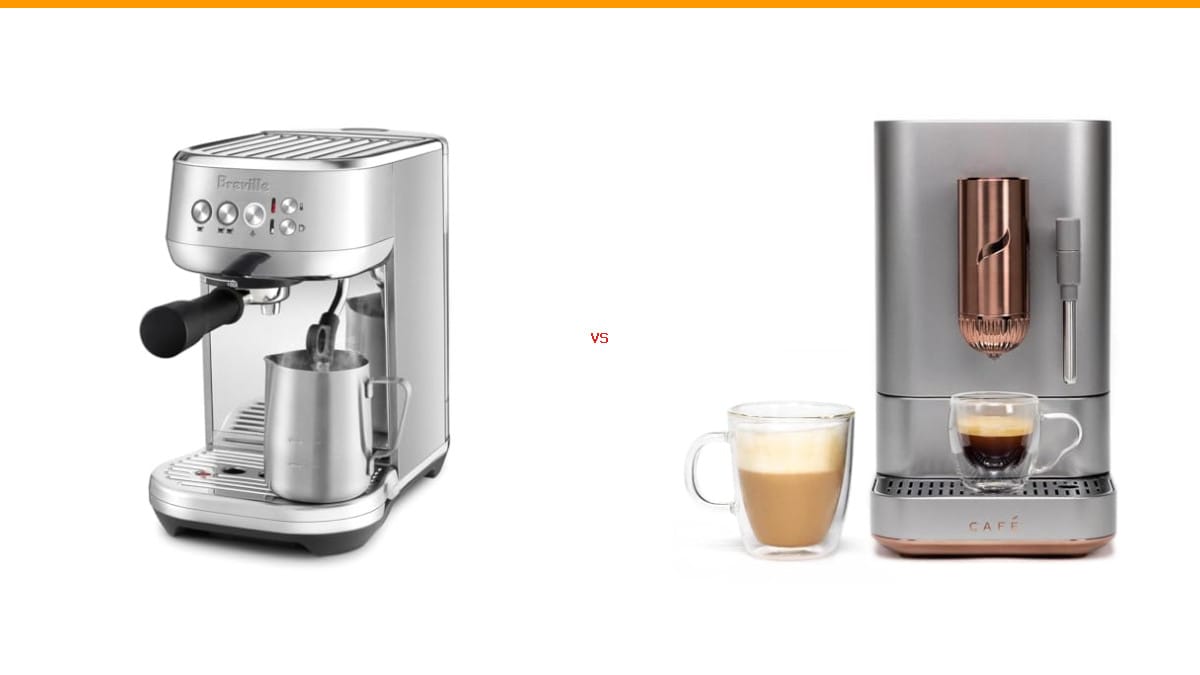
Most people shopping for a home espresso machine land on the same fork in the road: do I want to make the espresso myself, or do I want the machine to do it for me? The Breville Bambino Plus and the Café Affetto sit on opposite sides of that fork. One is a semi-automatic espresso machine that puts you in charge of every shot. The other is an automatic espresso machine that handles the grind, the dose, and the brew with a single button.
| Our Pick | Runner Up |

|

|
| Breville Breville BES500BSS Bambino Plus Espresso Machine, Brushed… | Café Café Affetto Automatic Espresso Machine + Milk… |
| See on Amazon | See on Amazon |
As an Amazon Associate I earn from qualifying purchases.
I’ve spent weeks with both machines on my counter. I pulled shots back to back, frothed milk for cappuccinos, and timed everything from warm-up to cleanup. The short version: the Bambino Plus rewards people who want to learn espresso. The Café Affetto rewards people who just want a decent cup without thinking about it. Neither is wrong, but one of them fits most homes better.
Let me walk you through what actually changes when you pick one over the other.
The Core Difference: Control vs. Convenience
This is not a spec sheet battle. The real difference is how much of the espresso-making process you want to own.
The Breville Bambino Plus is a semi-automatic espresso machine. You supply the grinder, you dose the portafilter, you tamp, you lock it in, and you start the shot. The machine controls water temperature with PID temperature control and does a low pressure pre-infusion, but everything else is on you. That sounds like a lot, but it’s also the reason you can eventually pull shots that taste better than most coffee shops.
The Café Affetto is an automatic espresso machine. It has a built-in conical burr grinder with 5 grind levels, a one-touch brew system that delivers Espresso, Americano, Lungo, or My Cup in under 90 seconds, and a steam wand that froths milk automatically. You press a button. It does the rest.
One machine is a tool. The other is an appliance. That’s the whole decision in one sentence.
What is a Semi-Automatic Espresso Machine? (The Barista’s Tool)
The Bambino Plus is Breville’s entry point into real espresso. It doesn’t have a grinder built in, so you’ll need a separate one. That’s a hassle for some people, but it’s also a blessing: you can upgrade the grinder later without replacing the machine.
The Workflow: Grind, Dose, Tamp, Pull
Here’s what my morning looked like with the Bambino Plus. I ground beans into the portafilter basket, tapped it to settle the grounds, tamped with firm pressure, locked the portafilter into the group head, and pressed the shot button. The whole process took about 45 seconds once I got the hang of it. The first week was slower. I pulled a few sour shots, a few bitter ones, and learned to adjust my grind size and dose to fix it.
The machine itself is forgiving. The PID temperature control keeps water at a consistent temperature, and the low pressure pre-infusion ramps up pressure gradually so the coffee bed saturates evenly. That means the machine handles the tricky parts of extraction. You handle the grind, dose, and tamp.
Pros and Cons of Going Semi-Auto
- Pros: Full control over shot quality, cheaper than most automatics, easier to repair, holds resale value, allows for upgrades like a better grinder or bottomless portafilter.
- Cons: Requires a separate grinder, has a learning curve measured in weeks, more steps per shot, easy to mess up if you rush.
The Bambino Plus also has an automatic steam wand for microfoam milk texturing. You can set the temperature and texture, and it steams milk hands-free. That’s a rare feature on a semi-auto at this level. It won’t give you the same tactile feel as a manual wand, but it produces consistent microfoam for latte art without burning the milk.
What is an Automatic Espresso Machine? (The One-Button Solution)
The Café Affetto is what happens when a coffee machine company decides to remove every possible obstacle between you and a finished drink. It’s a super-automatic espresso machine in everything but name, though Café markets it as automatic.
The Workflow: Press, Wait, Enjoy
My mornings with the Affetto went like this: fill the bean hopper, fill the water tank, press the Espresso button, wait 90 seconds, drink. That’s it. The built-in grinder doses the beans, the machine pre-infuses at low pressure, ramps up to 20 bars of rated pump pressure, and dispenses a shot. I didn’t touch a portafilter or a tamper once.
The My Cup setting is the standout feature. It defaults to a ristretto, but you can adjust the volume and strength through the SmartHQ app over Wi-Fi. I set mine to a slightly longer shot with a softer extraction. The app also gets software updates, which means the machine can improve over time.
Pros and Cons of Going Automatic
- Pros: One-touch convenience, built-in grinder, consistent results every time, Wi-Fi customization, fast clean-up, ideal for busy mornings.
- Cons: Less control over the final taste, harder to repair if something breaks, proprietary parts, lower resale value, the 20 bar pump is marketing noise (9 bars is the standard for espresso).
The steam wand on the Affetto rotates 90 degrees for easier positioning and comes with a stainless steel frothing pitcher with measurement markings. The built-in foam technology makes airy foam for cappuccinos or denser foam for latte macchiatos. It’s automatic, so you don’t control the texture directly, but you can choose the style.
Head-to-Head: Semi-Automatic vs. Automatic (Key Features Compared)
| Feature | Breville Bambino Plus (Semi-Auto) | Café Affetto (Automatic) |
|---|---|---|
| Built-in Grinder | No (requires separate grinder) | Yes (conical burr, 5 grind levels) |
| Brew Control | Full manual (dose, tamp, pull) | One-touch (Espresso, Americano, Lungo, My Cup) |
| Smart Features | None | Wi-Fi + SmartHQ app (volume, strength, updates) |
| Pump Pressure | Low pressure pre-infusion (standard 9 bar extraction) | Pre-infusion + 20 bar rated pump |
| Milk Frothing | Automatic wand (adjustable temp & texture) | Automatic wand (pre-set foam styles) |
| Warm-up Time | ~3 seconds (thermojet) | ~90 seconds total to brew |
| Repairability | User-serviceable parts | Proprietary parts, service required |
| Learning Curve | Weeks to master | Minutes to learn |
Ease of Use & Learning Curve
The Affetto wins this category by a mile. You can make a drinkable shot on day one. The Bambino Plus will frustrate you for the first few days. You’ll pull a bitter shot, then a sour one, then you’ll realize your tamp was uneven. Give it two weeks and you’ll be making shots that beat most cafes. Give the Affetto two weeks and you’ll still be making the same decent shot you made on day one.
That’s the trade-off. The Affetto has a flat learning curve and a low skill ceiling. The Bambino Plus has a steeper curve but a much higher ceiling. If you want to learn espresso, the semi-auto is the only choice. If you just want coffee, the automatic is the better fit.
Control Over the Shot (Taste & Texture)
This is where the Bambino Plus separates itself. With a semi-automatic espresso machine, you control grind size, dose, tamp pressure, and shot time. That means you can dial in a specific bean to bring out its sweetness, or adjust your recipe for a darker roast. The Affetto locks you into its preset recipes. You can adjust volume and strength in the app, but you can’t change the grind size mid-shot or alter the pre-infusion profile. The 20 bar pump sounds impressive, but espresso extracts best at 9 bars. That spec is marketing noise.
For taste, the Bambino Plus wins if you’re willing to put in the work. The Affetto wins if you want consistency without effort.
Milk Frothing & Latte Art Capabilities
Both machines have automatic steam wands, but they feel different in use. The Bambino Plus lets you set the milk temperature and texture level, which gives you more control over the microfoam. I found it produced silky, glossy milk that poured into latte art nicely.
The Affetto offers pre-set foam styles (airy for cappuccino, dense for latte macchiato) but not fine-tuned control. It’s fine for a home latte, but you won’t be pouring rosettas with it. The included frothing pitcher with measurement markings is a nice touch, though.
Maintenance, Cleaning, and Long-Term Costs
The Affetto requires more regular cleaning because of the built-in grinder. You’ll need to empty the grounds bin, wipe the brew unit, and descale regularly. If something breaks, you’re looking at a service call and proprietary parts. That can get expensive fast.
The Bambino Plus is simpler. No grinder to clean, just the portafilter, basket, and steam wand. Most issues are user-fixable, and parts are widely available. It also holds resale value better. A used Bambino Plus sells for a decent chunk of its original price. A used Affetto is a tough sell.
For long-term cost of ownership, the semi-auto is the smarter investment.
Which One Should You Buy? (A Decision Guide)
Choose the Breville Bambino Plus If You…
- Want to learn espresso and enjoy the process
- Already own a good grinder or plan to buy one
- Care about dialing in specific beans
- Want a machine that’s repairable and holds value
- Have 5 extra minutes in the morning for the ritual
Choose the Café Affetto If You…
- Want coffee with zero effort
- Don’t want to buy a separate grinder
- Appreciate app-based customization
- Have a busy morning and need speed
- Don’t plan on becoming a home barista
The Verdict: It’s About Your Morning Ritual
I’ll be direct. For most people, the Breville Bambino Plus is the better buy. It costs less than the Affetto, it makes better espresso once you learn it, and it won’t become a paperweight if a sensor fails. The learning curve is real, but it’s a skill you keep. The Affetto is convenient, but it’s a closed system. You can’t upgrade it, you can’t fix it easily, and the taste ceiling is lower.
That said, the Affetto is the right choice for someone who genuinely won’t use a manual machine. If you know you won’t tamp and grind every morning, buy the automatic. A decent one-touch shot beats a perfect shot that never happens.
My pick: the Bambino Plus. It’s the machine that grows with you. The Affetto is the machine you’ll outgrow.
If you’re still weighing options, check our automatic vs semi guide for a broader look, or see the best automatic machines under $1000 if you’re leaning that way. And if you already own one, read up on coffee machine maintenance to keep it running.
Frequently Asked Questions (FAQs)
Is a semi-automatic espresso machine harder to use than an automatic?
Yes, at first. The semi-auto requires you to grind, dose, tamp, and time the shot. It takes a few weeks to get consistent. An automatic does everything with one button, so it’s easy from day one. The trade-off is control. The semi-auto lets you fix a bad shot by adjusting your technique. The automatic doesn’t.
Do I need a separate grinder for the Breville Bambino Plus?
Yes. The Bambino Plus doesn’t have a built-in grinder. You’ll need a burr grinder, ideally one with fine adjustments. A good grinder makes a bigger difference to shot quality than the machine itself. Budget for that when comparing prices.
Can the Café Affetto make latte art?
It can make milk with enough texture for basic latte art, but you won’t have the same control as a manual steam wand. The pre-set foam styles get you close, but the Bambino Plus’s adjustable texture settings give you a better chance at microfoam.
Which machine is cheaper to maintain over time?
The Breville Bambino Plus. It has fewer parts to break, no grinder to service, and replacements are easy to find. The Café Affetto has a built-in grinder and proprietary components, so repairs often require a technician. That adds up fast.
Products related to this article
Sponsored / affiliate links. As an Amazon Associate I earn from qualifying purchases. I may earn additional commission from eligible campaigns.
 Coffee Espresso Machine Handle Replacement Parts, Cafe Bracket Handle for Lidl Silvercrest CM4621 CM4218 KF5002 KF500S Barista (for 51mm Portafilter Basket - Not included)
 Stainless Steel Moka Pot Pressed Powder Tool for 2 4 6 9 Cup Espresso Coffee Brewer(6 Cups)
 Coffee Mug Warmer & You are Awesome Mug Set, Electric Cup Warmer for Desk