You’re standing in the kitchen at 6:45 AM, half asleep, cranking a handle while your electric kettle boils. The thought crosses your mind: is this manual grinder actually saving me money on my electric bill, or am I just working harder for nothing?
It’s a fair question. Most articles tell you manual grinders use zero electricity and leave it at that. But that answer skips the interesting part: how much electricity does an electric grinder use by comparison, what that costs you per cup over a year, and whether the difference actually matters for your wallet or the planet. This article walks through the numbers with real wattage data, calculates the true cost per grind, and looks at a newer hybrid category that most people don’t know exists.

CEVING
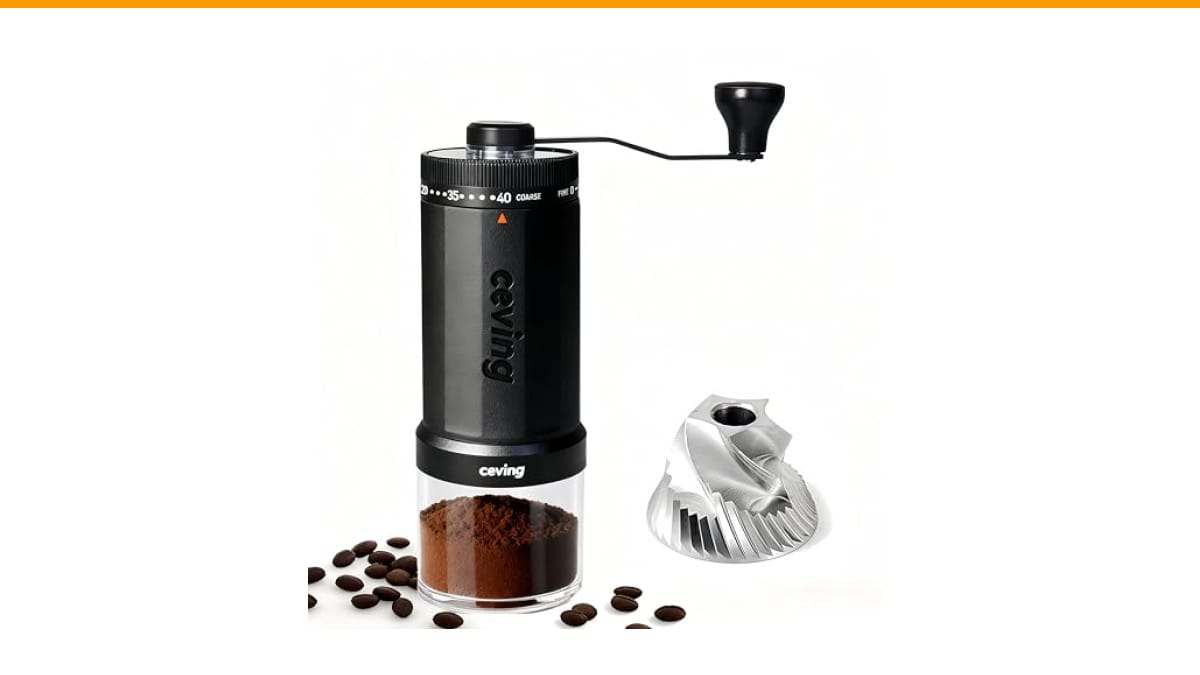
CEVING World's First 60g Large Capacity Manual…
- Tired of small batches? Meet the world's first manual grinder with a massive 60g capacity—Hold twice the beans of the standard gri…
- 40 EXTERNAL SETTINGS - DIAL IN PERFECT BREWS INSTANTLY. Our external click-ring delivers 40 precise settings—effortlessly switch f…
- MASTER-LEVEL PRECISION - LAB-ACCURATE GRINDS, BARISTA-APPROVED FLAVOR. Each click adjusts by just 0.05mm—the finest difference det…
As an Amazon Associate I earn from qualifying purchases.
You’ll walk away knowing exactly what your grinder costs to run, whether manual or electric, and where the real savings actually come from.
If you’re in the market for a manual grinder, the Check Price on Amazon solves the biggest complaint people have with hand grinders: capacity. Most manual grinders hold 20-30 grams of beans, which means two or three grinding sessions for a full French press. This one holds 60 grams, so you grind once and done. It also has 40 external settings and a stainless steel burr set, which makes it a practical daily driver rather than a camping novelty.
The Short Answer: Manual Grinders Use 0 kWh
Let’s get the headline out of the way. A manual coffee grinder uses zero electricity. No motor, no heating element, no digital display, no standby mode. The wattage rating is 0 W, the amperage is 0 A, and the kilowatt-hours consumed per year is 0 kWh.
That’s the entire electrical story. It’s not 0.001 kWh or “negligible” — it’s literally nothing. The grinder doesn’t plug into a wall, doesn’t have a battery, and doesn’t draw power when idle. Your electricity meter doesn’t even know it exists.
But that’s where most articles stop, and that’s where the useful information begins. Because the question isn’t really about electricity. It’s about total energy, effort, time, and cost. And those numbers tell a more interesting story.
Why “Zero Electricity” Isn’t the Whole Story (Human Energy vs. Electrical Energy)
Your arm does work when you grind coffee. That work comes from calories you burn, which come from food, which took energy to produce and transport. So a manual grinder doesn’t eliminate energy use — it shifts it from your wall outlet to your breakfast.
Here’s the practical comparison. Grinding 20 grams of medium-roast beans for a pour-over takes about 30-45 seconds with a decent manual grinder. Grinding the same amount with an electric burr grinder takes about 10-15 seconds. The manual grinder requires roughly 20-30 seconds of extra physical effort per cup.
For a light roast or very hard beans, that time stretches. I’ve spent a full 90 seconds grinding 18 grams of a dense Ethiopian natural with a hand grinder. It’s not exhausting, but it’s noticeable, especially first thing in the morning when your grip strength hasn’t woken up yet.
Human energy is cheap. Burning an extra 10-20 calories per cup costs fractions of a cent in food terms. But time is not free. If you value your morning at $20 per hour, an extra 30 seconds per cup costs about 17 cents in time. That’s more than the electricity cost of an electric grinder, which we’ll calculate next.
How Much Electricity Does an Electric Grinder Actually Use?
Electric grinders fall into two categories: blade grinders and burr grinders. Their power ratings differ significantly.
A typical blade grinder (the kind that looks like a mini food processor) has a motor rated between 150 and 200 watts. It runs for 10-20 seconds per batch, depending on how fine you’re grinding and how much coffee you’re making.
A typical electric burr grinder, like the popular Baratza Encore or a Breville Smart Grinder Pro, has a motor rated between 150 and 450 watts. The Encore draws about 70 watts while running, which is lower than its peak rating. The Breville draws around 165 watts during operation.
Here’s the key number: the wattage printed on the label is the maximum draw, not what it uses during normal grinding. Most electric grinders only hit peak wattage for a split second when starting up. During steady grinding, they draw 50-70% of the rated power.
Calculating Cost Per Grind (Wattage x Time)
Let’s do the math with real numbers. We’ll use the Baratza Encore as an example, since it’s the most common entry-level electric burr grinder.
The Encore draws about 70 watts during operation. Grinding 20 grams of medium roast takes about 15 seconds. That’s 70 watts x 0.0042 hours (15 seconds) = 0.29 watt-hours per grind. That’s 0.00029 kWh.
At the US average electricity rate of about 16 cents per kWh, one grind costs 0.00029 x 0.16 = 0.0000464 dollars. That’s less than one hundredth of a cent. Even if you grind four times per day, every single day for a year, your total electricity cost is about 7 cents.
Let me put that in perspective. A single coffee bean costs more than the electricity to grind it. The paper filter costs more. The water that passes through it costs more. The electricity to boil that water costs about 2-3 cents per kettle, which is 50 times more than the grinder uses.
A blade grinder uses more power but runs for a similar time. At 180 watts for 15 seconds, that’s 0.75 watt-hours per grind, or 0.00075 kWh. That works out to about 0.012 cents per grind, or roughly 18 cents per year at four grinds daily. Still nothing.
The Hidden Cost: Standby Power and Phantom Load
Here’s where the real difference appears. Most electric grinders don’t have a power switch. They’re plugged in 24/7, and they draw a small amount of power whenever they’re plugged in, even when not grinding.
This is called standby power, or phantom load. For a grinder with a digital display (like the Breville Smart Grinder Pro), standby draw is about 1-2 watts. For a simple grinder with no display, it’s closer to 0.5 watts.
Let’s calculate the annual cost of a 1-watt standby draw. 1 watt x 24 hours x 365 days = 8,760 watt-hours per year = 8.76 kWh. At 16 cents per kWh, that’s $1.40 per year.
That’s the real story. The standby power of an electric grinder costs about 20 times more than the actual grinding electricity. It’s still not a lot of money, but it’s not zero, and it’s avoidable if you unplug the grinder when you’re done.
If you want to eliminate that phantom load entirely, a manual grinder does exactly that. No plug, no standby, no draw.
Manual vs. Electric: The True Cost of Ownership Over 5 Years
Let’s build a complete 5-year cost model. We’ll compare a $150 electric burr grinder against a $60 manual grinder. These are realistic mid-range prices for decent equipment.
| Cost Factor | Electric Burr Grinder | Manual Grinder |
|---|---|---|
| Purchase price | $150 | $60 |
| Grinding electricity (5 years, 4 grinds/day) | ~$0.35 | $0.00 |
| Standby power (5 years, 1W average) | ~$7.00 | $0.00 |
| Replacement burrs (once in 5 years) | ~$35 | ~$0 (steel burrs last longer) |
| Total 5-year cost | ~$192.35 | ~$60.00 |
The electricity difference over 5 years is about $7.35. That’s it. The purchase price difference of $90 dwarfs the energy savings.
So if you’re switching to manual to save on your electric bill, you’re making a mistake. The energy savings are real but tiny. The real reasons to switch are grind quality (at a given price point, manual grinders often have better burrs than electrics), portability, noise, and counter space.
The real reasons to stick with electric are convenience, speed, and consistency when you’re making multiple cups or grinding for a crowd. A manual grinder is fine for one or two cups, but if you’re making a full French press for four people, you’ll be cranking for a while.
The Environmental Impact: Carbon Footprint of Your Morning Coffee
If the money savings are negligible, what about the planet? The carbon footprint of electricity varies by region. The US average is about 0.85 pounds of CO2 per kWh. In coal-heavy states like West Virginia, it’s over 2 pounds per kWh. In hydro-heavy states like Washington, it’s under 0.2 pounds.
Using the US average, an electric grinder’s annual grinding electricity (about 0.42 kWh per year for daily use) produces about 0.36 pounds of CO2. That’s less than the CO2 footprint of the coffee beans themselves, which is roughly 1-2 pounds per pound of roasted coffee.
The standby power is the bigger factor. At 8.76 kWh per year, that’s about 7.4 pounds of CO2 annually. Over 5 years, that’s 37 pounds of CO2 — roughly the same as burning 2 gallons of gasoline.
So yes, a manual grinder has a lower carbon footprint. But the difference is small compared to the footprint of the beans, the milk, the shipping, and the kettle. If you want to reduce your coffee’s environmental impact, buying beans from a local roaster or using less milk matters far more than switching grinders.
One more angle: manufacturing. A manual grinder has fewer parts, less metal, and no circuit board. It probably has a lower manufacturing footprint. But that’s hard to quantify without lifecycle assessment data, so I’ll just say it’s likely better and move on.
The New Hybrid: Battery-Powered and USB-C Manual Grinders
There’s a new category that blurs the line: manual grinders with a built-in electric motor, powered by a rechargeable battery or USB-C. These look like manual grinders but have a small motor that does the turning for you.
These hybrid grinders typically have a 200-400 mAh battery and a small DC motor rated at 5-10 watts. A full charge takes about 2 hours via USB-C and provides enough power for 10-20 grinding sessions, depending on bean hardness and grind size.
How much electricity does a USB-C grinder use per charge? A 400 mAh battery at 5V holds 2 watt-hours of energy. Charging it from empty takes about 2.5 watt-hours from the wall, accounting for charging inefficiency. That’s 0.0025 kWh per charge.
If you charge it twice per week, that’s 0.005 kWh per week, or 0.26 kWh per year. At 16 cents per kWh, that’s 4 cents per year. Even less than a plug-in electric grinder, and with zero standby draw when idle.
The catch: these hybrid grinders are relatively new, and quality varies wildly. Some have weak motors that stall on light roasts. Others have poor burr alignment. The category is promising, but I’d wait a generation or two before buying one as your primary grinder.
Frequently Asked Questions About Grinder Energy Use
Does a manual coffee grinder use any electricity at all?
No. A purely manual grinder has no electrical components. It uses 0 watts, 0 amps, and 0 kWh. The only energy input is your arm. Some hybrid models with USB-C motors do use electricity, but that’s a separate category.
How much does it cost to run an electric coffee grinder per use?
Roughly 0.005 to 0.02 cents per grind, depending on the grinder’s wattage and how long you run it. A 70-watt burr grinder running for 15 seconds costs about 0.005 cents. Even grinding 10 times per day, you’d spend less than a dollar per year on grinding electricity.
Is it worth switching from electric to manual to save money?
Not for the electricity. The annual savings are under $2, and often under $1. The real benefits of manual grinders are lower upfront cost, better grind quality at the same price point, zero noise, and portability. The real drawbacks are time, effort, and batch size limits. Choose based on those factors, not the electric bill.
Do electric grinders use power when turned off?
Most do, if they’re plugged in. Any grinder with a digital display, clock, or standby indicator draws power continuously. This phantom load is typically 0.5-2 watts, which costs $0.70-$2.80 per year. Unplug the grinder when not in use to eliminate this entirely.
What’s the most energy-efficient way to grind coffee?
A manual grinder, by definition, uses zero electricity. Among electric options, a simple on/off burr grinder with no display is most efficient, because it has no standby draw. Blade grinders use more power per grind but run for similar times, so the difference is small. The hybrid USB-C grinders are second only to manual in efficiency.
Bottom Line: Is Switching to Manual Worth It for Your Electricity Bill?
No. The electricity savings are real but trivially small — under $2 per year in almost every scenario. The standby power of an electric grinder is the only meaningful electrical cost, and you can eliminate that by unplugging it.
So why would you switch to manual? Because you want a better grind for less money. Because you’re tired of the noise. Because you travel and want fresh coffee on the trail. Because you don’t want another gadget on your counter. Those are all good reasons. Just don’t pretend it’s about the electricity.
And if you do switch, get one with a decent capacity. The CEVING 60g manual grinder handles a full French press in one batch, which removes the biggest practical complaint about hand grinding. It’s not perfect — no grinder is — but the 60-gram hopper and external adjustment ring make it a legitimate daily grinder, not a weekend novelty.
- Manual grinders use exactly 0 kWh. No standby, no phantom load, no electrical cost.
- Electric grinders cost about 0.005 cents per grind in electricity — less than a penny per year for most home users.
- The real electrical cost of an electric grinder is standby power: $1-$3 per year if left plugged in.
- Over 5 years, the total electricity difference between manual and electric is under $10. Purchase price matters far more.
- Carbon footprint difference is small, but manual grinders do win on manufacturing and energy inputs.
- USB-C hybrid grinders use about 4 cents of electricity per year — a middle ground worth watching.
- Choose a grinder based on grind quality, speed, noise, and capacity — not the electric bill.
For more on keeping your grinder in top shape, check our guide on cleaning coffee grinder. And if you’re still deciding between grinder types, our comparison of burr vs blade grinders covers the practical differences beyond energy use.
Products related to this article
Sponsored / affiliate links. As an Amazon Associate I earn from qualifying purchases. I may earn additional commission from eligible campaigns.
 VOBAGA Coffee Mug Warmer with 15oz Mug Set, Electric Coffee Cup Warmer
 SOLUSTRE Electric USB Coffee Cup Warmer with Temperature Settings Portable Milk and Beverage Heating Coaster for Office Desk Small Lightweight Design Easy to Clean Surface Multi Functional
 BESPORTBLE Coffee Cup Warmer USB Mug Warmer Heating Pad with 3 Temperature Settings Metal Cup Coaster for Office Desk Tea Milk Beverage Heating