French Press vs. Pour Over: The Brew-Off You Actually Need
You’ve narrowed your search to two iconic brewers: the Bodum Chambord French press and the Hario V60 pour over. Both make excellent coffee. Both have passionate fans. But they deliver radically different cups, and they demand different habits from you.
| Our Pick | Runner Up |

|

|
| Bodum Bodum 34oz Chambord French Press Coffee Maker,… | HARIO Hario V60 Plastic Coffee Dripper, Size 02,… |
| See on Amazon | See on Amazon |
As an Amazon Associate I earn from qualifying purchases.
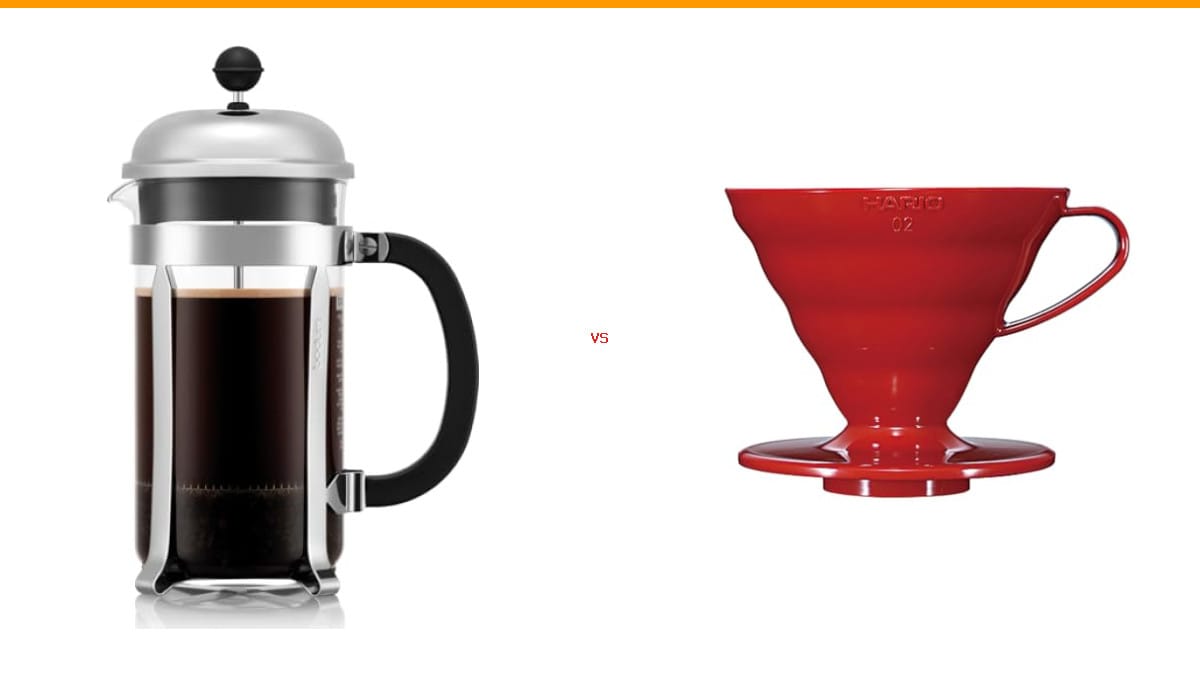
I’ve spent weeks testing both side by side, using the same beans, same water temperature, and same grind quality. The Bodum Chambord is a 34-ounce glass carafe with a polished stainless steel frame and a metal mesh plunger. The Hario V60 is a plastic cone with spiral ridges and a single large hole. They couldn’t be more different in design, and that difference shows up in every sip.
Here’s the short version: the French press gives you a heavy, oily, full-bodied cup that’s forgiving to brew. The pour over gives you a clean, bright, tea-like cup that rewards attention. Neither is objectively better — but one will fit your life better. Let’s break it down round by round.
At a Glance: The Quick Comparison Table
| Feature | Bodum Chambord French Press | Hario V60 Pour Over |
|---|---|---|
| Brewing method | Immersion (full submersion) | Drip (water passes through grounds once) |
| Filter type | Stainless steel mesh (reusable) | Paper filter (disposable, optional reusable) |
| Body and mouthfeel | Heavy, oily, thick | Light, clean, crisp |
| Acidity | Muted, rounder | Bright, pronounced |
| Brew time | 4 minutes (plus steeping) | 2.5–3 minutes (active) |
| Cleanup effort | Rinse carafe, dump grounds | Lift filter, rinse cone |
| Capacity | 34 oz (about 4–5 cups) | Size 02 (1–4 cups) |
| Grind size needed | Coarse (like sea salt) | Medium-fine (like table salt) |
| Skill required | Low — steep and plunge | Medium — pour control matters |
| Made in | Portugal | Japan |
This table sums up the core trade-offs. Now let’s get into the nitty-gritty of each brewer.
How They Work: Immersion vs. Drip Brewing
The Bodum Chambord uses immersion brewing. You add coarse coffee grounds, pour hot water over them, let everything sit together for four minutes, then press the plunger down. The metal mesh filter traps the grounds but lets fine particles and coffee oils pass through. That’s why the cup tastes rich and slightly gritty at the bottom.
The Hario V60 uses drip brewing. You place a paper filter in the cone, add medium-fine grounds, and pour water in a slow spiral. The water flows through the grounds once, extracting flavors as it goes, then drips into your cup or server below. The paper filter catches almost everything — oils, fine particles, even some flavor compounds.
The key difference is contact time. Immersion means the coffee sits in water the whole time, extracting more solubles. Drip means water passes through quickly, so extraction is more controlled. This single difference explains nearly every flavor and strength difference you’ll notice.
Flavor Face-Off: Body, Acidity, and Clarity
I brewed the same medium-roast Ethiopian beans in both. The French press cup was dark, syrupy, and heavy on the tongue. It tasted like chocolate and toasted nuts, with almost no sharpness. The pour over cup was lighter, brighter, and had a distinct citrus note that I hadn’t noticed in the French press. Both were good, but they tasted like different coffees.
Why French Press Tastes Richer
The metal mesh filter doesn’t trap coffee oils. Those oils carry flavor and contribute to a thick, velvety body. The French press also lets fine grounds slip through, which adds texture and a bit of sediment. If you like your coffee to feel like a meal, this is your brewer.
That richness has a downside. The same oils that taste great can go stale quickly, and the sediment at the bottom of your cup can be off-putting to some. I found that using a coarse grind helps reduce sludge, but it never fully disappears.
Why Pour Over Tastes Cleaner
The paper filter in the Hario V60 strips out oils and fine particles. The result is a crystal-clear cup with no sediment. Flavors become more distinct — you can pick out individual notes like berry, floral, or honey. The single large hole and spiral ridges let you control the flow rate, so you can adjust the strength and extraction to your taste.
The trade-off is that pour over can taste thin or weak if you don’t get the pour right. It also highlights any bitterness in the beans, because there’s no oil to mask it. You need decent technique to get a balanced cup.
The Practicalities: Time, Effort, and Cleanup
French press is more forgiving. You boil water, dump in grounds, wait four minutes, and plunge. No special pouring technique needed. Cleanup is simple: dump the grounds, rinse the carafe, and wipe the plunger. The glass carafe is dishwasher safe, but hand washing is gentler.
Pour over takes more active time. You need to heat water, wet the filter, add grounds, and pour in a controlled spiral for about three minutes. It’s not hard, but it requires focus. Cleanup is actually easier — you lift the paper filter out and toss it, then rinse the cone. No scrubbing.
For busy mornings, the French press wins because you can walk away during the steep. For a weekend ritual where you want to engage with the process, the pour over is more satisfying. I’ve burned my hand on the V60’s plastic cone more than once, though — it’s lightweight but not insulated.
Cost and Durability: Which is the Better Investment?
The Bodum Chambord is built from high-heat borosilicate glass and polished stainless steel. It feels sturdy, and the glass is thick. But glass can break if dropped, and the mesh filter can clog over time if you don’t clean it thoroughly. The Hario V60 is made of plastic, which is nearly indestructible. It’s also cheaper, though it looks less premium on your counter.
Ongoing costs differ too. The French press uses a reusable metal filter, so you only pay for coffee. The V60 requires paper filters, which you’ll buy regularly. You can get a reusable cloth or metal filter for the V60, but that changes the flavor profile and defeats the purpose of a clean cup.
Neither brewer will break the bank. The Bodum costs more upfront but has no recurring costs. The Hario is cheaper to start but has filter costs. Over a year, they roughly even out if you brew daily.
The Caffeine Question: Which Brews Stronger?
People often assume the French press has more caffeine because it tastes stronger. That’s not exactly true. Caffeine extraction depends on several factors: brew time, water temperature, and grind size. Immersion brewing does extract more caffeine per gram of coffee because the grounds are in contact with water longer. A typical French press cup has slightly more caffeine than a pour over cup, but the difference is small — maybe 10–20 milligrams per 8-ounce cup.
What you perceive as “strength” is often bitterness and body, not caffeine. The French press’s heavy body makes it feel stronger, but the V60 can actually produce a more caffeinated cup if you use a finer grind and a longer pour. If you’re sensitive to caffeine, both will give you a decent jolt. The real difference is in how the energy hits you — the French press’s oils slow absorption slightly, while the V60’s clean cup hits faster.
For most people, the choice shouldn’t hinge on caffeine. It should hinge on flavor preference and lifestyle.
How to Choose Based on Your Coffee Beans
Your bean choice should guide your brewer. Light roasts with fruity or floral notes — like Ethiopian Yirgacheffe or Kenyan AA — shine in the pour over. The paper filter lets those delicate aromatics come through clearly. Dark roasts with chocolate or nutty notes — like Sumatran or Brazilian — do better in the French press. The oils and body complement those deep, earthy flavors.
If you only drink one type of coffee, pick the brewer that matches it. If you switch between roasts, you might want both. I keep a French press for my morning dark roast and a V60 for afternoon light roasts. It’s not as expensive as you’d think, and it gives you the best of both worlds.
Grind size matters too. The French press needs a coarse grind — think sea salt. Too fine, and you’ll get sludge and bitterness. The V60 needs a medium-fine grind — like table salt. Too coarse, and the water will rush through, under-extracting and tasting sour. If you have a blade grinder, the French press is more forgiving because consistency matters less.
The Verdict: A Decision Matrix for Your Perfect Cup
Let’s score both brewers across five lifestyle factors. Give yourself a point for each statement that sounds like you.
- Busy mornings: French press (you can walk away) vs. pour over (you must watch it)
- Flavor clarity: Pour over (bright, complex) vs. French press (rich, bold)
- Cleanup speed: Pour over (toss filter) vs. French press (rinse carafe)
- Budget: French press (no filter costs) vs. pour over (cheaper upfront)
- Experience level: French press (beginner-friendly) vs. pour over (requires practice)
If you scored more points on the French press side, the Bodum Chambord is your brewer. It’s forgiving, produces a satisfying cup, and doesn’t demand technique. If you scored more on the pour over side, the Hario V60 is your brewer. It rewards attention and gives you a cleaner, more nuanced cup.
My honest recommendation? Most home users should start with the French press. It’s easier to get a good cup on day one, and it’s more forgiving of mistakes. The pour over is a better choice if you’re already into specialty coffee and want to explore flavor profiles. But if you have the counter space and the budget, owning both is the real answer.
I’ve written extensively about coffee maker maintenance and cleaning frequency, because both of these brewers need regular care to taste their best. The French press mesh filter especially can harbor old oils if you don’t clean it well.
Frequently Asked Questions
Can I use the same grind size for both?
No. The French press needs a coarse grind, about the size of sea salt. The V60 needs a medium-fine grind, like table salt. If you use a coarse grind in the V60, the water will rush through and under-extract, giving you a sour, weak cup. If you use a fine grind in the French press, you’ll get over-extraction and a bitter, sludgy mess. You’ll need to adjust your grinder when switching between methods.
Which method is better for a beginner?
The French press is far more beginner-friendly. You boil water, add grounds, wait four minutes, and plunge. There’s no pouring technique to learn, and the margin for error is wide. The V60 requires you to pour in a slow spiral, control the flow rate, and monitor the brew time. It’s not impossible, but it takes a few tries to get right. Start with the French press if you’re new to manual brewing.
How do I prevent bitterness in each method?
For the French press, use a coarse grind and don’t steep longer than four minutes. If it tastes bitter, your grind is too fine or your water is too hot — aim for 195–205°F. For the V60, use a medium-fine grind and pour in a steady spiral. If it tastes bitter, your grind is too fine or you’re pouring too slowly, which over-extracts. Also, make sure you’re using fresh, filtered water. Stale water can make any coffee taste off.
If you run into issues like a coffee maker that won’t brew, it’s usually a different problem entirely — but keeping your gear clean solves most taste problems.
Products related to this article
Sponsored / affiliate links. As an Amazon Associate I earn from qualifying purchases. I may earn additional commission from eligible campaigns.
 HomeBeyond Espresso Coffee Maker 12 Cups, Classic Stovetop Espresso Maker, 600ml / 20oz Coffeemaker for Gas & Ceramic Stovetops (Silver)
 Quick Heating Cup Warmer, Three Temperature Settings, Splashproof and Portable, for Coffee, Milk, Lightweight ABS Material
 Stainless Steel Moka Pot Pressed Powder Tool for 2 4 6 9 Cup Espresso Coffee Brewer(6 Cups)