You pull a shot first thing in the morning, and it takes twice as long as it did last week. The stream is thin, the crema is pale, and the coffee tastes slightly bitter. You check the machine — no obvious blockages. The culprit is almost always limescale building up inside the boiler and the brew head.
Hard water leaves mineral deposits that cling to the internal parts of any espresso machine. In a compact machine, the boiler is small, so even a thin layer of scale can mess with temperature stability and water flow. You don’t need to be a technician to fix this. Descale your machine every three to four months, and you’ll keep it running like the day you unboxed it.

Tillbrook
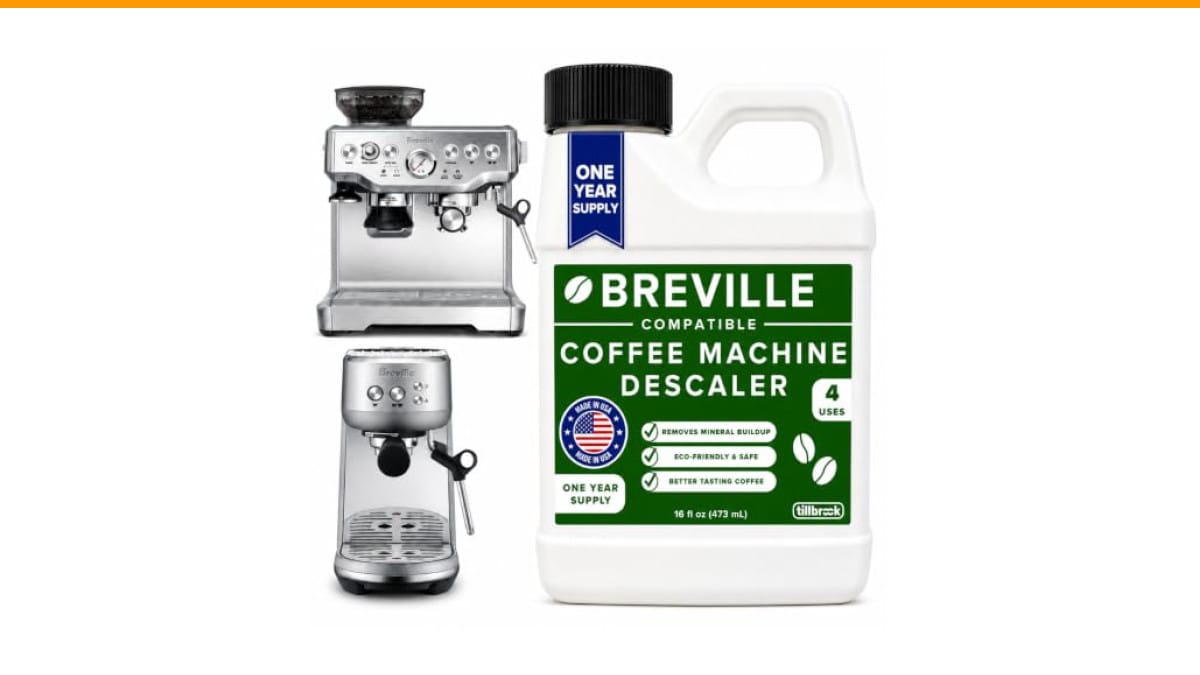
Breville Espresso Machine Compatible Descaler, 4 Uses,…
- EXCEPTIONAL RESULTS: Introducing Tillbrook Coffee Machine Descaler specifically formulated for Breville—the best choice for removi…
- 1 YEAR SUPPLY: Our concentrated formula is easy to use and provides remarkable value with 4 cleanings per bottle. Simply add 1/2 c…
- SCIENTIFICALLY ENGINEERED: Our advanced descaling solution is carefully crafted with powerful, all-natural ingredients that remove…
As an Amazon Associate I earn from qualifying purchases.
This guide walks you through the full process: what solution to use, how to run the cycle, and how to rinse so no residue ruins your next shot. You’ll also learn why some descaling methods are better than others for compact machines.
For most compact machines, a liquid descaler like the Tillbrook Coffee Machine Descaler does the job well. It’s a concentrated formula that gives you four cleanings per bottle, which works out to about a year of regular maintenance. The instructions are straightforward: mix half a cup of concentrate with water, run it through, then rinse twice.
What Actually Happens When You Skip Descaling
Scale acts like an insulator. It coats the heating element, so the machine has to work harder to reach the right temperature. That extra work shortens the life of the heating element and makes your shots taste inconsistent.
You’ll notice a few things before the machine gives up completely:
- Longer shot pull times — a 25-second shot starts taking 40 seconds
- Low water flow from the group head
- Loud gurgling or hissing sounds during brewing
- More steam than usual coming from the drip tray
None of these are fun to deal with. In my experience, a machine that’s never been descaled will eventually fail to reach brew pressure, and that’s a repair bill you don’t want. Regular descaling is cheaper than any service call.
Choosing the Right Descaler for a Compact Machine
Not all descalers are the same. Some are too aggressive for small aluminum boilers, and others are too weak to break down thick scale. Here’s what I look for:
- Liquid over powder — liquids dissolve completely and don’t leave clumps in the lines
- Food-safe acids — citric acid or lactic acid based formulas are gentle on parts and safe if a tiny amount lingers
- Compatibility — check the label for your brand. The Tillbrook formula is tested on Breville, Keurig, Nespresso, DeLonghi, and most other home machines, so it’s a safe pick
One thing to avoid: homemade vinegar solutions. Vinegar works, but it has a strong smell that lingers in the internal tubing for weeks. You’ll taste it in your coffee. A proper descaling solution doesn’t have that problem.
Step-by-Step Descaling Process for Compact Machines
Before you start, check your machine’s manual. Some manufacturers have specific steps for their models, but the general process is the same across most compact espresso machines.
Step 1: Prepare the Machine
Remove the portafilter, the water filter (if you use one), and any pod or capsule adapters. Take out the drip tray and give it a rinse. You want a clear path from the water tank to the group head.
Step 2: Mix the Descaler
Fill the water tank with the recommended amount of descaling solution. For the Tillbrook concentrate, that’s half a cup of solution, then fill the rest of the tank with fresh water. Do not use hot water — cold or room temperature water works best.
Step 3: Run the Descaling Cycle
Place a large container under the group head and the steam wand. Turn the machine on and run the descaling cycle if your machine has one. If it doesn’t, manually run water through the group head for about 30 seconds, pause for 15 minutes to let the solution soak, then run another 30 seconds.
Repeat this process until the water tank is empty. You’ll see scale particles coming out — that’s normal and means it’s working.
Step 4: Rinse, Rinse, Rinse
This is the step most people rush. Fill the tank with clean water and run the full cycle again. Then do it a second time. Residual descaler in the boiler will make your coffee taste flat and metallic. Two full rinse cycles are the minimum.
Step 5: Clean the Steam Wand
Descaling solution loosens milk residue inside the steam wand. Purge the wand into a container for a few seconds, then wipe the tip with a damp cloth. This clears both scale and old milk film.
If your machine is making unusual noises or leaking water, check our guide on loud noise fixes and leaking water solutions before you descale — sometimes those issues are mechanical, not scale related.
Descaling Methods Compared
| Method | Effectiveness | Time Required | Risk to Machine | Best For |
|---|---|---|---|---|
| Commercial liquid descaler | High — dissolves heavy buildup | 20–30 minutes | Low when used correctly | Most home machines |
| Citric acid powder | Medium — works on light scale | 30–45 minutes | Medium — can be harsh if over-concentrated | Budget option |
| White vinegar | Low to medium | 45–60 minutes | Medium — smell lingers, can corrode seals | Emergency use only |
| Descaling tablets | Medium — good for drip machines | 20 minutes | Low | Espresso machines with vertical boilers |
I’ve tested all four methods on compact machines. The liquid descaler wins for convenience and results. Tablets are fine for drip coffee makers, but they don’t always dissolve fully in the small water tanks of compact espresso machines. Vinegar is a last resort — it works, but you’ll be rinsing for days to get the smell out.
How Often Should You Descale a Compact Machine?
Every three to four months is the standard recommendation, but your water hardness changes that number. If you live in an area with hard water, you’ll need to descale closer to every two months. Soft water areas can stretch to four or five months.
You can buy water hardness test strips at most hardware stores. Dip one in your tap water and check the result. If you’re above 150 parts per million, consider using filtered water in your machine and descaling more frequently. A simple water filter in the tank reduces scale buildup significantly. Learn more about maintaining your machine for long life.
One honest caveat: descaling won’t fix a machine that’s already broken. If your pump is dead or the heating element has failed, descaling is too late. It’s a preventive measure, not a repair tool.
Common Mistakes People Make When Descaling
- Skipping the rinse cycle — the most common mistake. Residual descaler ruins the taste of your next few shots and can irritate your stomach if you drink enough.
- Using too much solution — more isn’t better. Over-concentrated descaler can damage rubber seals and plastic fittings.
- Descaling with the portafilter attached — the solution gets trapped in the basket and doesn’t reach the boiler properly.
- Forgetting the steam wand — milk residue mixes with scale and creates a sticky, foul-smelling paste inside the wand.
- Descaling a hot machine — always cool the machine down first. Hot water plus acid solution can flash-boil and spit out of the group head.
Frequently Asked Questions
Can I use vinegar to descale my compact espresso machine?
You can, but I’d rather you didn’t. Vinegar is acidic enough to break down scale, but it leaves a strong smell that takes multiple rinse cycles to remove. The smell gets into the rubber tubing and stays there for weeks. A commercial descaler costs about the same as a bottle of vinegar and works better without the aftertaste.
How long does the descaling process take?
Plan for 30 to 45 minutes from start to finish. The actual descaling cycle runs about 10 to 15 minutes, but you need two full rinse cycles after that. If your machine has a soak period built in, add another 10 minutes.
What happens if I don’t descale my espresso machine?
Scale builds up on the heating element and inside the boiler. The machine has to work harder to heat water, which wastes energy and shortens the lifespan of the heating element. Eventually, the boiler can clog completely, and the machine will stop brewing. That’s a $100 to $200 repair on a machine that costs $300 to $500 new.
Do I need to remove the water filter before descaling?
Yes. The water filter contains activated carbon that will absorb the descaling solution. That neutralizes the solution before it can clean the boiler, and it leaves the filter saturated with acid. Remove the filter, descale, rinse, then put a fresh filter in.
Can I descale a pod or capsule machine the same way?
Mostly, but you need to run the solution through the brew head without a pod in place. Use the largest cup setting to run the solution through. Check your machine’s manual first — some pod machines have a separate descaling mode that requires you to hold a button for a few seconds. Our guide to Nespresso not making a full cup covers a few common pod machine issues if you’re troubleshooting.
What to Do After Descaling
Once the rinse cycles are done, wipe down the outside of the machine and the drip tray. Run one shot of coffee and taste it. If it tastes clean and normal, you’re done. If you get a slight chemical taste, run one more rinse cycle with fresh water.
Set a reminder on your phone for three months from now. Consistency is what keeps a compact machine alive. A missed descale here and there won’t kill it, but a year of skipping will.
For deeper cleaning tips, including backflushing and group head maintenance, read our deep cleaning guide.
Here are the key points to remember:
- Descale every 3–4 months, or every 2 months with hard water
- Use a liquid descaler designed for espresso machines — the Tillbrook concentrate gives you 4 uses per bottle
- Always run two full rinse cycles after descaling
- Remove the water filter and portafilter before starting
- Never descale a hot machine
- Vinegar works in a pinch but leaves a lingering smell
- Descaling prevents breakdowns — it doesn’t fix them
Products related to this article
Sponsored / affiliate links. As an Amazon Associate I earn from qualifying purchases. I may earn additional commission from eligible campaigns.
 Coffee Espresso Machine Handle Replacement Parts, Cafe Bracket Handle for Lidl Silvercrest CM4621 CM4218 KF5002 KF500S Barista (for 51mm Portafilter Basket - Not included)
 Quick Heating Cup Warmer, Three Temperature Settings, Splashproof and Portable, for Coffee, Milk, Lightweight ABS Material
 SOLUSTRE Electric USB Coffee Cup Warmer with Temperature Settings Portable Milk and Beverage Heating Coaster for Office Desk Small Lightweight Design Easy to Clean Surface Multi Functional