For espresso, begin at a 1:2 ratio: 18 g of coffee in should yield about 36 g out. Then adjust for drink goal and roast. If you ignore ratio, you often get sour underextraction, bitter overextraction, or a shot with the wrong texture. This article shows how to calculate ratio, pick a starting point by roast and style, and read shot behavior so you can adjust dose and yield with purpose.
How is this calculated?
Press Calculate to see the math with your numbers.
What espresso ratio means



Espresso ratio is the dose-to-yield relationship, written as 1:x. It measures grams of dry coffee in and grams of liquid espresso out. A 1:2 shot means 18 g in and 36 g out, so the ratio is based on weight, not cup volume.
Why weight beats volume
Use a digital scale for both dose and yield. Shot glasses read volume, but crema, foam, and cup shape make volume less precise than grams. Weight gives you a repeatable number you can compare from shot to shot, basket to basket, and grinder setting to grinder setting.
Dose is the dry coffee input. For many home setups, a common range is 16 g to 22 g, and a common double-shot starting point is 18 g to 20 g. Yield is the liquid espresso output in grams. Useful examples are 27 g, 36 g, 45 g, and 54 g.
How do you calculate espresso ratio?

To calculate espresso ratio, divide the yield by the dose and write it as 1:x. If you dose 18 g and collect 45 g, the shot is 1:2.5. The math is simple, but the result tells you how concentrated the shot is.
The dose and yield formula
Formula: yield ÷ dose = ratio multiplier. Then write that as 1:x. For example, 36 ÷ 18 = 2, so the ratio is 1:2. This is why espresso ratio calculators are useful: they keep the focus on grams in and grams out, not on cup size or visual fill level.
- Weigh the dry dose in the basket.
- Pull the shot and stop at the target yield.
- Divide yield by dose to confirm the ratio.
- If the taste is off, change grind first and keep the dose fixed.
Example calculations
With 18 g in, 27 g out is a 1:1.5 ristretto. With 18 g in, 36 g out is a standard 1:2 normale. With 18 g in, 45 g out is 1:2.5. With 18 g in, 54 g out is 1:3, which is much longer and lighter.
A common first-timer mistake is changing the yield without noting the basket size. A basket that likes 18 g may not behave the same at 20 g or 22 g. The practical dose range changes with the basket, so treat the basket as part of the recipe, not a side note.
Standard espresso ratios
The standard double espresso uses a 1:2 ratio. The standard double example is 18 grams in and 36 grams out. That is the most common starting point for a balanced shot, and it gives you a clear baseline before you move shorter or longer.
Ristretto, normale, and lungo
A ristretto is listed at 1:1.5, so 18 g in gives 27 g out. A normale is listed at 1:2, so 18 g in gives 36 g out. A lungo is listed at 1:3, so 18 g in gives 54 g out. These are useful reference points, not fixed rules.
Ristretto usually tastes more intense because less liquid passes through the puck. Normale is often the best middle ground. Lungo stretches the shot and can taste lighter or more dilute, which can help in some milk drinks and can hurt in others if the coffee loses structure.
Which ratio should you start with?
Start with the drink goal and roast style, then choose a ratio that fits both. Light roasts often do better with a longer target than dark roasts, while milk drinks sometimes need a shot that stays strong after dilution. The right starting point is the one that gives you room to adjust taste without changing everything at once.
Light roast starting points
Light roasts often work well a little longer than 1:2. A balanced target can sit near 1:2.2 or 1:2.5, especially when the coffee tastes sharp at a short ratio. If the shot turns sour or thin, first slow the flow with a finer grind before changing dose or moving much longer.
Medium roast starting points
Medium roasts are usually the easiest place to begin at 1:2. One source places balanced medium-roast shots around 1:1.8 to 2.2, which gives room to move slightly shorter or longer. If the shot tastes weak, move a little longer. If it tastes heavy or bitter, shorten it or grind coarser.
Dark roast starting points
Dark roasts often need less extraction time and can feel harsh if pushed too long. A shorter start around 1:1.5 to 1:2 is common. If bitterness shows up fast, shorten the yield first, then make the grind coarser if the shot is also running slowly.
Espresso ratio chart
Use this table as a starting map, not a final rule. It links roast level, drink type, and taste goal to a starting ratio, dose range, target yield, and what to change first when the shot goes sour, bitter, weak, or too intense. Keep the dose fixed while you make the first correction.
| Roast level | Drink type | Taste goal | Starting ratio | Dose range | Target yield | Shot-time adjustment | What to change first |
|---|---|---|---|---|---|---|---|
| Light | Straight espresso | Clear, bright, not thin | 1:2.2 to 1:2.5 | 18 g to 20 g | 40 g to 50 g | If sour or fast, let it run a little longer after grinding finer | Sour: finer grind; Bitter: coarser grind; Weak: longer yield; Too intense: shorter yield |
| Light | Cortado | Strong enough for milk | 1:2 to 1:2.2 | 18 g to 20 g | 36 g to 44 g | Keep the shot in the normal window unless the cup tastes thin | Sour: finer grind; Bitter: shorter yield; Weak: finer grind before shortening milk; Too intense: longer yield |
| Medium | Standard double | Balanced and flexible | 1:2 | 18 g to 20 g | 36 g to 40 g | Stay near 25-30 seconds, then adjust taste with grind | Sour: finer grind; Bitter: coarser grind; Weak: longer yield; Too intense: shorter yield |
| Medium | Latte | Strong enough to cut through milk | 1:2 to 1:2.5 | 18 g to 22 g | 36 g to 55 g | Longer shots can work better if the milk volume is large | Sour: finer grind; Bitter: shorter yield; Weak: slightly longer yield; Too intense: shorter yield or coarser grind |
| Dark | Cappuccino | Bold through foam | 1:1.5 to 1:2 | 16 g to 20 g | 24 g to 40 g | Shorter extraction often helps keep bitterness in check | Sour: finer grind; Bitter: coarser grind; Weak: slightly longer yield; Too intense: shorter yield |
| Dark | Macchiato | Concentrated and sharp | 1:1.5 to 1:1.8 | 16 g to 18 g | 24 g to 32 g | Keep the shot short and watch for fast bitterness | Sour: finer grind; Bitter: shorter yield; Weak: longer yield; Too intense: coarser grind or shorter yield |
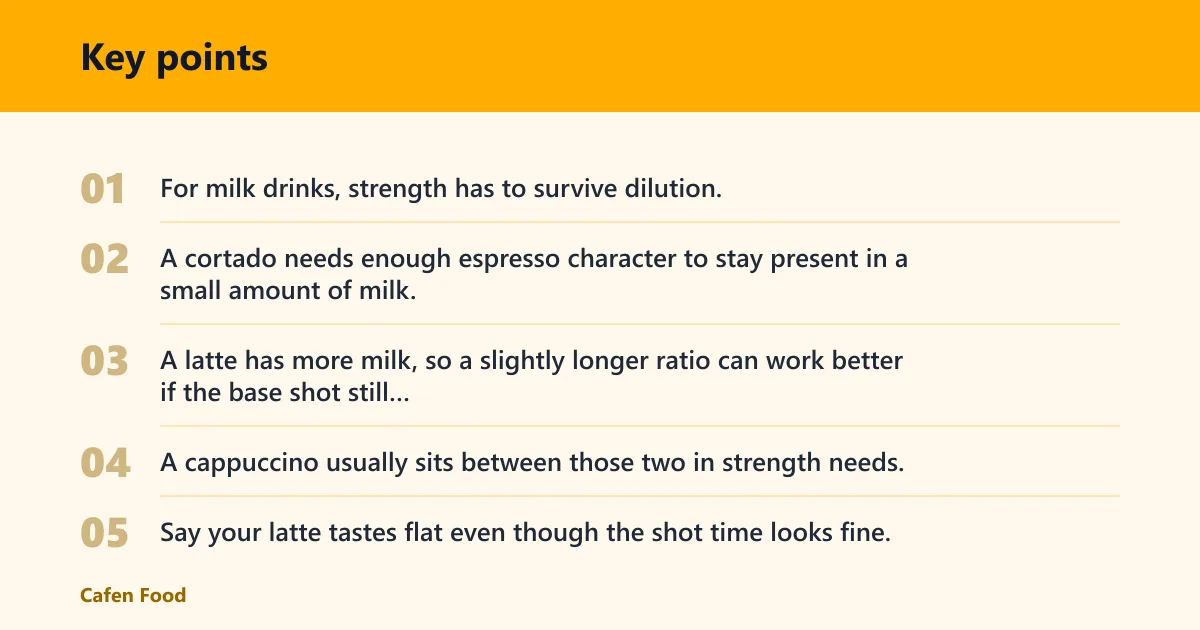
For milk drinks, strength has to survive dilution. A cortado needs enough espresso character to stay present in a small amount of milk. A latte has more milk, so a slightly longer ratio can work better if the base shot still tastes complete. A cappuccino usually sits between those two in strength needs, while a macchiato often relies on a concentrated shot and only a small amount of milk.
Say your latte tastes flat even though the shot time looks fine. If the ratio is too short, the espresso may be strong but not expressive enough once the milk goes in. In that case, moving from 1:2 to 1:2.2 or 1:2.5 can give the drink more clarity without making it watery.
How long should a shot take?
A common extraction window is 25-30 seconds. Use that window as a diagnostic, not as the only rule. Fast shots under 20 seconds often point to too much flow through the puck. Slow shots that take about 35 seconds or more often point to too much resistance, a grind that is too fine, or a shot that may turn bitter.
Fast shots under 20 seconds
If the shot races through too quickly and tastes sour, the grind is usually the first place to adjust. Go finer before changing dose or yield. A finer grind slows flow, raises extraction, and often brings more sweetness and body into the cup. Do not fix a fast shot by changing three things at once.
Slow shots over 35 seconds
If the shot crawls and tastes bitter or dry, go coarser first. A coarse adjustment lowers resistance and can pull the shot back into range. If the shot is still slow after that, then check dose and distribution. Keep one variable at a time so the next tasting tells you something useful.
Suppose an 18 g dose gives 18 g out in 18 seconds and tastes sharp. That is a fast, sour shot. The first change should be a finer grind, not a different basket, a different machine setting, and a different dose all at once. The next shot should stay near the same dose and target a longer yield.
How to adjust ratio without losing control
Change one variable at a time. If the shot is sour, start with grind finer. If it is bitter or slow, start with grind coarser. If the ratio is right but the drink is too weak, increase yield a little. If the espresso is too intense, shorten the yield a little before making broader changes.
- Pick a starting ratio based on roast and drink.
- Weigh the dose in grams.
- Target the yield in grams.
- Watch shot time, but use taste as the final check.
- Adjust grind first, then refine yield.
The point of an espresso ratio calculator is not to chase a single perfect number. It is to give you a repeatable starting point, then let taste, time, and grind point you toward the next shot. That is how 1:2 becomes a useful baseline instead of a rigid rule.
Frequently asked questions
What is espresso ratio?
Espresso ratio is the relationship between dry coffee dose and liquid espresso yield, written as 1:x. It is measured in grams, not milliliters. A 1:2 shot means 18 g of coffee in and 36 g of espresso out, which is the standard double starting point for many home setups.
How do I calculate espresso ratio from grams in and grams out?
Weigh the dose, weigh the yield, then divide yield by dose. If you start with 18 g and stop at 36 g, the ratio is 1:2. If you stop at 27 g, the ratio is 1:1.5. That simple calculation lets you compare shots without relying on cup volume.
What is the standard espresso ratio for a double shot?
The standard double espresso uses a 1:2 ratio. The standard example is 18 grams in and 36 grams out. It is a balanced starting point because it gives enough concentration for straight espresso while leaving room to move shorter for intensity or longer for clarity and milk drinks.
What ratio should I use for ristretto, normale, or lungo?
Use about 1:1.5 for ristretto, 1:2 for normale, and 1:2.5 to 1:3 for lungo. An 18 g dose yields 27 g for ristretto, 36 g for normale, and 54 g for lungo. Those targets help you choose a shot style before you start changing grind.
Should I measure espresso yield by grams or milliliters?
Measure yield by grams. A digital scale is more precise than a shot glass because crema and foam make volume readings less stable. Grams in and grams out give you a clear ratio, which makes dialing in much easier when you change baskets, beans, or brew goals.
How long should a 1:2 espresso shot take?
A 1:2 shot commonly lands in the 25-30 second window. Treat time as a diagnostic, not a final grade. If the shot is much faster, it may be sour and underextracted. If it is much slower, it may taste bitter or feel heavy, so grind changes should come first.
What if my espresso tastes sour or bitter at the wrong ratio?
If it tastes sour and the shot is fast, go finer first. If it tastes bitter and the shot is slow, go coarser first. Keep the dose fixed while you change grind, then adjust yield if needed. That sequence keeps the diagnosis clear and avoids masking the real problem.
Products related to this article
Sponsored / affiliate links. As an Amazon Associate I earn from qualifying purchases. I may earn additional commission from eligible campaigns.
 Coffee Espresso Machine Handle Replacement Parts, Cafe Bracket Handle for Lidl Silvercrest CM4621 CM4218 KF5002 KF500S Barista (for 51mm Portafilter Basket - Not included)
 HomeBeyond Espresso Coffee Maker 12 Cups, Classic Stovetop Espresso Maker, 600ml / 20oz Coffeemaker for Gas & Ceramic Stovetops (Silver)
 TECHTONGDA 4mm Meat Cutter Commercial Electric Slicer Shredded Diced for Steak Beef Pork Meat 5.7×3inch Feed Inlet QSJ-A