You’ve dialed in your grind size, you weigh your beans to the tenth of a gram, and your water temperature is locked at 93°C. Then you hit start on the espresso machine and just… guess. You watch the stream, count in your head, and stop the shot when it looks right. Maybe it’s 28 seconds, maybe it’s 35. You’re not sure, and the taste proves it — one day bright and fruity, the next day harsh and bitter.
That’s the exact gap a coffee scale with timer fills. It’s not about becoming a lab technician. It’s about giving your taste buds a reference point. This article breaks down what the timer actually does for your brew, where it genuinely helps, and when you’d be better off saving your money.

Styuanmmy
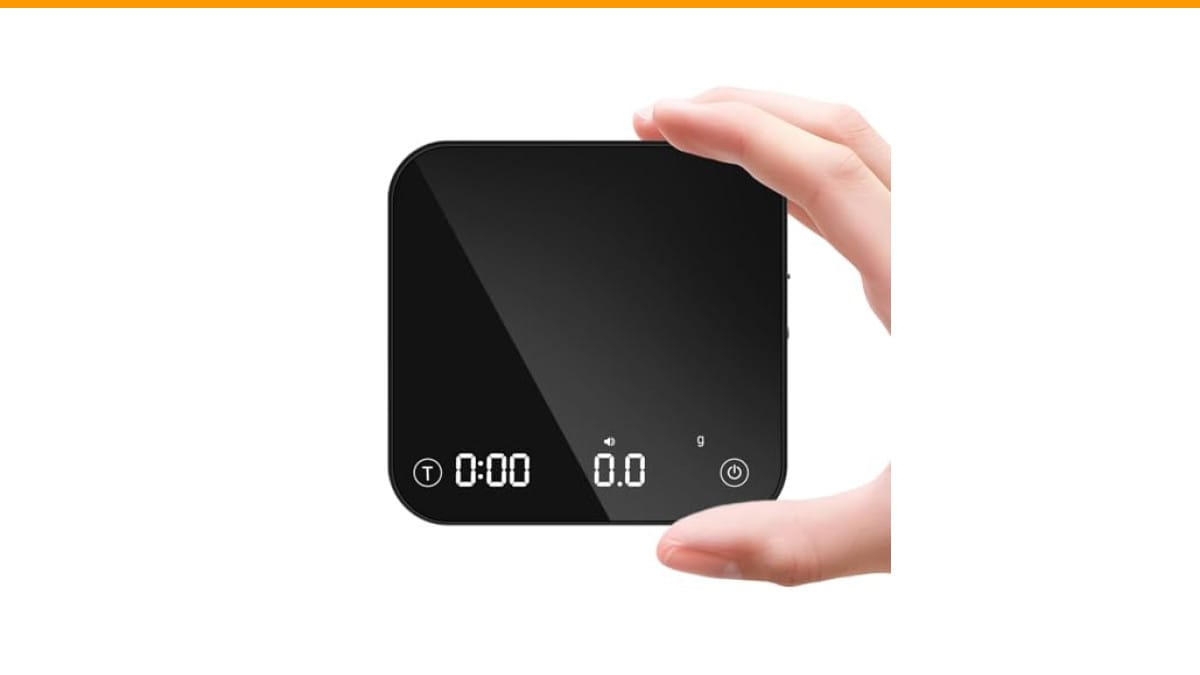
Mini Coffee Scale with Timer Automatic, 0.1g/2000g…
- Compact and Mini Design: This coffee scale is mini in size, measuring 4.11x4.11x0.79 inches. It can be placed directly in the palm…
- Precise Measurement: This kitchen espresso scale is equipped with a high-precision sensor, with a weighing range of 0.3 to 2000g a…
- LED Display Screen: The coffee scale with timer is made of a smooth glass platform and a hidden LED screen, which can be clearly r…
As an Amazon Associate I earn from qualifying purchases.
You’ll walk away knowing how to use time data to diagnose sour versus bitter shots, why the bloom timer matters for pour-over, and whether the auto-start feature is worth the hype. We’ll also cover immersion brews like French press and cold brew, because the timer isn’t just an espresso toy.
If you’re shopping for one, the Check Price on Amazon is a compact option we’ve used on a home espresso machine. It fits on the drip tray without blocking your cup, reads to 0.1g, and has three modes including an auto-start timer that kicks in when it senses water flow. It’s not the only option, but it’s a solid reference point for what these scales do.
The Real Difference Between a Timer and a Stopwatch
A stopwatch tells you how long something takes. A timer on a coffee scale tells you when to act. That sounds like the same thing, but it’s not.
With a stopwatch, you’re splitting your attention. You’re watching the clock, then the cup, then the flow, then back to the clock. Every glance costs you a second of observation. The timer on a scale sits right under your cup, so your eyes stay on the brew. You watch the liquid, and the time is just there in your peripheral vision.
The bigger difference is the auto-start function. On the Styuanmmy scale, you set the cup down, hit tare, and start the pump. The scale senses the water hitting the cup and starts the timer automatically. No fumbling for a button while holding a portafilter. That’s not a luxury — it’s removing a step that causes most people to skip timing altogether.
Think of it like driving a car with a speedometer in your line of sight versus one you have to look down at the floor to read. You’ll check the floor-mounted one less often, and you’ll drive less consistently because of it.
How Time Data Changes Your Coffee’s Flavor (Not Just Your Workflow)
Here’s where most articles miss the point. The timer doesn’t just make you more organized. It changes what you taste because it changes what you can fix.
Let’s say your espresso shot takes 22 seconds from pump start to stop. It tastes sour, sharp, almost like lemon juice. Without a timer, you might assume the beans are bad or the machine is broken. With a timer, you know the shot ran fast. Fast shots under-extract, pulling mostly the bright acids before the sugars dissolve. So you grind finer, which slows the flow, and suddenly the shot takes 30 seconds and tastes sweet and balanced.
That’s the diagnostic loop. The timer is a sensory translator — it converts what your tongue detects into a specific variable you can adjust.
Diagnosing Sour vs. Bitter Shots with Time
Here’s a quick matrix we use in testing:
| Shot Time (30g out) | Taste Profile | Likely Cause | Fix |
|---|---|---|---|
| Under 25 seconds | Sour, sharp, thin body | Under-extraction, flow too fast | Grind finer, increase dose |
| 25-35 seconds | Sweet, balanced, syrupy | Proper extraction range | Keep everything the same |
| Over 35 seconds | Bitter, dry, ashy aftertaste | Over-extraction, flow too slow | Grind coarser, decrease dose |
| Under 20 seconds with spritzing | Both sour and bitter | Channeling — water found a fast path | Distribute grounds evenly, check for clumps |
The last row is the sneaky one. Channeling happens when water carves a tunnel through the coffee puck. It over-extracts the path it takes and under-extracts everything else, so you get a confusing mix of sour and bitter. The timer shows you the shot finished way too fast, which points you to distribution problems — not grind size.
Without time data, you might chase the wrong variable for weeks. That’s the real cost of guessing.
The Pour-Over Bloom Timer: Why 30 Seconds Matters
For pour-over, the timer’s job is different. It’s not about total brew time — it’s about the bloom.
When you pour hot water over fresh coffee, it releases CO2. That gas pushes water away, which means the coffee doesn’t extract properly unless you let it degas first. The standard move is to pour about twice the coffee’s weight in water, then wait 30 seconds before the main pour.
Thirty seconds feels like an eternity when you’re standing there with a kettle. Without a timer, most people wait about 10 seconds and move on. The result is a flat, under-extracted cup because the water never really saturated the grounds. The scale timer keeps you honest. You start it when you start pouring, and it beeps or you glance at the display — no counting, no rushing.
Bloom times typically range from 15 to 45 seconds. The difference is real. At 15 seconds, the cup tastes hollow. At 30, it’s full and sweet. At 45, you’re wasting time but not ruining anything. The timer just makes sure you hit the floor.
The Auto-Start Feature: The Hidden Gem for Espresso
Manual timing works fine for a single daily espresso. But the auto-start timer on scales like the Styuanmmy changes the game for back-to-back shots.
Here’s the scenario. You’re making two lattes at 7 a.m. You pull the first shot, steam the milk, pour the latte. Then you pull the second shot. Your hands are busy. Your brain is already thinking about the milk. The scale senses the water flow and starts timing without you touching anything.
That’s the difference between timing every shot and timing only the ones you remember. Consistency in espresso comes from repetition, and repetition is only useful if you’re measuring each iteration. The auto-start removes the friction that makes people skip the measurement.
One caveat: auto-start only works if the scale is stable. If your espresso machine vibrates a lot, the scale might false-trigger. On a standard home machine, the Styuanmmy handles vibration fine, but it’s worth knowing before you buy.
When a Timer Scale Is a Waste of Money (Be Honest)
Not everyone needs this. If you drink drip coffee from a $30 machine and you’re happy with it, a 0.1g scale with a timer is overkill. The coffee-to-water ratio matters, but you can measure that with any cheap kitchen scale and a phone timer.
The timer scale earns its keep when you’re doing one of these:
- Pulling espresso shots and trying to dial in a new bag of beans
- Brewing pour-over and wanting repeatable results
- Making multiple drinks in one session and losing track of time
If you’re doing none of those, skip it. A basic scale plus your phone’s stopwatch gets you 80% of the way. The remaining 20% is convenience and precision — which is worth it for some, wasted on others.
The Styuanmmy model is under $30, which puts it in the impulse-buy range. But even at that price, it’s only a good purchase if you’ll actually use the timer function. A scale without a timer that costs $15 will weigh just as accurately.
How to Use the Timer for Immersion Brews (French Press & Cold Brew)
Most articles treat the timer as an espresso or pour-over tool. That’s shortsighted. Immersion brewing needs timing just as much, if not more.
For French press, the standard recipe is a 4-minute steep. But the clock starts when you pour the water, not when you put the lid on. If you spend 30 seconds pouring, your actual steep time is only 3:30. The scale timer lets you start it the moment water hits the grounds, so you get the full 4 minutes. A 5-minute steep at a slightly coarser grind gives a cleaner cup, but that’s a preference — the point is you need to know what your actual time is.
Cold brew is where the timer really shines. A 12-to-18-hour steep is a long time to track mentally. You start it at 8 p.m., and you need to remember to strain it by noon the next day. The timer on the scale counts up, but honestly, a phone alarm is better for this. The scale timer is more useful for the shorter steeps, like a 4-hour fast cold brew concentrate.
One useful trick: for immersion brews, set the scale to manual mode, start the timer when you start pouring, and leave it running while you clean up. When you come back to press or strain, you know exactly how long it steeped. That’s data you can use to adjust next time.
The Mental Load: Why a Timer Makes Mornings Easier
This is the benefit nobody talks about. A timer doesn’t just track time — it frees up your working memory.
In the morning, your brain is trying to remember your schedule, whether you fed the cat, and whether that email you sent yesterday was actually professional. Adding “count to 30 for the bloom” to that list is a recipe for failure. The scale does the counting. You just watch the water move.
This matters most on busy mornings. When you’re rushing, you’re more likely to skip the timer entirely and guess. That’s when your coffee gets worse, and you blame the beans or the machine. The scale removes the excuse. It’s right there, it’s automatic, and it takes zero mental effort.
That might sound like a small thing, but it’s the difference between a consistent daily cup and a rollercoaster of good and bad days.
How to Choose: A Simple Decision Tree
Before you buy, run through this:
- Do you brew espresso? If yes, get a timer scale. If no, go to step 2.
- Do you brew pour-over more than twice a week? If yes, get a timer scale. If no, go to step 3.
- Do you brew French press or cold brew? If yes, a timer helps but isn’t critical. A phone timer works. If no, skip it.
- Is your budget under $20? Get a basic scale and use your phone. If you can stretch to $30, the timer is worth it.
That’s the whole decision. It’s not about being a gear snob — it’s about matching the tool to your actual brewing habits.
If you’re already deep into espresso and your shots taste inconsistent, check your grind size and distribution first. A timer scale won’t fix a bad grinder. Once your grinder is solid, the scale becomes the next upgrade. And if you’re dealing with bitter or sour shots, read our guide on bitter coffee causes — that’s often a maintenance issue, not a timing one.
For pour-over, the bloom timer is the biggest immediate win. For espresso, it’s the auto-start. For immersion, it’s just knowing your real steep time. Pick the one that matches your routine.
Frequently Asked Questions
Can I just use my phone timer?
You can, and it works fine for a single brew. But it adds friction. You have to unlock your phone, open the timer app, start it, and then put the phone down where you can see it. That’s three extra steps. The scale timer is already where you’re looking. For espresso, the auto-start is the real advantage — your phone can’t sense water flow. For pour-over, a phone timer is acceptable, but you’ll find yourself checking it less often with a scale.
Does a timer make the coffee taste better automatically?
No. The timer only helps if you use the data to adjust your brew. It tells you the shot took 22 seconds, but you still have to grind finer and try again. The improvement comes from the iteration loop: time, taste, adjust, repeat. A timer accelerates that loop because it gives you a consistent reference point. It’s a tool for learning, not a magic wand.
What’s the ideal shot time for espresso?
For a standard 1:2 ratio (18g in, 36g out), most beans taste best between 25 and 35 seconds. But that’s a starting point, not a rule. Light roasts often taste better at 30-35 seconds, while dark roasts might peak at 25-28. The timer helps you find the sweet spot for your specific beans. Once you find it, you can replicate it every time.
Does the timer work for cold brew?
It works, but it’s not ideal. The Styuanmmy scale timer counts up in seconds and minutes, which is fine for a 4-hour fast cold brew. For a 16-hour overnight steep, you’re better off setting a phone alarm. The scale timer is most useful for the shorter immersion brews where you’re present and can watch the display.
Is 0.1g accuracy really necessary?
For espresso, yes. A 0.5g difference in your dose changes the extraction noticeably. For pour-over, 0.1g is more than enough — you’re measuring 15-30g of coffee, and 0.1g precision is overkill. The Styuanmmy scale reads to 0.1g up to 2000g, which covers everything from a single shot to a full French press. If you only brew pour-over, a 1g scale is fine, but 0.1g gives you room to grow into espresso.
What You Should Do With This
- If you pull espresso, the auto-start timer is the single best upgrade you can make after your grinder. It removes the excuse to skip timing.
- Use the time data to diagnose taste. Sour means fast, bitter means slow, both means channeling. Adjust one variable at a time.
- For pour-over, the 30-second bloom is non-negotiable. A timer scale makes it effortless.
- Don’t buy a timer scale for cold brew. Use a phone alarm for long steeps.
- If your shots are inconsistent, check your grinder and distribution before blaming the scale. A timer won’t fix bad technique.
- Keep your equipment clean. Scale sensors and espresso machines both drift when clogged with old coffee oils. See our guide on descaling your machine if you notice flavor changes.
- Start with a basic recipe, time it, taste it, and adjust. The timer is a guide, not a judge. Your palate is the final authority.
The bottom line is simple. A coffee scale with timer doesn’t make your coffee taste better by itself. It makes your coffee taste better because it lets you repeat what worked and fix what didn’t. That’s the whole game. If that sounds like something you need, the Styuanmmy Mini Coffee Scale is a compact, affordable way to get there. If you’re happy with your current routine, keep your money. Coffee is about enjoyment, not equipment. Just make sure you’re actually enjoying it.
And if you’re ever unsure whether your grinder is holding you back, read our comparison of burr and blade grinders. That’s often the real culprit behind inconsistent shots.
Products related to this article
Sponsored / affiliate links. As an Amazon Associate I earn from qualifying purchases. I may earn additional commission from eligible campaigns.
 PrintSupremacy Beechwood Personalized Kitchen Utensils, Non Stick Wooden Kitchen Gadget Pan Cookware, Cook Gift Set for Holidays, Engraved Kitchen Stuff (Plain, 1 pc - Slotted Spatula)
 PrintSupremacy Beechwood Personalized Kitchen Utensils, Non Stick Wooden Kitchen Gadget Pan Cookware, Cook Gift Set for Holidays, Engraved Kitchen Stuff (Plain, 3 pcs)
 Coffee Espresso Machine Handle Replacement Parts, Cafe Bracket Handle for Lidl Silvercrest CM4621 CM4218 KF5002 KF500S Barista (for 51mm Portafilter Basket - Not included)