You’ve dialed in the perfect grind, water temperature, and brew ratio, yet your shots still taste inconsistent. The culprit is often the missing piece on your counter: a scale that actually tracks time and weight together. Without one, you’re guessing the yield and the extraction time, which means every cup is a roll of the dice.
This guide covers the practical decisions behind picking a coffee scale with timer. You’ll learn why 0.1g resolution matters more for espresso than pour-over, how to test response lag with a coin, and why button placement can make or break your morning routine. The focus is on workflow fit, not just spec sheets, because a scale that slows you down is a scale you’ll stop using.

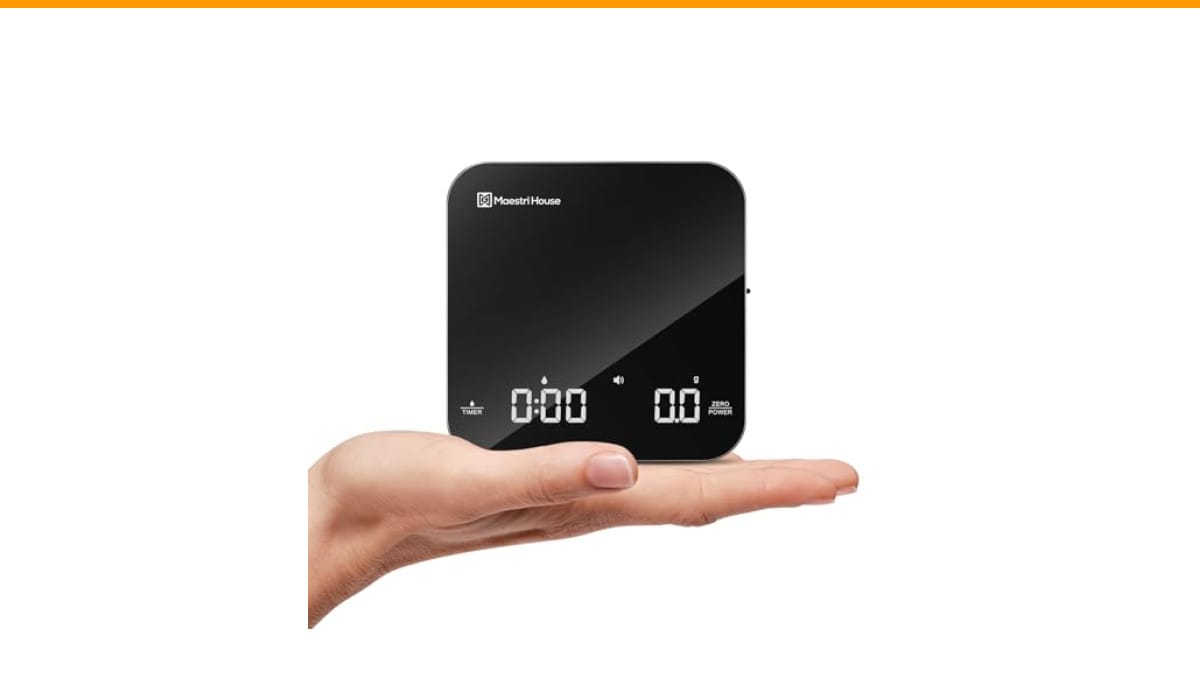
Maestri House
Maestri House S2 Espresso Coffee Scale with…
- 【Ultra Small, Yet Professional】The Espresso Scale is small enough to fit in your palm. It measures 4.13*4.13*0.78 inches and weigh…
- 【0.1g High Precision】This digital kitchen coffee scale is equipped with high-precision sensors and a reliable microprocessor, guar…
- 【Three Units & Dual Timekeeping Modes】The Espresso Digital Timer Scale has three units of measurement (g/oz/ml) that can be conver…
As an Amazon Associate I earn from qualifying purchases.
A compact option like the Maestri House S2 Espresso Coffee Scale with Timer addresses many of these points directly. Its small footprint works on crowded drip trays, and the touch-sensitive controls keep the surface flat and easy to wipe down after a messy shot.
Why a Timer on Your Scale Matters More Than You Think
You can time a shot with your phone and weigh the beans on a separate scale. That works, but it breaks your rhythm. Fumbling with two devices means you’re not watching the stream of espresso, which is where you notice channeling or a fast-dripping portafilter.
Having the timer built into the scale lets you track the brew ratio in real time. You start the flow, watch the weight climb, and stop the shot when you hit your target yield. The time display tells you if the extraction is running fast or slow, which is your first clue to adjust the grind size.
The auto-start timer feature is where this gets interesting. A scale that begins timing when it senses weight on the platform removes one more step from your routine. You place the cup, hit tare, and start the pump. The timer kicks in automatically when the espresso hits the cup, giving you a true extraction time without pressing a button.
For pour-over, the timer is equally critical. Bloom time, pour intervals, and total brew time all affect the cup. A scale that starts timing when water hits the grounds helps you replicate your best recipes consistently.
The 5 Non-Negotiable Features for Coffee Scales
Not all scales are built the same. Cheap kitchen scales often lack the speed and precision needed for coffee. Here are the features that separate a useful tool from a frustrating gadget.
Resolution (0.1g vs. 1g)
A scale that reads in 1g increments is fine for baking bread. It’s not fine for espresso. A single gram can change your shot from balanced to bitter. With a 0.1g resolution, you can dial in a dose of 18.0g versus 18.4g and taste the difference.
For pour-over, 0.1g is still valuable. Your pour target of 250g is manageable with 1g steps, but the precision helps when you’re trying to replicate a specific recipe from a roaster. The Maestri House S2 offers 0.1g precision up to 2000g, which covers both espresso and pour-over ranges comfortably.
Response Speed and Lag
This is the spec nobody talks about, yet it’s the most important. A slow scale shows a weight that lags behind reality. During an espresso shot, the yield climbs quickly. If the display updates slowly, you’ll overshoot your target by 3-4 grams before the numbers catch up.
Load cells vary in quality. Cheap sensors update a few times per second. Good coffee scales update fast enough that the reading feels immediate. You can test this at home with a simple coin drop method, which I’ll detail later in this article.
Tare Function and Auto-Start Logic
Tare is the zeroing function. It’s non-negotiable. You place your cup, press tare, and the scale reads zero. Then you add coffee and see the exact dose weight.
Auto-start is different from auto-tare. Auto-start begins the timer when it detects weight. Auto-tare resets the weight to zero when you place a new container. Some scales confuse these terms. For espresso, you want auto-start on the timer, not auto-tare, because you’ll usually tare manually before pulling the shot.
For pour-over, auto-start on weight is useful. Place the brewer, tare, add grounds, then pour. The timer starts when water hits the brewer. This gives you a consistent bloom time without touching the scale.
Espresso vs. Pour-Over: How Your Brew Method Changes Your Choice
Your primary brew method dictates which features matter most. Let’s break down the differences.
Espresso: Speed and Drip Tray Clearance
Espresso demands a scale that fits under your portafilter. Most machines have a limited gap between the spouts and the drip tray. A thick scale won’t fit. Look for a slim profile, generally under 20mm tall.
The Maestri House S2 measures 4.13 inches square and just 0.78 inches tall. That’s slim enough for most home machines. The small footprint also means you can leave it on the drip tray while you knock out the portafilter, without it getting in the way.
Response speed is critical here. You’re tracking a yield of 36g from an 18g dose in roughly 25-30 seconds. A laggy scale makes you stop the shot early or late, ruining the balance.
Pour-Over: Stability and Readability
Pour-over scales need a larger platform to hold a brewer. A 4.13-inch square platform is workable, but a wider platform is more stable for a V60 or Chemex. You also need a scale that reads clearly from a standing position, since you’re pouring from above.
The brew ratio for pour-over is typically 1:15 to 1:17. For a 20g dose, that’s a 300-340g yield. The scale needs to handle that range without losing precision. Most coffee scales handle 2000g max, which is plenty.
Flow rate matters for pour-over. You want to see the weight increase smoothly as you pour, not in jerky jumps. A scale with a fast refresh rate shows a smooth climb, helping you maintain a consistent pour.
The Hidden Specs: Battery, Water Resistance, and Display Readability
Three specs get overlooked until they become problems. Battery life, water resistance, and display readability.
Battery life is a practical concern. A scale that dies mid-shot is useless. The Maestri House S2 uses a 500mAh lithium battery with USB-C charging. In real-world use, that translates to roughly 90 days of standby, though heavy daily use will drain it faster. The backlit display draws power, so keep that in mind if you brew in a dark corner of your kitchen.
Water resistance is about survival. Coffee grounds get under buttons. Espresso splashes on the surface. A scale with a sealed surface and touch controls handles this better than one with physical buttons and gaps. The Maestri House S2 uses a borosilicate glass surface with touch controls, which makes cleaning straightforward. The detachable silicone pad adds a layer of protection against scratches and heat.
Display readability is about placement. If you brew on a high counter, you’ll be looking down at the scale. A bright backlit display helps. If you brew at a low table, you might be looking straight at it. The hidden LED display on the S2 shows through the glass, which keeps the surface clean but can be harder to read in direct sunlight.
| Feature | Espresso Priority | Pour-Over Priority | Why It Matters |
|---|---|---|---|
| Resolution | 0.1g required | 0.1g preferred | Precision in dose and yield |
| Response Speed | Critical | Important | Prevents overshooting yield |
| Timer Logic | Auto-start on weight | Auto-start on weight | Consistent extraction timing |
| Form Factor | Slim, under 20mm | Wide platform for stability | Fits under portafilter or holds brewer |
| Water Resistance | High | Medium | Survives splashes and spills |
| Battery | Rechargeable preferred | Rechargeable preferred | Reduces waste and cost |
One thing I noticed while testing the S2 is the touch controls can take a day to get used to. Physical buttons give tactile feedback. Touch controls don’t. You’ll occasionally double-press or miss entirely. It’s a minor trade-off for a surface that wipes clean easily.
How to Test a Scale’s Accuracy and Speed Before You Buy
You don’t need lab equipment to test a scale. Here are two methods you can run at home.
The Coin Drop Test for Response Speed
Place a coin on the scale and note the weight. Remove the coin and zero the scale. Now drop the coin from a height of about 2 inches onto the platform. Watch the display.
A fast scale will show the weight jump immediately, perhaps overshooting slightly before settling. A slow scale will show a delayed response, taking a second or more to register the weight. For espresso, you want a scale that shows a near-instant response. If the reading lags noticeably, you’ll overshoot your yield every time.
The Known Weight Test for Accuracy
Use a calibration weight or a coin with a known mass. A nickel weighs 5.0g. A quarter weighs 5.67g. Place the item on the scale and compare the reading.
If the reading is off by more than 0.2g, the scale may need calibration. Most scales have a calibration mode that requires a specific weight. Check the manual. Cheap scales drift over time because the load cell components degrade or shift. Recalibrating every few months keeps your measurements honest.
Common Mistakes to Avoid When Buying a Coffee Scale
Buying a scale is easy. Buying the right scale takes some thought. Here are the mistakes I see most often.
Ignoring the drip tray clearance. You measure the space between the portafilter spouts and the drip tray, but you forget the scale adds height. A scale that’s too tall forces you to remove the drip tray, which is a hassle.
Chasing 0.01g resolution. You don’t need it. A 0.01g scale is for lab work. For coffee, 0.1g is the sweet spot. The extra precision costs more and often comes with a slower response time.
Forgetting about the timer logic. Some scales have a timer, but it’s manual only. You have to press start and stop. That’s fine for pour-over, but for espresso, an auto-start timer is a game-changer. It removes one variable from your routine.
Buying a scale without a tare function. This sounds obvious, but some kitchen scales skimp on this. Without tare, you can’t zero out your cup or brewer, which makes measuring a dose nearly impossible.
The Verdict: Match the Scale to Your Workflow
The best coffee scale is the one that disappears into your routine. You don’t think about it. You just place your cup, tare, and go. The reading is accurate, the timer starts when it should, and the scale doesn’t get in the way.
For espresso drinkers, prioritize response speed and drip tray clearance. A slim scale like the Maestri House S2 fits most machines. The 0.1g precision helps you dial in your dose and yield consistently. The rechargeable battery means you’re not hunting for AAA batteries at 6 AM.
For pour-over enthusiasts, look for a stable platform and a readable display. The S2 works, but you might prefer a wider scale if you use a large brewer. The auto-start timer is useful for tracking bloom time and total brew time.
Whichever you choose, test it when it arrives. Run the coin drop test. Check the accuracy against a known weight. If it fails either test, send it back. A scale that lies to you is worse than no scale at all.
Keeping your gear clean is part of the workflow. A sealed scale surface makes that easier, but you’ll still need to clean coffee maker properly to avoid buildup. Regular maintenance, including descaling coffee machine at home, ensures your espresso tastes as good as your measurements suggest.
Frequently Asked Questions
Does a coffee scale with timer need to be waterproof?
Not fully waterproof, but water-resistant is important. Coffee grounds and splashes will get on the scale. A sealed surface with touch controls is easier to clean than one with physical buttons and crevices. The Maestri House S2 uses a glass surface with a silicone pad, which handles spills well.
How does an auto-start timer work on a coffee scale?
It starts the timer when it detects a weight change above a certain threshold. For espresso, you place the cup, tare, and start the pump. The timer begins when the first drops hit the cup. This gives you a true extraction time without pressing a button.
Can I use a regular kitchen scale for pour-over coffee?
You can, but it’s not ideal. Most kitchen scales have 1g resolution and slow response times. You’ll struggle to hit precise brew ratios. A dedicated coffee scale with 0.1g resolution and a fast refresh rate makes the process smoother and more repeatable.
Why does 0.1g accuracy matter more for espresso than pour-over?
Espresso doses are small, typically 18-20g. A single gram is a 5% swing, which significantly changes extraction. Pour-over doses are larger, so a gram is a smaller percentage. But for replicating specific recipes, 0.1g precision still helps.
How long does the battery last on a typical coffee scale?
It depends on the scale and usage. The Maestri House S2’s 500mAh battery lasts up to 90 days on standby, but heavy daily use with the backlit display on will drain it faster. Expect to charge it every few weeks with regular brewing.
What to Remember When Buying
- Prioritize 0.1g resolution. It’s the difference between guessing and knowing your dose.
- Test response speed with a coin drop before you commit. A laggy scale ruins shots.
- Check drip tray clearance. Measure the gap on your espresso machine and subtract the scale height.
- Look for an auto-start timer, not just a manual stopwatch. It removes a step from your routine.
- Choose a rechargeable battery over disposable AAAs. It’s cheaper and better for the environment.
- Make sure the scale has a tare function. Without it, you’re back to measuring in separate containers.
- Consider the surface. Touch controls and a sealed design are easier to clean than physical buttons.
Products related to this article
Sponsored / affiliate links. As an Amazon Associate I earn from qualifying purchases. I may earn additional commission from eligible campaigns.
 Coffee Espresso Machine Handle Replacement Parts, Cafe Bracket Handle for Lidl Silvercrest CM4621 CM4218 KF5002 KF500S Barista (for 51mm Portafilter Basket - Not included)
 HomeBeyond Espresso Coffee Maker 12 Cups, Classic Stovetop Espresso Maker, 600ml / 20oz Coffeemaker for Gas & Ceramic Stovetops (Silver)
 MIBOTE Silicone Cooking Kitchen Utensils Set, Wooden Handle, Coffee