A kettle boil time calculator estimates time, energy, and cost from fill level and wattage; for a typical 2,000–3,000 W kettle, 250 ml often boils in about 1–2 minutes, while a full 1.7 L kettle can take 4–6 minutes. Heating extra water adds waiting time and uses more electricity than a smaller fill. This guide shows how fill level changes boil time, boiling temperature, power use, and cost, so you can choose the right amount.
How is this calculated?
Press Calculate to see the math with your numbers.
Kettle boil time calculator
This calculator estimates how long a kettle takes to boil from three inputs: water volume, kettle wattage, and starting water temperature. It also converts the heating load into Wh, kWh, and kilojoules, then turns that into a rough cost using your electricity rate.
The main decision point is fill level. A half kettle needs much less energy than a full one, so it heats faster and costs less. That matters more than most people expect, especially when you only need a mug or two.
What the calculator estimates
The core calculation starts with water’s specific heat capacity, which is 4.186 kJ/kg°C; 4,184 J/kg°C is the same value written another way. Water also behaves simply enough for quick estimates: 1 liter of water is about 1 kilogram, so volume is the same as mass for most kettle math.
From there, the calculator estimates the heat needed to raise the water from a starting temperature to the boiling point, then adjusts for kettle efficiency. Real electric kettles are commonly around 80% to 95% efficient, and 90% is a reasonable default for planning.
Why fill level matters
Boiling 0.25 L instead of 1.7 L does two things at once. It cuts the energy required and shortens the wait. That is why fill level should come before wattage on the decision sheet: the same kettle can feel fast or slow depending on how much water you put in.
Say your kettle is rated at 2,200 W and you only need one mug. Filling it to the top still makes it heat all that extra water, even though the extra volume does nothing for the drink.
How long does it take to boil a kettle?
The direct answer is that boil time depends on water volume, starting temperature, wattage, and efficiency. At a common 20°C start temperature and about 90% efficiency, a 1.5 L fill usually takes several minutes, while a 0.25 L fill is much quicker. Higher wattage shortens the wait.
How wattage changes boil time
Wattage is the heater’s power input. A 1,500 W kettle adds heat more slowly than a 2,200 W kettle, so the lower-power model generally needs more time for the same amount of water. That is why wattage matters, but it does not erase the effect of fill level.
Examples in the 800–2200 W range are common. At the same volume and starting temperature, 800 W will take longer than 1,500 W, and 2,200 W will be faster than both.
Why real times run longer than ideal estimates
Theoretical time assumes perfect transfer of electrical power into water heating. Real kettles lose some heat to the kettle body, the steam path, and the surrounding air. A tight lid or covered setup reduces those losses; an open container loses more heat and takes longer.
Other slowdowns matter too. Limescale buildup, low voltage, a weak plug connection, or an overfilled kettle can all stretch the real boil time beyond the estimate.
What temperature does a kettle boil at?
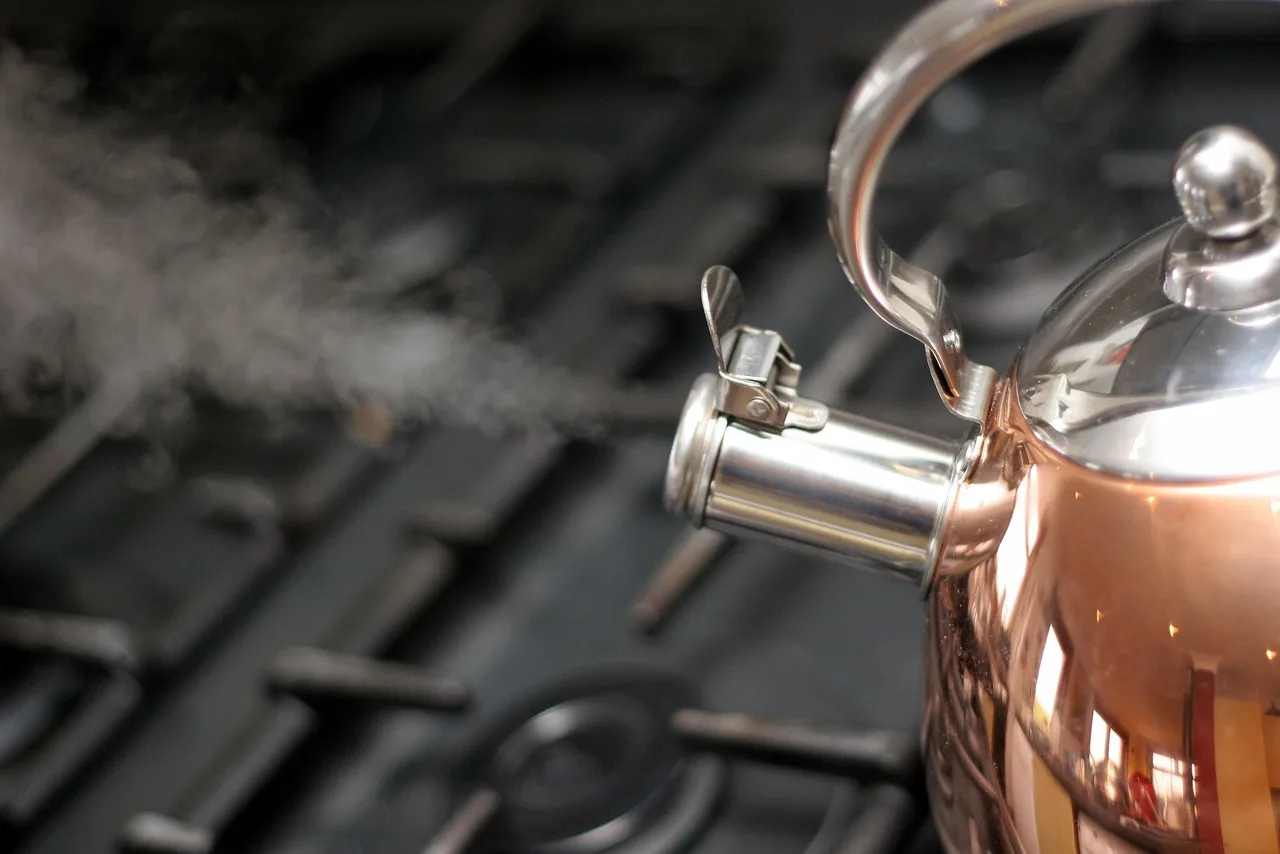
At sea level, water boils at 100°C / 212°F. That is the standard reference point used in most kettle calculations, but the actual boiling point drops as altitude rises. If you are above sea level, the kettle may finish heating at a lower temperature.
Sea level boiling point
At sea level, the boiling point is 100°C / 212°F. For plain boiling water, that is the endpoint most kettles are designed to reach. Once the water is there, extra heating does not make it hotter in normal use; it just makes more steam.
How altitude lowers the boiling point
Altitude changes the target temperature. Handy Chefdom lists 3,000 ft at 98.3°C / 209°F and 6,000 ft at 96.7°C / 206°F. A common rule of thumb puts about 2,500 ft near 95°C / 203°F and 5,000 ft near 90°C / 194°F.
That matters in practice. Tea, coffee, and instant meals often need hot water, not a full sea-level boil. At higher elevations, the kettle reaches boiling sooner because the target temperature is lower.
Tea and coffee temperatures versus a full boil
Some drinks do better below a full rolling boil. Green tea, for example, is often brewed with water below 100°C, while instant noodles and coffee usually use water close to boiling. If your goal is brewing rather than sterilizing, you may not need the kettle at its maximum fill or maximum endpoint.
Kettle boil time and cost table
This table compares the same 1,500 W kettle at a 20°C start temperature and about 90% efficiency. It shows the effect of fill level on estimated boil time, electricity used, and cost at three common electricity rates. The figures are rounded for easy comparison.
| Fill level | Water mass | Estimated boil time | Energy used | Cost at 15¢/kWh | Cost at 25¢/kWh | Cost at 35¢/kWh |
|---|---|---|---|---|---|---|
| 0.25 L | 0.25 kg | about 1.0 min | 0.0258 kWh | 0.39¢ | 0.65¢ | 0.90¢ |
| 0.5 L | 0.5 kg | about 2.1 min | 0.0516 kWh | 0.77¢ | 1.29¢ | 1.81¢ |
| 1.0 L | 1.0 kg | about 4.1 min | 0.1032 kWh | 1.55¢ | 2.58¢ | 3.61¢ |
| 1.5 L | 1.5 kg | about 6.2 min | 0.1548 kWh | 2.32¢ | 3.87¢ | 5.42¢ |
| 1.7 L full kettle | 1.7 kg | about 7.0 min | 0.1756 kWh | 2.63¢ | 4.39¢ | 6.14¢ |
The cost gap looks small for one boil, but it adds up across repeated use. A full kettle can use nearly seven times the energy of a 0.25 L fill. If you only need one cup, boiling the whole kettle is the expensive choice in both time and electricity.
Picture a 1.7 L kettle filled for a single mug. The water still needs the same rise in temperature across the whole tank, so the kettle draws energy for the full volume even though most of it sits unused.
How the calculation works
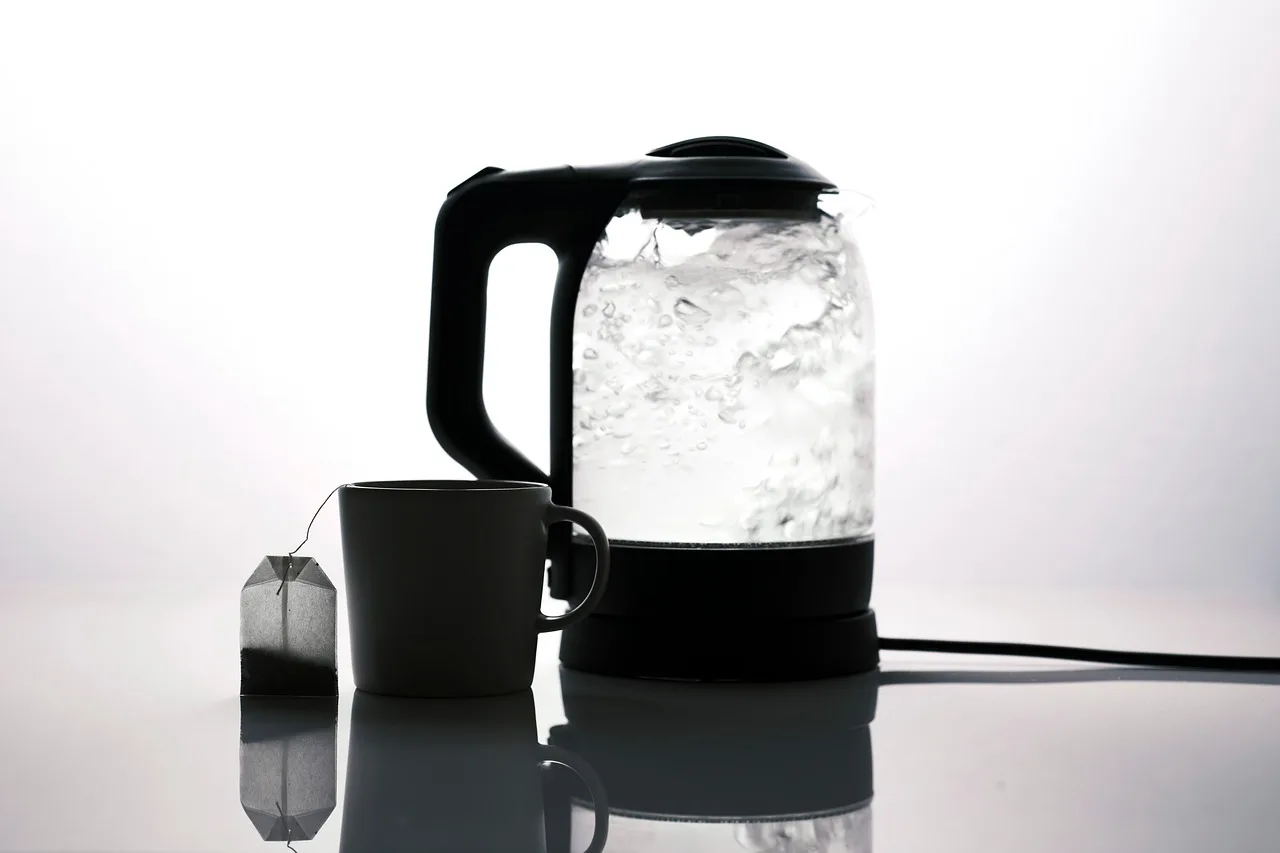
The calculation uses the heat needed to raise water temperature, then divides by kettle power and efficiency. In compact form: energy needed = mass × specific heat × temperature rise. For water, the specific heat is 4.186 kJ/kg°C, and the mass is close to the volume in liters.
Specific heat of water
Water needs about 4.186 kJ to raise 1 kilogram by 1°C. The same source states the same idea as 4 kilojoules per degree Celsius per kilogram, which is a rounded version of the same physics. That high heat capacity is why kettles need a noticeable burst of power to boil.
Heating efficiency and heat loss
Not all the electrical energy goes into the water. Some heats the kettle body, some escapes as steam, and some is lost to the room. Heron Tools gives around 90% efficiency as a reasonable estimate, while other references put modern electric kettles commonly in the 80% to 95% range.
Lid fit matters here. A tighter lid usually keeps more heat in the system, while an open top lets more steam and heat escape. The result is longer heating time and slightly higher energy use.
Turning energy into time and cost
To estimate time, divide the adjusted heat demand by kettle wattage. To estimate electricity use, convert the heat demand into Wh or kWh. To estimate cost, multiply the kWh by your electricity rate. That gives a better answer than a single generic boil-time number.
- Choose the water volume you actually need.
- Pick a starting temperature, usually 20°C / 68°F.
- Use the boiling point for your altitude.
- Apply the water heat formula and an efficiency allowance.
- Convert the result into time, Wh, kWh, and cost.
How much electricity does a kettle use?
A kettle uses electricity in proportion to the heat needed for the water, not the label wattage by itself. A half kettle uses about half the energy of a full kettle at the same start temperature. The result is easy to express in Wh, kWh, or kilojoules.
Wh, kWh, and kJ explained
Wh and kWh are electrical energy units. Kilojoules describe the heat demand more directly. For example, the table above shows that a full 1.7 L kettle at 20°C needs about 0.1756 kWh of electricity at 90% efficiency, which is about 632 kJ of input energy.
Typical use for a half kettle versus a full kettle
At the same wattage and starting temperature, 0.5 L uses roughly 0.0516 kWh, while 1.7 L uses about 0.1756 kWh. That is more than a threefold difference. If you regularly boil only the water you need, the savings are immediate and repeatable.
Why smart kettle keep-warm modes use extra energy
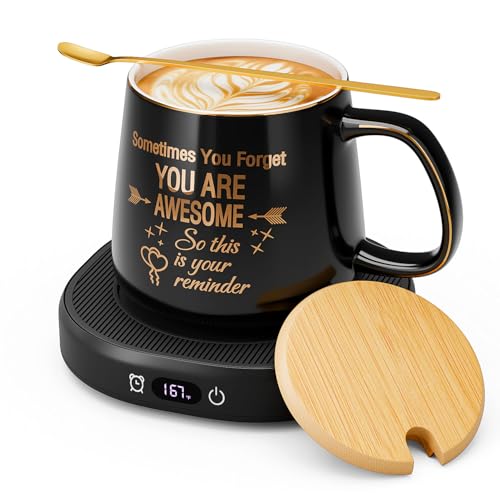
Keep-warm mode is separate from the boiling step. It holds already heated water near serving temperature, so it adds standby or reheating energy after the boil is done. That should not be mixed with the base boil calculation, because it changes the total electricity use in a different way.
What changes boil time in real kitchens?
Starting water temperature, limescale, lid fit, steam loss, voltage, and plug quality can all move the result away from the ideal calculation. Winter tap water is often colder, around 5–10°C, so it needs more heating than a 20°C assumption. A higher starting temperature shortens boil time.
Starting water temperature
The standard assumption is 20°C / 68°F. If your tap water starts colder, the kettle needs more energy to reach boiling. If it starts warmer, the kettle needs less. That is one reason the same kettle can feel faster in summer than in winter.
Limescale, lid fit, and steam loss
Limescale acts like insulation on the heater surface. It slows heat transfer into the water and can lengthen the boil. A badly fitted lid lets more steam escape, which raises losses and cuts efficiency. Open pots lose even more heat than covered ones.
Low voltage and weak plugs
Low voltage reduces delivered power, so the kettle heats more slowly. A weak plug, loose socket, or poor contact can do the same thing. If a kettle seems slow for its rating, electrical supply and connection quality are worth checking before blaming the formula.
Frequently asked questions
How much energy does it take to boil a full kettle?
A full 1.7 L kettle starting at 20°C and heated to sea-level boiling typically needs about 0.18 kWh of electricity at around 90% efficiency, or about 630 kJ of input energy. The exact figure changes with starting temperature, altitude, and kettle efficiency.
How much electricity does it use to boil a kettle?
Electricity use scales with water volume and temperature rise. A half-liter boil uses far less than a full kettle at the same settings. In the comparison above, 0.5 L uses about 0.0516 kWh, while 1.7 L uses about 0.1756 kWh.
How many kWh does it take to boil a kettle?
There is no single answer, because kWh depends on fill level, start temperature, and efficiency. A common estimate for a 1.7 L kettle from 20°C is about 0.1756 kWh at 90% efficiency. Smaller fills use less in direct proportion to the volume.
How much does it cost to boil a full kettle?
At 15¢, 25¢, and 35¢ per kWh, a full 1.7 L kettle in this example costs about 2.6¢, 4.4¢, and 6.1¢ per boil. The cost is small per use, but boiling more water than you need still wastes both money and time.
Products related to this article
Sponsored / affiliate links. As an Amazon Associate I earn from qualifying purchases. I may earn additional commission from eligible campaigns.