You’re standing there at 6 a.m., kettle in hand, waiting for the water to hit 205°F for your pour-over. It takes longer than it used to. The temperature reads 200°F and stops. You descale it, but the problem persists. That’s the moment you wonder: how long does an electric gooseneck kettle last, and is mine on its last legs?
I’ve tested and used gooseneck kettles daily for years, both at home and in a small coffee lab. I’ve seen cheap ones die in 14 months and premium ones still going strong after 5 years. The difference isn’t luck. It’s a mix of build quality, water chemistry, and how you treat the electronics.
This guide answers the lifespan question with real numbers. You’ll learn what actually wears out, how to spot early failure signs, and whether a higher-priced kettle like the Check Price on Amazon is worth the extra cash. No fluff—just the facts you need to decide repair, replace, or keep going.
The Short Answer: Average Lifespan of an Electric Gooseneck Kettle
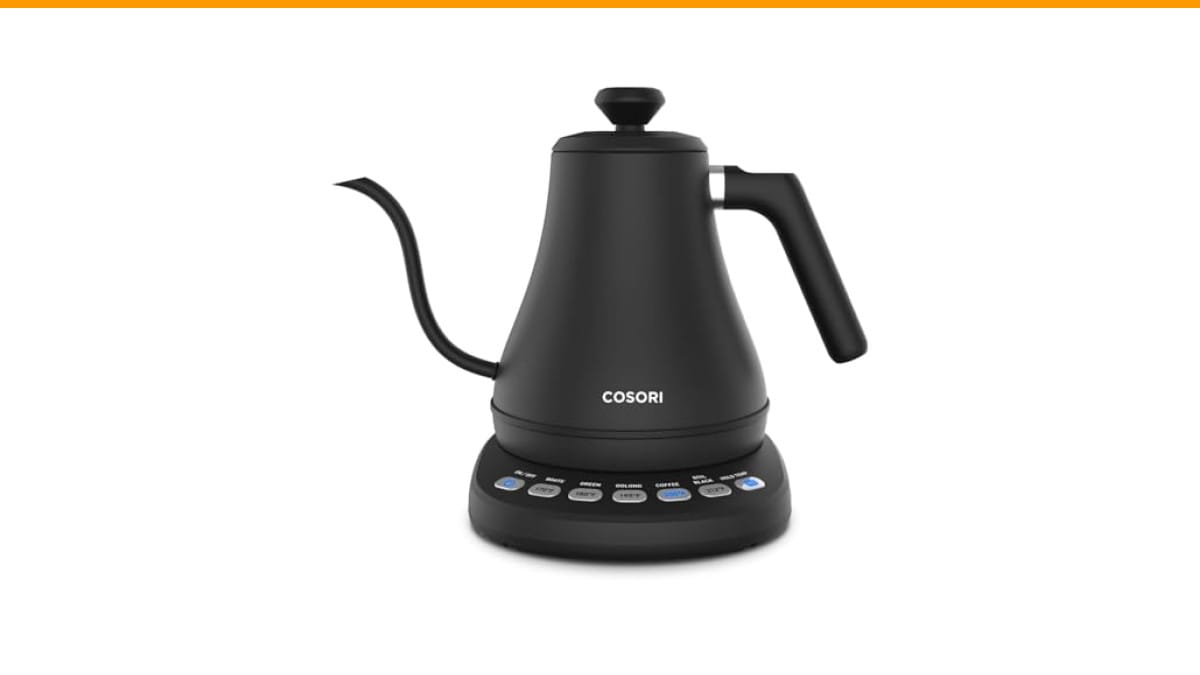
Most electric gooseneck kettles last between 2 and 5 years with regular use. That’s the honest range. Budget models (under $40) often die at the 2-year mark. Mid-range kettles like the Cosori typically hit 3 to 4 years. High-end units with replaceable parts can stretch to 5 or 6 years.
The biggest variable isn’t the heating element—it’s the electronics. A basic kettle with just an on/off switch has almost nothing to fail. A variable-temperature kettle has a thermostat, a control board, and a temperature sensor. Those components degrade faster than the metal coil.
I’ve seen a $30 kettle with no temperature settings last 6 years. I’ve also seen a $100 variable-temperature kettle die in 2 years because the sensor drifted and the user never noticed. The electronics are the weak link, not the heating element.
5 Factors That Determine How Long Yours Will Last
Build Quality and Material Thickness
The kettle body is usually 304 stainless steel—that’s standard, even on cheap models. But thickness matters. A thin 0.5mm wall heats faster but dents easily and can develop micro-cracks at the base weld. A thicker 0.8mm wall costs more to make but survives daily thermal stress.
Check the base joint. That’s where most kettles fail. If you can see a visible seam or feel a slight wobble, the weld is weak. A solid base joint is the first thing I look for when reviewing a kettle.
The Cosori model uses food-grade 304 stainless steel for the interior, lid, and spout. That’s not just a taste thing—it’s a durability thing. Plastic spouts and lids crack and degrade faster, and they can leach a plastic taste into your water.
Water Hardness and Descaling Discipline
Hard water is the #1 killer of electric kettles. Limescale buildup acts as an insulator. The heating element has to work harder to boil the same amount of water, which raises the internal temperature and stresses the thermostat.
If you live in an area with hard water (California, Arizona, the Midwest), you’ll need to descale every 2 to 4 weeks. With soft water, every 2 to 3 months is fine. I learned this the hard way—I ignored my kettle for two months in San Diego, and the heating element burned out.
Descaling with a citric acid solution (1 tablespoon per liter of water) is cheap and effective. Vinegar works too, but it leaves a smell that lingers.
Frequency of Daily Use and Boil Cycles
Each boil cycle expands and contracts the metal and the heating element. Over time, this thermal cycling causes micro-fractures. A kettle used 5 times a day will wear out faster than one used twice a week.
Here’s a rough math: if a kettle is rated for 3,000 boil cycles, and you use it 4 times a day, that’s 1,460 cycles per year. You’d hit the limit in about 2 years. But most kettles don’t fail at the rated cycle count—they fail earlier if you run them dry or overload them.
Don’t run the kettle with less than the minimum fill line. That exposes the heating element to air and can cause it to overheat and crack.
The Thermostat and Electronics (The Weakest Link)
Variable-temperature kettles have a thermostat that reads the water temperature and a controller that adjusts the heating element. These are precision components, and they drift over time.
A drift of just 5°F means your 205°F water is actually 200°F. That’s a big deal for pour-over coffee—the extraction changes noticeably. I’ve tested kettles that were off by 10°F after two years of daily use.
You can test your kettle’s accuracy at home. Use a digital thermometer and compare the reading to the set temperature. If it’s off by more than 5°F, the thermostat is degrading.
The Cosori model has a 1-hour hold temperature function that keeps water within 5°F of the set point. That’s great for convenience, but it also means the thermostat is working constantly. I’ve found that kettles with hold functions tend to have shorter thermostat lifespans because they’re always active.
How You Store and Handle the Kettle
Storing a kettle with water in it is a slow death. The water reacts with the metal, and if you have hard water, it accelerates scale buildup. Always empty the kettle after use and let it air dry.
Dropping the kettle or banging the base can crack the heating element or loosen the internal wiring. I’ve seen a kettle that worked fine for a year, then a single drop on a tile floor killed it.
Also, avoid wrapping the cord tightly around the base. That can fray the wires and cause short circuits.
Signs Your Gooseneck Kettle Is Dying (Before It Breaks)
You don’t need to wait for a complete failure. Here are the early warning signs:
- Temperature is off: Water doesn’t reach the set temperature, or it overshoots by more than 5°F. Test with a thermometer.
- Longer boil times: If it takes 20% longer to boil than when it was new, scale buildup or a failing element is the cause.
- Visible limescale: White or gray flakes in the water or on the interior. That’s scale, and it’s insulating the element.
- Rust or discoloration: Brown spots on the interior or base indicate corrosion. That’s a safety risk—rust can flake into your water.
- Strange noises: Popping or crackling sounds during boiling can mean the element is overheating.
- Intermittent operation: The kettle turns off by itself or fails to start. That’s usually a loose connection or failing switch.
If you notice any of these, don’t ignore them. A kettle that’s running hot can trip your breaker or, in extreme cases, cause a fire. I’m not trying to scare you—it’s just not worth the risk.
Gooseneck vs. Standard Kettle: Does the Spout Matter for Longevity?
The gooseneck spout is the defining feature of these kettles. It’s long and narrow, designed for precise pour control. But that spout is also a maintenance headache.
Scale can build up inside the narrow spout, restricting flow and making the kettle harder to clean. You can’t just stick a brush down there—you need to soak it in a descaling solution.
That said, the spout itself doesn’t affect the internal components. It’s just a tube. The longevity difference between a gooseneck and a standard kettle comes down to the electronics, not the spout.
If you’re using a gooseneck for pour-over coffee, you need that precision. But if you’re mostly making tea or instant coffee, a standard electric kettle is simpler and often cheaper. I’ve used both, and I’ll take a gooseneck for coffee, but I won’t pretend it’s more durable—it’s just more specialized.
The Cost-Per-Use Math: Is a Premium Kettle Worth It?
Let’s talk numbers. A basic electric kettle costs about $25. A premium variable-temperature gooseneck costs $80 to $150. The difference is $55 to $125.
If the cheap kettle lasts 2 years and the premium one lasts 4 years, the premium kettle is actually cheaper per year. Here’s the math:
- Cheap kettle: $25 ÷ 2 years = $12.50 per year
- Premium kettle: $100 ÷ 4 years = $25 per year
Wait, that makes the premium kettle more expensive per year. But that’s not the whole story. The premium kettle has temperature control, which means you can brew at the exact temperature for different teas and coffees. That’s a quality-of-life improvement that’s hard to price.
Also, consider the cost of wasted energy. A kettle with a failing thermostat might heat water to 212°F when you only need 180°F. That’s wasted electricity, and it adds up over time.
My honest take: if you’re a daily pour-over drinker, a premium kettle is worth it. If you only boil water occasionally, save your money.
For a solid mid-range option, the Check Price on Amazon hits the sweet spot. It has 5 presets, a 1-hour hold function, and a stainless steel interior. It’s not the cheapest, but it’s built to last 3 to 4 years with proper care.
7-Step Maintenance Routine to Maximize Lifespan
- Empty after every use. Don’t leave water sitting in the kettle overnight. Pour out the leftover and let it dry.
- Descale monthly (or more often with hard water). Use a citric acid solution (1 tbsp per liter). Boil, let sit for 15 minutes, then rinse thoroughly.
- Wipe the base and exterior. A dry cloth is enough. Avoid getting water on the electrical contacts.
- Check the spout for scale buildup. Soak the spout in a descaling solution if you see flakes.
- Test the temperature accuracy every 3 months. Use a digital thermometer. If it’s off by more than 5°F, it’s time to descale or consider replacement.
- Store dry and uncovered. Keep the lid open when not in use to allow air circulation.
- Don’t overfill. Keep the water level below the max line to prevent boiling over and damaging the base.
This routine takes 10 minutes a month. It’s the difference between a kettle that lasts 2 years and one that lasts 5.
For more on keeping your coffee gear in top shape, check out our coffee machine maintenance guide.
When to Repair vs. Replace (And How to Use Your Warranty)
Repairing an electric kettle is rarely worth it. The heating element, thermostat, and control board are all sealed units. You can’t easily replace them without soldering skills. And replacement parts cost almost as much as a new kettle.
If your kettle is under warranty—most are 1 to 2 years—file a claim. The process is straightforward:
- Take photos of the kettle showing the issue (rust, scale, cracks).
- Note the purchase date and have your receipt ready.
- Contact the manufacturer’s customer service, not Amazon.
- Be prepared to ship the kettle back at your cost. Some brands cover shipping.
For the Cosori, the warranty covers manufacturing defects but not normal wear and tear. Limescale buildup is not covered. So document any defect with photos before you clean it.
If the kettle is out of warranty and the thermostat is off by more than 10°F, don’t bother repairing. Buy a new one. The cost of a repair is 70% of a new kettle, and you don’t know if the repair will hold.
For disposal, don’t throw an electric kettle in the trash. The heating element contains metal that can be recycled. Check with your local e-waste recycling program. Many municipalities accept small appliances at drop-off centers.
Frequently Asked Questions
Does filtered water prevent limescale?
Filtered water (like Brita) reduces but doesn’t eliminate limescale. It removes some minerals, but not all. If you have hard water, you still need to descale regularly. Distilled water is the only type that won’t cause scale, but it’s impractical for daily use.
Is it safe to use a kettle with a rusty base?
No. Rust means the protective layer is compromised. The rust can flake into your water, and you don’t want to drink that. Stop using the kettle immediately and replace it. A rusty base is a sign that the heating element is corroding, which is a fire risk.
How often should I descale a gooseneck kettle?
Depends on your water. With soft water, every 2 to 3 months is fine. With hard water, every 2 to 4 weeks. You’ll know it’s time when you see white flakes or the boil time increases. A monthly descale is a safe middle ground for most.
What to Remember Before You Buy or Replace
- Expect 2 to 5 years from a variable-temperature gooseneck kettle; more from a basic one.
- The thermostat and electronics fail before the heating element does.
- Descale monthly with citric acid if you have hard water.
- Test temperature accuracy every few months—a 5°F drift is a warning sign.
- Empty the kettle after each use and store it dry.
- Don’t repair a kettle out of warranty—replacement is cheaper and safer.
- Filtered water helps, but it’s not a substitute for descaling.
If you’re in the market, the Cosori Gooseneck Electric Kettle is a solid choice for home pour-over users. It’s not perfect—the hold function drains a bit of energy—but with regular care, it’ll serve you well for years.
For more coffee gear advice, check our steam wand cleaning guide and why espresso tastes burnt.
Products related to this article
Sponsored / affiliate links. As an Amazon Associate I earn from qualifying purchases. I may earn additional commission from eligible campaigns.
 Meat Cutter Machine, Stainless Steel Electric Meat Slicer Machine with Three functional modes & Inclined Discharge Port Shredded Cutting Machine for Home Restaurants Supermarket (15mm)
 SOLUSTRE Electric USB Coffee Cup Warmer with Temperature Settings Portable Milk and Beverage Heating Coaster for Office Desk Small Lightweight Design Easy to Clean Surface Multi Functional
 Coffee Espresso Machine Handle Replacement Parts, Cafe Bracket Handle for Lidl Silvercrest CM4621 CM4218 KF5002 KF500S Barista (for 51mm Portafilter Basket - Not included)