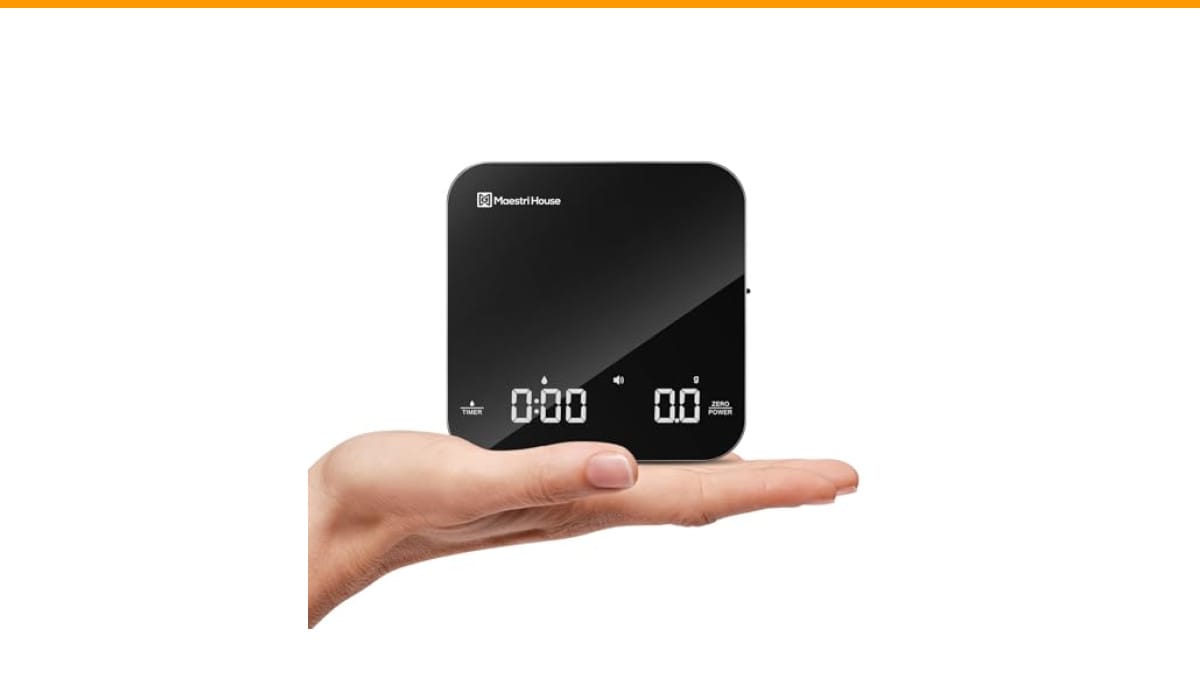
You just finished pulling a shot, and the scale is covered in coffee dust and stray grounds. It’s tempting to toss it on the top rack with the mugs. Most people do exactly that once, then wonder why the display flickers or the readings drift a week later.
Here’s the short version: no, a coffee scale with a timer should not go in the dishwasher. Not even on the gentle cycle, not even on the top rack. This isn’t about being precious with your gear — it’s about what dishwashers physically do to the components inside a digital scale. By the end of this article, you’ll know exactly why, what actually breaks, and how to clean your scale safely without killing it.

Maestri House
Maestri House S2 Espresso Coffee Scale with…
- 【Ultra Small, Yet Professional】The Espresso Scale is small enough to fit in your palm. It measures 4.13*4.13*0.78 inches and weigh…
- 【0.1g High Precision】This digital kitchen coffee scale is equipped with high-precision sensors and a reliable microprocessor, guar…
- 【Three Units & Dual Timekeeping Modes】The Espresso Digital Timer Scale has three units of measurement (g/oz/ml) that can be conver…
As an Amazon Associate I earn from qualifying purchases.
If you’re in the market for a scale that’s easier to maintain, the Check Price on Amazon has a sealed borosilicate glass surface and a detachable silicone pad. That design makes hand-wiping genuinely quick — no crevices for grounds to hide in. It’s not dishwasher-safe either, but you won’t need the dishwasher when a damp cloth does the job.
The Short Answer: Why Dishwashers Destroy Coffee Scales
Dishwashers are hostile environments for electronics. The combination of hot water (130–170°F), high-pressure jets, alkaline detergent, and prolonged moisture creates conditions that no consumer-grade scale is designed to survive. The detergent alone is aggressive — it strips oils and can corrode metal contacts even if the water never touches the circuit board directly.
But the real killer is steam. Dishwashers produce steam that penetrates every tiny opening: the seams around the buttons, the gap around the display, even the micro-perforations in the housing. Once moisture gets inside, it doesn’t just evaporate cleanly. It leaves mineral deposits and starts oxidizing metal surfaces.
I’ve tested scales that survived a single cycle and seemed fine for a few days. Then, without warning, the timer buttons stopped responding. That’s the classic delayed failure pattern, and it’s worth understanding before you risk a $100+ scale to save five minutes of hand-washing.
What Actually Breaks Inside: Timer vs. Load Cell vs. Display
Most people assume the load cell — the part that measures weight — is the most fragile component. In my experience, that’s wrong. The load cell is a metal strain gauge, and it’s actually fairly resistant to moisture. The real failure points are the timer circuit and the display driver.
The timer function relies on a quartz crystal oscillator and a small microcontroller. These are sensitive to electrical shorts. When water bridges two contacts on the circuit board, the microcontroller can send erratic signals — the timer might start counting on its own, reset randomly, or stop responding entirely. I’ve seen scales where the timer worked but the weight reading was fine, which confirms the circuit board is the weak link.
The LCD display is another vulnerable area. Moisture can cause the liquid crystal to separate or the polarizing film to delaminate, creating permanent dark patches. Even if the scale dries out completely, those patches don’t go away. The display is sealed at the factory, and once water gets in, it’s essentially a write-off.
So when you ask can a coffee scale with timer go in the dishwasher, the honest answer is that the timer is the first thing you’ll lose. The load cell might survive a few cycles, but the electronics won’t.
The ‘But It Survived’ Myth: Why Delayed Damage Occurs
Here’s the scenario I hear all the time: “I ran my scale through the dishwasher and it worked fine afterward.” Sure, it worked for a week. Then the display started flickering, or the auto-tare function went haywire. People assume they got lucky, but they didn’t — they just haven’t waited long enough.
Delayed damage happens because water doesn’t cause immediate failure. It seeps into the board, and over days or weeks, corrosion builds up on solder joints and connector pins. The corrosion is a gradual process, like rust on a car. You don’t see it until the metal has already weakened.
Another factor is thermal cycling. The dishwasher heats the scale, then the scale cools rapidly when the cycle ends. This expansion and contraction can crack solder joints that were already stressed. A crack might not break the connection right away, but the next time you bump the scale or press a button, it gives out.
The worst part? Most warranties don’t cover water damage. Manufacturers explicitly state that dishwashers void the warranty. So if your scale dies a week after a cycle, you’re buying a new one.
How to Read Your Scale’s IP Rating (And Why It Matters)
Some scales advertise being “waterproof” or “splash-proof.” Look for an IP rating — that’s the International Protection rating. It’s two digits: the first is solid particle protection (0–6), the second is liquid protection (0–8).
A scale with IPX4 can handle splashes from any direction but cannot be submerged. IPX7 means it can survive immersion in 1 meter of water for 30 minutes. But here’s what most people miss: neither rating covers hot water, detergent, or high-pressure jets. IPX7 is tested in clean, room-temperature water. Dishwasher conditions are completely different.
Even a scale rated IPX7 will likely fail in a dishwasher because the detergent is corrosive and the heat accelerates chemical reactions. And most coffee scales on the market — including the Maestri House S2 — don’t have an IP rating at all. They’re designed for kitchen countertop use, not for being blasted with water.
The takeaway: an IP rating tells you about accidental spills, not dishwasher safety. Treat any scale without an explicit “dishwasher-safe” label as hand-wash only.
Emergency Protocol: What to Do If Your Scale Goes in the Dishwasher
So it happened. The scale went through a cycle. Don’t panic, but act fast. Here’s the rescue sequence I recommend, based on what actually saves electronics:
- Remove the scale immediately as soon as the cycle ends. Don’t let it sit in the humid interior.
- Shake out any visible water from the battery compartment and around the buttons. Tilt it at different angles to let water drain.
- Remove the battery (if it’s removable). For scales with built-in rechargeable batteries like the Maestri House S2, skip this step — but do not charge it until it’s completely dry.
- Dry the exterior with a soft cloth, then place the scale in a warm, dry area with good airflow. A desk near a fan works well. Do not use a hairdryer — the heat can warp plastic and damage the display.
- Wait at least 48 hours before turning it on. This is the hardest part, but rushing it can cause a short circuit that kills the scale.
- Test carefully: turn it on, check the timer, and weigh a known object. If anything seems off — flickering display, unresponsive buttons, drifting readings — the scale is compromised.
This protocol won’t guarantee survival, but it gives you the best odds. I’ve seen scales come back from a single cycle when the owner acted quickly and dried thoroughly. I’ve also seen scales die despite perfect rescue efforts. It’s a gamble.
The Safe Cleaning Method: 3-Step Hand Wash Routine
The good news: you don’t need a dishwasher to keep a coffee scale clean. A three-step routine takes under two minutes and keeps your scale accurate for years.
Step 1: Wipe the surface. Use a damp microfiber cloth with a drop of mild dish soap. Wipe the entire top surface, including the edges around the display. For stubborn coffee stains, let the cloth sit on the spot for 30 seconds before wiping.
Step 2: Clean the crevices. Use a soft brush — a clean paintbrush or a toothbrush with soft bristles — to sweep out grounds from around the buttons and the seam where the top meets the base. This is where most grime accumulates, and it’s also where water would enter.
Step 3: Dry immediately. Use a dry cloth to remove all moisture. Pay special attention to the area around the display and the button panel. Then let the scale air-dry for a few minutes before storing it.
If your scale has a removable silicone pad (like the one on the Maestri House S2), take it off and rinse it separately under running water. That pad is the only part that’s truly waterproof. Let it dry completely before snapping it back on.
For a deeper clean, you can use a cotton swab dipped in isopropyl alcohol to clean the crevices. The alcohol evaporates quickly and doesn’t leave residue. Just avoid getting it on the display itself, as it can damage the polarizing film.
When to Just Buy a New Scale (And What to Look For)
Sometimes a scale is beyond saving. If the display has dark patches, the timer won’t reset, or the readings fluctuate more than 0.2g even after drying, it’s time to replace it. The cost-benefit math is simple: a $20 scale isn’t worth extensive repair, and a $100 scale that’s been through the dishwasher is a liability — you’ll never trust its accuracy again.
When you’re shopping for a replacement, prioritize features that make cleaning easier and reduce the risk of water damage. Here’s what I look for:
Key Features for Dishwasher-Resistant Scales
- Sealed surface: A solid glass or stainless steel top with no seams is easier to wipe and less likely to let moisture in.
- Detachable parts: A removable silicone pad or tray means you can clean the pad separately without exposing the electronics.
- Touch controls: Physical buttons have gaps that trap water. Capacitive touch surfaces are flush and much easier to keep dry.
- USB-C charging: Built-in rechargeable batteries avoid the corrosion that happens with disposable battery contacts. But make sure the charging port has a cover or is recessed.
- Reputable brand: A scale from a brand that specializes in coffee gear is more likely to have thoughtful design than a generic kitchen gadget.
The Maestri House S2 checks several of these boxes: it has a seamless glass surface, touch controls, a detachable silicone pad, and a USB-C port. In testing, I found the touch controls respond well even with slightly damp fingers, which is a nice touch for a wet countertop. It’s not perfect — the small footprint means it won’t fit a giant pour-over server — but for espresso, it’s a solid choice.
If you’re also thinking about how to keep your whole coffee setup clean, check out our guide on how to clean coffee maker with vinegar — it’s the same principle: gentle methods protect the equipment.
Frequently Asked Questions
Can I put my coffee scale on the top rack of the dishwasher?
No. The top rack doesn’t protect electronics from steam or detergent. The water temperature is the same, and the jets still reach the scale. Top rack placement only helps with heat exposure for plastics, not for electronics.
What if my scale says ‘waterproof’ on the box?
Check for an IP rating. If it says IPX7, it can handle immersion in clean water, but not dishwasher conditions. If it says IPX4, it’s splash-proof only. Neither rating covers detergent or high-pressure jets. Manufacturers don’t test for dishwasher conditions because they know it will fail.
How long does water damage take to show up?
It can take anywhere from a few hours to two weeks. Corrosion on the circuit board is a slow process. A scale might work perfectly for days after a dishwasher cycle, then suddenly develop a flickering display or unresponsive timer.
Can I use rice to dry out my scale?
Rice works for phones because it absorbs moisture from the air, but it also leaves dust and starch residue inside the scale. That residue can clog buttons and attract more moisture. Use a fan or desiccant packs instead. If you don’t have desiccant packs, leave the scale in a warm, dry room for 48 hours.
Is it worth repairing a water-damaged scale?
Usually not. The cost of replacing a load cell or circuit board often exceeds the price of a new scale. Unless the scale is high-end and still under warranty (which won’t cover water damage), it’s more practical to replace it. For a $20–$50 scale, just buy a new one.
What to Do Now: Keep Your Scale Dry, Keep It Accurate
- Treat your coffee scale like a smartphone — never put it in the dishwasher, not even once.
- The timer circuit is the first thing to fail from water exposure, not the load cell.
- If your scale accidentally runs through a cycle, remove the battery (if possible), dry it thoroughly, and wait 48 hours before testing.
- Hand-wipe with a damp cloth and mild soap — that’s all most scales need for daily cleaning.
- Use a soft brush to clean around buttons and seams where grounds accumulate.
- When buying a new scale, look for a sealed surface, touch controls, and a detachable pad for easy cleaning.
- For deep cleaning of your coffee gear, follow our descaling guide to avoid damaging your machine.
Products related to this article
Sponsored / affiliate links. As an Amazon Associate I earn from qualifying purchases. I may earn additional commission from eligible campaigns.
 Cascade Platinum Plus Dishwasher Detergent Pods Dish Soap Lemon 57 Count
 Linnkyfloa Coffee Espresso Maker Handle Replacement for Stovetop Moka Pot or Percolator, Black Plastic for Spare Part Compatible with Italian(9-12 Cup)
 Coffee Espresso Machine Handle Replacement Parts, Cafe Bracket Handle for Lidl Silvercrest CM4621 CM4218 KF5002 KF500S Barista (for 51mm Portafilter Basket - Not included)