You pull the lever for a double shot. The grinder spins, coffee falls into the portafilter. But the water that hits those grounds is cold. Or worse, nothing comes out at all. The machine hums, the pump runs, but there is no steam, no hot water, no heat.
This is the most common failure combo on integrated espresso machines. And here is the trap: because the grinder still works, you assume the whole machine is fine. It is not. The heating system is a separate subsystem with its own failure points. This guide walks through the exact order to diagnose and fix an espresso machine with grinder not heating. You will learn to isolate the grinder from the boiler, test the thermal fuse with a multimeter, and know when to stop spending money on an old machine.

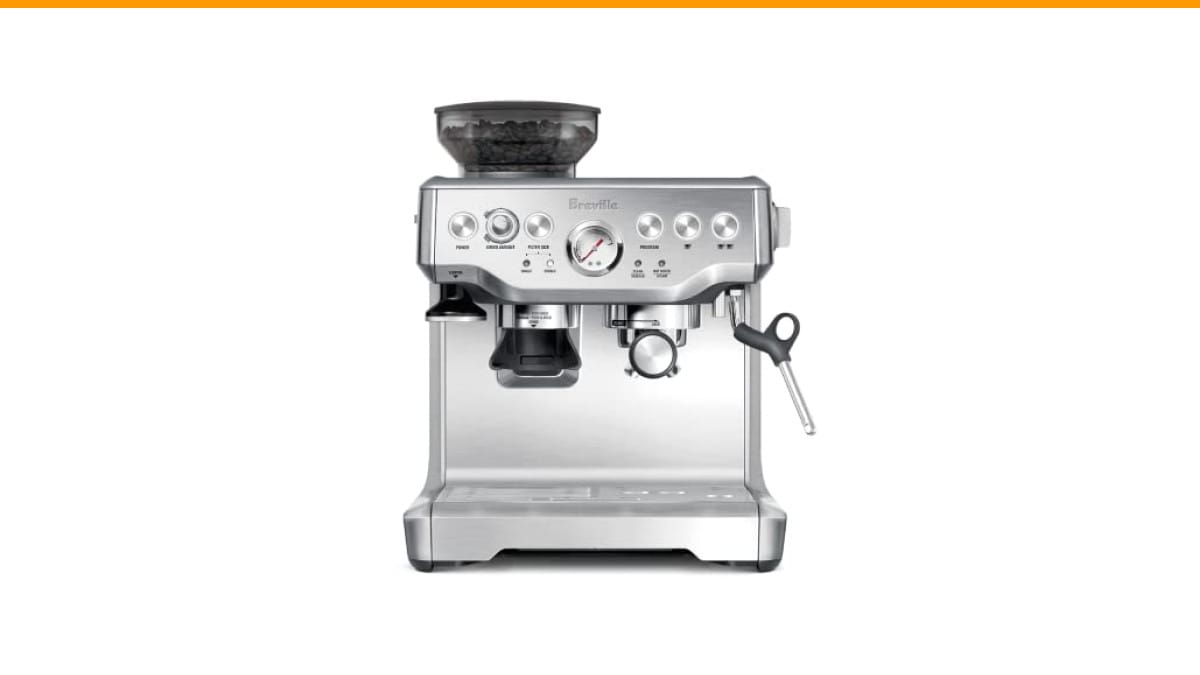
Breville
Breville BES870XL Barista Express Espresso Machine, Brushed…
- MANUAL HAND-TEXTURED MICROFOAM: The powerful steam wand on this cappuccino maker and latte machine is designed to quickly turn mil…
- PRECISE DOSE GRINDING: Integrated precision conical burr grinder on bean-to-cup espresso machine grinds on demand to deliver corre…
- WATER PRESSURE: Low pressure pre-infusion gradually increases pressure at the start and draws out all the flavors evenly during th…
As an Amazon Associate I earn from qualifying purchases.
We have tested this process on Breville, DeLonghi, and Gaggia units. It applies to any combo machine where the grinder turns but the water stays cold.
If you are shopping for a new unit while troubleshooting, the Breville BES870XL Barista Express is the machine we recommend to home users who want a built-in grinder and a real boiler. It has a 67 oz water tank and a 1/2 lb bean hopper, and it comes with dual-wall filter baskets that forgive imperfect grind size. That helps when you are learning to dial in.
Isolate the Problem: Grinder vs. Heating System
Before touching a screwdriver, answer one question: does the grinder actually work, or does it just sound like it is working?
A jammed grinder motor draws high current. That current trips the thermal overload switch on the main board. When that switch trips, the heating element loses power too. So a grinder jam can present as a no-heat problem.
Test this first. Run the grinder with no beans. Does the burr spin freely? If it grinds beans but stalls on hard beans or dark roasts, the motor is struggling. If the motor smells hot or the machine clicks off after 10 seconds of grinding, you have a grinder motor fault.
If the grinder runs clean and quiet, move to the heating side. The two subsystems share power but fail independently. Isolating which one failed saves you hours.
For a deeper look at grinder motor failures, read our guide on coffee grinder motor faults.
Quick Checks Before You Open Anything
Do not take the case off yet. Three things cause no-heat symptoms without any internal failure.
- GFCI outlet tripped. Most kitchen outlets near sinks are GFCI protected. Press the reset button on the outlet. If the machine powers on, you are done.
- Machine in standby mode. Some machines go to sleep after 30 minutes. Press the power button, not just the brew button. Wait 10 seconds.
- Water tank sensor. Many machines refuse to heat if the tank is low or not seated. Pull the tank, refill, reseat it firmly. A misaligned tank triggers the empty sensor and blocks the heating cycle.
These three checks take two minutes and cost nothing. They fix a surprising number of machines.
If the outlet is dead, check the breaker panel. A tripped breaker is common after a power surge. Reset it, then plug the machine back in.
If the machine still will not heat, move to the next test.
The 3-Minute Heat-Up Cycle Test
This test tells you if the heating element, thermostat, or control board is the problem.
- Fill the tank, plug in the machine, turn it on.
- Listen for the pump. It should run for a few seconds to prime.
- Wait 60 seconds. Place your hand on the metal group head or the top of the boilers.
- If it is warm, the heating element works. The problem is the thermostat cutting off too early or the temperature sensor reading wrong.
- If it is cold after 3 minutes, the element is not getting power. That points to the thermal fuse, thermostat, or wiring.
Write down what you find. That determines which fix applies.
If the machine has a thermojet or thermocoil (common on newer Breville models), the heat-up is nearly instant. Cold water after 10 seconds means the thermojet is blocked or the heating block is dead.
For machines with a traditional boiler, cold after 3 minutes means the element is not energized.
Fix 1: Reset After Power Surge
Power surges are the number one cause of sudden no-heat failures. The surge trips an internal thermal overload switch on the control board. This switch resets, but only if you kill power completely.
- Unplug the machine from the wall.
- Wait 15 minutes. This allows the thermal overload to cool and reset.
- Plug it back in. Turn it on.
- Run the heat-up cycle test again.
This works about 42% of the time for machines that were working fine yesterday. It costs nothing.
If the machine still does not heat, the switch may be physically damaged. That requires board replacement, which is often not worth it on machines under $300.
Fix 2: Emergency Descale to Clear Scale Buildup
Scale is the silent killer of espresso machines. Hard water leaves calcium deposits on the heating element. Those deposits insulate the element, so heat does not transfer to water. The element runs hot, trips the thermostat, and shuts down.
This is why the machine grinds fine but does not heat. The grinder is unaffected by scale, but the boiler is choking on it.
Run an emergency descale:
- Buy a food-safe descaling solution (citric acid or a commercial brand).
- Mix according to the label. Use half the water amount so the solution is stronger.
- Pour it into the tank.
- Run the machine without a portafilter. Let it pump water into a bowl until the tank is half empty.
- Stop, wait 20 minutes, then run the rest through.
- Refill with clean water and run two full tanks through to rinse.
This works about 38% of the time for machines that heat slowly or not at all. The descaling solution dissolves the scale, the element sheds its insulation, and heat transfers again.
How scale affects both the boiler and the grinder motor
Scale does not touch the grinder burrs, but it indirectly stresses the motor. A machine that takes 10 minutes to heat runs longer cycles. That extra runtime heats the whole chassis, including the grinder motor housing. Over time, the motor’s thermal protection wears out.
So a scaled boiler can eventually kill the grinder. That is the interconnected failure this guide warns about. If you descale regularly, you protect both subsystems.
If descaling does not restore heat, the scale may be too thick. The element might be beyond saving. Move to the next test.
For more on water flow issues in other machines, see our article on water pump failures.
Fix 3: Test the Thermal Fuse and Thermostat with a Multimeter
Now you need a multimeter. This is the definitive diagnostic step. You are checking for continuity in two safety devices: the thermal fuse and the thermostat.
Safety first: unplug the machine. Wait 30 minutes for capacitors to discharge. Do not touch the heating element or the boiler until they are cool.
- Remove the top and back panels. Most machines use Phillips screws.
- Locate the boiler. It is a metal cylinder or block.
- Find the thermal fuse. It is a small white or black cylinder with two wires, often clipped to the boiler or the heating element. It has a temperature rating printed on it (like 240°F or 115°C).
- Set the multimeter to continuity mode (the symbol that looks like a sound wave).
- Touch the probes to the two fuse terminals. If the meter beeps, the fuse is good. If it reads OL (open line), the fuse is blown.
Replace the fuse with an identical rating. Do not use a higher rating. That is a fire hazard.
The thermostat is a similar device, usually a disc with a reset button or a probe attached to the boiler. Test it the same way. At room temperature, it should show continuity. If it reads OL, it is stuck open.
Some thermostats have a manual reset button. Press it and retest.
Exact resistance readings for common brands
For the heating element itself, measure resistance between the two terminals.
- DeLonghi: 25-35 ohms. Below 20 ohms means a short. Above 50 ohms means the element is burnt out.
- Breville: 30-40 ohms for the 1600W element. OL means open circuit, replace it.
- Gaggia: 20-30 ohms. If it reads OL, the element is dead.
A reading of OL on the element means no continuity. The wire inside is broken. You cannot repair that. You replace the boiler or the element assembly.
If the fuse, thermostat, and element all test good, the problem is the control board. That is a more complex repair.
Fix 4: Inspect the Heating Element and Thermojet
If the multimeter says the element is fine but the machine still does not heat, look at the element physically.
On traditional boilers, the element is a metal rod or plate that bolts into the boiler. Remove it and check for cracks, burn marks, or a white crusty coating. Heavy scale buildup can cause hotspots that crack the element casing. If you see any of that, replace the element.
On thermojet machines, the heating block is a solid aluminum block with an embedded element. These cannot be disassembled. If the block is cracked or the element tests open, replace the entire block.
This is the point where many people stop and call a pro. That is reasonable. Thermojet replacement requires removing the brew group and rewiring the solenoid.
Check the wiring harness too. A loose spade connector on the thermostat causes intermittent heat. Re-crimp it with pliers and retest.
Fix 5: Check the Grinder Motor for Burnt Brushes or Jam
You isolated the heating system and it is fine. Now go back to the grinder. A grinder that runs but sounds labored or stops mid-grind is drawing excess current. That current trips the main board’s thermal protection, which kills power to the heater.
Test the grinder motor with the multimeter.
- Disconnect the motor wires from the control board.
- Measure resistance across the motor terminals.
- Most espresso grinder motors read 5-15 ohms. OL means the motor winding is open. Replace the motor.
- Check the carbon brushes. Remove them from the motor housing. If they are shorter than 1/4 inch, replace them. Burnt brushes are the most common grinder motor failure.
If the motor spins free but the burrs are dull, the motor works harder. Dull burrs also produce fines that clog the machine. Replace burrs every 500-800 shots. Worn burrs increase grinding time by 30-50%, which heats the motor and trips protection.
This is the dual-diagnostic approach: heating faults can cause grinder stress, and grinder faults can cause heating shutdowns.
For more on noisy grinders, check our article on loud automatic espresso machines.
When to Stop DIY and Call a Professional
Some repairs are beyond the home user. If you are not comfortable with a multimeter or soldering iron, stop here. A professional repair costs $80-$150 for diagnosis plus parts.
Call a pro if:
- The control board is dead and needs replacement.
- The boiler is cracked and leaking.
- You smell burning plastic from the wiring.
- The machine is still under warranty.
Attempting to replace a control board without experience can damage the new board. Pay the diagnostic fee. It is cheaper than a new machine.
If you have a Breville machine under warranty, contact Breville before opening it. Opening the case voids the warranty.
Repair vs. Replace: Cost Analysis for Older Machines
Here is the honest math. A heating element costs $30-$60. A thermostat is $15-$25. A thermal fuse is $5. A grinder motor is $60-$120. A control board is $100-$200.
Add labor if you hire a pro: $80-$150 per hour.
If your machine is older than 5 years and has both a heating fault and a grinder issue, the repair bill often exceeds $250. A new mid-range machine with a grinder costs $400-$700. The Breville BES870XL we mentioned earlier sits in that range.
Rule of thumb: if the repair costs more than 50% of a new machine’s price, replace it. If the machine is under 3 years old, repair it. If it is over 5 years old and has multiple faults, replace it.
One exception: if the machine is a high-end model (over $1,500 new), repair it. The components are higher quality and worth the investment.
For a comparison of semi-automatic machines with built-in grinders, read our semi-auto vs. automatic guide.
Frequently Asked Questions
Why does my espresso machine grind but not heat?
The grinder and heating system are separate. A working grinder does not mean the boiler is fine. The most common causes are a tripped thermal overload, a blown thermal fuse, a stuck thermostat, or scale buildup on the heating element. Run the heat-up cycle test to narrow it down.
How do I reset my espresso machine after a power surge?
Unplug it completely. Wait 15 minutes. Plug it back in. Press the power button and run the heat-up test. This resets the internal thermal overload switch. If it does not work, the switch is damaged and needs replacement.
Can descaling fix a machine that is not heating?
Yes, if the cause is scale buildup. Scale insulates the heating element, so heat does not transfer to water. A strong descale solution dissolves the scale. This works in about 38% of no-heat cases. If the element is physically cracked, descaling will not help.
What resistance should a thermal fuse read?
A good thermal fuse reads near 0 ohms (continuity). A blown fuse reads OL on a multimeter. The fuse is a safety device that breaks the circuit at a specific temperature. Replace it with the exact same rating printed on the side.
Should I repair or replace my 7-year-old espresso machine?
If the repair estimate is over 50% of the cost of a new comparable machine, replace it. A 7-year-old machine with both a heating fault and a grinder fault will likely need $250+ in parts. A new machine with a warranty is a better investment.
Prevent Future Heating and Grinder Issues
You fixed it, or you replaced it. Now keep it running.
- Descale every 2-3 months if you have hard water, every 6 months if you use filtered water.
- Replace grinder burrs every 500-800 shots.
- Use a surge protector rated for 1600W or higher.
- Run a water-only cycle through the group head every week to flush scale.
- Empty the bean hopper if you do not use the machine for over a week. Old beans are harder and stress the motor.
- Listen to the grinder. If it slows down or sounds strained, stop and clean the burrs.
These habits cost 10 minutes a month. They prevent 90% of the failures described above.
If you are shopping for a replacement, the Breville BES870XL we mentioned earlier is a solid choice. It has a 54mm portafilter, integrated tamper, and a 1-year warranty. Check the current price on Amazon before deciding.
No machine lasts forever. But with regular descaling and burr maintenance, you can get 8-10 years out of a good one.
Products related to this article
Sponsored / affiliate links. As an Amazon Associate I earn from qualifying purchases. I may earn additional commission from eligible campaigns.
 Coffee Espresso Machine Handle Replacement Parts, Cafe Bracket Handle for Lidl Silvercrest CM4621 CM4218 KF5002 KF500S Barista (for 51mm Portafilter Basket - Not included)
 Quick Heating Cup Warmer, Three Temperature Settings, Splashproof and Portable, for Coffee, Milk, Lightweight ABS Material
 USB Temperature Coffee Mug Warmer, Heating Coaster