You pull a shot that tastes slightly off. The timing felt right, the grind looked right, but something’s wrong. Most home baristas blame the beans or the grinder. More often than not, the culprit is a coffee scale that drifted out of calibration or has a dirty sensor pad.
A coffee scale with timer is the workhorse of a good brew station. It measures dose, tracks extraction time, and helps you repeat a winning recipe. But it’s a precision instrument with moving parts, electronics, and a load cell that responds to micro-deformations. Treat it like a cheap kitchen gadget and it will lie to you within six months. This guide covers the specific maintenance steps that keep your scale accurate, responsive, and clean — without voiding the warranty or damaging the internals.

Maestri House
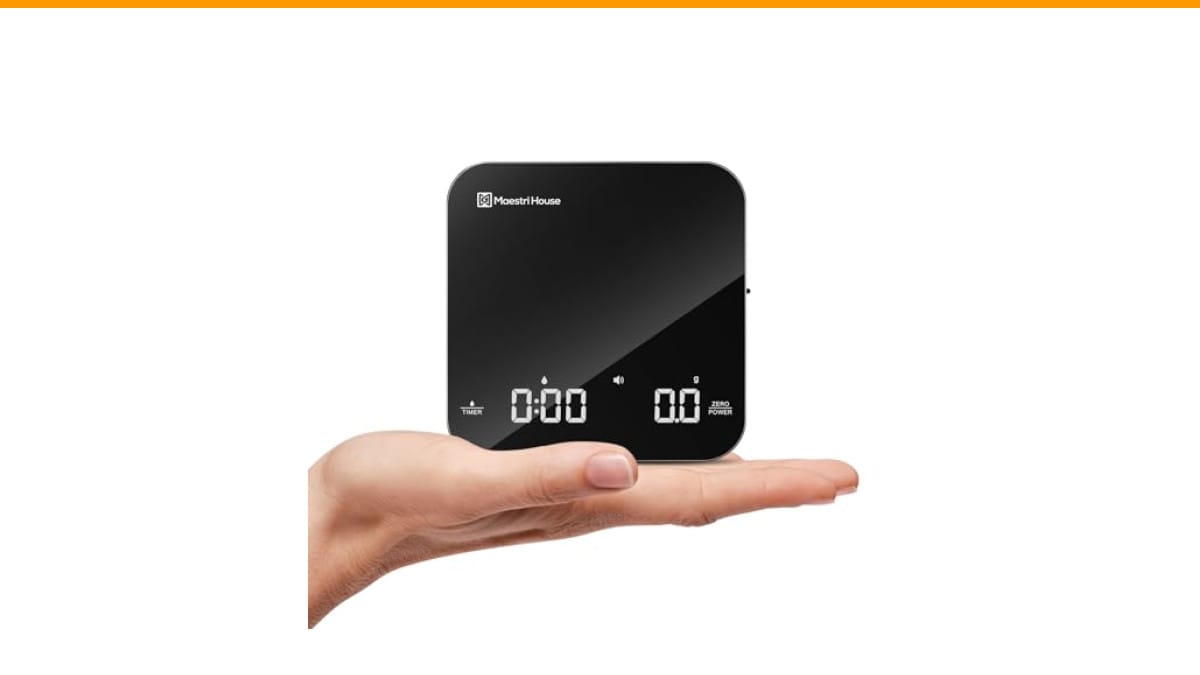
Maestri House S2 Espresso Coffee Scale with…
- 【Ultra Small, Yet Professional】The Espresso Scale is small enough to fit in your palm. It measures 4.13*4.13*0.78 inches and weigh…
- 【0.1g High Precision】This digital kitchen coffee scale is equipped with high-precision sensors and a reliable microprocessor, guar…
- 【Three Units & Dual Timekeeping Modes】The Espresso Digital Timer Scale has three units of measurement (g/oz/ml) that can be conver…
As an Amazon Associate I earn from qualifying purchases.
You’ll walk away knowing how to clean it safely, when and how to calibrate it, how to care for the battery, and how to store it so the sensors don’t drift. I’ll also point out a few common mistakes that shorten a scale’s life.
One tool that makes this easier is the Maestri House S2 Espresso Coffee Scale with Timer. Its sealed borosilicate glass surface and detachable silicone pad mean fewer crevices for coffee dust and water to hide in, which simplifies cleaning compared to scales with exposed seams. The touch controls and hidden display also remove the buttons that usually trap grinds.
Why Coffee Scales Lose Accuracy (And How to Prevent It)
Every digital scale uses a load cell — a metal bar that bends microscopically under weight. That bend changes electrical resistance, and the scale converts the change into a reading. Coffee dust, moisture, and temperature swings all interfere with that process.
The biggest killer is moisture. Even a few drops of water that seep into the seam around the weighing platform can corrode the load cell contacts. Over time, readings start to drift by 0.2 to 0.5 grams. That might not sound like much, but for espresso, 0.3 grams of dose difference changes extraction noticeably.
Heat is the second issue. Setting a hot portafilter or pour-over kettle directly on the scale warps the plastic housing and stresses the load cell mount. Most scales are rated for ambient temperatures, not direct contact with a 90°C metal object.
So the prevention strategy is simple: keep it dry, keep it cool, and keep it clean. That means wiping the surface after every use, not just when you remember.
Cleaning Your Scale: The Right Way and the Wrong Way
Most people grab a wet paper towel and scrub. That’s fine for the top surface, but it’s a risk if water runs down the sides. Here’s the method I use after testing several scales side by side, including the Maestri House S2.
- Turn the scale off and remove any detachable parts. On the Maestri House S2, that means peeling off the silicone pad. On other models, remove the weighing tray if it lifts off.
- Brush off loose coffee grounds with a dry, soft pastry brush or a dedicated camera lens brush. Don’t blow on it — your breath carries moisture.
- Dampen a microfiber cloth with plain water or a drop of mild dish soap. Wring it out until it’s barely damp. Wipe the top surface and the silicone pad.
- Use a dry corner of the cloth to wipe the surface again, removing any soap residue.
- Check the edges and seams with a cotton swab. If you see coffee dust accumulating in the gap between the glass top and the body, gently sweep it out with a dry swab. Do not push it deeper.
- Let it air dry for 10 minutes before using or storing.
What about the underside? Flip the scale over and wipe the rubber feet with a dry cloth. Wet feet can leave marks on your counter and, more importantly, can let moisture into the battery compartment if the seal is weak.
Never submerge the scale. Never run it under a tap. Never spray cleaner directly onto the surface — always spray onto the cloth first. If you own a scale with a removable top plate, check the manufacturer’s instructions before removing it; some are glued down and will crack if forced.
Calibration: When and How Often
Calibration is the step most people skip. A scale that reads 18.0 grams when you put an 18.0 gram weight on it is calibrated. But load cells drift over time due to temperature changes, mechanical stress, and aging components.
Here’s my rule: recalibrate every two to three months if you use the scale daily. Also calibrate after any of these events:
- The scale was dropped or knocked off the counter
- You notice readings fluctuate by more than 0.1 gram when you place and remove the same object three times
- You moved to a new location with significantly different temperature or humidity
- You cleaned the scale thoroughly and removed the weighing platform
Most scales have a calibration mode. On the Maestri House S2, you press and hold the unit button until the display shows a calibration prompt, then place the required weight (usually 500g or 1000g) on the center of the platform. The exact sequence varies by model, so check your manual.
You need a certified calibration weight. A kitchen dumbbell or a bag of beans is not accurate enough. A 100g stainless steel calibration weight costs about $10 and is worth it. Place it dead center, because off-center placement introduces leverage errors that throw off the reading.
After calibrating, test with two different weights — one light (like 5g) and one heavy (like 500g). If both read correctly, you’re done. If the light weight is accurate but the heavy one isn’t, the load cell may be damaged, and calibration won’t fix it.
Battery Care and Storage Habits
Rechargeable scales like the Maestri House S2 (which has a 500 mAh lithium battery and USB-C charging) need different care than AA-powered scales. Lithium batteries degrade faster when kept at 100% charge or at very low charge for long periods.
Practical advice: don’t leave the scale plugged in overnight every night. Charge it when it drops to about 20%, unplug it when it hits 100%, and use it. The S2 is rated for up to 90 days on a single charge, so you won’t be charging often anyway.
If you plan to store the scale for more than a month, charge it to about 60% first. That’s the sweet spot for lithium battery longevity. Storing it dead flat will eventually kill the battery permanently.
Storage also matters for the load cell. Don’t stack heavy objects on top of the scale. The load cell is designed to measure up to 2000g, but constant pressure from a 5kg bag of beans on top will deform it over time. Store the scale on its own, ideally in a drawer or on a shelf where nothing presses on the platform.
Temperature matters too. Don’t leave the scale in a car in summer. The interior of a parked car can hit 60°C, which is enough to warp the plastic housing and shift the load cell zero point. Room temperature is fine; a sunny windowsill is not.
Common Mistakes That Shorten Scale Life
I’ve seen these mistakes in home kitchens and in testing sessions. Avoiding them is half the battle.
- Weighing hot items directly on the surface. Use the silicone pad or a small plate. The Maestri House S2 includes a silicone pad for this reason.
- Using the scale as a trivet. It’s not one. A hot kettle or portafilter left on the surface transfers heat into the load cell.
- Ignoring drift. If your shots start taking longer to hit the same yield, check your scale before changing grind size. A 0.3g drift is enough to change flow rate.
- Cleaning with alcohol or solvent. These can dissolve the adhesive holding the glass top or damage the touch-sensitive coating. Stick to water and mild soap.
- Pressing the touch controls with hard objects. Use a fingertip, not a spoon handle. The touch sensors on the S2 are responsive but not indestructible.
One more thing: check the zero function regularly. Place an empty cup on the scale, press tare, and see if it returns to 0.0g when you remove the cup. If it doesn’t, the scale needs recalibration or cleaning.
Comparison: Maintenance Approaches by Scale Type
| Maintenance Task | Sealed Glass Top (e.g., Maestri House S2) | Removable Tray Scale | Budget Scale with Exposed Buttons |
|---|---|---|---|
| Cleaning method | Wipe damp cloth over glass and silicone pad | Remove tray, wash separately, wipe base | Careful swab around buttons, avoid water |
| Water risk | Low — sealed surface | Medium — tray seam can trap water | High — water seeps under buttons |
| Calibration frequency | Every 2–3 months | Every 1–2 months (tray removal can shift zero) | Every month (cheaper load cells drift faster) |
| Battery care | Rechargeable, charge at 20% | AA/AAA, remove batteries if storing | AA, remove batteries if storing |
| Storage precautions | Keep flat, no heavy stacking | Keep tray off if storing long-term | Keep in original box to protect buttons |
The sealed design makes the S2 lower maintenance than most. But even it needs the same calibration discipline. No scale is maintenance-free.
Five Questions People Actually Ask
How do I know if my coffee scale is inaccurate?
Test it with a known weight. Use a calibration weight, or weigh 100ml of water (which should read 100g at room temperature). Place the weight, remove it, place it again. If the reading varies by more than 0.1g between tries, the scale needs calibration. Another sign: your espresso shots start running faster or slower with the same grind setting and dose, which suggests the dose weight is off.
Can I wash my coffee scale under running water?
No. Even if the scale claims waterproof, the internal load cell and electronics will eventually corrode. Water pressure can force moisture past gaskets. Wipe with a damp cloth instead. If you must rinse the silicone pad, remove it first and dry it fully before reattaching.
How often should I calibrate a scale I use daily?
Every two to three months is a good baseline for a quality scale. If you drop it, notice drift, or move to a new environment, calibrate immediately. Budget scales may need monthly calibration because their load cells are less stable.
Does the timer need maintenance too?
The timer is electronic, so it doesn’t wear out, but it can get confused if you press the buttons with wet or dirty fingers. Keep the touch surface clean and dry. If the timer starts lagging or skipping, a full reset (turn off, wait 10 seconds, turn on) usually fixes it.
My scale won’t tare to zero. What’s wrong?
First, clean the surface and check for debris under the platform. Then recalibrate. If it still won’t zero, the load cell may be damaged from a drop or from being stored under heavy weight. At that point, replacement is usually more cost-effective than repair.
What to Do Next: A Simple Maintenance Routine
- Wipe the surface with a dry microfiber cloth after every brewing session — takes 10 seconds.
- Do a deeper clean with a damp cloth once a week, including the silicone pad and edges.
- Calibrate on the first day of every other month. Put a reminder on your calendar.
- Charge the battery when it hits 20%, not at the end of the day every day.
- Store the scale flat, with nothing on top, away from direct sunlight and heat sources.
- Test zero and accuracy with a known weight every time you recalibrate.
- If you notice drift between calibrations, check for water damage or a loose platform before blaming the beans.
A coffee scale with timer is a precision tool, but it’s not delicate. A few minutes of weekly care keeps it accurate for years. The same goes for your coffee grinder and your espresso machine — regular maintenance beats emergency repairs every time. If you’re dealing with scale buildup in your machine, that’s a separate issue from your weighing scale; check out our guide on descaling your coffee machine to keep that running smoothly too.
Take care of your scale, and it will take care of your shot consistency. Ignore it, and you’ll be chasing ghosts in your recipe that are actually just a 0.2g measurement error.
Products related to this article
Sponsored / affiliate links. As an Amazon Associate I earn from qualifying purchases. I may earn additional commission from eligible campaigns.
 Coffee Espresso Machine Handle Replacement Parts, Cafe Bracket Handle for Lidl Silvercrest CM4621 CM4218 KF5002 KF500S Barista (for 51mm Portafilter Basket - Not included)
 SOLUSTRE Electric USB Coffee Cup Warmer with Temperature Settings Portable Milk and Beverage Heating Coaster for Office Desk Small Lightweight Design Easy to Clean Surface Multi Functional
 Long Handle Wooden Spoon For Mixing Coffee Tea Jam and Bath Salt In Kitchen, Environmentally Friendly Table Spoon, 8.6 Inches,4 Pieces…