You’re standing there at 6:30 in the morning, waiting for the water to hit 205°F for your V60. The kettle is humming away, and a thought crosses your mind: Is this thing eating my electricity bill alive? It’s a fair question, and one that most coffee forums don’t answer with actual numbers.
Here’s the short version: a typical electric gooseneck kettle uses between 0.05 and 0.12 kWh per boil, depending on volume and starting water temperature. That translates to roughly one to three cents per pour. Over the course of a year, you’re looking at maybe $5 to $15 total, assuming you brew daily. This article walks you through the exact math, the hidden costs most people miss, and how your kettle compares to a standard electric model.

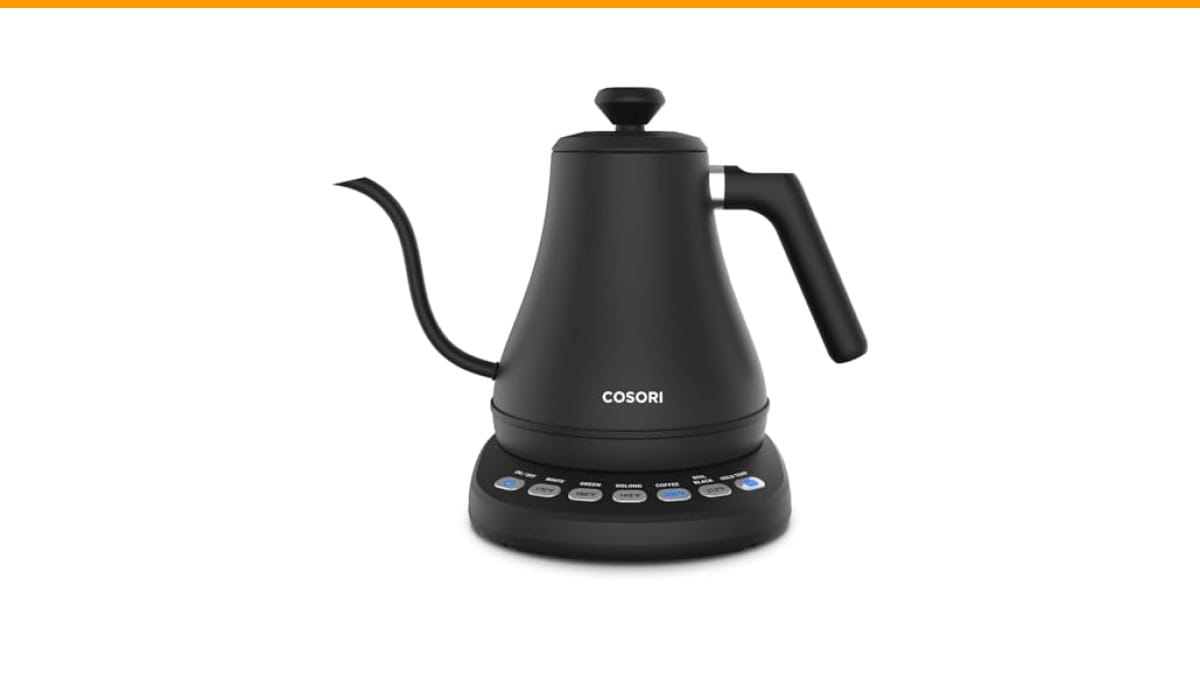
Cosori
Cosori Gooseneck Electric Kettle with Temperature Control,…
- 5 𝑶𝑵𝑬-𝑻𝑶𝑼𝑪𝑯 𝑷𝑹𝑬𝑺𝑬𝑻𝑺: Your Gooseneck Electric Kettle features 5 precise temperature presets. These accurate presets make brewing co…
- 1-𝑯𝑶𝑼𝑹 𝑲𝑬𝑬𝑷 𝑾𝑨𝑹𝑴: Use the HOLD TEMP function to keep the contents of your kettle warm for up to 1 hour so that you can enjoy your…
- 𝑬𝑹𝑮𝑶𝑵𝑶𝑴𝑰𝑪 𝑫𝑬𝑺𝑰𝑮𝑵: Refined ergonomic design allows for precise water flow control for perfect pour-over brewing
As an Amazon Associate I earn from qualifying purchases.
If you’re shopping for a kettle that balances precision with reasonable power draw, the Cosori Gooseneck Electric Kettle with Temperature Control is a solid option. It runs at 1200W, which keeps the energy use modest while still boiling a full 0.8L in about four minutes. We’ll get into why that wattage matters shortly.
Gooseneck Kettle Wattage and Power Ratings Explained
Wattage is the rate of energy consumption. It tells you how fast the kettle draws power from the wall, not how much total energy it uses. A 1500W kettle pulls more power per second than a 1200W model, but it also finishes boiling faster. In many cases, the total energy used ends up nearly identical.
Most gooseneck kettles on the market fall into two camps:
- 1200W models – Common for 0.8L to 1.0L kettles. Slower boil times, but gentler on older home circuits.
- 1500W models – Usually found on 1.0L kettles. Faster boils, but they need a dedicated 15-amp circuit if other appliances are running.
The voltage matters too. In the US, standard outlets supply 120V. A 1500W kettle draws about 12.5 amps, which is near the limit of a typical 15-amp breaker. If your kitchen shares a circuit with a toaster or microwave, you might trip the breaker. That’s not an efficiency issue, but it’s a real-world consideration that affects which kettle you can actually use.
Thermal efficiency is where gooseneck kettles actually differ from each other. The heating element is fully submerged in the water, so nearly all the energy goes into heating the water itself. There’s minimal loss to the surrounding air. That said, a kettle with a thinner stainless steel body will lose more heat to the room than one with better insulation. It’s a small difference, but it adds up if you use the keep-warm function frequently.
How to Calculate Your Exact Cost Per Boil
You don’t need a smart plug or a fancy energy monitor to figure this out. A simple formula gives you the answer in under a minute.
The Formula: Watts x Hours = kWh
Electricity is billed in kilowatt-hours (kWh). One kWh is 1,000 watts running for one hour. To find your cost per boil:
- Convert the kettle’s wattage to kilowatts (divide by 1,000).
- Multiply by the boil time in hours (minutes divided by 60).
- Multiply by your electricity rate per kWh.
Example: A 1200W kettle boils 0.8L in 4 minutes (0.067 hours). That’s 1.2 kW x 0.067 hours = 0.0804 kWh. At the US average rate of $0.17 per kWh, that’s about 1.4 cents per boil.
Real-World Example: 1200W vs. 1500W Kettle
Let’s compare two kettles boiling the same 0.8L of water from 68°F tap temperature to 212°F:
- 1200W kettle: Boil time ~4 min. Energy used: 0.080 kWh. Cost: $0.014.
- 1500W kettle: Boil time ~3.2 min. Energy used: 0.080 kWh. Cost: $0.014.
The total energy is virtually the same. The faster kettle draws more power for less time, and the slower one draws less power for longer. Physics doesn’t care how fast you heat the water; it takes the same amount of energy to raise a given volume of water by a given temperature.
Where you see real differences is in the volume of water. Boiling a full liter costs about 25% more than boiling 0.8L. Boiling just one cup (237ml) costs about a third of a full boil. This is the single biggest lever you have for reducing energy use, and we’ll come back to it.
Hidden Energy Costs: Standby Power and Idle Draw
Most electric gooseneck kettles sit on their base when not in use. That base often has a small LED display and a control board that stays on, even when the kettle isn’t heating. This is standby power, and it’s easy to overlook.
Standby draw is typically 1 to 3 watts. That sounds tiny, but it runs 24/7. At 2 watts continuously, you’re using 1.44 kWh per month. At $0.17 per kWh, that’s about $0.24 per month, or $2.93 per year. It’s not going to break the bank, but it’s pure waste if you never use the display when the kettle is idle.
Some models have a physical power switch that cuts all power. Others rely on the display’s auto-off feature, which usually kicks in after 30 minutes of inactivity. If your kettle has a keep-warm function, that’s a different story. Holding water at a set temperature for an hour can draw 300-600W intermittently, which adds up to 0.3-0.6 kWh per session. That’s 10 to 20 times the cost of a single boil.
My advice: if you don’t need the display clock, unplug the base when the kettle is empty. If you use keep-warm, treat it as a convenience feature with a real cost, not a freebie.
Gooseneck vs. Standard Kettle: Which Uses More Energy?
People assume a gooseneck kettle is less efficient because it looks more delicate. That’s not true. Both types use the same submerged heating element technology. The difference is in how you use them.
A standard electric kettle often has a larger capacity (1.5L to 1.7L) and a higher wattage (1500W to 1800W). If you fill it to the max every time, you’re boiling more water than you need. That’s wasted energy. A gooseneck kettle’s smaller capacity (0.8L to 1.0L) forces you to boil closer to your actual pour volume.
For pour-over brewing specifically, a gooseneck kettle is actually more efficient. You’re typically boiling 500-600ml for a single cup. A standard kettle with a 1.5L minimum fill line forces you to heat triple the water. The gooseneck lets you heat exactly what you’ll pour.
| Kettle Type | Typical Wattage | Typical Capacity | Energy for 500ml Boil | Cost per Boil (at $0.17/kWh) |
|---|---|---|---|---|
| Gooseneck (1200W) | 1200W | 0.8L | 0.050 kWh | $0.008 |
| Gooseneck (1500W) | 1500W | 1.0L | 0.050 kWh | $0.008 |
| Standard (1500W) | 1500W | 1.7L | 0.050 kWh | $0.008 |
| Standard (1800W) | 1800W | 1.7L | 0.050 kWh | $0.008 |
Notice the energy per 500ml is the same across all types. The difference is that a standard kettle tempts you to fill it higher. If you boil 1.5L in a standard kettle instead of 500ml, you’re using 0.150 kWh per boil, which is three times the cost. The kettle isn’t less efficient; your habit is.
One more point: induction kettles are slightly more efficient than standard electric ones because they heat the vessel directly. But gooseneck induction kettles are rare and expensive. For most home users, the difference is a fraction of a cent per boil, so it’s not worth chasing.
How to Reduce Electricity Use with Your Gooseneck Kettle
You don’t need to change your brewing routine to save money. A few small adjustments will cut your energy use by 30-50%.
Boil Only What You Need
This is the biggest lever. If you typically brew a 300ml cup, boil 350ml, not a full liter. The energy difference is linear: boiling half the water uses half the electricity. It also cuts your boil time, which means less waiting in the morning.
Descale Regularly for Faster Boils
Mineral scale acts as an insulator. A layer of calcium carbonate on the heating element slows heat transfer, which means the kettle runs longer to reach the same temperature. That’s wasted energy. A quick descale with white vinegar or citric acid every month or two keeps the element bare and the boil time short. If your kettle is taking noticeably longer to boil than when it was new, scale is the likely culprit.
Unplug When Not in Use
Standby power is small but avoidable. If your kettle’s base has a glowing display, it’s drawing power. Unplugging it when you’re done for the day eliminates that draw completely. It also protects the electronics from power surges, which is a nice bonus.
If you use the keep-warm function, use it sparingly. One hour of keep-warm costs more than the initial boil itself. Set a timer, or better yet, just pour your water into a pre-heated thermos if you need it hot later.
Frequently Asked Questions
How many amps does an electric gooseneck kettle draw?
A 1200W kettle draws 10 amps on a 120V circuit. A 1500W kettle draws 12.5 amps. Both are safe on a standard 15-amp household circuit, but you shouldn’t run another high-draw appliance on the same circuit at the same time.
Is it cheaper to boil water in a gooseneck kettle or a microwave?
A microwave is actually less efficient for small volumes. Microwaves waste energy heating the air and the container. A kettle transfers heat directly into the water. For 500ml, a kettle uses about 0.05 kWh; a microwave uses roughly 0.08-0.10 kWh for the same result. The kettle is also more precise for temperature control.
Does a higher wattage gooseneck kettle use more electricity?
No, not for the same volume of water. A 1500W kettle heats faster than a 1200W one, but the total energy used is nearly identical. The main difference is boil time and circuit load. Higher wattage only costs more if you’re boiling larger volumes more frequently.
How much does it cost to run a gooseneck kettle every day for a year?
Assume one 500ml boil per day at 0.05 kWh. At $0.17 per kWh, that’s $0.0085 per day, or about $3.10 per year. If you boil a full liter daily, double that to roughly $6.20 per year. Even with the keep-warm function used occasionally, you’re unlikely to exceed $10 annually.
Does using filtered water reduce electricity use?
Not directly. Filtered water doesn’t change the specific heat of water. However, filtered water has fewer dissolved minerals, which means less scale buildup over time. Less scale means the heating element stays efficient, so your boil times don’t creep up. It’s an indirect benefit, but a real one.
Final Verdict: Is It Expensive to Run?
No, an electric gooseneck kettle is one of the cheapest appliances in your kitchen to run. The math is simple:
- Single 500ml pour costs about 1 cent.
- Full 0.8L boil costs about 1.5 cents.
- Daily brewing for a year costs less than a single bag of specialty coffee.
- Standby power adds a few dollars per year if you leave it plugged in.
- Keep-warm is the only feature with a meaningful cost, roughly 10-20 cents per hour.
- Boiling only what you need cuts your energy use by half or more.
- Regular descaling keeps boil times short and energy use low.
The real cost isn’t electricity; it’s the wasted water and time from boiling more than you need. A gooseneck kettle’s narrow spout and precise control already nudge you toward smarter brewing habits. Pair that with the cost-per-pour math above, and you’ve got nothing to worry about on your next electric bill.
If you’re in the market, the Cosori Gooseneck Electric Kettle handles this well. Its 1200W element keeps the amp draw low, and the 0.8L capacity matches the needs of most home brewers. Check the current price on Amazon if you want to compare it against other models.
For more on keeping your gear in top shape, read our guide on cleaning coffee makers and why bitter coffee after cleaning happens. Both tie directly into the descaling advice above.
Products related to this article
Sponsored / affiliate links. As an Amazon Associate I earn from qualifying purchases. I may earn additional commission from eligible campaigns.
 Coffee Mug Warmer & You are Awesome Mug Set, Electric Cup Warmer for Desk
 Quick Heating Cup Warmer, Three Temperature Settings, Splashproof and Portable, for Coffee, Milk, Lightweight ABS Material
 SOLUSTRE Electric USB Coffee Cup Warmer with Temperature Settings Portable Milk and Beverage Heating Coaster for Office Desk Small Lightweight Design Easy to Clean Surface Multi Functional