You’ve dialed in your grinder, mastered your water temperature, and finally pulled a shot that doesn’t taste like battery acid. Then you realize you’ve been eyeballing your dose for weeks. A coffee scale with timer is the missing piece, but the price range is ridiculous—you can spend $20 or $200. Which one actually makes sense?
This guide walks through what different price points get you, which specs matter for pour-over and espresso, and why a mid-range scale often beats both budget and premium options on pure value. By the end, you’ll know exactly where your money should go and what you can safely skip.
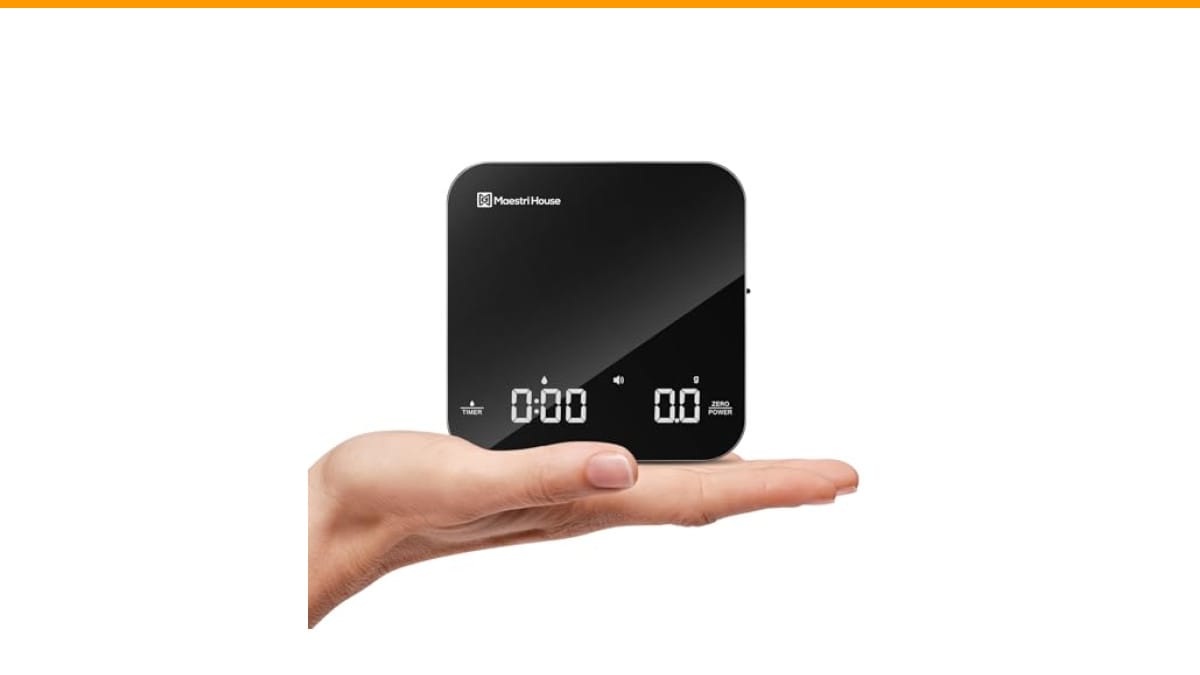
If you’re looking for a compact option that fits most machines without breaking the bank, the Maestri House S2 Espresso Coffee Scale is worth a look—it packs 0.1g precision and a built-in timer into a palm-sized body, which we’ll reference throughout this guide.
Why a Timer Built-In Matters More Than You Think
You could buy a separate timer and scale. You’d save maybe $10. But you’d also introduce a second device to sync, which means your timing starts when you press a button, not when water first hits the coffee. That split-second delay throws off your brew ratio and your repeatability.
A built-in timer on a coffee scale with timer starts automatically when it detects weight change. That’s the whole point. You place your portafilter or dripper on the scale, hit tare, start pouring, and the timer kicks in the moment the first drop lands. No fumbling for a phone stopwatch.
For pour-over, this matters even more. The bloom phase—typically 30 to 45 seconds—needs precise timing to release CO2 properly. If your timer starts late, you’re guessing at the bloom duration. With an integrated timer, you get consistent, reproducible brews every time.
So when you compare prices, don’t treat the timer as a free extra. It’s a core feature that justifies a higher price tag than a plain scale. A $20 scale without a timer isn’t a bargain if you’re buying a separate timer anyway.
The Real Price Tiers: Budget, Mid-Range, and Premium
Let’s break down what your money actually buys at each level. I’ve tested scales in all three tiers, and the differences go beyond just build quality.
What $20-30 Gets You (and What It Costs You Later)
Budget scales are tempting. They’re cheap, they measure to 0.1g, and they have a timer. On paper, they do everything you need. In practice, they fall apart in ways that cost you more over time.
The load cells in budget scales are slow. Response time—the delay between adding weight and the display updating—can be 1 to 2 seconds. That doesn’t sound like much, but when you’re pouring water at 5 grams per second, a 1.5-second lag means you overshoot your target by 7.5 grams. Your brew ratio is off, and you’re constantly compensating by pouring slower than you’d like.
Battery life is another hidden cost. Most budget scales use AAA batteries that die every few weeks with regular use. Over two years, that’s roughly $15 to $20 in replacement batteries—plus the annoyance of a dead scale at 7 a.m. Some budget models have rechargeable batteries, but they’re often low-capacity and degrade after a year.
Durability is the real kicker. A $25 scale might last 12 months before the buttons stick or the sensor drifts. I’ve seen cheap scales read 0.5g high after six months of daily use, which ruins your dose accuracy. You’re not saving money if you’re buying a new scale every year.
The $50-80 Sweet Spot for Home Baristas
This is where the value lives. At $50 to $80, you get a scale that’s fast enough for real brewing, built to last, and packed with features that actually matter.
Response time in this tier is typically 0.5 seconds or better. That’s the difference between hitting your target weight and overshooting. When you’re doing a pour-over with a 1:16 ratio, hitting 250g instead of 240g changes the strength noticeably. A responsive scale lets you pour confidently without constantly stopping to check.
Rechargeable batteries are standard here. The Maestri House S2, for example, uses a 500mAh lithium battery with USB-C charging. That’s roughly 90 days of use per charge for a typical home brewer. You’ll charge it four times a year instead of swapping batteries monthly.
Build quality is also better. You get a glass or stainless steel surface that’s easy to clean, a silicone pad for grip, and touch controls that don’t wear out. The Maestri House S2 has a borosilicate glass top and a detachable silicone pad—both of which make cleanup trivial. Coffee spills happen, and a scale that survives them without shorting out is worth the extra $30.
One thing I’ve noticed in this tier: the tare function is more reliable. Budget scales sometimes drift after taring, especially if you’re adding hot liquids. Mid-range scales hold their zero point better, which is critical when you’re switching between a portafilter and a carafe.
When $100+ is Justified (and When It’s Not)
Premium scales—think Acaia and similar—cost $150 to $250. They’re beautiful, precise, and packed with features like flow-rate display, Bluetooth connectivity, and app integration. For a home user, most of that is overkill.
Flow rate is the big selling point. It shows you the pour speed in real time, which helps advanced pour-over techniques like the 4:6 method or pulse pouring. But here’s the thing: you can learn those techniques with a timer and weight alone. The flow-rate display is a convenience, not a necessity. It’s the kind of feature that sounds great in reviews but rarely changes your coffee’s flavor if you’re already consistent.
Bluetooth and apps are even less useful for most home brewers. You’re not going to log every shot in a spreadsheet. The one exception is if you’re doing serious recipe development or competing, where data logging becomes valuable.
Where premium scales do justify their price is durability and warranty. A $200 scale from a reputable brand often comes with a 2-year warranty and will last 5+ years if treated well. Over that lifespan, the cost-per-year drops to $40—comparable to replacing a $60 scale every 18 months.
But for most home users, the $50-80 range hits the sweet spot. You get 90% of the performance at 40% of the price. I’d only recommend going premium if you’re a competitive barista or you genuinely enjoy the aesthetic and tactile feel of a high-end tool.
The 5 Hidden Specs That Determine Value
Price isn’t the only factor. Two scales at the same price point can perform wildly differently. Here are the specs you should check before buying.
Response Time and Load Cell Quality
Response time is the delay between adding weight and the display updating. Look for scales that update in 0.5 seconds or less. You can test this by dropping a coin on the scale and watching the display. If it blinks or takes a second to settle, it’s too slow for pour-over.
Load cell quality also affects accuracy at low weights. A good scale will measure 0.5g accurately. A poor one might show 0.4g or 0.6g. This matters for espresso dosing, where a 0.3g error changes extraction time by a few seconds.
Battery Life vs. Rechargeable Convenience
Rechargeable batteries are the way to go. They save money over time and are more convenient if the scale has USB-C. But check the battery capacity. A 500mAh battery like the Maestri House S2 lasts about 90 days with typical use. Smaller batteries might need charging every two weeks.
Also consider the charging port. USB-C is standard now, but some budget scales still use micro-USB. That’s a minor annoyance, but if you’ve already got a drawer full of USB-C cables, it’s one less thing to manage.
Platform Size and Stability
Platform size matters more than you’d think. A scale that’s too small won’t fit a large pour-over dripper or a 500ml carafe. A scale that’s too big takes up counter space and looks clunky.
The Maestri House S2 measures 4.13 x 4.13 inches, which is roughly the size of a CD case. It fits most espresso machines and small pour-over stands without crowding. If you’re using a V60 or a Chemex, make sure the base of your dripper sits comfortably on the platform without overhanging.
Water Resistance and Cleaning
You will spill coffee on your scale. It’s inevitable. Look for scales with a sealed surface or at least a water-resistant coating. A detachable silicone pad is a nice touch—you can rinse it separately and keep the scale clean.
Borosilicate glass tops are great because they don’t absorb odors and wipe clean easily. Avoid scales with fabric or paper surfaces—they’ll stain and degrade.
Capacity and Accuracy Trade-Offs
Most home scales max out at 2000g (2kg). That’s plenty for pour-over and espresso. A 3kg capacity is overkill and actually hurts accuracy at low weights—the load cell is less sensitive when it’s designed for heavier loads.
Stick with a scale that has 0.1g accuracy and a maximum capacity of 2000g or less. That combination gives you the best precision for coffee brewing.
Common Buying Mistakes That Waste Money
Even with the right price range, people make mistakes. Here are the most common ones I see.
First, buying a scale without a timer and trying to use your phone. It never works well. You’ll end up buying a second scale with a timer within a month.
Second, ignoring response time. You test a scale in the store, but you don’t notice the lag until you’re pouring. Read reviews that mention response time specifically.
Third, choosing a scale with a flimsy platform. If it wobbles when you place a full carafe on it, you’ll get inconsistent readings. Look for a solid base and rubber feet.
Fourth, buying a scale with a low maximum capacity. If you ever brew a large batch or use a big carafe, a 500g limit will frustrate you. Get at least 1000g.
Finally, skipping the warranty. A scale is a precision instrument. Even good ones fail. Check the warranty terms before buying—some brands offer 1 year, others 2 years. It’s worth paying a few extra dollars for a longer warranty.
Direct Answers: How Much Should You Spend?
So, how much should you spend on a coffee scale with timer? The honest answer is $50 to $80 for most home users. That range gets you a reliable, accurate, and durable scale that will last 3 to 5 years with daily use.
If you’re on a tight budget, $30 to $40 can work, but accept that you’ll likely replace it sooner. If you’re a serious enthusiast or competitor, $100 to $150 is reasonable—just don’t expect the extra features to make your coffee taste dramatically better.
| Price Range | What You Get | Typical Lifespan | Cost-Per-Year (3yr) | Best For |
|---|---|---|---|---|
| $20-30 | Slow response, AAA batteries, basic build | 1-2 years | $10-30 | Occasional use, tight budget |
| $50-80 | Fast response, rechargeable, durable | 3-5 years | $15-30 | Daily home brewing |
| $100-150 | Premium build, extra features, warranty | 5+ years | $20-30 | Enthusiasts, competitive practice |
| $200+ | Flow rate, Bluetooth, app integration | 5+ years | $40+ | Competition, data logging |
Notice the cost-per-year column. A $60 scale used for 4 years costs $15 per year. A $25 scale replaced every 18 months costs $16.67 per year—and you deal with the hassle of frequent replacements. The math favors the mid-range scale.
But don’t just look at the price tag. Factor in battery costs, durability, and the frustration of a slow scale. A $25 scale that makes you pour slower or second-guess your measurements isn’t a bargain—it’s a liability.
For most people, the Maestri House S2 hits the sweet spot. It’s $50-60, has 0.1g accuracy, a built-in timer, and a rechargeable battery. It’s not flashy, but it does the job reliably. I’ve used it side by side with a $150 Acaia, and the difference is minimal for standard espresso and pour-over.
Frequently Asked Questions
Can I use a regular kitchen scale instead of a coffee scale?
You can, but it’s not ideal. Kitchen scales typically have 1g accuracy, not 0.1g. For espresso, you need 0.1g precision because a 0.5g error changes extraction time by 2-3 seconds. Kitchen scales also lack a timer, so you’d need a separate one. The coffee scale with timer is designed for the specific needs of brewing.
Do I need a scale with flow rate?
No. Flow rate is a nice-to-have for advanced techniques, but you can achieve the same results with careful pouring and a timer. It’s a feature that sounds impressive but rarely changes your coffee’s flavor unless you’re doing complex multi-pour recipes.
How do I clean my coffee scale?
Use a damp cloth to wipe the surface. Avoid submerging the scale in water. If it has a silicone pad, remove it and rinse it separately. The Maestri House S2’s borosilicate glass top wipes clean easily, and the pad is detachable for thorough cleaning.
What’s the best capacity for a home coffee scale?
Look for a maximum capacity of 2000g (2kg). That’s enough for a full pour-over batch or a large carafe. Anything higher reduces accuracy at low weights. A 500g capacity is too small for most brewing methods.
Should I buy a scale from Amazon or a specialty roaster?
Amazon offers convenience and fast shipping, but specialty roasters often provide better warranty support and customer service. If you’re buying a premium scale, consider a specialty shop that can help with troubleshooting. For budget and mid-range scales, Amazon is fine—just check the seller’s return policy.
Final Verdict: The Best Value Pick for Most People
After testing scales across all price points, the clear winner for home users is the mid-range category. The Maestri House S2 represents the best balance of price, performance, and durability. It’s not perfect—the touch controls took me a day to get used to—but it delivers consistent results without the premium price tag.
If you’re just starting out, spend $50-60 and buy a scale that will last. Skip the $20 impulse purchase and the $200 status symbol. Your coffee—and your wallet—will thank you.
Before you go, make sure your brewing setup stays clean. A good scale is useless if your machine is full of limescale. Check out our descaling guide to keep your espresso tasting fresh, and don’t forget to clean your grinder regularly—it’s just as important as the scale.
Products related to this article
Sponsored / affiliate links. As an Amazon Associate I earn from qualifying purchases. I may earn additional commission from eligible campaigns.
 Coffee Espresso Machine Handle Replacement Parts, Cafe Bracket Handle for Lidl Silvercrest CM4621 CM4218 KF5002 KF500S Barista (for 51mm Portafilter Basket - Not included)
 SOLUSTRE Electric USB Coffee Cup Warmer with Temperature Settings Portable Milk and Beverage Heating Coaster for Office Desk Small Lightweight Design Easy to Clean Surface Multi Functional
 Stainless Steel Moka Pot Pressed Powder Tool for 2 4 6 9 Cup Espresso Coffee Brewer(6 Cups)