You just unpacked a compact espresso machine, and the counter looks great. Then reality hits: the manual is thin, the portafilter feels tiny, and you’re not sure if you should tamp harder or lighter. Most people give up after a few bitter or watery shots. That’s a shame, because a compact machine can pull a genuinely good espresso once you understand its quirks.
This guide walks through the entire process, from water prep to milk texturing, with the specific numbers and habits that matter. You’ll learn why grind size matters more than pressure, how to avoid the overheating trap that plagues small machines, and what to do when your shots run too fast or too slow. No fluff, just the stuff that works.

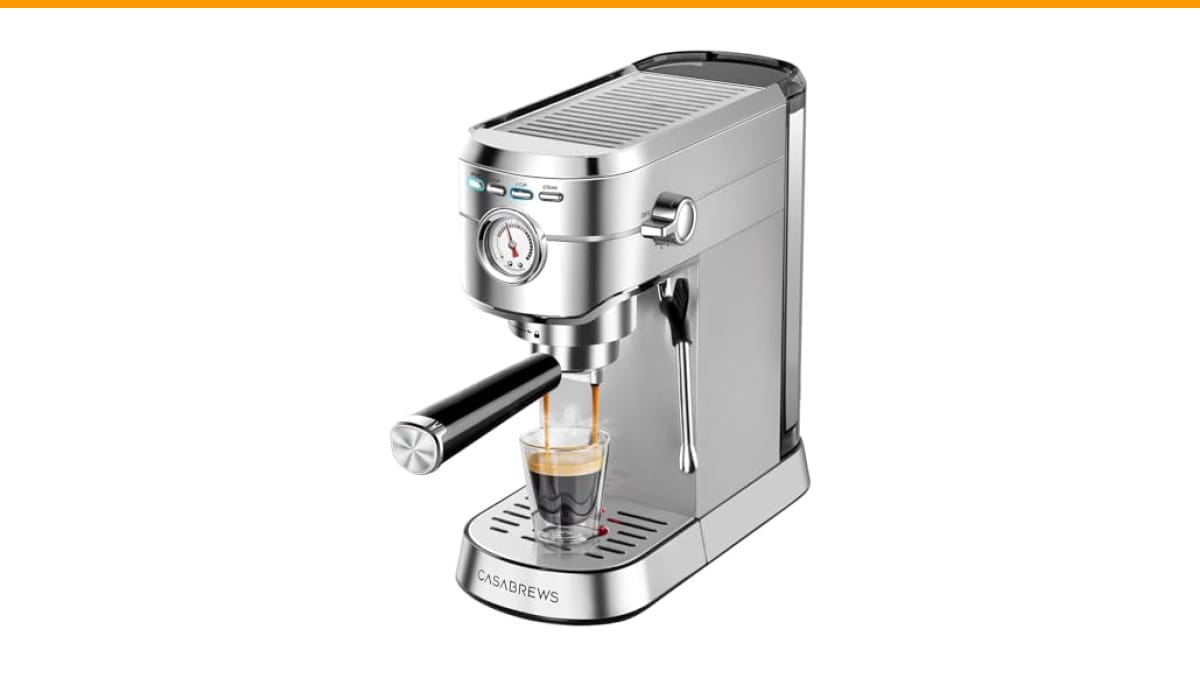
CASABREWS
CASABREWS CM5418 Compact Espresso Machine with Milk…
- Make Your Favorite Espresso Coffee At Home: The CASABREWS coffee machine with milk frother allows you to prepare all your favorite…
- Professional 20 Bar Pressure System: Semi-Automatic 2-in-1 Espresso Maker, with 20 bar professional Italian pump and 1350 W powerf…
- Milk Frothing System: Our espresso machine with milk frother has a powerful steam wand, so you can texture creamy, rich microfoam…
As an Amazon Associate I earn from qualifying purchases.
If you’re using a machine like the CASABREWS CM5418 Compact Espresso Machine, the principles here apply directly. Its 20-bar pump and 1350 W boiler are typical of this class, and the built-in pressure gauge gives you real feedback while you pull a shot. That’s a feature you’ll appreciate once you start dialing in.
What Actually Makes a Good Compact Espresso Machine Shot?
Compact machines have a reputation for weak, sour espresso. Most of the time, that’s not the machine’s fault. It’s the grind. These machines need a fine, consistent grind, but not as fine as you’d use for a commercial lever machine. If your shots gush out in 10 seconds, your grind is too coarse. If they drip like a leaky faucet, it’s too fine.
You’re aiming for a shot that takes 25–30 seconds from the moment you hit the brew button. That timing assumes the water is at the right temperature, which is another common issue. Small boilers heat up fast, but they also lose heat quickly. Give the machine a full 10 minutes to warm up, not 3. Run a blank shot (no coffee) through the portafilter to heat the group head and your cup. That simple step stabilizes temperature more than anything else.
Water quality matters too. Hard water will scale up your boiler in weeks, not months. Use filtered or bottled water if your tap is hard. And always use fresh beans, ground right before brewing. Pre-ground coffee goes stale in days, and you’ll never get the crema you’re after.
One more thing: don’t ignore the pressure gauge. On machines like the CASABREWS, the gauge shows you the pressure during extraction. Ideal range is 9–10 bar. If it reads lower, your grind is too coarse or your tamp is light. If it pegs high, ease up on the tamp or grind slightly coarser. That gauge turns guesswork into data.
Step-by-Step: Pulling a Shot on a Compact Machine
Here’s the routine I use every morning, and it works on any semi-automatic compact machine.
- Heat everything. Turn on the machine, wait for the lights to stop blinking. Run a blank shot with the portafilter locked in and an empty cup underneath. This warms the group head and the cup.
- Weigh your dose. For a single basket, use 7–9 grams. For a double, 14–18 grams. Weighing beats scooping every time. A cheap kitchen scale is worth it.
- Grind fine. You want the texture of table salt, slightly finer. If your grinder has settings, start in the middle and adjust from there.
- Distribute and tamp. Tap the portafilter gently to level the grounds, then tamp with even pressure. Aim for 30 pounds of pressure — about the force you’d use to push a heavy door closed. Don’t twist at the end; that can crack the puck.
- Lock and brew. Lock the portafilter in, place your cup, and hit the 1-cup or 2-cup button. Watch the gauge. Adjust the grind for the next shot based on timing and taste.
- Stop at the right volume. For a double, 36–40 grams of liquid out (about 2 ounces) is the target. If your machine runs automatic, you may need to stop it manually once you hit that weight.
The first shot after a long pause will be off. That’s normal. Pull one and toss it, or use it for a flat white where the milk hides imperfections.
Crema should be golden-brown and thick enough to hold a spoon. If it’s pale and thin, your beans are old or your grind is too coarse. If it’s dark with brown spots, your grind is too fine and the shot is over-extracted.
Frothing Milk on a Compact Steam Wand
Compact machines have short steam wands, and that changes your technique. You can’t get the same deep pitcher angle as on a commercial machine. But you can still make silky microfoam — it just takes practice.
Start with cold milk. Whole milk textures best, but 2% works too. Oat milk is trickier; it needs a lighter hand. Fill your pitcher no more than one-third full. Any more and it will overflow when the milk expands.
Purge the wand first. Let steam shoot out for 2–3 seconds to clear any water condensation. Then submerge the tip just below the surface, at about the 2 o’clock position.
Turn the steam on full. You’ll hear a paper-tearing hiss — that’s the air being folded in. Keep the tip at the surface for 3–5 seconds, or until the milk has grown about 50% in volume. Then lower the pitcher so the tip is deeper, creating a whirlpool that blends the foam. Watch the thermometer: stop at 140°F (60°C). Any hotter and the milk scorches, and the sweetness dies.
Tap the pitcher on the counter to pop big bubbles, then swirl it. The milk should look like wet paint, glossy and uniform. If you see big bubbles, you aerated too long or too fast. Next time, keep the tip closer to the surface for less time.
Here’s the catch with compact machines: they overheat quickly. The CASABREWS manual warns about this, and it’s real. After frothing, the machine needs a few minutes to cool down before you brew again. If you ignore this, the machine may go into protection mode and flash the 1-cup or 2-cup lights. Let it rest, and it resets. Plan your workflow so you brew first, then steam, then clean up. That way you’re not waiting between shots.
Comparing Compact Machines vs. Full-Size Semis
I’ve used both, side by side, for weeks. Compact machines have trade-offs you should know about before you buy.
| Factor | Compact Semi-Automatic | Full-Size Semi-Automatic |
|---|---|---|
| Footprint | Fits under a cabinet, easy to store | Needs dedicated counter space |
| Warm-up time | 5–10 minutes | 15–20 minutes |
| Steam power | Adequate for one pitcher, but slow | Strong, can steam while brewing |
| Temperature stability | Can overheat after steaming; needs cooldown | Dual boilers or heat exchangers hold steady |
| Pressure gauge | Often present (cheap to add) | Common on mid-range models |
| Best for | 1–2 drinks at a time, small kitchens | Multiple drinks, back-to-back shots |
| Price range | Lower entry cost | Higher, but more durable internals |
The biggest difference I noticed is workflow. On a full-size machine, you can pull a shot and steam milk simultaneously. On a compact, you do them one after the other, and you have to wait between. That’s fine for a single latte. It’s frustrating if you’re making drinks for four people.
The other thing is temperature. Compact machines use smaller boilers, which means temperature drops when you pull a shot. You can compensate by warming the group head and using a thicker cup. But if you’re chasing perfection, a full-size machine holds temperature better.
On the plus side, compact machines are genuinely easy to live with. They heat up faster, take up less space, and cost less. For a daily driver or a first espresso machine, they’re a smart pick.
Troubleshooting Common Compact Machine Problems
You’ll hit issues. Here’s what they mean and what to do.
Shot runs too fast (10 seconds). Grind finer. If that doesn’t help, increase your dose by a gram. Also check that you’re tamping evenly — a tilted tamp creates channels and fast flow.
Shot runs too slow (40+ seconds). Grind coarser. Also check for stale beans. Old coffee produces slow, bitter shots. If your machine has a descaling cycle, run it — scale buildup can restrict flow.
No crema. Old beans are the usual culprit. Fresh beans should give you crema even with a mediocre grind. If your beans are fresh, try a slightly finer grind.
Machine flashes lights after steaming. That’s the overheating protection. Turn it off, wait 10 minutes, and try again. Don’t brew right after steaming.
Water leaks from the portafilter. The group head seal may be worn, or you’re not locking the portafilter in all the way. Check the gasket for cracks. If it’s fine, lock it in with a bit more force.
For deeper issues like persistent leaks or loud noises, check our guides on leaking water and loud noises. Most fixes are simple, but some need a professional.
Maintenance That Keeps a Compact Machine Alive
Compact machines are more forgiving than full-size ones when it comes to maintenance, but they still need care. Here’s the minimum.
- Rinse the portafilter and basket after every use. Coffee oils go rancid and ruin flavor.
- Run a water-only shot through the group head once a day to flush out residue.
- Wipe the steam wand with a damp cloth immediately after frothing. Milk residue is sticky and hard to remove later.
- Deep clean the steam wand weekly. Remove the tip and soak it in warm water with a drop of dish soap.
- Descale every 1–3 months, depending on your water hardness. Use a commercial descaler, not vinegar — vinegar can damage rubber seals.
- Change the water in the tank daily. Stale water breeds bacteria and adds off-flavors.
If you skip descaling, scale builds up inside the boiler and the machine loses pressure. That’s when shots get weak and the machine starts making weird noises. Regular descaling prevents most of those problems. For a deeper clean, follow our deep clean guide once a month.
Frequently Asked Questions
Can I use pre-ground coffee in a compact espresso machine?
Yes, but it’s not ideal. Pre-ground coffee is usually ground for drip machines, which is too coarse for espresso. You’ll get a fast, weak shot. If you must use pre-ground, look for an ‘espresso’ grind, and use a pressurized basket if your machine has one. Those baskets create fake crema and forgive a coarse grind. Most compact machines come with a pressurized basket as standard.
Why does my espresso taste sour?
Sour taste means under-extraction. The water didn’t pull enough flavor out of the coffee. Grind finer, increase your dose, or make sure your water is hot enough. A sour shot often happens when the machine hasn’t warmed up fully. Give it the full 10 minutes, not 2.
How long should a shot take on a compact machine?
For a double shot, 25–30 seconds is the sweet spot. That’s from when the pump starts to when you stop. If it’s faster, your grind is too coarse. If it’s slower, your grind is too fine. Use the pressure gauge to confirm — you want 9–10 bar on most machines.
Do I need a separate grinder for espresso?
Yes, if you want good results. Blade grinders chop beans unevenly, which leads to bitter and sour flavors at the same time. A burr grinder gives you a consistent particle size, which is essential for espresso. Even an inexpensive hand burr grinder beats a blade grinder. If you’re serious, look for one with fine adjustments.
Why does my machine stop working after I steam milk?
That’s the overheating protection. Compact machines have small boilers, and steaming raises the temperature above brewing range. The machine shuts down to protect itself. Wait 10–15 minutes, and it will reset. To avoid this, brew your shot first, then steam. If you need to brew again, let the machine cool down before starting.
What I’d Tell a Friend Buying a Compact Machine
- Warm up for 10 minutes, not 2. It’s the single biggest flavor upgrade.
- Weigh your dose. 18 grams in a double basket beats a scoop any day.
- Grind fine, but not too fine. Aim for table salt texture.
- Use the pressure gauge. It’s your feedback loop.
- Brew first, steam second. Avoid the overheating shutdown.
- Clean the steam wand after every use. Milk residue is your enemy.
- Descale every 1–3 months. Scale kills compact machines faster than anything.
Compact machines aren’t perfect, but they’re a solid entry point. Learn their rhythm, and you’ll be pulling shots that surprise you. When you’re ready to upgrade or just want to compare options, check our guide on automatic vs. semi-automatic machines. And if you’re shopping on a budget, our best under $1000 list has some real winners.
Products related to this article
Sponsored / affiliate links. As an Amazon Associate I earn from qualifying purchases. I may earn additional commission from eligible campaigns.
 Coffee Espresso Machine Handle Replacement Parts, Cafe Bracket Handle for Lidl Silvercrest CM4621 CM4218 KF5002 KF500S Barista (for 51mm Portafilter Basket - Not included)
 SOLUSTRE Electric USB Coffee Cup Warmer with Temperature Settings Portable Milk and Beverage Heating Coaster for Office Desk Small Lightweight Design Easy to Clean Surface Multi Functional
 Wrenmor Replacement Handle For Coffee Espresso Moka Stove Pot, Black Plastic Accessory Compatible With 1/3/6/9/12 Cup Sizes For Easy Installation And Long-Lasting Use(1 Cup)