You twist the handle, feel the burrs catch, and wait for that familiar warmth on the outside of the chamber. It never comes. So you start to wonder if something is broken. Is your manual coffee grinder not heating because it’s defective? Or did you miss a step?
Here’s the short answer: a manual grinder is supposed to stay cool. Heat is the enemy of coffee flavor. When beans get hot from friction, they release oils faster, which can turn your cup bitter before you even add water. Electric grinders fight this with slower speeds and metal housings that act as heat sinks. A manual grinder doesn’t have that problem because you are the motor, and you simply aren’t fast enough to generate dangerous heat.

CEVING
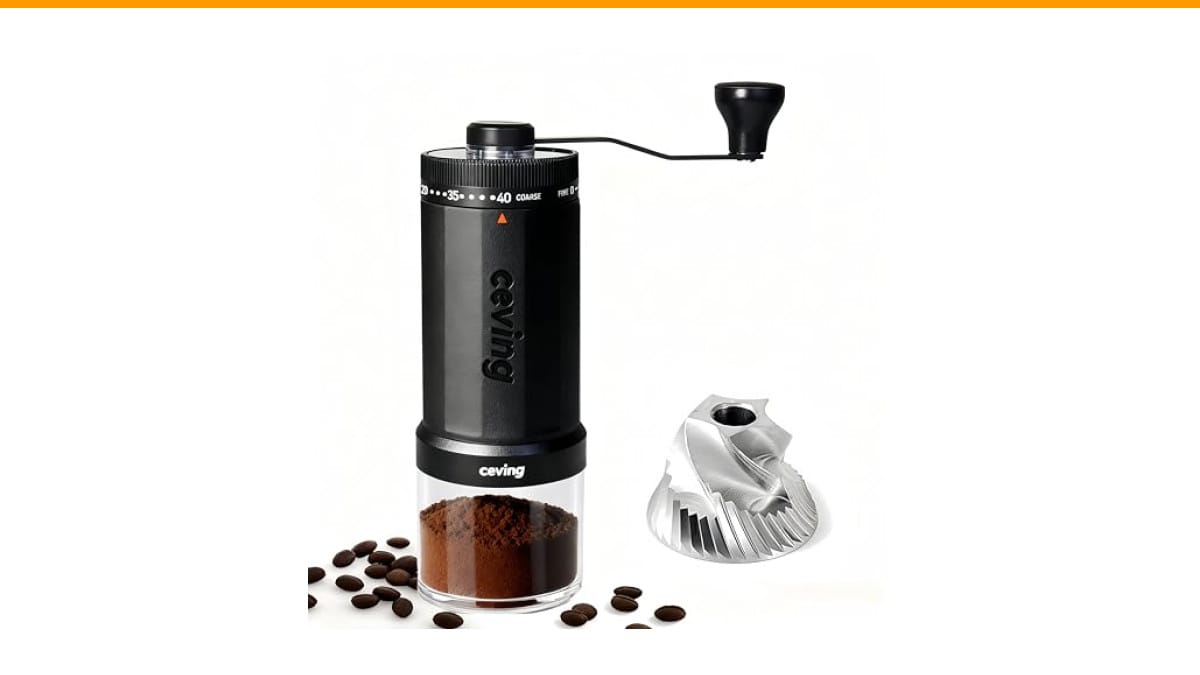
CEVING World's First 60g Large Capacity Manual…
- Tired of small batches? Meet the world's first manual grinder with a massive 60g capacity—Hold twice the beans of the standard gri…
- 40 EXTERNAL SETTINGS - DIAL IN PERFECT BREWS INSTANTLY. Our external click-ring delivers 40 precise settings—effortlessly switch f…
- MASTER-LEVEL PRECISION - LAB-ACCURATE GRINDS, BARISTA-APPROVED FLAVOR. Each click adjusts by just 0.05mm—the finest difference det…
As an Amazon Associate I earn from qualifying purchases.
What you’ll walk away knowing: why heat happens (or doesn’t), what a warm grinder actually means, how to tell if your grinder is working correctly, and when you should genuinely worry about performance. We’ll also look at one specific grinder that sidesteps the usual capacity complaints.
If you’re tired of grinding twice just to fill a French press, the CEVING 60g manual coffee grinder holds twice the beans of a standard unit. That means one session instead of two, which also means less time holding the handle and less chance of your arm getting tired. It’s a practical fix for a real annoyance, especially if you brew for more than one person.
Why Your Grinder Feels Cool (And Why That’s a Win)
Friction creates heat. That’s basic physics. When two surfaces rub together, energy turns into warmth. In a coffee grinder, the burrs are doing the rubbing. But here’s the thing: the amount of heat depends on speed and pressure, not just effort.
An electric grinder spins at 500 to 1,000 RPM. A manual grinder tops out around 100 to 150 RPM with a steady hand. That’s five to ten times slower. Less speed means less friction per second. Your hand simply cannot generate the same thermal load as a motor.
So if your manual coffee grinder isn’t heating up, that’s not a defect. It’s a design advantage. The beans are being cut, not smashed. The oils stay inside the grounds where they belong, and your cup tastes cleaner.
Compare that to a blade grinder, which chops at 20,000 RPM and turns beans into dust while warming the whole chamber. If you’ve ever felt a blade grinder after twenty seconds, you know the difference. The burr vs blade comparison on this site covers that trade-off in more detail.
What a Warm Grinder Actually Means
You’ll occasionally feel warmth on a manual grinder. That’s normal in a few specific situations.
First, if you’re grinding very dark roasted beans, they’re brittle and dense. They resist the burrs more, which creates extra friction. Second, if you’re grinding for espresso, the fine setting means the burrs are nearly touching. That close contact generates more heat than a coarse setting for French press.
Third, if you’re grinding more than 30 grams without a break, the metal parts absorb heat from continuous work. The handle might feel slightly warm, but the chamber should never get hot to the touch. If it does, you’re pushing too hard or the burrs are misaligned.
A quick test: grind 20 grams of medium roast at a medium setting. Stop and touch the outside of the chamber. It should feel room temperature or barely warm. If it’s noticeably hot, check that the burr carrier is seated properly. A loose or crooked burr will rub against the housing, creating heat that has nothing to do with the beans.
How to Test Your Grinder’s Performance Without a Thermometer
You don’t need a laser thermometer to know if your grinder is working right. You need your eyes and your taste buds.
Grind 18 grams of coffee at a medium setting. Look at the grounds. Are they uniform? Do you see a mix of fine powder and large chunks? Some variation is normal, but if you see half the batch looking like flour and half looking like cracked pepper, the burrs are dull or the alignment is off. That’s a bigger problem than heat.
Next, time yourself. A decent manual grinder should handle 18 grams in about 30 to 60 seconds. If it takes three minutes, either the burrs are dull or you’re using a blade grinder in disguise. Slow grinding isn’t about heat; it’s about efficiency.
Finally, brew a cup. If the coffee tastes flat or hollow, the grind might be too fine, which causes over-extraction. If it tastes sour, the grind is too coarse. Neither of those issues has anything to do with temperature. They’re about particle size and consistency.
If your grinder is genuinely struggling, check the cleaning routine. Oils and residue build up over time and make the burrs work harder. A simple brush-down after each use and a deep clean every few weeks keeps things smooth. Our step-by-step cleaning guide walks you through it without taking the whole unit apart.
When Heat Does Become a Problem
There is one scenario where heat matters: very fine grinding for espresso. At that setting, the burrs are close enough to touch during part of the rotation. Friction goes up, and you might feel warmth after a 20-gram dose. That’s not a failure. It’s physics.
But if the grinder becomes uncomfortable to hold, you have a real issue. That usually means the burrs are rubbing against each other, not cutting the beans. This happens when the adjustment ring is set too fine for the bean size, or when the burr carrier is worn down.
Here’s a quick test: set the grinder to its coarsest setting and run it empty. Listen. You should hear a clean whir, not a metallic scraping sound. If you hear scraping, stop using it immediately. Running it that way will damage the burrs and generate serious heat.
Also, don’t ignore the handle. If the handle gets hot, that’s a sign of bearing friction, not bean friction. A drop of food-safe lubricant on the axle usually fixes that. Just make sure it’s rated for contact with coffee.
| Symptom | Likely Cause | What to Do |
|---|---|---|
| Chamber stays cool, grinds fine | Normal operation | Keep going, nothing to fix |
| Slight warmth on dark roasts | Bean density and friction | Grind in shorter bursts, let it rest |
| Hot to the touch after fine grind | Burrs too close or misaligned | Adjust coarser, check burr seating |
| Handle gets hot | Bearing friction | Lubricate the axle with food-safe oil |
| Scraping sound, no heat | Burrs rubbing metal on metal | Stop use, inspect or replace burrs |
That table covers the common scenarios. The takeaway is simple: a cool grinder is a healthy grinder. Heat is a warning sign, not a feature.
Does Grinder Capacity Change the Heat Equation?
Not really. Heat comes from friction, not volume. Grinding 60 grams at once vs. 30 grams twice takes the same total energy. The difference is that a larger chamber lets you grind continuously without stopping to empty it.
That’s where the CEVING 60g manual grinder earns its keep. You load a full batch, grind once, and you’re done. No mid-grind pause to dump grounds into a separate container. For a French press or cold brew batch, that saves a solid minute and keeps your workflow clean.
It also has 40 external click settings, which means you can switch from espresso to pour-over without opening the grinder. That’s a minor convenience that becomes major when you’re dialing in a new bag of beans. And the stainless steel burrs hold their edge longer than ceramic ones, which means less friction over time and fewer heat issues down the road.
Common Questions About Manual Grinder Heat
Is it normal for a manual grinder to get warm at all?
Yes, slightly. If you’re grinding a dark roast at a fine setting for more than 30 seconds, the metal parts will absorb some warmth. That’s normal. The key is the word slightly. If you can hold the grinder comfortably in your palm, you’re fine. If you need a towel, something is wrong.
Can heat ruin my coffee grounds?
Heat accelerates oxidation. That’s why stale coffee tastes flat. But the heat from a manual grinder is nowhere near the level that causes oxidation. You’d need to exceed 60°C (140°F) to start degrading the oils noticeably. A manual grinder won’t get there unless you’re grinding for several minutes non-stop. Don’t do that.
Why does my electric grinder get hot but my manual one doesn’t?
Motor speed. Electric grinders spin fast, and fast means friction. Manual grinders rely on your arm, which is slow and steady. The trade-off is time. You spend more effort, but you get cooler grounds. That’s one reason many coffee enthusiasts prefer manual grinders for single doses.
Should I worry about the burrs wearing out from friction?
All burrs wear eventually. Steel burrs last longer than ceramic ones, but they’re not immortal. If you notice your grind becoming less consistent over time, or if the grinder starts taking noticeably longer, check the burrs for dull edges. A good set of steel burrs should last several years with regular home use.
Does a larger capacity grinder take longer to grind?
No. Grinding 60 grams takes roughly twice as long as grinding 30 grams, but you do it in one session. The burrs don’t work harder per bean. The only difference is the chamber size. If anything, a larger chamber lets you apply more consistent pressure because you’re not stopping and starting.
What to Remember Next Time You Grind
- A cool grinder is working correctly. Heat is not a sign of quality.
- Dark roasts and fine settings will warm the body slightly. That’s expected.
- If the grinder gets hot to the touch, check burr alignment, not the beans.
- Scraping sounds mean stop. Metal-on-metal contact damages burrs fast.
- Clean your grinder regularly. A dirty burr set works harder and heats up more.
- If you’re grinding for a crowd, a 60g capacity grinder like the CEVING model cuts your grinding time in half.
- Trust your hands. If it feels normal, it probably is.
Manual grinding is a tactile experience. You feel every bean crack and crunch. That feedback is useful. Use it. And if you run into other grinder issues down the line, the Bodum grinder troubleshooting guide covers similar territory for electric models.