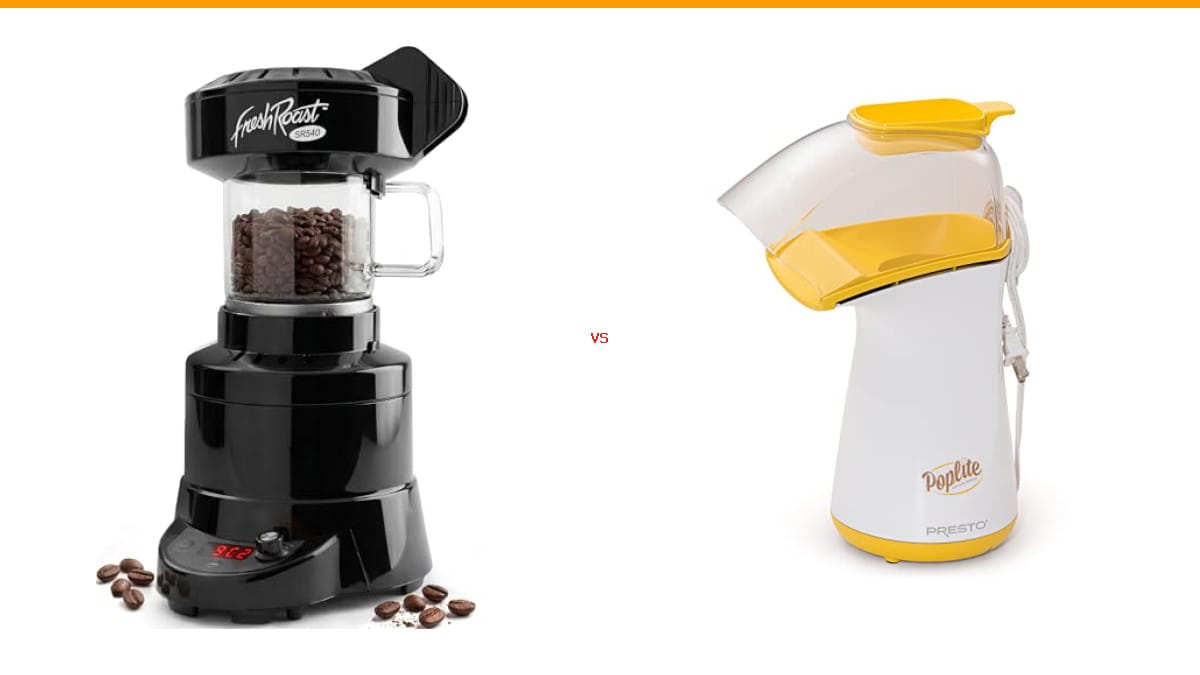
You want fresh roasted coffee. You saw a video of someone pouring green beans into a popcorn popper, and another showing a slick machine with digital readouts. Now you are stuck comparing a $30 kitchen gadget against a purpose-built roaster. This decision matters because it sets up your entire morning routine for the next few years.
| Our Pick | Runner Up |

|
|
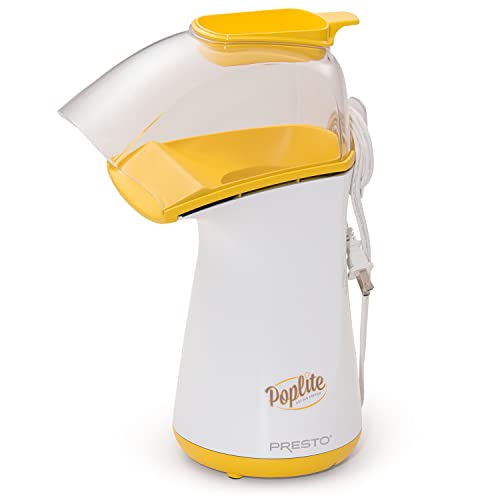
| Fresh Roast Fresh Roast SR540 Automatic Coffee Bean Roaster… | Presto Presto 04820 PopLite Hot Air Popcorn Popper |
| See on Amazon | See on Amazon |
As an Amazon Associate I earn from qualifying purchases.
The short answer: the Fresh Roast SR540 wins for anyone who wants control and consistency. The Presto PopLite works, but it is a compromise that gets old fast. I have used both, and the gap is wider than the price difference suggests. Let me show you exactly where they differ.
The $30 Question: Why This Comparison Matters
People compare these two because they both use hot air to roast beans. The principle is the same: hot air circulates around green coffee, driving off moisture until the beans crack and turn brown. The execution could not be more different.
Your decision hinges on how much you value control. The Presto is a single-speed hot air blower with a plastic chute. The Fresh Roast has variable heat settings, fan control, and a real-time temperature display. One is a toy that happens to roast coffee. The other is a tool built for the job.
I roasted about two pounds of beans through each over a month. I burned batches, made decent light roasts, and learned the quirks of both. Here is what actually matters.
| Feature | Fresh Roast SR540 | Presto PopLite |
|---|---|---|
| Batch capacity | 120 grams (about 4 scoops) | About 70-80 grams if you do it right |
| Heat control | 9 power levels | Single fixed temperature |
| Fan control | Variable convection fan | Fixed speed |
| Temperature display | Real-time digital readout | None |
| Roast time | Under 10 minutes | 3-5 minutes (too fast for control) |
| Chaff collection | Built-in chaff collector | Chaff flies everywhere |
| Smoke management | Some smoke, manageable | Lots of smoke near second crack |
| Materials | Glass roasting chamber | Plastic base and chute |
| Original purpose | Coffee roasting | Popcorn |
Air Popcorn Popper: The Fast and Frugal Route
The Presto PopLite is a classic. It pops 18 cups of popcorn in about 2.5 minutes, and it does that job well. As a coffee roaster, it is a hack. A fun hack, but a hack.
I started with this method because it was cheap. I already owned one. I dumped in 70 grams of green beans, pointed a box fan at the window, and waited. The first crack came around the 3-minute mark. The whole roast finished by minute five. That is too fast.
Pros and Cons
Pros: It is nearly free if you already own one. It is compact and stores easily. Cleanup is simple since you do not use oil. It works in a pinch.
Cons: No temperature control. No fan speed adjustment. The plastic chute can melt if you run it too long. Chaff goes everywhere. You cannot slow the roast down to develop flavor. The batch size is small, so you will roast often.
The ‘First Crack’ Problem: Speed vs. Control
Here is the core issue. Coffee needs a gradual temperature climb. You want to hit first crack around 8-10 minutes for a balanced cup. The Presto blasts through that in half the time. The result is a roast that tastes baked or grassy, with little acidity and a flat body.
You can try to fix this by plugging the popper into a dimmer switch. I did that. It gives you some control, but the heating element and fan are wired together. Drop the power, and the fan slows too. Beans stop moving and scorch. It is a frustrating workaround.
I also had to deal with smoke. Every roast produced enough smoke to set off the kitchen alarm. The plastic housing gets hot enough to worry about. It works, but it never feels safe.
Pick the Presto if… you want to try home roasting for under $30 and you are okay with inconsistent results. It is a gateway drug, not a long-term solution.
Dedicated Roaster: The Fresh Roast SR540
The Fresh Roast SR540 is a real coffee roaster. It has a glass chamber, a digital display, and separate controls for heat and airflow. It costs more, but it solves the problems the Presto creates.
My first batch was a medium roast of a Guatemalan bean. I set the power to level 7, kept the fan on medium, and watched the temperature climb. The display showed 390°F as first crack started around minute 7. I dropped the heat to level 5 and let it develop for another two minutes. The result was a clean, sweet cup with noticeable acidity.
Pros and Cons
Pros: Nine heat settings give real roast profile control. The variable fan keeps beans moving without stalling. The digital temperature display takes the guesswork out. The chaff collector contains the mess. It roasts up to 120 grams, enough for a week of coffee.
Cons: It costs significantly more. The chaff collector is a bit flimsy. It still produces smoke, so you need ventilation. The cooling cycle is short, so you should transfer beans to a metal pan quickly.
Mastering the Controls: Heat and Airflow
The SR540 lets you adjust heat and fan independently. That is the big deal. You can run high heat with low airflow to develop body, or low heat with high airflow for a brighter, lighter roast. The Presto cannot do any of that.
It took me a few roasts to get the hang of it. My first batch stalled because I set the fan too high and the heat too low. The second batch ran away because I did the opposite. By the third roast, I had a rhythm. The learning curve is real, but the payoff is consistency.
The machine is built for countertop use. It is not huge, but it takes up more space than the Presto. The glass chamber lets you watch the beans change color, which is both useful and satisfying.
Pick the Fresh Roast SR540 if… you plan to roast regularly and want to learn the craft. It gives you room to grow without jumping to a $1,000 machine.
Head-to-Head: Air Popper vs. Dedicated Roaster
Batch Size and Throughput
The Fresh Roast handles 120 grams per batch. The Presto realistically handles about half that. If you drink two cups a day, that is a roast every three or four days with the SR540. With the Presto, you will roast every other day. The extra capacity alone saves time.
Roast Profile Control (Light vs. Dark)
This is where the Fresh Roast wins outright. You can stretch a roast to 10 or 12 minutes, which develops sugars and reduces grassy notes. You can also push into second crack for a dark roast without burning the beans. The Presto hits second crack so fast that the beans often taste burnt and smoky, not roasty.
Cleanup and Maintenance
The Presto is easier to clean. You wipe the base and chute, and you are done. The Fresh Roast has a chaff collector that needs emptying and a glass chamber that needs wiping. Neither is hard, but the SR540 takes an extra minute per roast.
Total Cost of Ownership
Green coffee costs the same regardless of your roaster. The real cost difference is the machine. The Presto is a fraction of the price. But you will likely replace it after a few months because the results are poor. The Fresh Roast costs more upfront but lasts for years. Factor in the cost of ruined batches and frustration, and the dedicated roaster is the better value.
Electricity use is negligible for both. The Presto runs shorter but at full power. The Fresh Roast runs longer but at variable power. It is a wash.
The Verdict: Which One Should You Buy?
Buy the Fresh Roast SR540. It is the better tool for the job. The control over heat and airflow translates directly to better coffee. The Presto is fine for a single experimental batch, but it is not a roasting solution.
I kept my Presto for popcorn. I use the Fresh Roast for coffee. That is the honest division of labor.
If you are on a tight budget, start with the Presto. Just know you will upgrade. If you can stretch the budget, skip the intermediate step and get the SR540. You will save money in the long run.
Safety Checklist for Both Methods
Roasting coffee produces smoke and chaff. Both are fire hazards if ignored. Here is how to stay safe with either machine.
- Roast near an open window or under a range hood. Smoke gets thick near second crack.
- Keep the machine away from curtains and paper towels.
- Do not leave the roaster unattended. Roasts go from light to burnt in under a minute.
- Let the machine cool completely before storing it.
- Empty the chaff collector after every roast. Chaff is flammable.
- Do not use an extension cord with the Presto. It draws high wattage.
Neither machine is dangerous if you pay attention. But both need ventilation. Do not roast in a closed kitchen.
FAQ: Quick Answers for Beginners
Can I really use an air popcorn popper for coffee?
Yes, but only the hot air type like the Presto. Stir-crazy or oil-based poppers will ruin the beans. The results are inconsistent, and you have no control over temperature. It is a starting point, not a destination.
How much coffee can I roast at once?
The Fresh Roast SR540 handles 120 grams, which is about 4 scoops. The Presto handles about half that. Roasting more than that in the Presto causes uneven roasts and stalled beans.
What is first crack, and why does it matter?
First crack is the sound beans make when internal pressure builds and the bean structure expands. It sounds like popcorn popping. It marks the start of the light roast range. Second crack is a quieter, oilier snap that indicates a darker roast. You want to hear first crack around 7-9 minutes for best flavor.
Do I need to buy special green coffee beans?
Yes. You cannot roast the brown beans from the grocery store. You need green, unroasted beans. They stay fresh for about two years, so you can buy in bulk. Look for organic or fair trade varieties if that matters to you.
Beyond the Popper: When to Upgrade to a Dedicated Roaster
You will know when the Presto is not enough. The moment you want a specific roast level and cannot achieve it, that is the signal. The Fresh Roast SR540 is the natural next step. It gives you the controls to chase a particular flavor profile without spending thousands.
If you get serious, you will eventually want a drum roaster or a larger fluid bed machine. But that is a conversation for another day. For now, the SR540 is the best balance of price, control, and capacity for a home user.
Before you buy, make sure your grinder can handle the fresh beans. A good burr grinder makes a huge difference. If you are still using a blade grinder, check out our grinder comparison to see why it matters. And if you are dealing with bitter coffee from a recent roast, our guide on bitter coffee causes might help you dial in your brew.
Roasting at home is a hobby that pays for itself in flavor. The Fresh Roast SR540 makes that hobby enjoyable. The Presto makes it a chore. Choose the tool that matches your commitment.
Products related to this article
Sponsored / affiliate links. As an Amazon Associate I earn from qualifying purchases. I may earn additional commission from eligible campaigns.
 Quick Heating Cup Warmer, Three Temperature Settings, Splashproof and Portable, for Coffee, Milk, Lightweight ABS Material
 HomeBeyond Espresso Coffee Maker 12 Cups, Classic Stovetop Espresso Maker, 600ml / 20oz Coffeemaker for Gas & Ceramic Stovetops (Silver)
 House Gem Coffee Mug Warmer for Desk, Candle Warmer Plate, 12H Timer, Wood