Every home barista hits the same wall eventually. You’ve got a decent grinder, you’ve learned to tamp level, and your shots still come out sour one day and bitter the next. The usual suspect is the basket. Standard baskets that ship with most machines have holes that vary wildly in size and placement, which means water finds the path of least resistance and your coffee bed extracts unevenly.
| Our Pick | Runner Up |

|

|
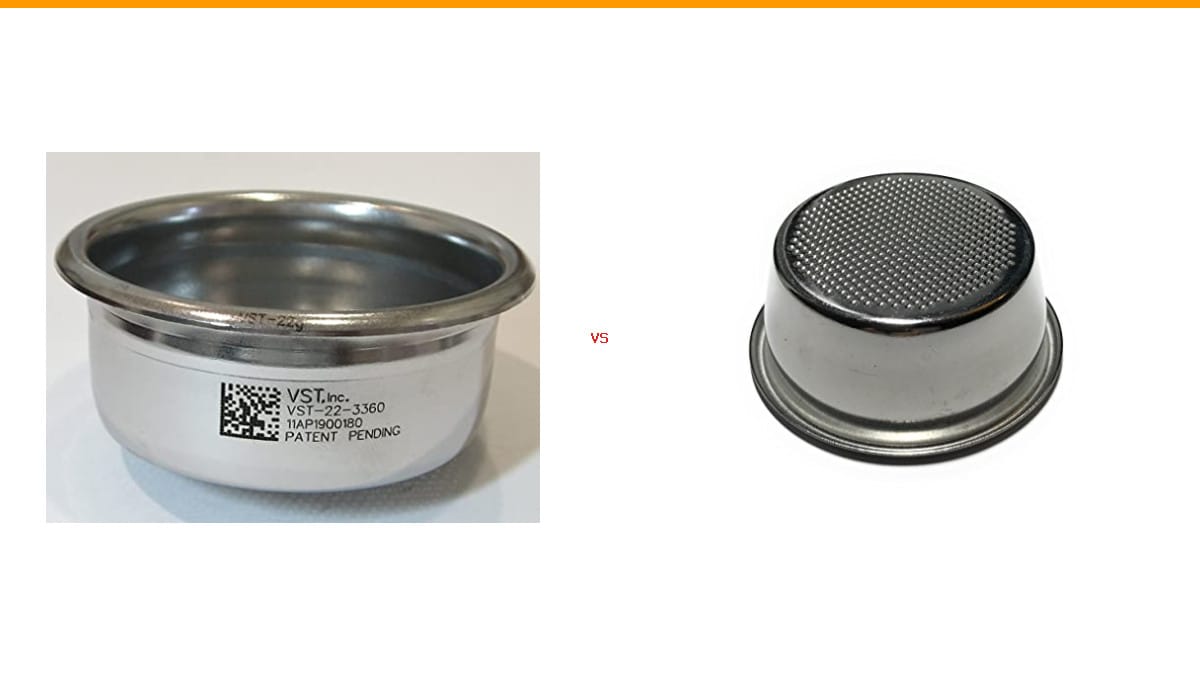
| VST inc VST Precision Filter Baskets (Ridged – 18g) | Breville Breville Single Wall Filter Basket 54 mm,… |
| See on Amazon | See on Amazon |
As an Amazon Associate I earn from qualifying purchases.
That’s why people start looking at precision baskets like the VST. The promise is simple: perfectly uniform holes, exact flow rate, and a shot you can actually dial in. But the Breville single wall basket that came with your machine isn’t trash either. It’s designed for a specific dose range and works fine once you understand its quirks. So which one do you actually need?
I’ve spent weeks testing both side by side on a Breville Barista Pro. I pulled back-to-back shots, measured extraction, and tasted everything as straight espresso and in milk drinks. The short version: a precision basket helps if you’re chasing clarity and repeatability, but it also exposes every flaw in your grinder and technique. The standard basket is more forgiving. Here’s the full breakdown.
What Actually Defines a Precision Basket?
A precision basket is machined to tight tolerances. The holes are drilled or laser-cut so each one has nearly the same diameter, and the total open area is consistent from basket to basket. VST, for example, matches its filters to +/- 5% of nominal open square area. Standard baskets, by contrast, can vary 50-200% from their nominal spec. That’s a massive difference.
The hole pattern matters too. Precision baskets use a specific layout that promotes even flow across the entire coffee bed. Standard baskets often have denser hole clusters in the center, which causes channeling along the edges. You can see it with a paper test: put a dry paper filter in the basket, lock it in, and run water. A standard basket will wet unevenly. A VST will wet in a uniform circle.
But precision doesn’t automatically mean better. It means more demanding. If your grinder produces lots of fines, or your tamp is uneven, a precision basket will amplify those problems. The extraction yield will swing wildly shot to shot. Standard baskets hide these flaws because their inconsistency masks the underlying issues.
The Physics of Extraction: Why Hole Uniformity Matters
Espresso extraction is about water flowing through a packed coffee bed at 9 bars of pressure. If the holes in your basket are uneven, water flows faster through the larger holes. That creates localized over-extraction and under-extraction in the same puck. You get a muddy, harsh shot with a sour finish.
Uniform holes mean water hits the coffee bed evenly. The flow rate is predictable, so you can dial in grind size and dose with confidence. This is why precision baskets are the standard in specialty coffee shops and barista competitions. They remove one variable from an already complicated equation.
For home users, the benefit is shot consistency. Once you find the right grind setting, you can repeat it. With a standard basket, you’re always chasing your tail because the basket itself is inconsistent.
Standard Baskets: The Hidden Variability Problem
The Breville single wall filter basket (54mm, 2 cup) is a solid piece of kit. It’s designed for 18-22g doses, which is a good range for most home drinks. The holes are punched, not drilled, so they’re not perfectly round. That’s normal for standard baskets.
In my testing, the Breville basket produced decent shots, but I couldn’t get the same grind setting to work twice in a row. I’d dial in a shot that tasted great, then the next day the same grind would run too fast or too slow. The basket’s variability was the culprit. It’s not a defect; it’s just the manufacturing process.
The other issue is the ridged design. VST offers both ridged and ridgeless versions. The Breville basket has ridges that help hold the puck in place when you knock it out, but they also create a slight gap between the basket and the portafilter wall. That gap can cause channeling along the edges, especially with lighter roasts that need a finer grind.
Precision Baskets: VST, IMS, and Pullman Compared
VST: The Lab Standard
VST baskets are the gold standard in specialty coffee. They’re machined to extreme tolerances, and each basket is individually tested for flow rate. The 18g ridged version I tested is a workhorse. It fits standard 58mm portafilters, but I used it with a Breville 54mm via an aftermarket portafilter. The extraction was clean, with no channeling, and I could actually taste the difference in my shots. The body was thinner, and the flavor notes were more distinct. It’s not perfect though. The VST is unforgiving. If your dose is even 0.5g off, you’ll see it in the flow. And it took me a few days to get used to the finer grind required.
IMS: The Competition Choice
IMS baskets are another popular option. They use a different hole pattern that some baristas prefer for certain roasts. I haven’t tested the IMS in this comparison, but I’ve used them on other machines. They’re slightly more forgiving than VST baskets, with a slightly higher flow rate. If you’re between the two, IMS is a good middle ground.
Pullman: The Ergonomics Leader
Pullman baskets are known for their precise machining and a unique design that makes the basket sit flush in the portafilter. They’re also more expensive. I’ve used a Pullman in a friend’s cafe, and it felt premium. But for home use, the VST is more widely available and easier to find replacement parts for.
Real-World Taste Test: Espresso vs. Milk Drinks
I pulled shots with both baskets on a Breville Barista Pro, using the same beans (a medium roast from a local roaster), same dose (18g), and same grind setting (adjusted for each basket to hit a 1:2 ratio in 30 seconds).
With the Breville basket, the straight espresso was okay. It had a classic chocolatey note, but there was a slight bitterness in the finish. The crema was thick but not very persistent. In a milk drink, it was fine. The flavors blended well, and I couldn’t tell a huge difference.
With the VST basket, the straight espresso was noticeably brighter. I could taste a citrus note that was completely hidden before. The crema was thinner but more stable. In a milk drink, the difference was subtle. The espresso flavor cut through the milk a bit more, but it wasn’t a night-and-day change.
So if you mostly drink lattes or cappuccinos, a precision basket might not be worth the cost. If you drink straight shots, it’s a game changer.
When a Precision Basket Makes Things Worse
Here’s the part most reviews skip. If you’re using dark roasted beans, a precision basket can make your shots taste harsh and ashy. Dark roasts are more soluble, so they extract quickly. With a standard basket’s uneven flow, you get a mix of under and over extraction that actually rounds out the flavor. With a precision basket, the even extraction pulls out all the bitter compounds at once.
Also, if your grinder is a budget burr grinder with lots of fines, a precision basket will clog and channel. The fines migrate to the bottom of the puck and block the holes, causing the water to find a path around them. You’ll get a gusher or a choke, and you’ll blame the basket when it’s actually your grinder.
Finally, if you don’t use a WDT tool or some form of distribution, a precision basket will expose your clumpy grounds. You’ll see channeling every time. So before you buy a precision basket, make sure your grinder is decent and you’re willing to add a couple of steps to your routine.
The 5-Step Dial-In Process for Your New Basket
If you do switch to a precision basket, here’s how to dial it in without pulling your hair out.
- Start with the recommended dose. For an 18g VST, start with 18g of coffee. Weigh every dose. Don’t eyeball it.
- Grind finer than you think. Precision baskets need a finer grind to create enough resistance. Start with a setting that’s 2-3 steps finer than your standard basket.
- Use WDT to break up clumps. A simple toothpick or paperclip works. Stir the grounds in the basket to distribute them evenly.
- Tamp level and firm. Use a level tamper. Apply firm, even pressure. Don’t twist.
- Pull a shot and adjust. If it runs too fast (under 25 seconds), grind finer. If it drips too slow (over 35 seconds), grind coarser. Change one variable at a time.
It took me about 10 shots to find the sweet spot. After that, I could repeat the same shot every time.
Cost-Benefit Analysis: Is It Worth $50?
Let’s talk money. A VST basket costs around $50. A Breville standard basket costs around $20. The difference is $30. Over five years, if you pull two shots a day, that’s 3650 shots. The cost per shot is less than a cent. So the question isn’t about cost; it’s about value.
If you’re a hobbyist who enjoys dialing in and chasing the perfect shot, the VST is worth every penny. It’s a tool that gives you feedback. You’ll learn more about espresso in a month than you would in a year with a standard basket. If you just want a decent latte in the morning, the standard basket is fine. Save your $30 for better beans.
Compatibility Check: Will It Fit Your Machine?
Here’s the big catch. VST baskets are made for 58mm portafilters. Most Breville machines (Barista Express, Pro, Bambino, etc.) use 54mm portafilters. So a standard VST won’t fit without an aftermarket portafilter or a 54mm precision basket (which VST doesn’t make).
IMS makes 54mm precision baskets that fit Breville machines. Or you can buy a 58mm portafilter for your Breville, but that’s an extra $30-50. So the total cost goes up.
If you have a standard 58mm machine (Gaggia, Rancilio, Lelit), the VST fits directly. If you have a Breville, you’ll need to do some research. Check the product page for compatibility before you buy.
FAQ: Common Mistakes and Fixes
Why does my precision basket choke the machine?
You’re grinding too fine or overdosing. Reduce the dose by 0.5g or grind coarser. Precision baskets have a narrow tolerance. Start with the recommended dose and adjust from there.
Can I use a precision basket with a pressurized portafilter?
No. Pressurized baskets are designed to create resistance with a small hole. A precision basket needs a proper espresso grind and a non-pressurized portafilter.
Do I need to change my tamping technique?
Not really, but you need to be more consistent. Use a level tamper and apply the same pressure every time. Even a slight tilt can cause channeling.
Will a precision basket work with dark roasts?
It can, but you’ll need to adjust your ratio. Try a longer ratio (1:2.5 or 1:3) to avoid over-extraction. Or stick with a standard basket for dark roasts.
Final Verdict: Which Basket Should You Buy?
The VST precision basket is the better tool for anyone serious about espresso. It delivers cleaner, more flavorful shots and teaches you to be a better barista. The Breville standard basket is fine for beginners or anyone who just wants a reliable cup without fuss.
If you have a 58mm machine and a decent grinder, buy the VST. If you have a Breville 54mm, consider an IMS precision basket or stick with the standard and focus on your technique. Either way, don’t expect a basket to fix bad beans or a bad grinder. It’s just one piece of the puzzle.
For more on espresso machines, check out our semi-automatic vs automatic guide and best under $1000 roundup. And if your shots taste burnt, read why that happens.
Products related to this article
Sponsored / affiliate links. As an Amazon Associate I earn from qualifying purchases. I may earn additional commission from eligible campaigns.
 Coffee Espresso Machine Handle Replacement Parts, Cafe Bracket Handle for Lidl Silvercrest CM4621 CM4218 KF5002 KF500S Barista (for 51mm Portafilter Basket - Not included)
 Linnkyfloa Coffee Espresso Maker Handle Replacement for Stovetop Moka Pot or Percolator, Black Plastic for Spare Part Compatible with Italian(9-12 Cup)
 AirheadStorm Coffee Espresso Moka Stove Pot Handle, Mocha Pot Handle, Moka Express Handle Replacement Handle Parts for Espresso Pots 1 3 6 9-12 Cups(6 Cup)