You just finished a shot and noticed the extraction time has crept from 25 seconds to 40. The pump sounds strained, and the steam wand sputters. Your espresso machine is telling you it needs a descale. You reach for the generic coffee machine descaler under the sink, then stop. Will it work? Or will it wreck a machine you paid serious money for?
This is the question that trips up more home baristas than almost any other maintenance topic. The short answer is yes, you can use coffee machine descaler on espresso machines — but only if the acid chemistry matches your machine’s boiler material. Use the wrong acid and you risk pitting the boiler, voiding the warranty, and ruining the taste of your coffee for months. This guide breaks down exactly what’s inside different descalers, which ones are safe for which machines, and how to descale without causing damage.

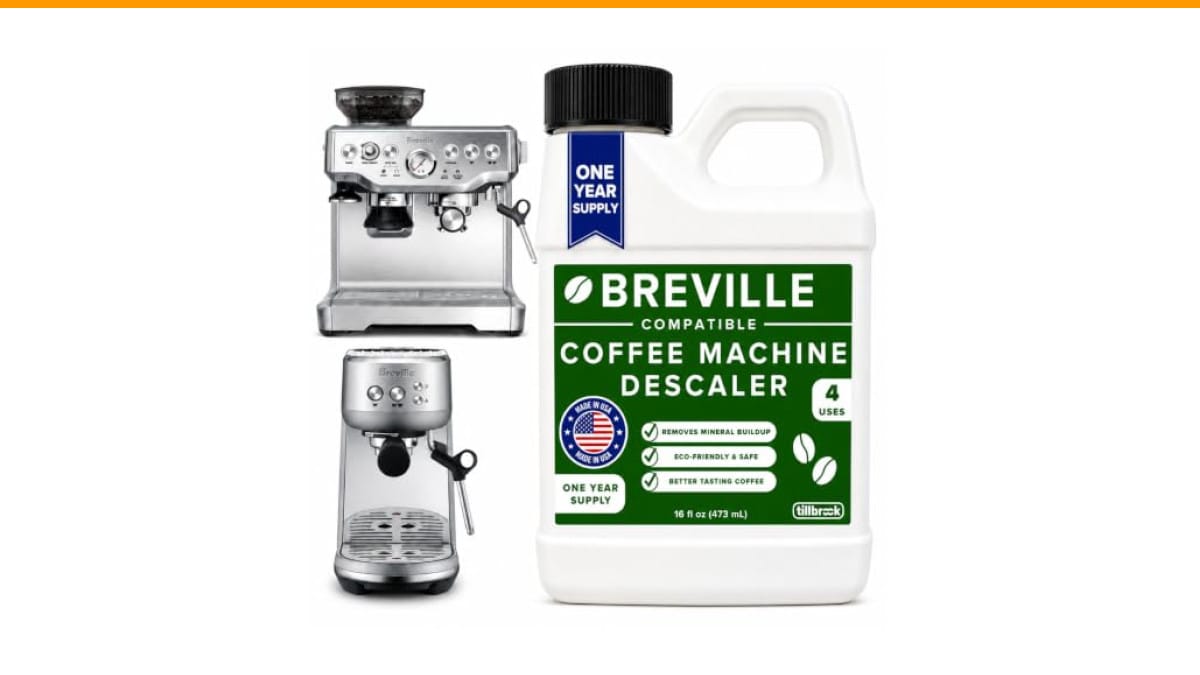
Tillbrook
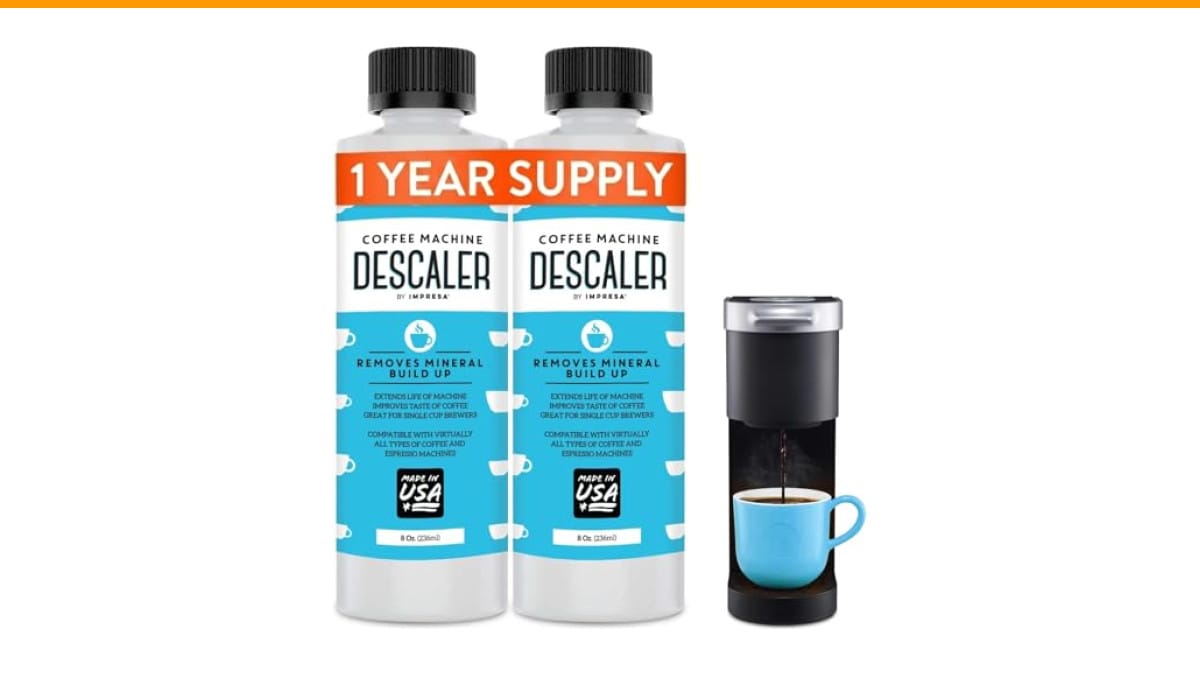
Breville Espresso Machine Compatible Descaler, 4 Uses,…
- EXCEPTIONAL RESULTS: Introducing Tillbrook Coffee Machine Descaler specifically formulated for Breville—the best choice for removi…
- 1 YEAR SUPPLY: Our concentrated formula is easy to use and provides remarkable value with 4 cleanings per bottle. Simply add 1/2 c…
- SCIENTIFICALLY ENGINEERED: Our advanced descaling solution is carefully crafted with powerful, all-natural ingredients that remove…
As an Amazon Associate I earn from qualifying purchases.
If you’re shopping for a safe option, the Tillbrook Breville-Compatible Descaler is formulated for espresso machines and tested across most major brands. It uses a food-grade acid blend that handles limescale without attacking brass or aluminum components. We’ll get into why that matters in a moment.
The Short Answer: Yes, But With Critical Caveats
Most coffee machine descalers will physically run through an espresso machine. The liquid goes in the reservoir, the pump pushes it through the group head, and it comes out the other side. That doesn’t mean it’s safe for your machine.
Espresso machines operate at 9 bars of pressure and heat water to 195–205°F. The boiler and internal tubing are made of brass, aluminum, or stainless steel. Different acids interact with these metals in very different ways. A descaler that works fine in a $30 drip coffee maker can eat through the aluminum boiler of a $600 espresso machine in a single cycle.
The critical caveats are:
- Boiler material matters more than brand name. Check your machine’s manual or manufacturer website before choosing a descaler.
- Dilution ratios are not interchangeable. Espresso machines need a weaker acid solution than drip machines because of the metal exposure.
- Rinse cycles are non-negotiable. Leftover acid residue will leach into your coffee and can cause gastrointestinal irritation.
Why “Coffee Machine Descaler” Is a Misleading Label
Manufacturers slap the same label on products designed for completely different machines. A drip coffee maker has a plastic water path, a heating element, and no real pressure. An espresso machine has a metal boiler, a pump, and precision valves. The descaling requirements are not the same.
Generic coffee machine descalers often use citric acid as the active ingredient. Citric acid is cheap, effective on limescale, and safe for plastic and stainless steel. But it’s aggressive on aluminum and can corrode brass fittings over time. Many espresso machine manufacturers — including Breville, Gaggia, and Rancilio — explicitly warn against citric acid-based descalers.
The label also hides concentration differences. A “concentrated” descaler for drip machines might be 30–50% acid. Espresso machine descalers are typically formulated at 10–20% acid because the contact time with metal parts is longer and the boiler is sealed. Using a high-concentration product on an espresso machine is like using bleach to clean a countertop — it works, but it damages the surface.
The Chemical Breakdown: What’s Actually Inside Your Descaler
Descalers work by dissolving calcium carbonate and magnesium deposits — the scale that builds up when hard water is heated. The active acid determines how fast that happens and what collateral damage occurs.
Acid Types and Their Effects on Brass and Aluminum Boilers
Here’s the chemistry you need to know, without the PhD:
- Citric acid: Found in many generic descalers. Great for drip machines, but it chelates aluminum ions, meaning it pulls metal particles into solution. On an aluminum boiler, repeated use thins the walls and can cause pinhole leaks. On brass, it’s less harmful but still not ideal.
- Sulfamic acid: The workhorse of commercial espresso machine descalers. It’s a strong acid but has a low reaction rate with brass and stainless steel. This is the acid used in most products from Urnex, Puly Caff, and similar brands. It’s the safest choice for brass boilers.
- Lactic acid: A milder organic acid used in some eco-friendly descalers. It’s safe on most metals but slower-acting. You’ll need longer descaling cycles or repeated applications for heavy scale.
- Phosphoric acid: Common in food-grade descalers. Effective on scale and safe for stainless steel, but it can darken brass and leave a film if not rinsed thoroughly.
- Acetic acid (vinegar): The home remedy that everyone tries once. It’s too weak to remove heavy scale in a single pass, and the smell lingers in the boiler for weeks. Some manufacturers void warranties if vinegar is used.
If you own a machine with an aluminum boiler — common in entry-level models from Delonghi and some older Gaggia units — your options are narrower. Look for a descaler explicitly labeled as safe for aluminum. Most espresso-specific descalers are, but double-check the label.
The Real Risks of Using a Generic Descaler
I’ve seen the aftermath of a citric acid descale on an aluminum boiler. The machine worked fine for two weeks, then started leaking from the bottom. When opened up, the boiler had hairline cracks — the acid had thinned the metal from the inside. The repair cost more than the machine was worth.
Beyond catastrophic failure, there are subtler risks:
- Pump damage: Undissolved scale particles can get pulled into the pump and score the internal vanes. A descale that loosens scale but doesn’t flush it out properly can make pump noise worse, not better.
- Valve sticking: The three-way solenoid valve that releases pressure after a shot has tiny passages. Acid residue can cause the valve to stick, leading to dripping from the group head or pressure issues.
- Warranty voidance: Most manufacturers require descaling with their recommended product or an equivalent. If you use a generic descaler and the boiler fails, the warranty claim gets denied. Document your descaling with photos of the product and date stamps.
- Off-taste that won’t go away: Some acids bind to metal ions and create compounds that taste metallic or bitter. A thorough rinse usually fixes this, but heavy scale combined with the wrong acid can leave a permanent taint in porous brass.
How to Check If Your Descaler Is Safe for Your Espresso Machine
Before you pour anything into your reservoir, do a two-minute check:
- Find your boiler material. Look in the manual under “specifications” or search the model number online. If you can’t find it, email the manufacturer’s support and ask directly.
- Read the descaler label for the active acid. If it lists citric acid and your boiler is aluminum, stop. If it lists sulfamic or lactic acid, you’re likely safe.
- Check for the words “espresso machine safe” or “for all espresso machines.” This is a marketing claim, but it’s usually backed by testing. Be wary of products that say “for all coffee makers” without specific espresso mention.
- Look for a dilution ratio. If the label says “use full strength” or “no dilution,” it’s not meant for espresso machines. Espresso descalers always require dilution.
When in doubt, buy a product specifically formulated for espresso machines. The Tillbrook descaler is a good example — it’s labeled for espresso machines, uses a food-grade formula, and comes with clear dilution instructions. It’s not the cheapest option on the shelf, but it won’t cost you a new boiler either.
Step-by-Step: Descaling Your Espresso Machine Safely
Once you’ve confirmed your descaler is safe, the process is straightforward. Here’s the method that works for most single-boiler and heat-exchange machines. Dual-boiler machines have additional steps, which we’ll cover after this.
Pre-Rinse and Preparation
Start by removing the portafilter, basket, and any removable parts. Run a blank shot (water only, no coffee) through the group head to warm the machine and clear loose debris. This also tells you if the pump is working normally before you add acid.
For the steam wand, purge it for 10 seconds. You want any milk residue gone before the acid hits it — acid and milk proteins create a sticky mess that’s hard to remove.
The Descaling Cycle
Mix your descaler according to the label. Most espresso descalers use a ratio of 1 part solution to 3–4 parts water. Pour it into the reservoir.
Run the machine with the portafilter in place (no coffee) and a blank basket. Run about 2 ounces through the group head, then stop. Let the machine sit for 15–20 minutes. This soak time lets the acid work on scale that’s baked onto the boiler walls. Don’t skip the soak — running the full cycle without pausing just pushes acid through without dissolving much.
After the soak, run the rest of the reservoir through the group head in 4-ounce increments. Alternate between the group head and the steam wand — open the steam valve for 10 seconds, close it, then run more water through the group. This flushes acid through both paths.
Critical Rinse Phase
This is where people mess up. You need to run at least two full reservoirs of clean water through the machine. Not one. Two. If you can still smell acid in the steam wand output, run a third.
Fill the reservoir with fresh water, run it all through the group head, then purge the steam wand for 30 seconds. Refill and repeat. The rinse water should taste flat and neutral before you pull your next shot.
For dual-boiler machines, the process is the same but you must descale each boiler separately. Some machines have a dedicated descale mode that cycles through both. Check your manual. If you have a dual boiler without a descale mode, you’ll need to run the descale solution through the brew boiler, then repeat with the steam boiler. This is more involved and worth doing carefully — a partially descaled dual boiler will have uneven temperature stability.
What to Do If You Already Used the Wrong Descaler
Mistakes happen. If you already ran a citric acid descaler through your aluminum boiler, here’s your damage control plan:
- Rinse immediately and thoroughly. Run three full reservoirs of clean water through the machine. This dilutes any remaining acid and stops the corrosion process.
- Backflush with plain water. If your machine has a blind basket, run 3–4 backflushes with clean water. This clears acid from the group head and solenoid valve.
- Inspect for leaks. After the rinse, run the machine for 10 minutes and check under the drip tray and around the boiler for moisture. Small leaks now will become big problems later.
- Document everything. Take photos of the descaler bottle, the date, and the machine’s condition. If you need to file a warranty claim, this evidence shows you attempted maintenance in good faith.
- Watch for changes. If extraction time gets longer, pump noise increases, or you see scale flakes in your cup, the corrosion may have loosened scale that’s now circulating. You’ll need a proper descale with the right product.
In most cases, a single wrong descale won’t kill the machine immediately. But repeated use of the wrong acid will. If you’re unsure whether your machine is damaged, have a technician inspect it before the next descale.
Water Hardness: The Missing Variable in Your Descaling Schedule
Manufacturers say “descale every 3 months” because that’s the safe average. But your water hardness determines the actual frequency. If you have soft water, you might go six months between descales. If you have very hard water, you might need one every month.
Here’s how to test your water hardness at home:
- Use a test strip. You can buy water hardness test strips online or at a pool supply store. Dip one in your tap water and compare the color. They cost about $10 for a pack of 50.
- Check your local water report. Most municipalities publish annual water quality reports online. Look for “total hardness” measured in grains per gallon (gpg) or parts per million (ppm).
- Observe your kettle. If your tea kettle accumulates white scale within a week, you have hard water. If it stays clean for months, you have soft water.
Use this rule of thumb: soft water (under 1 gpg) means descale every 6 months. Moderate (1–3 gpg) means every 3–4 months. Hard (3–7 gpg) means every 2 months. Very hard (over 7 gpg) means monthly, or consider using filtered or bottled water.
Water filters help but don’t eliminate the need for descaling. A filter removes some minerals but not all. If you use a filter, you can stretch the descale interval by about 50%.
The Bottom Line on Descaler Compatibility
Using a coffee machine descaler on an espresso machine is possible, but it’s not a one-size-fits-all situation. The acid type, concentration, and your boiler material all determine whether you’re cleaning the machine or damaging it.
Here’s what to remember:
- Check your boiler material before buying descaler. Aluminum boilers need a descaler labeled safe for aluminum. Brass and stainless steel can handle sulfamic acid.
- Avoid citric acid for espresso machines. It’s too aggressive on aluminum and not ideal for brass. Stick with sulfamic, lactic, or phosphoric acid formulas.
- Dilute properly. Espresso descalers are concentrated. Follow the label ratio exactly. More acid doesn’t mean a better clean — it means more risk.
- Rinse twice minimum. Acid residue ruins coffee taste and can damage seals. Two full reservoirs of clean water is the baseline.
- Test your water hardness. Your descaling schedule should be based on your water, not a generic calendar reminder.
- Document your maintenance. Photos and dated notes protect your warranty claim if something fails.
- When in doubt, buy a product made for espresso machines. The Tillbrook descaler is a solid choice that won’t leave you second-guessing. Check the current price on Amazon and keep a bottle on hand.
For more on keeping your machine in top shape, read our guide on descaling at home and our tips for long-term machine care. If you’re hearing unusual noises, our article on loud espresso machines covers common causes.
Products related to this article
Sponsored / affiliate links. As an Amazon Associate I earn from qualifying purchases. I may earn additional commission from eligible campaigns.
 Coffee Espresso Machine Handle Replacement Parts, Cafe Bracket Handle for Lidl Silvercrest CM4621 CM4218 KF5002 KF500S Barista (for 51mm Portafilter Basket - Not included)
 Linnkyfloa Coffee Espresso Maker Handle Replacement for Stovetop Moka Pot or Percolator, Black Plastic for Spare Part Compatible with Italian(9-12 Cup)
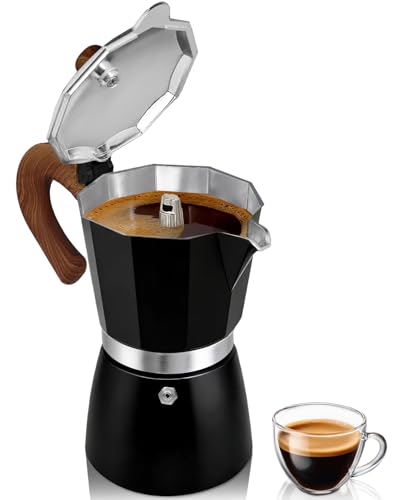 Belly Moka Coffee Maker Stovetop Espresso Maker 9 Cup Aluminum Moka Pot Percolator 15oz 450ml Easy Brewing for Electric Ceramic Stoves Home Camping Italian Cuban Café Classic Black