You’re standing in the aisle or scrolling through tabs, and every French press looks the same: a glass cylinder, a metal plunger, a handle. Then you read the reviews and one person swears by a $20 model while another claims you need a $100 one. The truth is messier than that, and the right choice depends less on price and more on how you actually drink coffee.
This guide walks through the decisions that matter—glass vs. stainless steel, filter fineness, capacity, and even your tap water—so you can pick a press that fits your routine, not someone else’s. I’ve tested presses side by side, brewed hundreds of cups, and broken more carafes than I’d like to admit. Here’s what I’ve learned.

Veken
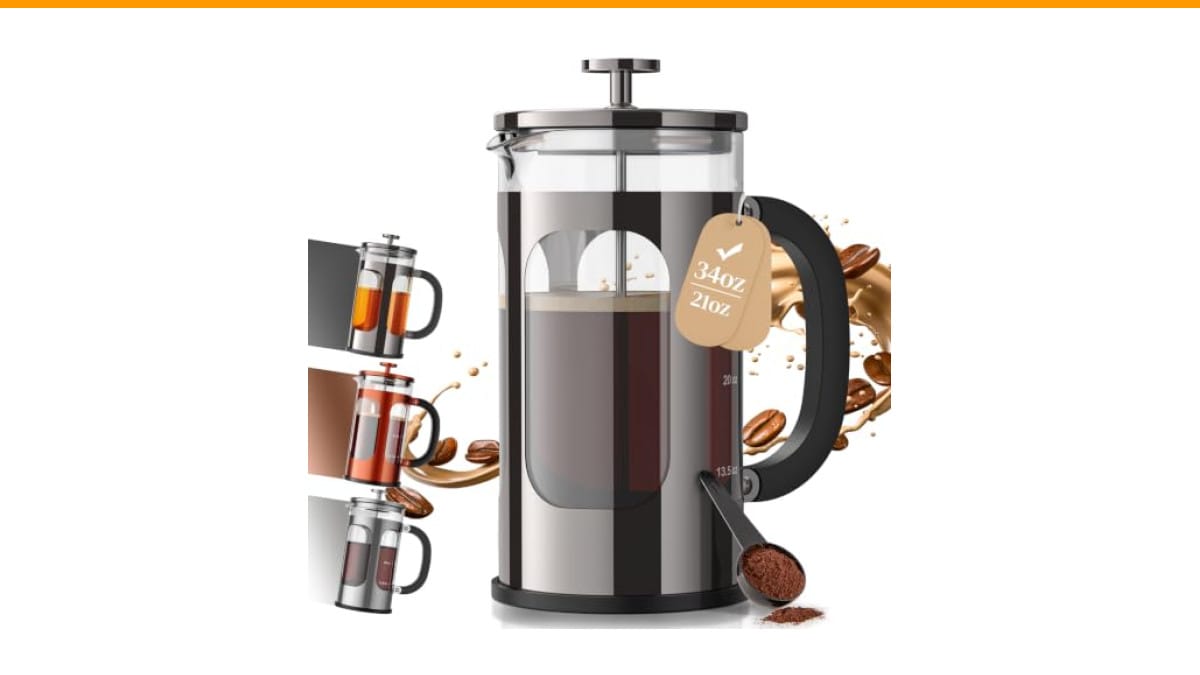
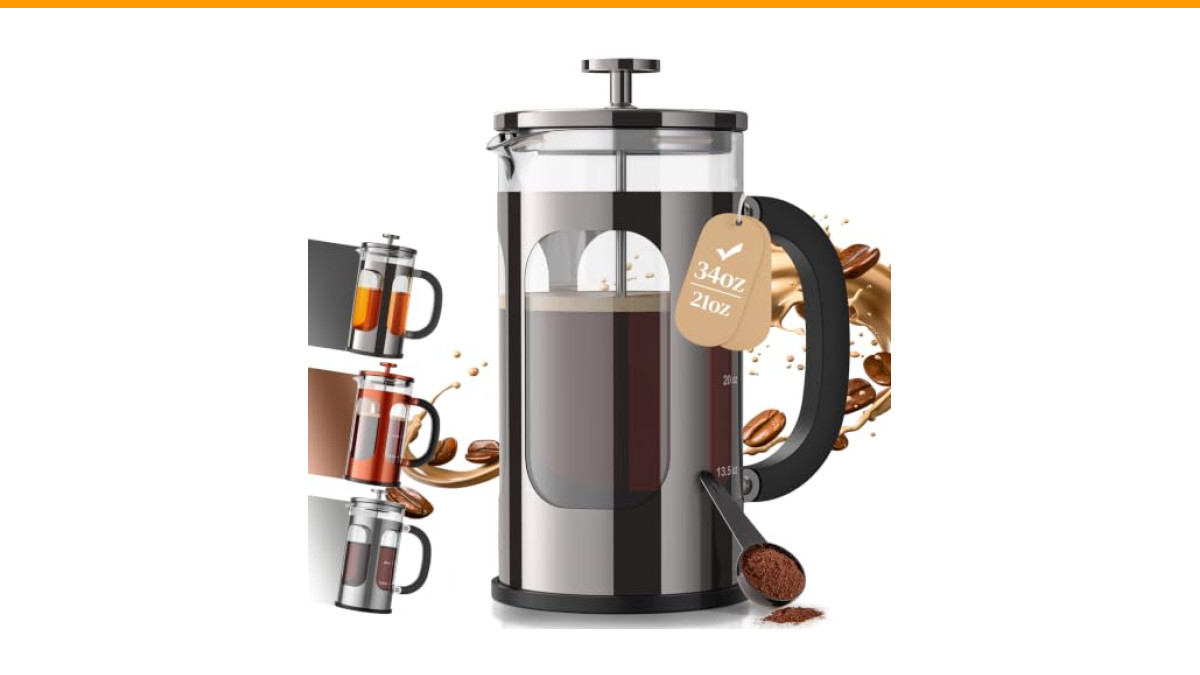
Veken 34oz French Press Coffee Maker, No…
- No Plastic Touching Food: Made with 304 stainless steel and food-grade silicone, our French press keeps all brewing surfaces plast…
- Thickened Glass and Versatile Brewing: Made of high borosilicate glass that resists thermal shock up to 302°F, this thick durable…
- 4-Level Filtration for Pure Coffee: This French press has a 4-layer stainless steel filter—spiral plate, cross plate, and two fine…
As an Amazon Associate I earn from qualifying purchases.
If you’re in a hurry, skip to the final checklist at the bottom. But if you want to avoid buying twice, read the sections on material and filter first—those are where most people go wrong.
One option that checks many boxes is the Veken French Press Coffee Maker. It uses 304 stainless steel and food-grade silicone for all brewing surfaces, so no plastic touches your coffee. The high borosilicate glass handles thermal shock up to 360°F, and the 4-level filtration system keeps sediment out of your cup. It’s a solid all-around choice if you want durability without the double-wall price tag.
The 30-Second Answer: How to Choose Your French Press
Start with your drinking habits, not the product specs. Ask yourself three questions:
- How much coffee do I brew at once? (single cup vs. full carafe)
- Do I drink it immediately or let it sit? (glass vs. insulated)
- Do I mind a few grounds in my cup? (mesh vs. micro-filter)
If you brew one mug and drink it right away, a 12-ounce glass press with a standard mesh filter works fine. If you pour a carafe and sip over an hour, you need a double-wall stainless model or you’ll be drinking lukewarm coffee. If sediment drives you crazy, look for a press with a fine micro-filter (like Espro) or one that accepts paper filters.
That’s the core. Everything else—brand, looks, price—comes second. A $30 press that fits your routine beats a $100 one that doesn’t.
Why French Press? The Flavor Profile and Brewing Mechanics
French press is immersion brewing. Grounds sit in water for 4 minutes, and you press a plunger to separate them. That’s it. No paper filter absorbs the natural oils, so your cup has a richer mouthfeel and more body than drip coffee. Those oils also carry flavor compounds that paper filters trap, which is why press coffee tastes bolder and more complex.
The trade-off is sediment. Even a fine mesh lets through a few micro-grounds, especially if you grind too fine. That’s not a flaw—it’s part of the character. Some people love the gritty finish; others can’t stand it. Know which camp you’re in before you buy.
Compared to a pour-over, the French press is forgiving. You don’t need a gooseneck kettle or perfect technique. The main variables are grind size, water temperature, and steep time. Get those close and you’ll get a good cup. Get them right and you’ll get a great one.
The 5 Critical Variables: Material, Filter, Capacity, Durability, and Price
Glass vs. Stainless Steel vs. Double-Wall Insulated
Glass is the classic choice. It’s cheap, you can see the brew, and it doesn’t hold onto flavors from previous batches. The downside is fragility and heat loss. A glass carafe loses heat fast—your coffee drops from 200°F to 170°F within 10 minutes in a room-temperature kitchen. If you drink slowly, that’s a problem.
Single-wall stainless steel (like the Veken) fixes the breakage issue and keeps coffee warmer longer than glass, but you still lose heat through the walls. Double-wall insulated presses (like Frieling) keep coffee hot for over an hour, but they cost more and you can’t see the brew. Also, the double-wall design means you can’t microwave the carafe if you want to reheat.
My take: if you’re clumsy or plan to travel, go stainless. If you’re a purist who wants to watch the extraction and you drink fast, glass is fine. Double-wall is worth it only if you regularly forget your coffee for 30 minutes.
Mesh vs. Micro-Filter: The Sediment Trade-Off
Standard French presses use a single-layer mesh filter—usually 100-200 microns. That lets through fine particles, giving that classic press texture. Micro-filter presses (like Espro) use a double-layer fine mesh that catches nearly everything. The result is a cleaner cup, closer to drip, but you lose some of the body.
There’s also a hybrid option: some presses accept paper filters on top of the mesh. That gives you the cleanest cup possible, almost zero sediment, but you’re adding a paper taste if you don’t rinse it first. I’ve used the Fellow Clara, which has a fine mesh that sits between standard and micro—great balance, but it costs more than most.
For most home users, a standard mesh is fine. If you’re the type who picks grounds out of your teeth, go micro or paper. Just know you’re trading a bit of richness for clarity.
The Water Factor: Why Your Tap Water Matters More Than You Think
Water makes up about 98% of your cup. If your tap water tastes like chlorine or has high mineral content, no press will fix that. Hard water (high calcium and magnesium) actually extracts coffee better, but it also leaves scale on your carafe and can make the brew taste bitter if over-extracted. Soft water (low minerals) yields a flatter, more acidic cup.
I tested this with two identical presses side by side—one with filtered water, one with straight tap. The filtered batch was noticeably sweeter and less harsh. The tap batch had a metallic edge. It’s not about buying fancy bottled water; a simple Brita filter or a zero-water pitcher makes a real difference.
If your water is very hard (above 150 ppm), consider using bottled spring water for brewing. It’s cheap and consistent. And always use cold, fresh water—not hot from the tap, which can contain dissolved minerals from your water heater.
The Plunge Physics: Speed, Pressure, and Mouthfeel
Most people press the plunger as fast as they can. That’s a mistake. Pressing too quickly forces water through the mesh at high pressure, which can push fine grounds through the filter and into your cup, making it gritty. It also creates turbulence that over-extracts the bottom layer of grounds, adding bitterness.
The right technique: press slowly and evenly, taking about 30 seconds for a full plunge. Apply steady, gentle pressure—not a forceful push. You want to separate the grounds, not compact them into a brick. A slow plunge also gives you more control over the final mouthfeel. If you want a lighter body, stop pressing when the plunger reaches the bottom and don’t force it further.
Here’s a pro tip: after plunging, pour the coffee immediately. Don’t let it sit on the grounds. The brew keeps extracting, and you’ll end up with a bitter, over-extracted cup. I’ve ruined more than a few mugs this way.
Size Guide: Matching Volume to Your Pouring Habits
French presses come in sizes from 12 ounces to 51 ounces (1.5 liters). The right size depends on how much you drink and whether you share.
| Capacity | Typical Use | Best For |
|---|---|---|
| 12 oz (350 ml) | 1 mug | Single-serve, travel |
| 17 oz (500 ml) | 1-2 mugs | Couples, small breakfast |
| 34 oz (1 L) | 3-4 mugs | Families, small gatherings |
| 51 oz (1.5 L) | 5-6 mugs | Large groups, office |
Note that the listed capacity is the total volume, not the brewed coffee volume. You’ll lose about 10-15% because the grounds absorb water. A 34 oz press actually yields around 29 oz of coffee—about 3.5 mugs.
If you brew for one, a 12-17 oz press is ideal. It takes less coffee and less space. But if you entertain or have a partner who also drinks coffee, go with a 34 oz. It’s the most versatile size and still fits under a standard cabinet.
Special Use Cases: Travel, Office, and Single-Serve Options
Travel presses are usually 12-17 oz, made of unbreakable stainless steel, and often have a lid that doubles as a cup. The Veken fits this niche—it’s compact enough for a backpack and has no plastic parts, which is a plus if you’re hiking or camping. I’ve used it on road trips and it’s survived being tossed around.
For the office, consider a 17 oz press with a sturdy carafe and a lid. You’ll want something that won’t shatter if someone knocks it over. Also think about noise: pressing a metal plunger against glass can make a loud clank. Some presses have a silicone ring that dampens the sound—check for that if you’re in a quiet cubicle.
Single-serve options like the 12 oz size are perfect for a quick cup without committing to a full carafe. You can also make cold brew directly in a small press—just steep grounds in cold water for 12 hours and plunge. That’s a great summer trick.
The Cost-Per-Brew Analysis: Is ‘Buy-Once’ Worth It?
Let’s do the math over 5 years. A $30 glass press will likely need a replacement carafe at least once—that’s $15-20. If you break it twice, you’re at $60-70 total. A $60 double-wall stainless press might last the full 5 years with no replacements, bringing your cost to $60. That’s about even.
But there’s another factor: coffee waste. A fine filter extracts more from your grounds, so you can use slightly less coffee per brew. A standard mesh lets you get away with a coarser grind, which means you can buy cheaper pre-ground coffee and still get a decent cup. Over 5 years, that difference adds up.
My advice: don’t buy the cheapest press you can find—the glass is thin and the plunger feels flimsy. But you also don’t need a $150 luxury model. The sweet spot is $30-60 for a quality glass or stainless press. Check the Veken French press price on Amazon—it’s in that range and it’s built to last.
The Ultimate Brew Recipe: Ratios, Grind Size, and Timing
Here’s the recipe I’ve settled on after years of testing. It’s forgiving and produces a rich, balanced cup.
- Grind 1 gram of coffee per 15 ml of water (a 1:15 ratio). For a 34 oz press, that’s about 60 grams of coffee and 900 ml of water.
- Use a coarse grind—like sea salt. If you don’t have a grinder, buy pre-ground coffee labeled ‘coarse’ or ‘French press.’ Avoid fine grinds; they’ll clog the filter and make mud.
- Heat water to 200°F (just off boiling). Let it rest 30 seconds after boiling.
- Add coffee to the press, pour in about half the water, and stir gently to saturate all grounds.
- Wait 1 minute, then add the remaining water. Place the plunger on top but don’t press yet.
- Steep for 3 more minutes (total 4 minutes).
- Press slowly over 30 seconds.
- Pour and drink immediately.
If the coffee tastes bitter, your grind is too fine or the water is too hot. If it tastes sour, your grind is too coarse or the steep time is too short. Adjust one variable at a time.
Troubleshooting Matrix: Common Symptoms and Quick Fixes
| Symptom | Likely Cause | Fix |
|---|---|---|
| Sediment in cup | Grind too fine, or filter mesh too coarse | Grind coarser, or use a micro-filter press |
| Bitter taste | Over-extraction (water too hot, steep too long) | Lower water temp to 195°F, reduce steep time by 30 sec |
| Sour taste | Under-extraction (grind too coarse, steep too short) | Grind finer, increase steep time to 4.5 min |
| Weak coffee | Too little coffee, or water too cool | Increase coffee to 1:14 ratio, use water at 200°F |
| Plunger hard to press | Grind too fine, or filter clogged | Grind coarser, clean filter thoroughly |
| Glass carafe cracks | Thermal shock (hot water on cold glass) | Pre-warm the carafe with hot tap water before brewing |
If you’re dealing with a clogged filter, a deep clean is in order. Take apart the plunger and soak the mesh in a vinegar solution—check our guide on cleaning with vinegar for the right ratio.
Cleaning and Maintenance: The Hidden Factor in Longevity
A French press is simple, but it collects coffee oils and grounds that go rancid. That rancid residue ruins the taste of your next brew. You should rinse the carafe and plunger immediately after use—coffee dries fast and gets sticky.
Once a week, do a deeper clean. Disassemble the plunger and filter, then soak all parts in warm soapy water. For stubborn stains, use a paste of baking soda and water. Avoid putting the glass carafe in the dishwasher—the detergent and heat can etch the glass and make it cloudy.
The Veken’s filter is designed for easy disassembly, which is a plus. You can rinse it under running water and it’s clean in seconds. If you let it sit for a day, you’ll need to scrub, but that’s true for any press.
Regular cleaning also extends the life of the rubber seal on the plunger. If the seal dries out or cracks, you’ll see coffee grounds in your cup. Replace it when that happens—it’s a cheap fix. And if you notice a musty smell from your press, it’s time for a deep clean—see our article on why regular cleaning matters.
The Final Checklist: 7 Questions to Ask Before Buying
- How many cups will I brew at once? Choose capacity 2x your typical mug count.
- Do I drink my coffee within 10 minutes? If yes, glass is fine. If no, go insulated.
- Do I mind a few grounds? If yes, look for a micro-filter or paper-compatible press.
- Will I travel with it? If yes, pick stainless steel with a lid.
- Is my water hard? If yes, budget for a filter or bottled water.
- How much counter space do I have? A 34 oz press is about 4 inches wide—measure first.
- Am I willing to clean it by hand? If you hate handwashing, a dishwasher-safe model is worth the extra cost.
Answer these honestly, and you’ll narrow down to a handful of options. Then read a couple of reviews and pick the one that fits your budget.
Frequently Asked Questions
Can I use a French press for tea?
Yes, and it works well. The mesh filter keeps loose leaves out of your cup. Just use a shorter steep time—3 to 5 minutes for most black teas, less for green. Rinse the press thoroughly afterward to avoid coffee flavors mixing with tea.
How do I make cold brew in a French press?
Use a 1:8 ratio of coffee to cold water. Stir, cover, and refrigerate for 12-18 hours. Plunge slowly and pour. You’ll get a concentrate—dilute with water or milk to taste. The Veken’s glass carafe handles the cold fine.
What’s the ideal grind size for a French press?
Coarse, like breadcrumbs or sea salt. If you use pre-ground coffee, look for ‘coarse’ or ‘French press’ on the bag. Too fine a grind will clog the filter and make the coffee bitter and sludgy.
How do I clean a French press without breaking the glass?
Let it cool down first, then rinse with warm water. Use a soft sponge and mild dish soap. Never plunge a glass carafe in cold water while it’s hot—that’s a recipe for cracking. For stubborn coffee oils, use baking soda.
Is a stainless steel French press better than glass?
It depends. Stainless is unbreakable and keeps coffee hotter longer, but you can’t see the brew, and some models have a metallic taste if the steel is low grade. Glass is cheaper, clearer, and neutral in taste, but fragile. If you’re clumsy, go stainless.
What to Do Next
You now know the variables that matter. Pick your material, filter, and size, then match them to your habits. A $30 press that fits your routine is better than a $100 one that doesn’t. And remember to use good water—that’s the cheapest upgrade you can make.
If you want a solid all-around choice that covers most of these bases, the Veken French Press is worth a look. It’s stainless and glass, has a 4-level filter, and cleans up easily. Check the current price on Amazon and see if it fits your list.
One last tip: buy a spare carafe if you choose glass. It’s cheaper than replacing the whole press when you drop it. Trust me.
Products related to this article
Sponsored / affiliate links. As an Amazon Associate I earn from qualifying purchases. I may earn additional commission from eligible campaigns.
 HomeBeyond Espresso Coffee Maker 12 Cups, Classic Stovetop Espresso Maker, 600ml / 20oz Coffeemaker for Gas & Ceramic Stovetops (Silver)
 Linnkyfloa Coffee Espresso Maker Handle Replacement for Stovetop Moka Pot or Percolator, Black Plastic for Spare Part Compatible with Italian(9-12 Cup)
 Supvision 3 Cup Moka Pot Aluminum 150ml Italian Coffee Maker