Two coffee makers walk into a kitchen. One costs less than a dinner out; the other costs more than a week’s groceries. Both claim to make espresso. One of them is lying.
| Our Pick | Runner Up |

|

|
| Bialetti Bialetti Moka Express Iconic Italian Stovetop Espresso… | Breville Breville BES500BSS Bambino Plus Espresso Machine, Brushed… |
| See on Amazon | See on Amazon |
As an Amazon Associate I earn from qualifying purchases.
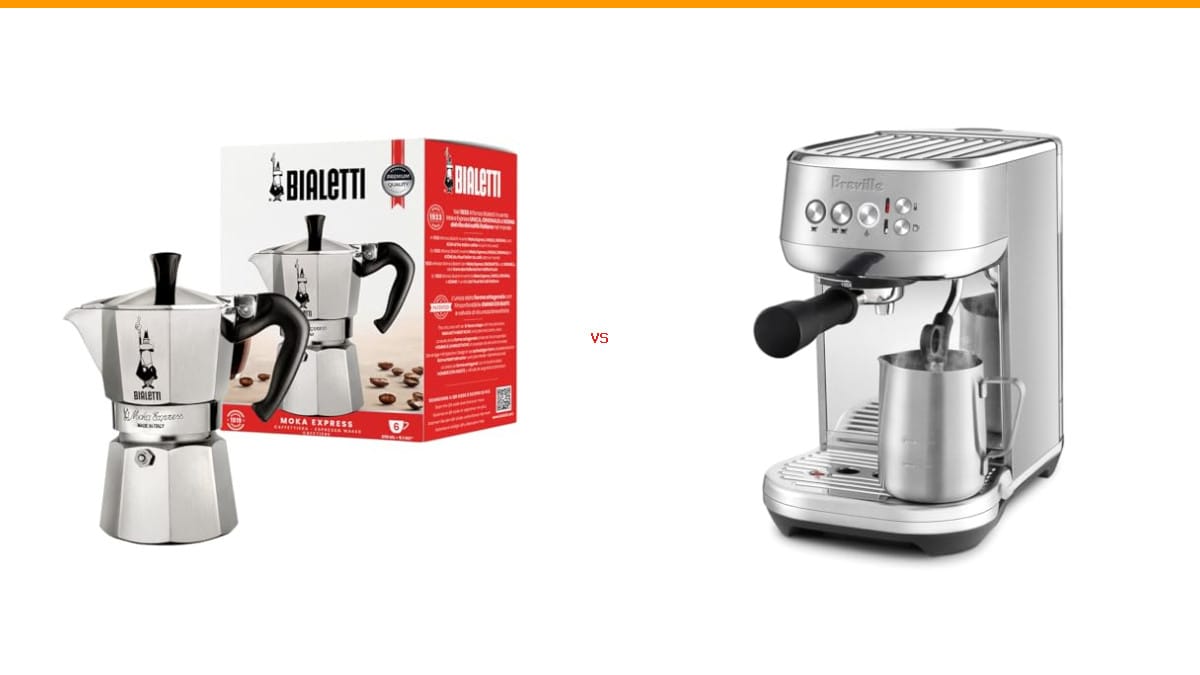
The Bialetti Moka Express and the Breville Bambino Plus represent two completely different approaches to coffee. The Moka pot is a 90-year-old Italian design that uses stovetop steam pressure. The Bambino Plus is a modern electric espresso machine with digital temperature control and automatic milk frothing. People compare them because they both produce strong, concentrated coffee. But they’re not the same drink, and they’re not for the same person.
I’ve used both extensively. I’ve pulled shots on the Bambino for weeks, and I’ve made countless Moka pots on gas and electric stoves. Here’s the honest breakdown.
The Core Difference: Pressure, Not Beans
Espresso requires about 9 bars of pressure. That’s roughly 130 pounds per square inch pushing water through finely ground coffee. A Moka pot generates somewhere between 1 and 2 bars. That’s it.
That pressure gap changes everything: extraction, crema, flavor, and body. The Bambino Plus uses a pump to hit that 9-bar target. The Moka pot relies on steam pressure from boiling water. You can use the same beans and the same grinder, but you’ll get different results.
So when someone says a Moka pot makes espresso, they’re wrong. It makes strong coffee that resembles espresso. Good, but not the same.
What Is a Moka Pot? (And Why It’s Not Espresso)
The Bialetti Moka Express is an icon. Designed in 1933 by Alfonso Bialetti, it’s an aluminum octagonal pot with three chambers: a bottom boiler, a middle filter basket, and a top collection chamber. You fill the bottom with water, put ground coffee in the basket, screw it together, and put it on heat.
As the water boils, pressure builds and pushes water up through the coffee grounds and into the top chamber. The result is a concentrated, strong brew with a thick layer of foam on top. That foam is often called crema, but it’s not true espresso crema. I’ll explain why in a moment.
This particular model is the 6-cup version, which makes about 12 ounces of coffee. It’s made in Italy and works on gas, electric, and induction (with an adapter plate). The handle stays cool during brewing, and the safety valve is easy to clean.
But it’s not espresso. The pressure is too low, the water temperature is too high (boiling vs. the ideal 195–205°F), and the brew time is longer. It’s a stovetop coffee maker that makes a strong, bold cup. Call it what it is.
What Is an Espresso Machine? (From Manual to Super-Auto)
The Breville Bambino Plus is a semi-automatic espresso machine. That means you control the grind, dose, and tamp, but the machine handles water temperature and pressure. It has digital temperature control (PID) to keep water at the right temperature, low-pressure pre-infusion for even extraction, and an automatic steam wand for milk texturing.
Semi-automatic machines like this one are the middle ground. They cost more than a Moka pot but less than fully automatic machines. They require some skill — you’ll need a good grinder and some practice to dial in the shot. But they reward you with real espresso: true crema, balanced flavors, and the ability to make lattes and cappuccinos.
There are also manual lever machines (cheaper, more control) and super-automatic machines (expensive, push-button convenience). The Bambino Plus sits in the semi-auto category, which is where most home baristas land.
The Price Spectrum: $50 vs. $500 vs. $2,000
The Moka Express costs around $30–50 depending on size and retailer. The Bambino Plus costs around $500. A super-automatic machine can run $2,000 or more.
That price difference reflects the complexity. The Moka pot is a simple mechanical device with no electronics. The Bambino Plus has a pump, PID controller, steam wand, and a stainless steel body. You’re paying for precision and convenience.
But here’s the thing: a $50 Moka pot can make a genuinely good cup of strong coffee. A $500 espresso machine can make a bad shot if you don’t know what you’re doing. The price isn’t the only factor.
Head-to-Head: Moka Pot vs. Espresso Machine
Let’s put them side by side. I’ve used both in my kitchen, and I’ve compared them directly with the same beans and grinder.
| Feature | Bialetti Moka Express | Breville Bambino Plus |
|---|---|---|
| Brewing pressure | 1–2 bars (steam) | 9 bars (pump) |
| True espresso crema | No (foam emulsion) | Yes |
| Milk steaming | No | Yes, automatic |
| Temperature control | None (boiling water) | PID digital control |
| Pre-infusion | No | Low-pressure pre-infusion |
| Time to brew | ~5 minutes | ~1 minute (plus warm-up) |
| Skill required | Minimal | Moderate |
| Cleaning | Rinse with water, no soap | Descale regularly, clean portafilter |
| Portability | Yes, can travel | No, countertop only |
| Heat source | Stovetop (gas/electric/induction with adapter) | Electric |
| Milk drinks (latte, cappuccino) | No | Yes |
| Cost | Low | High |
Brewing Pressure & Extraction Science
Pressure determines extraction. Higher pressure forces water through the coffee faster, extracting more solubles and creating a thicker body. The Bambino Plus’s 9-bar pump extracts more flavor compounds than the Moka pot’s 1–2 bars.
The Moka pot compensates with longer brew time and hotter water. That means more bitter compounds come out. The result is a bolder, harsher cup. The Bambino Plus with its PID control keeps water at 200°F, which is ideal for balanced extraction.
In my side-by-side test, the same beans tasted completely different. The Moka pot produced a dark, intense brew with a slightly burnt note. The Bambino Plus made a sweeter, more complex shot with brighter acidity. The difference is obvious to anyone who tastes them back to back.
Crema: Real vs. ‘Fake’ (The Emulsion Test)
Moka pot foam is often called crema, but it’s not. True espresso crema is an emulsion of coffee oils, CO2, and water created by high pressure. It’s golden-brown, thick, and lasts for minutes.
The Moka pot’s foam is a coarser, lighter layer that dissipates quickly. It’s mostly air bubbles from the boiling water, not a true emulsion. You can see the difference: espresso crema clings to the cup, while Moka foam sits on top and fades.
So if you’re chasing that rich, velvety crema, the Moka pot will disappoint. The Bambino Plus delivers it every time.
Flavor, Body, and Acidity (With Data)
Espresso from the Bambino Plus has a higher acidity (pH around 4.5–5.0) and a lighter body than Moka pot coffee. The Moka pot brews at a higher temperature, which breaks down more acids, resulting in a lower acidity (pH around 5.5–6.0) and a heavier, more bitter body.
For flavor, the Bambino Plus highlights origin notes — fruity, floral, chocolatey. The Moka pot tends to flatten those subtleties into a single strong, roasty taste. If you drink coffee black, the Moka pot is fine. If you want to taste the beans, you need the espresso machine.
Caffeine Content: The Surprising Truth
Here’s a surprise: the Moka pot often delivers more caffeine per ounce than espresso. Because it uses a longer brew time and more coffee by volume, a 2-ounce Moka shot can pack 80–100 mg of caffeine, while a 2-ounce espresso shot has around 60–80 mg.
But the Bambino Plus gives you more control. You can use a lighter roast or adjust the dose to lower caffeine. The Moka pot is what it is. If you’re sensitive to caffeine, the Moka pot might be too strong.
The Practicality Test: Time, Cleaning, and Skill
The Learning Curve: Stovetop vs. Dialing In
The Moka pot is forgiving. Fill the boiler, add coffee, heat, wait for the gurgle, done. You don’t need a scale or a timer. It takes about 5 minutes, and the result is always drinkable.
The Bambino Plus requires more effort. You need a good grinder (the machine doesn’t come with one), you need to weigh your dose, and you need to tamp consistently. Expect a learning curve of a few days to get a shot that doesn’t taste sour or bitter. But once you nail it, the payoff is real.
Maintenance Nightmares: Gaskets vs. Descaling
The Moka pot has a rubber gasket that wears out over time. You’ll need to replace it every 6–12 months, depending on use. Cleaning is simple: rinse with water, never soap, and never put it in the dishwasher. Soap and dishwasher can strip the seasoning and affect the taste.
The Bambino Plus needs regular descaling to prevent scale buildup, and you’ll need to backflush the group head and clean the steam wand after each use. It’s more work, but the machine is built to last with proper care. If you ignore maintenance, you’ll get bad shots and potential leaks.
For most people, the Moka pot is easier to live with. It’s low-maintenance, cheap to replace, and forgiving.
Lifestyle Fit: Milk Drinks, Portability, and Kitchen Space
If you drink lattes or cappuccinos, the Moka pot is a dead end. It has no steam wand. You’d have to heat milk separately and froth it with a manual frother or a French press. The Bambino Plus has an automatic steam wand that textures milk to your preferred temperature and foam level. That’s a game-changer for milk drink lovers.
Portability: the Moka pot is compact and doesn’t need electricity. You can take it camping or use it on a gas stove anywhere. The Bambino Plus is a countertop appliance that needs 120V power and a stable surface. No comparison there.
Kitchen space: the Moka pot takes up almost no room. The Bambino Plus is about 12 inches wide and 12 inches tall, so it’ll eat up counter space. If you have a tiny kitchen, that matters.
The Verdict: Which Should You Buy in 2026?
Here’s my honest take. If you want true espresso, milk drinks, and are willing to learn, get the Breville Bambino Plus. It’s a capable machine that produces café-quality shots at home. It costs more, but it’s worth it for the right person.
If you want a cheap, simple, portable way to make strong coffee, get the Bialetti Moka Express. It’s not espresso, but it’s a great coffee maker. You’ll save money, and you’ll get a decent cup in minutes.
Most people who buy a Moka pot are looking for a budget espresso alternative. They end up disappointed when it doesn’t produce crema or steam milk. If that’s you, save up for the Bambino Plus. But if you just want a strong morning brew without fuss, the Moka pot is a solid choice.
I’ll be direct: the Moka pot is not a budget espresso machine. It’s a different drink. Once you accept that, you’ll enjoy it for what it is.
FAQs: Quick Answers to Common Questions
Can I use a Moka pot to make espresso?
No. The Moka pot doesn’t generate enough pressure (1–2 bars vs. 9 bars) to produce true espresso. It makes strong coffee with a different flavor profile.
Is the Breville Bambino Plus worth the extra money?
If you drink espresso-based drinks daily and value real crema and milk steaming, yes. The automatic steam wand and PID temperature control justify the cost for most home baristas.
How do I clean a Moka pot?
Rinse it with water after each use. Never use soap, and never put it in the dishwasher. Replace the gasket periodically to maintain pressure.
Which is easier to use for a beginner?
The Moka pot is easier. No grinder needed (though pre-ground works), no tamping, no timing. The Bambino Plus has a learning curve, but it’s manageable with practice.
For more on espresso machines, check our automatic vs semi-auto guide. If you’re troubleshooting an existing machine, see why espresso tastes burnt or how to descale.
Products related to this article
Sponsored / affiliate links. As an Amazon Associate I earn from qualifying purchases. I may earn additional commission from eligible campaigns.
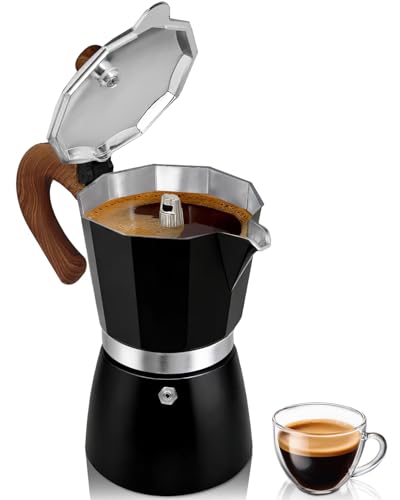 Belly Moka Coffee Maker Stovetop Espresso Maker 9 Cup Aluminum Moka Pot Percolator 15oz 450ml Easy Brewing for Electric Ceramic Stoves Home Camping Italian Cuban Café Classic Black
 Belly Moka Coffee Maker Stovetop Espresso Maker 6 Cup Aluminum Moka Pot Percolator 10oz 300ml Easy Brewing for Electric Ceramic Stoves Home Camping Italian Cuban Café Classic Silver
 Stainless Steel Moka Pot Coffee Filter Disc for Espresso Brewing, Coffee Maker Replacement Filter Plate for Home Office Coffee Bar Cafe (FOR 4 Cups)