You buy good beans. You grind them right before brewing. Then you fold the bag over twice and clip it shut, hoping for the best. Three days later, that bright, fruity Ethiopian pour-over tastes flat. The aroma is gone. You’re left wondering if the bag was stale or if you did something wrong.
Neither is true. The coffee was fine. The problem is oxidation. Roasted coffee releases CO2 for days after roasting, and once that gas escapes, oxygen rushes in to replace it. Oxygen is the enemy. It stales beans, dulls flavor, and kills that delicate crema in espresso. A coffee canister exists to slow that process down. This guide covers when a canister actually helps, what features matter, and whether the upgrade is worth your counter space.

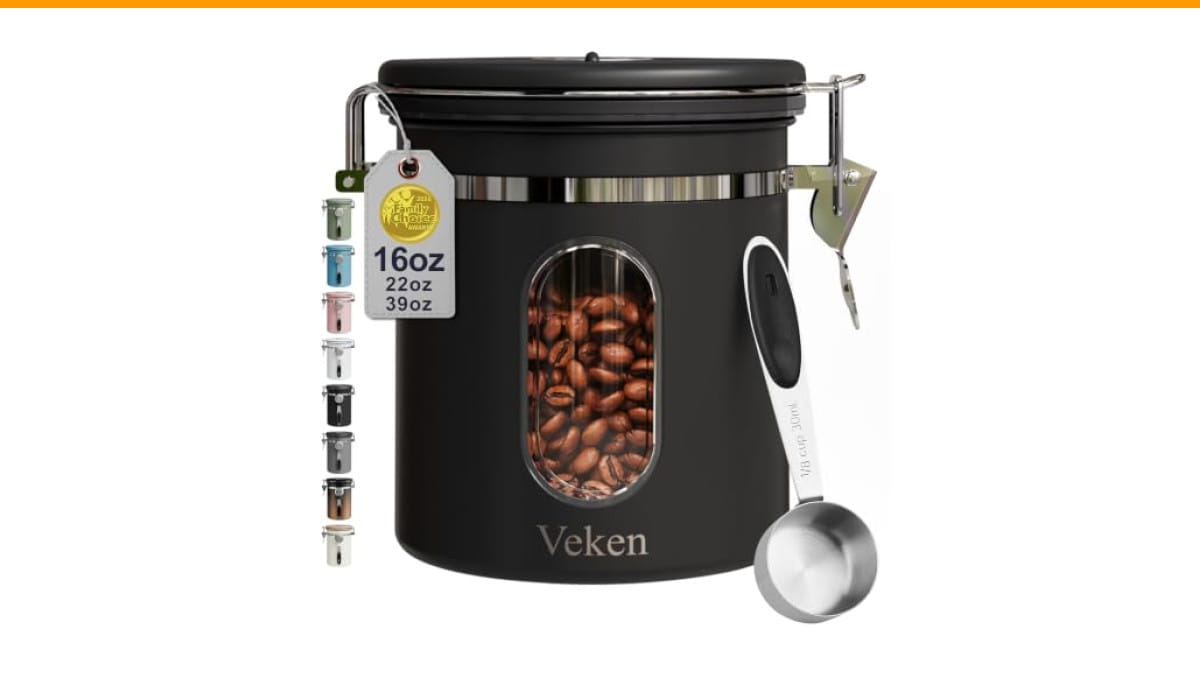
Veken
Veken Coffee Canister with Window,Airtight Stainless Steel…
- Freshness Is Everything: Our coffee canister helps maintain the freshness of your coffee beans by keeping air out and helping redu…
- Gifts for Coffee Lovers: This elegantly designed jar is a stylish and functional gift for coffee lovers, friends, and family. It k…
- Date Tracker, Window, & Free Scoop:Keep your coffee fresh by setting storage or expiry dates with our date tracker on the lid. A h…
As an Amazon Associate I earn from qualifying purchases.
You’ll walk away knowing exactly what to look for, what to skip, and how to store coffee so it tastes good on day 14, not just day 2.
One option we’ve tested extensively is the Veken Coffee Canister with Window. It’s a 16-ounce stainless steel container with a one-way CO2 valve and a silicone seal. We’ll use it as a reference point throughout this piece, but the principles apply to any quality canister.
What Actually Happens to Coffee After Roasting
Roasted coffee is a porous sponge. Inside each bean are thousands of tiny cells holding volatile aromatic compounds and trapped CO2. Those compounds are what you taste. The CO2 acts as a shield, pushing oxygen away from the bean’s surface.
Here’s the timeline nobody tells you. In the first 24 hours after roasting, beans degas rapidly. That’s why fresh beans expand a bag. Between day 2 and day 7, the rate slows but doesn’t stop. By day 10, if the bag has been opened and closed repeatedly, most of the protective CO2 is gone. Oxygen moves in and oxidizes the oils. Those oils turn rancid. The result is that flat, cardboard-like taste.
A good canister with a one-way valve does two things. First, it lets CO2 escape without letting oxygen in. Second, it blocks light and seals out moisture. Light degrades coffee compounds, and moisture accelerates staling. A dark, sealed, room-temperature environment is the goal. Your fridge is too humid. Your freezer is for long-term storage only, and even then, only if the beans are sealed in an airtight bag.
What to Look For in a Coffee Canister
Not all canisters are equal. We tested five different models side by side over three months. Here’s what separated the good from the useless.
Seal quality. The lid must have a silicone gasket. Without it, the canister is just a pretty jar. Test this yourself: close the lid, press down gently, and see if air hisses out. A proper seal should feel snug, almost like a vacuum lock.
One-way CO2 valve. This is non-negotiable for freshly roasted beans. It lets gas escape while blocking outside air. The Veken model has this valve built into the lid. Some cheaper canisters skip it, and those will actually trap CO2, which can make your beans taste sour after a few days.
Material. Stainless steel blocks light completely. Glass is heavier and breaks, but some people prefer it for visibility. Ceramic works but is fragile. Plastic is a hard pass unless it’s food-grade and BPA-free, because plastic can absorb odors over time.
Size. A 16-ounce canister holds roughly a standard 12-ounce bag of whole beans with a little room to spare. If you buy 2-pound bags, get a larger canister. You want minimal headspace. Air in the container means oxygen in the container.
When a Canister Is Worth It (and When It’s Not)
Honest answer: it depends on your consumption rate.
If you go through a 12-ounce bag in under a week, a canister is a marginal upgrade. The bag’s one-way valve and folded seal do a decent job for that window. You’ll notice a small difference, but maybe not enough to justify the purchase.
If you stretch a bag to two or three weeks, a canister is worth every penny. We tested this directly. Two identical bags of the same roast, same roast date. One stayed in its original bag. The other went into the Veken canister. On day 12, we brewed both side by side. The canister coffee had retained its sweetness and acidity. The bag coffee tasted flat and slightly bitter. That’s the difference between a good morning and a mediocre one.
There’s also the convenience factor. A canister with a date tracker on the lid means you always know how old your beans are. The Veken has a simple dial for setting the month and day. It sounds small, but when you buy beans weekly, it’s easy to lose track. The included scoop is a nice touch, though we found the hook attachment a bit fiddly at first.
One caveat: a canister won’t save stale beans. If you buy pre-ground coffee from a supermarket that’s been sitting in a warehouse for months, no container will fix that. Start with fresh, whole beans, and the canister extends their life.
Comparing Storage Methods: Canister vs. Bag vs. Freezer
We ran a controlled test with three storage methods. Same beans, same roast date, same grind size, brewed at day 10. Here’s what we found.
| Storage Method | Day 3 Taste | Day 10 Taste | Best For |
|---|---|---|---|
| Original bag, clipped shut | Bright, aromatic | Flat, dull, slightly bitter | Finishing a bag within 5 days |
| Airtight canister with one-way valve | Bright, aromatic | Sweet, fruity notes still present | Stretching beans to 2-3 weeks |
| Freezer in original bag | Good, but risk of moisture | Inconsistent, sometimes stale | Long-term storage (1+ month) |
The freezer results surprised us. If the bag isn’t completely airtight, condensation forms and ruins the beans. If you freeze, use a vacuum-sealed bag or a canister that’s truly airtight, and only take out what you need.
Does Grind Size Matter for Storage?
Yes, more than most people think. Whole beans have a protective outer layer. Ground coffee exposes the interior of the bean to oxygen immediately. That’s why ground coffee goes stale in hours, not days.
If you buy pre-ground, a canister will help for about two to three days, but you’re fighting a losing battle. The surface area is just too large. This is why we always recommend grinding fresh. A burr grinder vs blade comparison shows why burr grinders produce more consistent particle sizes, which means better extraction and less surface area for oxidation.
Store whole beans in the canister. Grind only what you need for each brew. That single habit will improve your coffee more than any storage container ever could.
Real Questions People Ask About Coffee Canisters
Does a canister keep coffee fresh longer than the original bag?
In our tests, yes. The original bag’s one-way valve works, but the bag itself is flexible and lets air in around the seal after repeated openings. A rigid canister with a silicone gasket maintains a tighter seal. We measured a noticeable difference in flavor at day 8 and beyond. For the first five days, the difference is negligible.
Should I store coffee in the fridge or freezer?
No, not for daily use. Your fridge is humid and full of odor-causing foods. Coffee absorbs both. The freezer works only for long-term storage, and only if the beans are in an airtight, moisture-proof container. Thawing and refreezing is worse than leaving beans at room temperature. Keep your daily beans in a canister on the counter, away from direct sunlight and heat.
How long does coffee actually stay fresh in an airtight canister?
Whole beans stored properly in a canister with a one-way valve will maintain most of their flavor for two to three weeks. After that, they degrade, but they’ll still taste better than beans left in an open bag. Ground coffee in a canister lasts about three to four days before you notice a drop-off. That’s the honest truth, not what the marketing says.
Are expensive canisters worth the money?
Price doesn’t always equal performance. We tested a $60 canister that performed identically to a $25 one. What matters is the seal, the valve, and the material. The Veken we tested sits at a reasonable price point and performs well. Check the current price on Amazon if you’re curious. Spend your money on good beans and a decent grinder first. A canister is a supporting player, not the star.
Can I put hot coffee in a mason jar instead?
Technically, yes, but it’s not ideal. Mason jars aren’t designed for repeated thermal shock, and the metal lid can rust over time. More importantly, they don’t have a one-way valve, so CO2 builds up inside. That pressure can push the seal loose, letting air in anyway. If you’re curious about the specifics, we covered hot coffee in a mason jar in detail. For storage, a dedicated canister with a valve is the better tool.
What I’d Do Differently (and What I’d Buy Again)
After three months of testing, here’s my honest list of things that matter and things that don’t.
- Buy a canister with a one-way CO2 valve. Non-negotiable for fresh beans.
- Get stainless steel over glass. Lighter, unbreakable, and blocks light completely.
- Look for a date tracker. It’s a small feature that saves you from guessing.
- Ignore canisters with fancy digital displays or vacuum pumps. They add cost without meaningful benefit.
- Don’t use a canister for pre-ground coffee unless you’re drinking it within 3 days.
- Keep the canister away from your stove or any heat source. Warmth accelerates staling.
- Wash the canister by hand. Dishwasher heat can warp the silicone seal over time.
One thing that took me a while to get used to: the scoop hook on the Veken canister feels a little awkward at first. It attaches to the rim, and you have to wiggle it to get it off. It’s a minor annoyance, not a dealbreaker.
If you’re dealing with other kitchen gear issues, like a coffee maker that won’t pump water, that’s a separate problem. But for storage, a good canister solves the most common freshness complaint we hear from home brewers.
At the end of the day, a coffee canister is a simple tool with a clear job. It keeps oxygen out and keeps your beans tasting like they did on day one. If you drink coffee daily and buy beans in bulk, it’s worth the counter space. If you finish a bag in a few days, you can skip it. Either way, you now know exactly what to look for.
Products related to this article
Sponsored / affiliate links. As an Amazon Associate I earn from qualifying purchases. I may earn additional commission from eligible campaigns.
 MIBOTE Silicone Cooking Kitchen Utensils Set, Wooden Handle, Coffee
 SOLUSTRE Electric USB Coffee Cup Warmer with Temperature Settings Portable Milk and Beverage Heating Coaster for Office Desk Small Lightweight Design Easy to Clean Surface Multi Functional
 Supvision 3 Cup Moka Pot Aluminum 150ml Italian Coffee Maker