You’ve watched the barista at your local shop weigh every dose, start the timer, and stop the shot at exactly 36 grams. You get home, eyeball your grounds, and hope for the best. Some days your espresso tastes bright and sweet; other days it’s sour or harsh. Same bag of beans, same grinder, same machine. The only variable is you.
That inconsistency is exactly where a coffee scale with timer earns its keep. This article walks through what these scales actually do, when they matter, and whether you can get away without one. You’ll also get a few specifics on what to look for, so you don’t overpay for features you’ll never use.

Maestri House
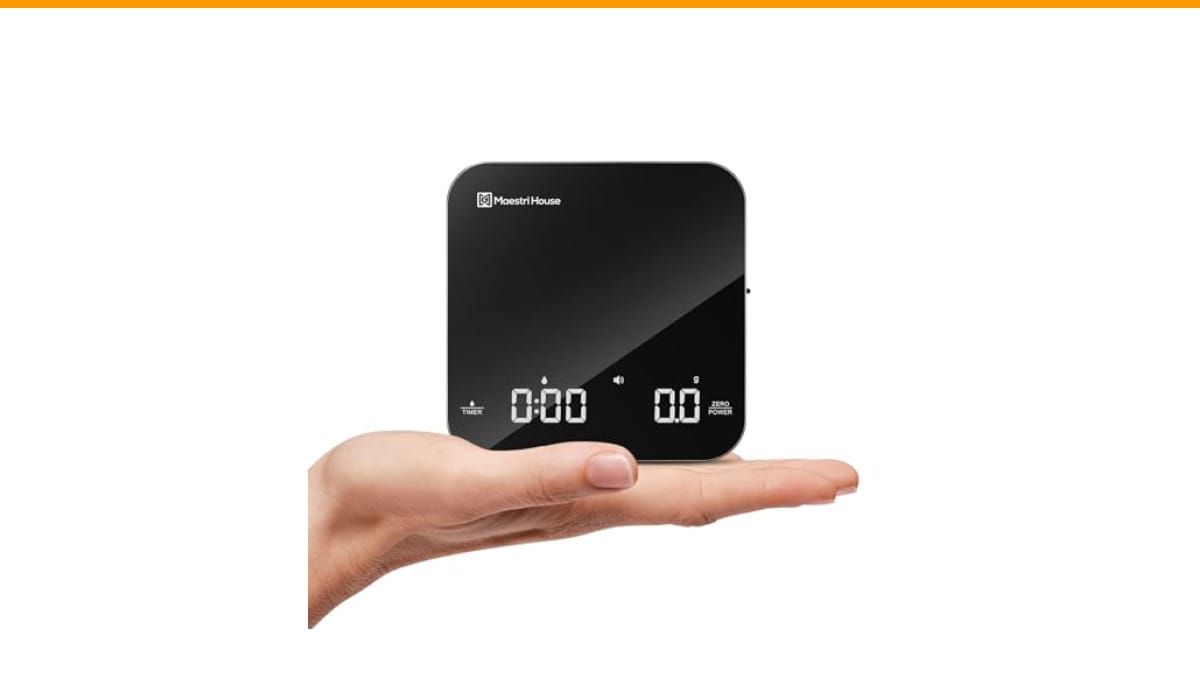
Maestri House S2 Espresso Coffee Scale with…
- 【Ultra Small, Yet Professional】The Espresso Scale is small enough to fit in your palm. It measures 4.13*4.13*0.78 inches and weigh…
- 【0.1g High Precision】This digital kitchen coffee scale is equipped with high-precision sensors and a reliable microprocessor, guar…
- 【Three Units & Dual Timekeeping Modes】The Espresso Digital Timer Scale has three units of measurement (g/oz/ml) that can be conver…
As an Amazon Associate I earn from qualifying purchases.
If you’re already shopping, the Maestri House S2 Espresso Coffee Scale with Timer handles the core job well: it measures to 0.1g, has a built-in timer, and fits under most portafilters. We’ll get into the details below.
What Does a Coffee Scale with Timer Actually Do?
A coffee scale with timer combines two tools into one. The scale measures weight; the timer tracks brew time. In espresso, you use both together to control the ratio — the weight of coffee in versus the weight of coffee out.
For pour-over, the same combo lets you track your bloom time and total brew time. You don’t need to juggle a phone timer and a separate scale. That might sound minor, but when you’re trying to pour steadily, having the timer right under your dripper makes a real difference.
The Maestri House S2, for instance, has two timing modes: automatic and manual. In automatic mode, the timer starts as soon as it senses the first drops of espresso hitting the glass. That’s handy because it removes the guesswork of when to start timing. You just place your cup, hit tare, and start your shot.
When a Scale with Timer Is Non-Negotiable
If you drink straight espresso or Americanos, a scale with timer is near essential. Here’s why.
Your espresso recipe is a ratio. A typical starting point is 1:2 — 18 grams of ground coffee in, 36 grams of liquid espresso out. But the extraction time matters just as much. A 36-gram shot that finishes in 20 seconds will taste different than one that finishes in 35 seconds. Without a scale, you’re guessing both the output weight and the time. You might hit the right volume, but volume varies based on crema and temperature. Weight is the only accurate measure.
For milk drinks, you have more leeway. A latte or cappuccino masks extraction flaws with milk and sugar. But if you ever want to dial in a shot to taste better black, you need the data. A scale with timer gives you that data every single time.
Pour-over has the same logic. The coffee-to-water ratio is weight-based. The bloom time is a timer-based step. The total brew time tells you if your grind is too fine or too coarse. Without a scale, you’re flying blind.
When You Can Skip It
If you only drink drip coffee from an automatic machine or use a pod system, a coffee scale with timer is overkill. The machine handles the water and time for you. A simple kitchen scale is enough if you want to weigh your grounds for consistency.
Same goes for French press. The ratio matters, but the timing window is forgiving — 4 minutes is fine, 4:30 is fine, 3:45 is fine. You don’t need a timer built into the scale; your phone works.
But here’s the catch: if you’re reading this, you’re probably curious about espresso or pour-over. And once you start chasing better coffee, the scale becomes the first upgrade you should make — before a new grinder, before a new machine.
What to Look For in a Coffee Scale with Timer
Not all scales are created equal. Here are the specs that actually matter.
Precision: 0.1g resolution is the minimum for espresso. 1g scales are useless for dosing. The Maestri House S2 reads in 0.1g increments up to 2000g, which covers everything from a single dose to a full pour-over batch.
Size: Your scale needs to fit under your portafilter while your cup sits on it. Most espresso machines have limited clearance. A scale that’s too big won’t fit. The S2 measures about 4.1 inches square and 0.78 inches tall — small enough for most machines, but check your specific model’s clearance.
Timer integration: Some scales have a separate timer button; others auto-start. Auto-start is a nice touch for espresso because it syncs with the first drop. Manual mode is better for pour-over, where you want to start timing when you start pouring.
Battery life: Rechargeable beats replaceable. The S2 has a 500mAh battery that lasts up to 90 days per charge, according to the manufacturer. That’s a long time between charges, and USB-C charging means you can top it up with the same cable as your phone.
Water resistance: Coffee brewing is messy. A scale with a sealed surface or a silicone pad will survive spills. The S2 includes a detachable silicone pad that protects against water and heat.
One thing I’ll note: the touch-sensitive buttons on the S2 took me a day to get used to. They’re not physical buttons, so you have to tap precisely. Once you get the hang of it, it’s fine, but it’s not as satisfying as a clicky button.
Comparison: Coffee Scale with Timer vs. Alternatives
| Method | Best For | Pros | Cons |
|---|---|---|---|
| Scale with timer (e.g., Maestri House S2) | Espresso, pour-over, any ratio-based brew | All-in-one, accurate, auto-timer, portable | Costs more than a plain scale, touch buttons take practice |
| Kitchen scale (no timer) | Drip, French press, baking | Cheap, simple, durable | Need separate timer, no auto-start, often 1g resolution |
| Phone timer + measuring spoons | Casual brewing | Free, zero gear | Inaccurate, inconsistent, frustrating |
| Built-in machine timer | Some espresso machines | No extra gear | Only tracks total shot time, not weight; you still need a scale |
As you can see, the scale with timer is the only option that gives you both weight and time in one device. For anyone serious about espresso, that’s the whole ballgame.
Real Questions People Ask
Can I use a regular kitchen scale for espresso?
You can, but only if it has 0.1g precision. Most kitchen scales read to 1g, which means your 18g dose could actually be 17.2g or 18.8g. That’s a 4% swing, which is enough to change the taste of your shot. Also, you’ll need a separate timer. It’s doable, but clunky.
Does a coffee scale with timer work for pour-over?
Yes, and it’s actually one of the best uses. You can weigh your beans, then place your dripper on the scale, zero it out, and pour water while watching the weight. The timer lets you hit your bloom time (usually 30-45 seconds) and your total brew time (usually 2:30-4:00). The Maestri House S2 has a manual timer mode that you can start with a tap.
How much does a good coffee scale with timer cost?
Prices vary, but expect to pay between $30 and $80 for a reliable model with 0.1g precision and a timer. The Maestri House S2 sits in that range. Check the current price on Amazon, as it fluctuates. You don’t need a $200 Acaia unless you’re a competitive barista.
Is a coffee scale with timer worth it for a beginner?
Yes, if you’re starting with espresso or pour-over. It removes guesswork and gives you consistent results from day one. It’s actually easier to learn on a scale than without one, because you can replicate a good cup. If you’re just doing drip coffee, skip it.
How do I clean a coffee scale with timer?
Most scales with a glass or silicone surface can be wiped with a damp cloth. Avoid submerging the base in water. The Maestri House S2 has a borosilicate glass top and a detachable silicone pad, so you can wipe the glass and rinse the pad separately. Just don’t run the whole scale under the tap.
What You Should Do Next
- If you brew espresso or pour-over, a scale with timer is the single most impactful upgrade you can make.
- Look for 0.1g precision, a compact footprint, and a timer that starts automatically for espresso.
- Rechargeable battery and water resistance are worth paying a little extra for.
- Skip the scale entirely if you only drink drip or French press.
- Check clearance under your espresso machine before buying — measure the space.
- Use your scale every day for a week; it’ll become second nature.
If you’re dealing with a machine that’s not cooperating, check our guides on descaling your machine or why coffee tastes bitter after cleaning. Those issues can throw off your brew even with a perfect scale.
Products related to this article
Sponsored / affiliate links. As an Amazon Associate I earn from qualifying purchases. I may earn additional commission from eligible campaigns.
 Coffee Mug Warmer & You are Awesome Mug Set, Electric Cup Warmer for Desk
 Coffee Espresso Machine Handle Replacement Parts, Cafe Bracket Handle for Lidl Silvercrest CM4621 CM4218 KF5002 KF500S Barista (for 51mm Portafilter Basket - Not included)
 SOLUSTRE Electric USB Coffee Cup Warmer with Temperature Settings Portable Milk and Beverage Heating Coaster for Office Desk Small Lightweight Design Easy to Clean Surface Multi Functional