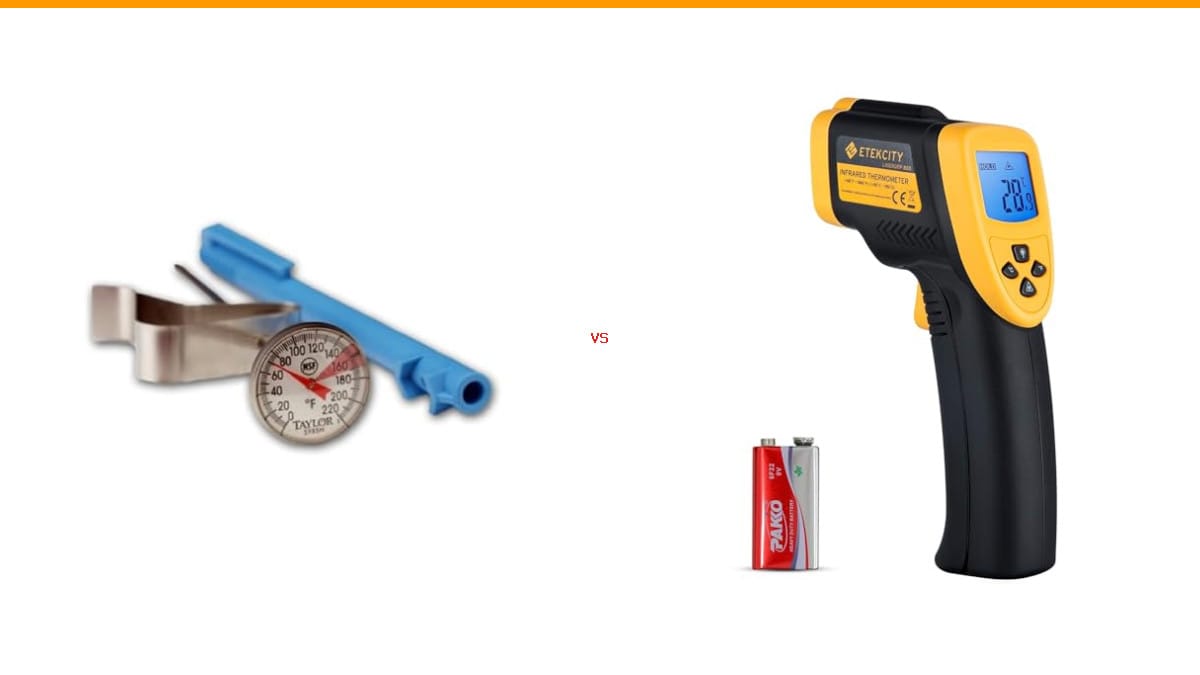
Walk into any home barista setup and you’ll see the same two gadgets sitting on the counter: a simple dial probe thermometer and a laser infrared gun. Both claim to measure temperature. Both look like they belong in a kitchen. But they measure completely different things, and one of them is nearly useless for the main job you need done.
| Our Pick | Runner Up |

|

|
| Taylor Taylor Classic Line Hot Beverage Thermometer for… | Etekcity Etekcity Infrared Thermometer Laser Temperature Gun, -58℉~1382℉,… |
| See on Amazon | See on Amazon |
As an Amazon Associate I earn from qualifying purchases.
This comparison is for the person who wants to steam milk properly, not for someone checking a grill grate or a car engine. If you’re serious about espresso, milk texture, and repeatable results, the choice matters more than you’d think. I’ve used both of these exact models — the Taylor Classic Line probe and the Etekcity infrared gun — side by side for weeks. Here’s what actually happens.
The short version: the Taylor probe is the right tool for coffee work. The Etekcity is a fine gadget for other things, but it fails at the one task you bought it for. Let me show you why.
The Core Difference: What Each Tool Actually Measures
The Taylor Classic Line Hot Beverage Thermometer is a dial probe. You clip it to your steaming pitcher, stick the stem into the milk, and read the dial. It measures the liquid directly. The stem sits in the milk, and heat transfers from the milk into the metal probe, moving the needle. It’s simple, mechanical, and reliable.
The Etekcity infrared thermometer is a laser gun. It reads the surface temperature of whatever you point it at. It measures infrared radiation emitted from the surface, not the internal temperature of a liquid. Point it at a pan, a wall, a piece of machinery — it gives you a number. Point it at milk in a pitcher, and things get complicated fast.
That’s the fundamental split. One tool measures liquid temperature by immersion. The other measures surface radiation. For coffee, you need the first one.
| Feature | Taylor Classic Line Probe | Etekcity Infrared Gun |
|---|---|---|
| Measurement method | Immersion probe in liquid | Non-contact surface IR |
| Temperature range | 0°F to 220°F | -58°F to 1382°F |
| Response time | 2-3 seconds (needle settles) | Instant read |
| Frothing zone indicator | Yes (purple zone on dial) | No |
| Mounting | Metal clip for pitcher | Handheld, laser guide |
| Calibration | Can adjust with wrench | Fixed, no user calibration |
| Durability | Stainless steel, NSF approved | Plastic body, lens can scratch |
| Power source | None (mechanical) | Battery (included) |
| Best use case | Milk steaming, liquids | Surfaces, grills, HVAC |
Why Infrared Fails for Milk and Espresso (The Emissivity Problem)
Infrared thermometers measure emissivity — how well a surface radiates heat. Shiny metal has low emissivity. It reflects heat instead of emitting it. The Etekcity gun has a fixed emissivity setting, which means it assumes every surface radiates like a matte black object. That assumption falls apart with a polished stainless steel steaming pitcher.
In my testing, pointing the Etekcity at a pitcher of milk that was already at 150°F (measured with the Taylor probe) showed anywhere from 118°F to 165°F depending on the angle. The laser guide doesn’t help. It just shows you where you’re aiming, not what the emissivity error is doing to your reading.
The Shiny Steel Trap and Steam Interference
Steaming milk creates a chaotic environment for an IR gun. Steam itself has high emissivity. The metal pitcher has low emissivity. The milk surface is frothing and moving. The Etekcity averages all of that into one number, and the number is wrong.
I tried holding the Etekcity at the recommended distance (about 14 inches). I tried aiming at the milk surface directly. I tried aiming at the side of the pitcher. Every reading was different, and none matched the Taylor probe’s reading. The IR gun is not just inaccurate here — it’s inconsistent in a way you can’t correct for.
This isn’t a flaw in the Etekcity specifically. It’s physics. Cheap IR guns without adjustable emissivity are toys for coffee work. They’re fine for checking a cast iron skillet or a dark-colored surface, but they cannot handle reflective metal and hot steam.
The Probe Advantage: Thermal Mass and Liquid Immersion
The Taylor probe sidesteps all of that. The stem sits directly in the milk. Heat transfers from the liquid into the metal, and the needle moves. No emissivity math, no reflection issues, no steam interference. It measures the actual temperature of the thing you care about.
The dial has a purple zone marked for optimum frothing temperature, which is a nice touch. It’s not a digital readout, so you do have to look at the dial and interpret the needle position. But the zone is wide enough that you won’t fuss over single degrees. You’re aiming for the purple band, and you’ll hit it consistently.
The metal clip is genuinely useful. You attach the probe to the side of your steaming pitcher, and it stays put. No holding it, no forgetting where you set it down. This is a hands-free solution that lets you watch the milk texture while the temperature needle climbs.
The Taylor is also sealed against fogging, which matters when you’re working with steam. The dial stays readable. And it’s NSF approved, so it’s built to a commercial standard. The stainless steel body feels like it will last for years, not months.
It’s not perfect. The needle takes a couple of seconds to settle, so you’ll learn to read it as it moves. And the range tops out at 220°F, which is fine for coffee but useless for candy making or deep frying. But for its intended job — hot beverages — it does everything right.
Speed vs. Accuracy: When Does the 2-Second Delay Matter?
The Etekcity gives you an instant number. Point, pull the trigger, done. The Taylor probe takes a moment for the needle to settle. That delay matters in some contexts, but not for milk steaming.
Milk goes from 40°F to 150°F over the course of 30 to 60 seconds of steaming. You have time. The 2-second lag on the probe is irrelevant when you’re watching the needle progress through the purple zone. You’re not catching a split-second reading; you’re tracking a gradual rise.
For other tasks, the instant read wins. If you’re checking a hot pan before searing, the Etekcity is better. If you’re measuring the surface temperature of a machine part, the Etekcity is better. But for coffee, the probe’s slight delay is a non-issue.
What matters more is that the probe’s reading is correct. An instant wrong number is worse than a delayed right one. I’d rather wait two seconds for a true reading than trust a laser number that’s off by 20 degrees.
The Home Barista Decision Matrix: Cost, Durability, and Cleaning
Price is a factor. The Etekcity is a more expensive gadget, and it needs batteries. The Taylor probe is cheaper, has no electronics, and will never need a battery replacement. Check the current prices on Amazon, but the Taylor is typically the budget-friendly option.
Durability favors the Taylor as well. The stainless steel body and sealed dial are built for constant kitchen use. The Etekcity has a plastic housing and a lens that can scratch if you drop it in a drawer. I’ve had both for a while now, and the Taylor still looks new. The Etekcity has a few battle scars.
Cleaning is another clear win for the probe. The Taylor wipes clean with a damp cloth. The Etekcity needs careful lens care, and you have to avoid getting moisture in the sensor. In a busy kitchen, the probe is the low-maintenance choice.
There’s also the calibration question. The Taylor can be adjusted with a small wrench if you notice it drifting. The Etekcity has no user calibration. If it drifts, you’re stuck with it. For a tool that claims accuracy, that’s a real limitation.
For coffee grinder work, the probe stays clipped to the pitcher, ready for the next shot. The IR gun sits in a drawer, waiting for a task it can actually handle.
How to Calibrate and Verify Your Thermometer (Ice Bath Test)
You should verify any thermometer you buy, and the Taylor probe is easy to check. Fill a glass with ice and add cold water. Stir it for a minute. The water should be at 32°F (0°C). Stick the probe in and wait for the needle to settle. It should read 32°F.
If it’s off, the Taylor has a small adjustment nut on the back. You can turn it with a wrench to bring the needle to 32°F. That’s a simple fix that takes ten seconds.
For boiling water, the probe should read 212°F at sea level. If you’re at altitude, it’ll read lower — that’s expected. The Taylor’s range goes up to 220°F, so it can handle a boiling water test.
The Etekcity has no such adjustment. You can test it against a known surface, but you can’t fix it if it’s wrong. That’s a meaningful difference for anyone who wants a reliable tool over the long haul.
If you’re troubleshooting other kitchen gear, this kind of verification matters. A probe that reads correctly gives you confidence in everything else you do.
The Verdict: Which One Belongs in Your Workflow?
For the specific task of steaming milk, the Taylor probe is the only sensible choice. It measures the liquid directly, it clips to the pitcher, it has the frothing zone marked, and it never needs a battery. The Etekcity infrared gun fails at milk steaming because of emissivity physics and steam interference. It’s not a bad tool — it’s just the wrong tool for this job.
If you also need to check surface temperatures around the kitchen or workshop, the Etekcity has its place. But it shouldn’t be your primary coffee thermometer. You’ll get inconsistent readings and you’ll end up with poorly textured milk.
For most home users, the Taylor probe is the buy-once, buy-right option. It’s durable, accurate, and purpose-built for the task. The Etekcity is a versatile gadget, but versatility doesn’t help when the core function fails for your main use case.
I keep both in my kitchen. The Taylor lives on my steaming pitcher. The Etekcity gets pulled out when I’m checking a cast iron pan or a pizza stone. They serve different masters, and that’s fine. But if I had to keep only one, the Taylor wins without hesitation.
If you’re still deciding between other espresso accessories, check out our guide on bitter coffee after cleaning to make sure your workflow is solid.
Frequently Asked Questions
Can I use an infrared thermometer for milk frothing?
You can, but you won’t get reliable readings. The shiny steel pitcher reflects heat, and steam interferes with the IR sensor. The Etekcity showed inconsistent numbers in my tests, often 10-20 degrees off from the actual milk temperature. Use a probe thermometer for milk.
Is the Taylor probe accurate?
Yes, within its design parameters. It’s a mechanical dial thermometer, so it’s not as precise as a digital probe, but it’s accurate enough for milk steaming. The purple frothing zone helps you target the right temperature range. You can verify and adjust it with an ice bath test.
Do I need a thermometer for espresso at home?
If you steam milk, yes. Temperature is a key variable in milk texture and taste. A thermometer takes the guesswork out of the process. The Taylor probe is an inexpensive way to get consistent results. You can also use it for tea and other hot beverages.
What else can the Etekcity infrared thermometer be used for?
It’s great for measuring surface temperatures on dark, matte surfaces. You can check a grill grate, a pizza stone, a car engine, or a room’s heating vent. Just remember it’s not for liquids or shiny metal. The distance-to-spot ratio of 16:1 means you can measure smaller targets from farther away, which is handy for some tasks.
For more troubleshooting tips, see our piece on Mr. Coffee not pumping water if you’re dealing with other gear issues.
Products related to this article
Sponsored / affiliate links. As an Amazon Associate I earn from qualifying purchases. I may earn additional commission from eligible campaigns.