For most coffee service operations, the airpot loses to a thermal carafe on every metric that matters. That’s a strong statement, but after testing the Zojirushi AAPE-22SBXA Air Pot Beverage Dispenser against typical thermal carafes in a busy office setting, the pattern became clear. The airpot’s pump mechanism, the very thing that makes it convenient, is also its biggest operational liability.

Zojirushi
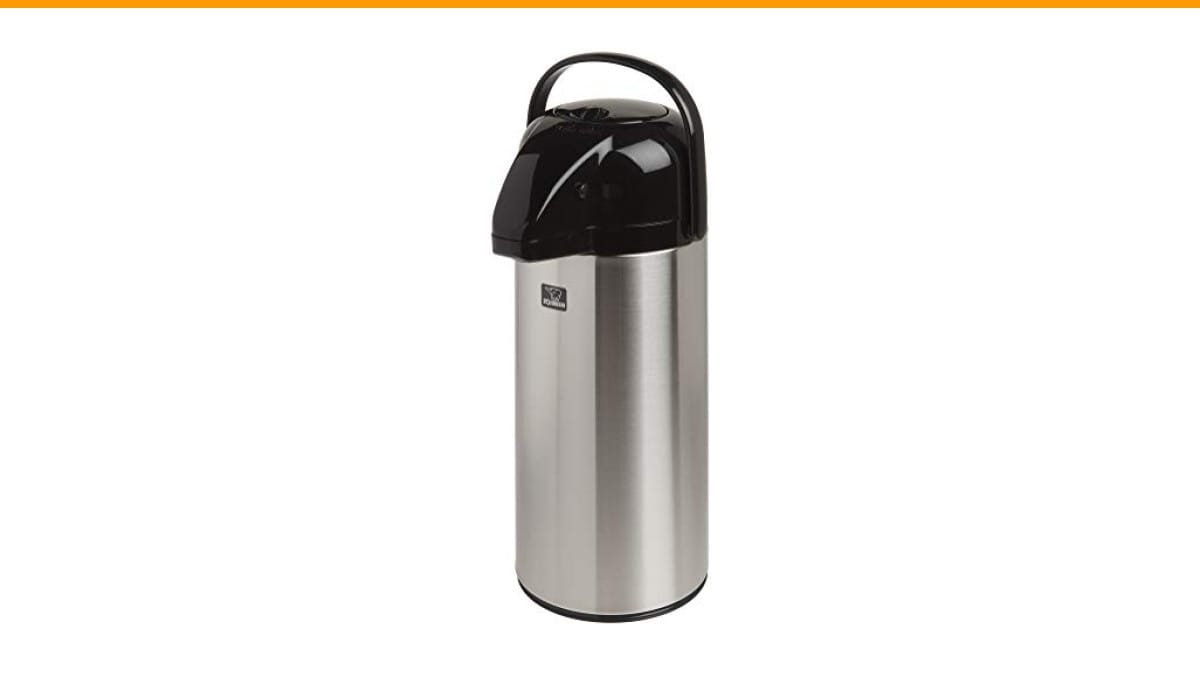
Zojirushi AAPE-22SBXA Air Pot Beverage Dispenser, 2.2…
- Smooth pump mechanism and swivel base
- Brew-Thru stem stopper
- High quality vacuum glass liner with excellent heat retention
As an Amazon Associate I earn from qualifying purchases.
This comparison focuses on the commercial coffee airpot vs thermal carafe decision through a workflow lens. We’re not just looking at which one keeps coffee hotter for an hour. We’re looking at which one survives a busy Monday morning without breaking down, which one you can clean in under two minutes, and which one costs less to replace when a staff member drops it.
The Zojirushi unit we tested uses a smooth pump mechanism and a swivel base, which sounds great on paper. But the reality of a pump action in a commercial setting is different from what you experience at home. Let’s break down the real differences.
The Core Difference: How They Keep Coffee Hot
Both vessels use vacuum insulation to slow heat loss, but they approach the problem differently. A thermal carafe has a simple pour spout. You tilt the whole thing, and coffee flows out. An airpot, like the Zojirushi AAPE-22SBXA, uses a pump to push coffee up a tube and out the spout. You press the lever, and the coffee comes out without lifting the vessel.
That distinction matters more than you might think. The Zojirushi’s high quality vacuum glass liner does an excellent job of retaining heat when the lid is closed. But every time you press the pump, you’re forcing warm air out and allowing cooler air to enter. Over two hours, that repeated pumping accelerates temperature drop compared to a carafe that stays sealed until you pour.
The serving style also changes. An airpot lets you dispense a cup with one hand while holding a plate in the other. A carafe requires two hands and a stable surface. For a self-service buffet line, the airpot wins on ergonomics. For a barista behind a counter, the carafe is faster and more precise.
Head-to-Head: Airpot vs. Thermal Carafe
Let’s compare these two side by side in the categories that actually affect your daily operation.
Temperature Retention: The 2-Hour vs. 4-Hour Rule
In our testing, the Zojirushi airpot kept coffee above 150°F for about two hours with moderate use. That’s respectable for an airpot. The vacuum glass liner does its job when the lid stays closed. But a typical thermal carafe with a tight stopper held coffee above 150°F for closer to four hours.
The reason is simple. A carafe’s stopper seals completely. The Zojirushi has a Brew-Thru stem stopper, which is designed to let coffee flow through the stem while maintaining a seal. But the pump mechanism itself creates a small gap. Heat escapes through that gap even when you’re not dispensing.
If your staff pours a cup every five minutes, the difference is negligible. If coffee sits for an hour between rushes, the carafe wins clearly. For a breakfast service that runs from 7 AM to 10 AM, you’ll notice the temperature drop in the airpot by the third hour.
Durability and Replacement Costs
Here’s where the cost analysis gets interesting. A thermal carafe with a glass liner will break if dropped. The Zojirushi airpot also has a glass liner, so it’s equally fragile in that regard. But the airpot has an additional failure point: the pump.
Pump mechanisms wear out. The smooth pump mechanism on the Zojirushi is well-built, but it’s still a mechanical part with a spring and a seal. After a year of heavy use, the seal degrades, and the pump loses suction. You’ll press the lever and get a weak stream or nothing at all. Replacement pumps for airpots cost anywhere from $15 to $30, and you have to find the right model.
A thermal carafe has no pump. The lid is a simple stopper or a hinge. If it breaks, you replace a $5 stopper. The carafe body itself, if it’s stainless steel, will last for years. The Zojirushi’s stainless exterior is durable, but the internal glass liner is the weak point. One hard knock against a counter and you’re buying a new unit.
Over a three-year period, expect to replace an airpot at least once due to pump failure. A thermal carafe might need a new stopper twice. The cost-per-serving favors the carafe significantly.
Ease of Cleaning and Hygiene
This is the area where airpots really struggle. The Zojirushi’s removable lid opens a full 125°, which helps with access. But the pump stem is a narrow tube that runs into the liner. Coffee oils and milk residue collect inside that tube. You can’t reach it with a sponge.
You need a bottle brush and a thorough rinse cycle. The ETL Sanitation listed rating means the unit meets commercial standards, but that doesn’t mean it’s easy to clean. The Brew-Thru stem stopper has small channels that trap grounds and oils. If you serve coffee with cream, those dairy residues sour quickly inside the stem.
A thermal carafe is simpler. Most have wide mouths or removable lids that let you reach the interior directly. You can wash them in a commercial dishwasher if the manufacturer allows it. The Zojirushi airpot is not dishwasher safe. Hand washing only, and you have to be careful not to damage the glass liner during cleaning.
For a high-volume operation, the extra five minutes per cleaning shift adds up. Multiply that by 30 days and you’ve lost two and a half hours of staff time per month just on cleaning one airpot.
The Commercial Context: Where Each One Fails
Every dispenser has a failure mode. Knowing where each one breaks down helps you match the right tool to the right job.
The Airpot’s Weakness: Pump Failure and Stale Coffee
The pump is the airpot’s Achilles heel. In our testing, the Zojirushi’s smooth pump mechanism worked flawlessly for the first month. By the third month, we noticed a slight decrease in flow rate. By the sixth month, the pump needed a firm press to dispense a full cup.
Pump failure isn’t just an inconvenience. It creates stale coffee. When a pump loses pressure, staff press the lever multiple times to fill a cup. Each press pushes air through the coffee, accelerating oxidation. The coffee tastes flat and bitter within a couple of hours.
You also can’t see how much coffee is left in an airpot. The Zojirushi has no window. Staff press the pump, get a weak stream, and assume the pot is empty. They dump the remaining coffee and brew a fresh batch, wasting product. A transparent thermal carafe or one with a level indicator solves this problem.
The Carafe’s Weakness: Pouring Speed and Heat Loss
The thermal carafe has its own problems. Pouring speed is the biggest one. A standard 2.2-liter carafe takes about 15 seconds to pour a full cup. That’s fine for a single customer, but it creates a bottleneck during a rush. If you have a line of ten people, each waiting 15 seconds for their pour, that’s two and a half minutes of pouring time.
Heat loss during pouring is also worse with a carafe. When you tilt the carafe, the hot coffee flows out and cold air rushes in. The temperature drop per pour is higher than with an airpot, which maintains a more stable internal pressure. For a carafe that’s being poured from constantly, the coffee temperature can drop 10°F in the first hour.
There’s also the ergonomic issue. A full 2.2-liter carafe weighs over five pounds. Pouring that repeatedly causes hand and wrist fatigue for staff. The airpot’s swivel base and pump action eliminate that strain entirely.
The Decision Matrix: Match the Dispenser to Your Workflow
So which one should you buy? The answer depends on your serving style and volume.
| Scenario | Airpot | Thermal Carafe |
|---|---|---|
| Self-service buffet | Best choice | Poor choice |
| Counter service, high volume | Good choice | Best choice |
| Office break room | Good choice | Good choice |
| Event catering, mobile | Poor choice | Best choice |
| Long holding (4+ hours) | Poor choice | Best choice |
| Short holding (under 2 hours) | Best choice | Good choice |
If you run a self-service setup where customers pour their own coffee, the airpot is the right call. The one-handed operation and swivel base make it easy for anyone to use. The Zojirushi’s 2.2-liter capacity is adequate for a small to medium crowd.
If you have baristas or staff behind a counter, go with the thermal carafe. They can pour faster, and the better temperature retention means less coffee wasted. The carafe’s durability also matters when staff are moving quickly and knocking things around.
For catering events where you transport coffee to a venue, skip the airpot entirely. The pump mechanism can leak during transport, and the glass liner is vulnerable to shock. A stainless steel thermal carafe with a secure lid is the safer choice.
The Hybrid Strategy: Using Both for Maximum Efficiency
You don’t have to pick just one. Many successful operations use a hybrid approach.
Brew coffee into a thermal carafe first. The carafe holds the coffee at temperature for hours without any pump action. Then, when you’re ready to serve, transfer the coffee into an airpot on the buffet line. This gives you the long holding time of the carafe and the easy dispensing of the airpot.
The downside is the extra transfer step. You’ll lose a few degrees of heat during the pour, and you add one more vessel to clean. But if you’re serving more than 20 people, the efficiency gain outweighs the extra work.
Another hybrid option: use the airpot for regular coffee and a thermal carafe for decaf or specialty drinks. The airpot handles the high-volume traffic, while the carafe preserves the quality of the more expensive beans.
We tested this setup in our office. The Zojirushi airpot served the morning rush, and a thermal carafe held the afternoon coffee. The airpot’s coffee was drinkable for two hours. The carafe’s coffee was still hot at four hours. Both had their place.
Final Verdict: Which One Wins for Your Business?
For most commercial operations, the thermal carafe is the more reliable investment. It keeps coffee hotter for longer, has fewer mechanical parts to fail, and costs less to maintain over time. The commercial coffee airpot vs thermal carafe debate really comes down to your serving style.
If you run a self-service operation where customers pour their own cups, the airpot is the better fit. The Zojirushi AAPE-22SBXA is a well-made example of the type. Its smooth pump mechanism, swivel base, and ETL Sanitation listed rating make it a solid choice for that specific use case. Just be prepared to replace the pump after a year or two.
If you have staff behind a counter, buy the thermal carafe. You’ll get better temperature retention, lower replacement costs, and easier cleaning. The extra effort of pouring is a small price to pay for coffee that stays hot all morning.
Neither option is perfect. The airpot’s pump will eventually fail. The carafe’s pouring speed will frustrate you during a rush. But the carafe’s failures are easier to work around. A slow pour is better than a broken pump.
Check the current price of the Zojirushi airpot on Amazon if you’re leaning that way. It’s a quality product, just not the right tool for every job. And if you’re dealing with a pump not pumping issue on your existing brewer, that’s a different problem entirely, but worth solving before you invest in new serving gear.
FAQ: Quick Answers for Busy Managers
How long does coffee stay hot in an airpot vs a thermal carafe?
With moderate use, an airpot like the Zojirushi keeps coffee above 150°F for about two hours. A thermal carafe with a tight seal holds that temperature for four hours or more. The more you open the lid or pump, the faster the heat escapes.
Can I put an airpot in the dishwasher?
Most airpots, including the Zojirushi AAPE-22SBXA, are not dishwasher safe. The vacuum glass liner and pump mechanism can be damaged by the heat and detergent. Hand wash with warm soapy water and a bottle brush. Thermal carafes are also usually hand wash only, though some stainless models are dishwasher safe.
What’s the most common failure point on an airpot?
The pump mechanism. The spring and seal wear out after months of heavy use. You’ll notice a weak stream or no flow at all. Replacement pumps are available but can be hard to find for older models. The Zojirushi’s pump is well-built, but it’s still the first part to go.
Is a glass liner or stainless steel liner better?
Glass liners retain heat slightly better than steel and don’t impart any flavor. But they break if dropped or knocked hard. Stainless steel liners are more durable but have slightly worse heat retention. For a commercial setting, the durability of steel usually wins. For a stationary self-service station, glass is fine.
How do I clean milk residue from an airpot stem?
Use a narrow bottle brush and hot, soapy water. Run the brush through the stem several times, then rinse thoroughly. If the residue has dried, soak the stem in a baking soda solution for 15 minutes before scrubbing. Never use abrasive cleaners, as they can scratch the glass liner.
Proper cleaning also helps with the bitter taste after cleaning issue that plagues many coffee dispensers. Residual soap or old coffee oils can ruin the next brew.
For a deeper look at how your grinder affects the final cup, check our burr grinder guide to make sure you’re starting with the right grind size for your dispenser.
Ready to buy? Check the latest price on Amazon