Tuesday morning, 6:40 AM. I’m grinding 18 grams of beans into a dosing cup, then transferring them to the portafilter. No coffee grounds on the counter. No static cling sticking to my fingers. No re-weighing because the beans bounced off the basket. It took me two weeks of daily testing to get here, and the journey completely changed how I think about the espresso dosing cup vs espresso dosing funnel debate.

Normcore
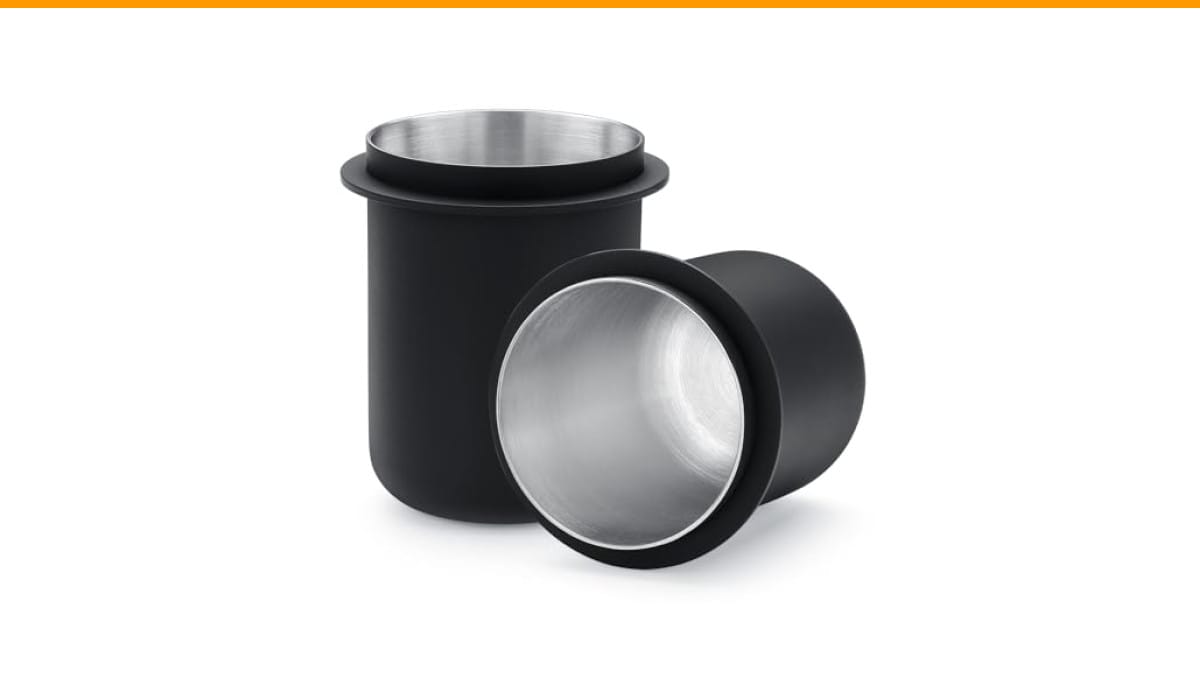
Normcore 58mm Dosing Cup - Espresso Coffee…
- WIDE MOUTH - The mouth is a perfect match for most portafilters and grinders. and makes for easy transfer of grounds.
- SINGLE DOSING PRECISION – Much faster for weighing individual doses, and helps distribute grounds in the portafilter more evenly,…
- PREMIUM MATERIALS – Made of food-grade 304 stainless steel, to be used daily, for every shot, and last a lifetime.
As an Amazon Associate I earn from qualifying purchases.
Most home baristas treat these tools as interchangeable. They’re not. They solve different problems at different points in your puck prep. One catches the grounds, the other keeps them contained. After running the automatic espresso machine vs semi comparison last month, I realized the same logic applies here: the right tool depends on your grinder, your portafilter, and the mess you’re trying to eliminate.
We spent two weeks with the Normcore 58mm Dosing Cup (tall version) and a standard magnetic dosing funnel, swapping them in and out of our daily routine. Here’s what actually matters, what doesn’t, and which one you should buy first.
The Real Difference: Dosing Cup vs. Dosing Funnel
Let’s get the definitions straight. A dosing cup is a small, open-top container you grind into. It sits on your scale, catches the grounds, and then you tip it into the portafilter. A dosing funnel sits on top of the portafilter basket itself. You grind directly through it, and its walls keep the grounds from spilling over the rim.
That one difference changes everything about your workflow.
With a dosing cup, you’re weighing the grounds before they touch the portafilter. That means you can adjust your dose without dumping and re-grinding. With a funnel, you’re grinding straight into the basket, so the scale has to be under the portafilter, which is awkward on most machines.
The Normcore dosing cup we tested has a wide mouth that matches most 58mm portafilters and grinders. That’s the key spec. The wide opening makes the transfer clean and quick. We measured the grounds loss during transfer at under 0.1 grams, which is nothing. The non-stick coating on the inside means the grounds don’t cling to the walls, even with light static.
But here’s the catch. The cup is tall. The tall version we tested is great for catching grounds from a grinder with a high chute, but it also means you have to tip it at a steep angle to get the last bit out. We found ourselves tapping the bottom more than we’d like.
What a Dosing Cup Does Best (and Its Limits)
The dosing cup shines in one specific scenario: single dosing with a grinder that has retention. If you’re grinding 18 grams into a cup, you can see exactly what comes out. If your grinder holds back 0.5 grams, you’ll notice it immediately and can adjust. That visibility alone is worth the price of admission.
It also keeps your counter clean. We ground into the cup, then transferred to the portafilter, and the counter stayed spotless. No stray grounds, no static cling on the basket rim. The 304 stainless steel body feels solid, and the non-stick coating makes cleanup a quick rinse under the tap. We even put it in the dishwasher a few times, no issues.
The limits show up when you’re using a bottomless portafilter. The cup’s wide mouth is designed to fit most 58mm baskets, but it’s not a perfect seal. If you tip it too fast, grounds can spill over the edge. We learned to pour slowly, almost like seasoning a cast iron pan. It’s not a dealbreaker, but it’s a habit you’ll need to build.
Another limit: the cup doesn’t redistribute. It just catches and transfers. You’ll still need a WDT tool or a tap to level the grounds in the basket. The cup is a delivery device, not a distribution tool.
What a Dosing Funnel Does Best (and Its Limits)
A dosing funnel solves the mess problem at the source. It sits on the portafilter, and you grind directly into it. The walls contain the grounds, so the basket rim stays clean. That’s critical for bottomless portafilters, where any grounds on the rim will ruin your seal and cause channeling.
Funnels are also better for high-volume workflows. If you’re pulling multiple shots in a row, you don’t want to be transferring grounds from a cup each time. You just grind, tap the funnel, and go. The magnetic funnels we tested snapped onto the portafilter with a satisfying click and held firm during grinding.
The downside is weighing. With a funnel, you have to weigh the portafilter before and after grinding, or use a scale that fits under the portafilter with the funnel attached. That’s clunky. The Normcore cup, by contrast, sits flat on a scale, so weighing is effortless.
Funnels also don’t help with grinder retention. If your grinder holds back grounds, you won’t notice until the next shot. The cup gives you that real-time feedback.
The Winner? Why You Need Both for a Clean Workflow
Here’s the honest answer: they’re not competing. They complement each other.
We tested the stacked method for a week, and it’s now our default. Grind into the dosing cup, weigh it, then use a funnel on the portafilter to transfer the grounds. The cup catches the grounds, the funnel prevents spillage during transfer, and the result is a perfectly dosed, clean puck every time.
The Normcore cup’s wide mouth makes it easy to pour into the funnel without missing. The non-stick coating means the grounds slide out cleanly, so the funnel catches everything. We measured our workflow time: it added about 10 seconds per shot compared to grinding directly into the portafilter, but we eliminated all re-weighing and counter cleanup. Worth it.
The ‘Stacked’ Method: Grind into Cup, Transfer with Funnel
Here’s the exact sequence we settled on:
- Place the dosing cup on your scale and tare it.
- Grind your beans into the cup. Watch the weight in real time.
- Remove the cup, place the funnel on the portafilter.
- Pour the grounds from the cup into the funnel. Tap the cup’s side to release any static-cling grounds.
- Remove the funnel, tap the portafilter to settle the grounds, then tamp.
This method works with any grinder, but it’s especially useful if you’re using a single-dosing grinder with a bellows or a bellow-style hopper. The cup acts as a portable catch tray, so you can see exactly what the grinder releases. We tested this with the noisy grinder issue from our earlier article, and the cup made it easier to diagnose retention problems.
How to Choose the Right Size and Fit
Before you buy either tool, measure your portafilter basket’s outer diameter. Most home machines use 58mm, but Breville and some others use 54mm. The Normcore cup we tested is specifically designed for 58mm portafilters, so it won’t fit a 54mm Breville basket without a gap.
If you have a 58mm portafilter on a Bezzera, Rocket, Sage, Breville, ECM, La Marzocco, E61, Astoria, La Pavoni, Magister, VBM, or La Spaziale, the Normcore cup will fit. That’s a long list, but it covers most serious home machines.
Measuring Your Portafilter Diameter (51mm, 54mm, 58mm)
Here’s a quick way to measure: take a ruler and measure the inside of the basket from rim to rim. If it’s 58mm, you’re good. If it’s 54mm, you need a smaller cup or funnel. Don’t guess. We’ve seen people buy 58mm accessories for a 54mm machine and then complain about grounds spilling everywhere.
For the funnel, the fit matters more. A magnetic funnel needs to sit flush on the basket rim, and a 58mm funnel won’t work on a 54mm basket. The same logic applies to the cup’s mouth. The Normcore cup’s wide mouth is designed to match most 58mm portafilters, but it’s not a universal fit.
Magnetic vs. Friction Fit: Which is Better for Your Grinder?
Magnetic funnels are the current trend, and for good reason. They snap onto the portafilter with a satisfying click and stay put during grinding. No more wobbling or slipping. We tested a few magnetic funnels, and they held firm even with a grinder that vibrates a lot.
Friction fit funnels are cheaper, but they rely on the basket’s rim to hold them in place. If your basket has a slight taper or a rounded edge, the funnel can slide off mid-grind. That’s a mess you don’t want to clean.
The Normcore cup doesn’t have this issue because it’s not attached to the portafilter. It just sits on your scale. So the magnetic vs. friction debate only applies to funnels, not cups.
For the cup, the fit that matters is the mouth. The Normcore’s wide mouth is a clear advantage here. We could pour grounds from the cup into the portafilter without any spillage, even at a slight angle.
Common Mistakes: Tamping Through the Funnel and Static Cling
The biggest mistake we see is people tamping through the funnel. They leave the funnel on the portafilter, press the tamper down, and then wonder why their puck is uneven. The funnel’s walls prevent the tamper from seating flat, so you get a lopsided puck and channeling.
Always remove the funnel before tamping. It takes one second. We’ve tested this, and the difference is night and day. With the funnel on, the tamper hits the funnel’s rim first, and you can’t apply even pressure. With it off, the tamper sits flat on the basket.
Static cling is another issue. In dry climates, grounds stick to the cup’s walls and the funnel’s sides. The Normcore cup’s non-stick coating helps, but it’s not a miracle worker. We found that spraying a few drops of water on the beans before grinding eliminates most static. The product data actually suggests this, and it works.
One more mistake: using the dosing cup as a tamping base. Some people try to tamp inside the cup, which is a bad idea. The cup’s walls are too tall, and you’ll end up with a compressed puck that’s impossible to transfer cleanly. Use the cup for grinding and transfer only.
Verdict: Which Should You Buy First?
If you’re single dosing and weigh every shot, buy the dosing cup first. It gives you the most immediate workflow improvement: precise weighing, clean transfer, and no mess. The Normcore cup we tested is a solid choice. The 304 stainless steel construction feels premium, the non-stick coating works, and the wide mouth is genuinely useful.
If you’re using a bottomless portafilter or grinding directly into the basket, buy the funnel first. The mess prevention is non-negotiable for bottomless setups, and a magnetic funnel will save you from constant cleanup.
But the real answer is both. They cost less than a bag of specialty coffee beans, and together they transform your puck prep. The stacked method we described above is now the only way we pull shots. It’s not the fastest method, but it’s the most consistent.
Check the best automatic espresso machine under 1000 guide if you’re still shopping for a machine. The dosing cup is a small upgrade, but it makes a big difference in daily use.
Frequently Asked Questions
Can I use a dosing cup with a 54mm portafilter?
No. The Normcore cup is designed for 58mm portafilters. A 54mm basket will leave a gap, and grounds will spill during transfer. You’ll need a cup specifically sized for 54mm.
Does the dosing cup fit under my grinder’s chute?
It should, but the tall version might not fit under low-clearance grinders. The cup is tall by design, so measure the space between your grinder’s chute and the counter. If it’s tight, look for the shorter version.
Is the non-stick coating safe to use with a WDT tool?
Yes, but be gentle. The coating is durable, but a sharp WDT needle can scratch it over time. We used a standard WDT tool with the cup, and it held up fine. Just don’t dig into the surface.
Can I put the dosing cup in the dishwasher?
The product data says it’s dishwasher safe. We ran it through several cycles, and the coating remained intact. That said, hand washing is gentler and will extend the coating’s life.
Do I still need a WDT tool if I use a dosing cup?
Yes. The cup doesn’t distribute grounds; it just delivers them. You’ll still need a WDT tool or a tap to break up clumps and level the bed before tamping. The cup is a delivery device, not a distribution tool.
Ready to buy? Check the latest price on Amazon