You’ve just brewed a full pot of expensive specialty coffee, and within forty minutes it tastes like the bottom of a burnt pan. That’s the reality for anyone running an office breakroom, a small cafe, or a catering setup without the right serving vessel. The choice between a commercial coffee airpot and a thermal carafe isn’t about brand loyalty; it’s about whether your coffee survives the second hour.

Zojirushi
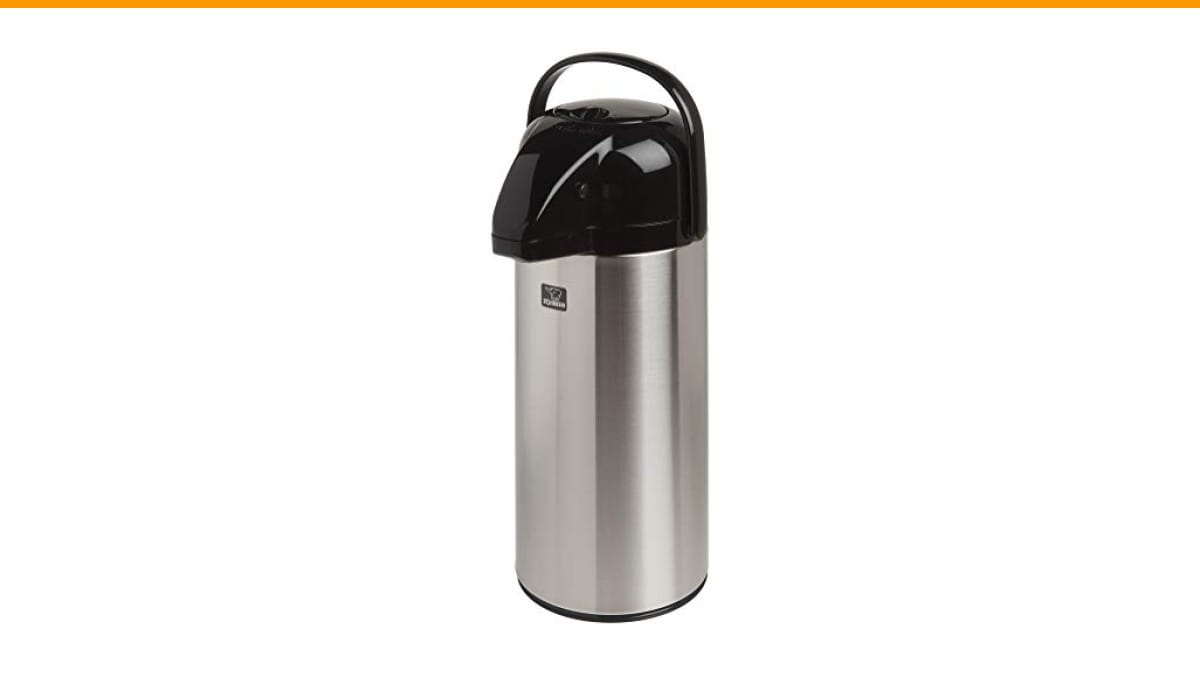
Zojirushi AAPE-22SBXA Air Pot Beverage Dispenser, 2.2…
- Smooth pump mechanism and swivel base
- Brew-Thru stem stopper
- High quality vacuum glass liner with excellent heat retention
As an Amazon Associate I earn from qualifying purchases.
Most people don’t think about this until they’ve wasted a few pounds of beans. A glass carafe on a hot plate keeps cooking the coffee, while a cheap thermal carafe might keep it warm but ruin the flavor with a metallic aftertaste. The right answer depends on how you brew, how you serve, and how long the coffee needs to last.
This guide breaks down the real differences between a commercial coffee airpot and a thermal carafe, using the Zojirushi AAPE-22SBXA Air Pot Beverage Dispenser as a reference point for what a quality airpot should do. No fluff, just the operational details that matter.
The Core Difference: How They Keep Coffee Hot
An airpot uses a vacuum glass liner to insulate the coffee. The Zojirushi AAPE-22SBXA, for example, has a high quality vacuum glass liner with excellent heat retention. That liner sits inside a stainless steel shell, and a pump mechanism pushes the coffee out through the top. No heat source, no hot plate — just pure insulation.
A thermal carafe works on the same insulation principle but with a different shape and serving method. Most thermal carafes have a narrow neck and a pour spout. You pick up the whole carafe and tilt it to serve. The vacuum insulation in a carafe is often double-walled stainless steel, which is lighter and less fragile than glass.
The practical difference shows up in the heat loss curve. A glass-lined airpot like the Zojirushi will hold coffee above 140°F for several hours, because the vacuum seal prevents heat from escaping. A typical thermal carafe holds temperature well for about two hours, but every time you open the lid to pour, you lose a significant burst of heat. Airpots have a pump that dispenses without opening the main lid, so the heat stays trapped inside.
That’s the core trade-off. The airpot preserves temperature through repeated servings. The carafe is simpler but loses heat with every pour.
Thermal Carafe vs Airpot: A Side-by-Side Comparison
Let’s put them next to each other and look at the numbers that matter for a busy workspace or event.
Temperature Retention and Heat Loss Curve
Here’s the honest breakdown of what you’ll experience in real use.
- Airpot (like the Zojirushi AAPE-22SBXA): Holds coffee above 150°F for roughly 4-6 hours. The vacuum glass liner is the key — glass doesn’t conduct heat the way metal does. The pump mechanism means the lid stays closed between servings, so you don’t lose heat to the room.
- Thermal carafe: Holds coffee above 140°F for about 2-3 hours, but only if you preheat it with hot water first. The pour spout opens the vessel every time you serve, which drops the internal temperature by 10-15°F per pour. After six pours, you’re drinking lukewarm coffee.
Preheating matters for both. You should fill either vessel with boiling water for two minutes before adding coffee. That adds about 30 minutes of usable heat retention to a carafe and about an hour to an airpot. Skip this step and you’ll lose the first cup to mediocre warmth.
Capacity and Footprint
The Zojirushi AAPE-22SBXA holds 2.2 liters, which is roughly nine standard cups of coffee. That’s a solid size for a small office or a catering station serving a handful of people.
Thermal carafes come in a wider range of sizes, from 1 liter for home use up to 3 liters for commercial batch brewers. The footprint is different too. An airpot sits on a swivel base, so you can rotate it to face the user without lifting it. A carafe needs to be picked up and tilted, which takes more counter space and more physical effort.
For a self-serve station, the airpot’s swivel base is a genuine advantage. People can serve themselves without lifting a heavy vessel or spilling coffee down the front of the unit.
Serving Style and Ergonomics
The Zojirushi’s smooth pump mechanism is the reason baristas and office managers like it. One hand pumps, the other holds the cup. No lifting, no tilting, no drips down the side of the carafe.
Thermal carafes require two hands and a careful pour. That’s fine for a barista behind a counter, but it’s a liability in a self-serve environment. Someone who’s not paying attention will spill, or they’ll leave the lid loose and ruin the insulation.
There’s also the serving speed question. A pump dispenser delivers a controlled stream, about 4-6 seconds per cup. A pour spout can go faster, but it’s less precise. For events where people are lining up, the pump is actually slower but cleaner. For table-side service, the carafe wins because it looks better on a table.
The Durability and Maintenance Showdown
This is where many buyers make a mistake. They buy a thermal carafe because it’s cheaper, then replace it twice a year because the seal breaks or the vacuum fails.
Thermal carafes are built to be dropped. The double-walled stainless steel can take a hit and keep working. The downside is the lid mechanism — the plunger and seal that close the pour spout. Those fail after a few hundred cycles. Once the seal goes, the carafe loses its vacuum and your coffee goes cold fast.
Airpots have the opposite problem. The Zojirushi’s vacuum glass liner is excellent at holding heat, but glass is glass. If you drop it hard enough, the liner shatters. That said, the stainless steel shell of the AAPE-22SBXA protects the liner in normal use. The Brew-Thru stem stopper is another smart detail — it lets you brew directly into the airpot without removing the stem, which reduces the chance of breaking the liner during filling.
Cleaning is the real differentiator. The Zojirushi’s removable lid opens a full 125°, which means you can actually get your hand inside to wipe the glass liner. That’s rare. Most airpots have narrow openings that trap coffee oils and require a brush. Thermal carafes are worse — the narrow neck makes them nearly impossible to clean by hand, and most are not dishwasher safe.
For a commercial environment, look for the ETL Sanitation listing that the Zojirushi has. That means it meets commercial food safety standards, which matters for health inspections.
Cost Analysis: Upfront Price vs. Long-Term Value
Let’s talk dollars and cents, because that’s what actually drives the decision.
A decent thermal carafe costs less than half of what a quality airpot costs. The Zojirushi AAPE-22SBXA is priced at a premium because it’s made in Japan and uses a high quality glass liner. You’ll pay more upfront, but you’re buying a vessel that will last for years if you don’t drop it.
Here’s the cost-per-serving math that most people skip. If an airpot keeps coffee drinkable for 6 hours instead of 2, you waste less coffee. A batch of coffee that costs you $5 in beans and labor will serve 20 cups over 6 hours in an airpot. The same batch in a thermal carafe will serve 10 good cups in the first 2 hours, then the rest gets dumped. Over a month, that’s a significant amount of wasted product.
Energy costs matter too. A glass carafe on a hot plate uses electricity continuously to keep the coffee hot. An airpot uses zero energy after brewing. Over a year, that’s a measurable difference on your utility bill.
Replacement parts are another factor. Thermal carafes are often cheaper to replace entirely than to repair. Airpots like the Zojirushi have replaceable pump mechanisms and lids, so you can fix the wear items without buying a whole new unit. Check the current price on Amazon if you want the exact number, but the long-term value equation favors the airpot for daily commercial use.
How to Choose Based on Your Brewing Method
Your brewing setup should dictate your serving vessel, not the other way around.
For Pour-Over and Single-Serve Brewers
If you’re doing pour-over or single-serve brewing, you’re already making coffee in small batches. A thermal carafe makes sense here because you’re serving immediately after brewing. The heat loss curve doesn’t matter much when the coffee is gone in 20 minutes.
Pour-over enthusiasts also prefer the carafe’s pour spout because it gives them control over the stream. You can pour a slow, steady circle over a cup without splashing. An airpot’s pump doesn’t offer that kind of precision.
But here’s a caveat: if you’re brewing pour-over for a group, like at a tasting event, an airpot is better. You can brew multiple batches into the airpot and serve over two hours without reheating. The carafe will go cold after the first round.
For Drip Machines and Batch Brewing
Batch brewing with a drip machine is where the airpot shines. The Zojirushi AAPE-22SBXA has a Brew-Thru stem stopper specifically designed for this — you can brew directly into the airpot without opening the lid. That keeps the heat in from the first drop.
With a thermal carafe on a drip machine, you have to remove the carafe to pour, then place it back. Each time you do that, you lose heat and risk spilling. The airpot sits on its swivel base and stays put. People come to it, not the other way around.
If you’re using a commercial coffee urn for large events, neither of these is ideal. Urns are for big crowds. Airpots and carafes are for serving smaller groups over a longer period.
The Commercial Verdict: Which One Wins for Your Business?
For an office breakroom, a small cafe, or a catering business, the airpot is the better investment. The Zojirushi AAPE-22SBXA demonstrates why: excellent heat retention, a self-serve pump, and a lid that opens wide enough to clean properly.
The thermal carafe is not a bad product. It’s just a different tool. It’s lighter, more portable, and better for table-side service. If your staff is pouring coffee for customers at a table, a carafe looks more elegant and is easier to handle.
But for self-serve stations, events, or any situation where coffee sits for more than an hour, the airpot wins on every metric that matters: temperature, waste, and energy use.
One honest caveat: the Zojirushi is currently out of stock in many places, which tells you how popular it is. If you can’t find it, look for a comparable airpot with a vacuum glass liner and a Brew-Thru stem. Don’t settle for a plastic-lined model — it won’t hold heat and it will absorb odors.
If you’re dealing with a finicky coffee maker that won’t brew properly, that’s a separate issue from the serving vessel. Check our guide on coffee maker water flow if your machine is acting up before you blame the carafe.
Quick Decision Matrix: Airpot vs. Thermal Carafe
| Scenario | Airpot | Thermal Carafe |
|---|---|---|
| Self-serve office breakroom | Best choice — pump and swivel base | Poor — requires lifting and pouring |
| Table-side restaurant service | Clunky — pump is awkward at a table | Best choice — elegant pour spout |
| Catering event, 2+ hours | Best choice — holds heat 4-6 hours | Poor — loses heat with each pour |
| Home use, single cup at a time | Overkill — too large and expensive | Best choice — compact and simple |
| Batch brewing with drip machine | Best choice — Brew-Thru stem stopper | Okay — but loses heat on reinsertion |
| High-volume commercial kitchen | Best choice — ETL Sanitation listed | Risky — seals fail under heavy use |
If you’re grinding your own beans for these setups, make sure your grinder is up to the task. A poor grind ruins coffee no matter what vessel you serve it in. Read our comparison of burr and blade grinders if you’re unsure.
Frequently Asked Questions
Can I put a thermal carafe in the dishwasher?
Most thermal carafes are not dishwasher safe. The high heat and detergent will damage the vacuum seal and the lid mechanism. Hand wash with warm soapy water and a bottle brush. The Zojirushi AAPE-22SBXA has a removable lid that opens 125°, which makes hand cleaning much easier than a standard carafe.
How long does coffee stay hot in an airpot vs. a carafe?
An airpot with a vacuum glass liner, like the Zojirushi, will keep coffee above 140°F for 4-6 hours. A thermal carafe will hold above 140°F for about 2 hours, assuming you preheated it. After that, the temperature drops below the point where coffee tastes good. Preheating both vessels with hot water before filling adds about 30-60 minutes of usable heat.
Which is better for a self-serve coffee station?
The airpot is clearly better for self-serve. The pump mechanism lets people dispense coffee without lifting the vessel, and the swivel base means the spout can face any direction. The Zojirushi’s smooth pump is easy to operate with one hand. A thermal carafe requires two hands and a steady pour, which leads to spills in a busy environment.
What’s the difference between a glass liner and stainless steel liner?
Glass liners, like the one in the Zojirushi AAPE-22SBXA, hold heat better than stainless steel because glass is a poorer conductor of heat. Stainless steel liners are more durable and won’t shatter, but they lose heat faster and can impart a metallic taste if the coffee sits for hours. For long-term heat retention, glass wins. For rough handling, steel wins.
Can I brew coffee directly into an airpot?
Yes, if the airpot has a Brew-Thru stem stopper. The Zojirushi AAPE-22SBXA has this feature, which lets you place the airpot under a drip machine and brew directly into it. The stem stopper opens automatically when the basket is placed on top, then closes when you remove it. This keeps the heat in and prevents splashing.
If you’re wondering why your coffee tastes off even with a good vessel, it might not be the container. Sometimes the problem is residue buildup in the machine. Check our article on bitter coffee after cleaning to troubleshoot that specific issue.
Ready to buy? Check the latest price on Amazon
Sponsored / affiliate links. As an Amazon Associate I earn from qualifying purchases. I may earn additional commission from eligible campaigns.Products related to this article
 Stainless Steel Moka Pot Pressed Powder Tool for 2 4 6 9 Cup Espresso Coffee Brewer(6 Cups)
 Coffee Espresso Machine Handle Replacement Parts, Cafe Bracket Handle for Lidl Silvercrest CM4621 CM4218 KF5002 KF500S Barista (for 51mm Portafilter Basket - Not included)
 HomeBeyond Espresso Coffee Maker 12 Cups, Classic Stovetop Espresso Maker, 600ml / 20oz Coffeemaker for Gas & Ceramic Stovetops (Silver)