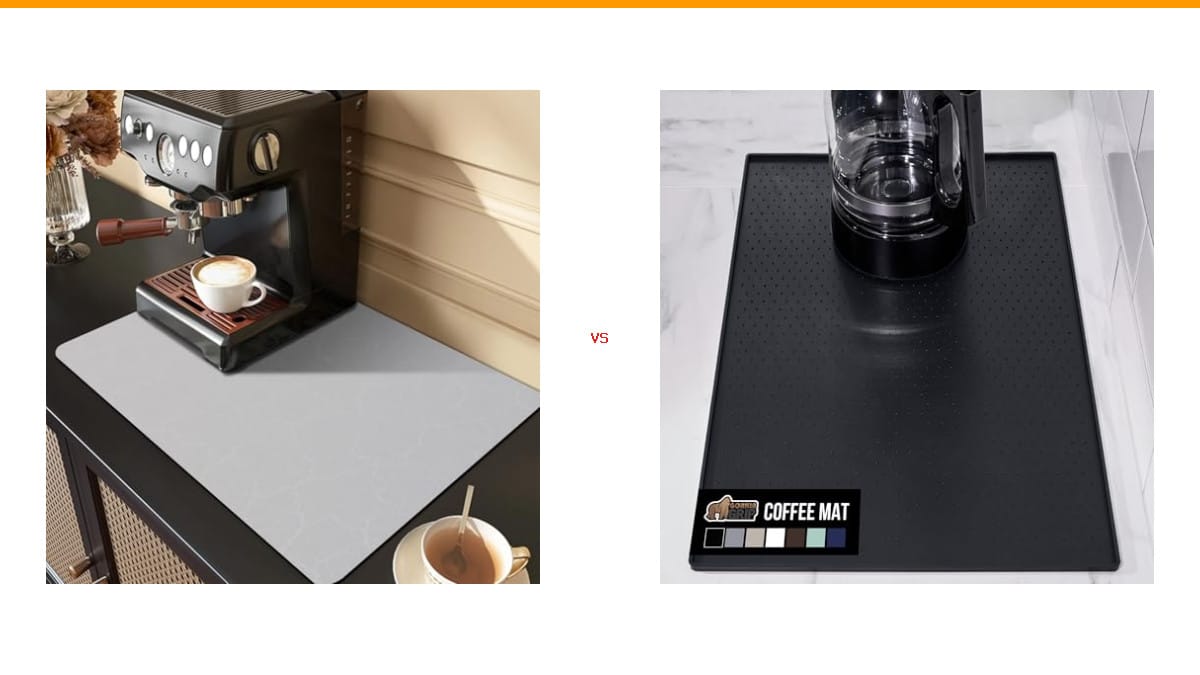
Walk into any serious home coffee setup and you’ll spot one of these mats under the machine. But they’re not the same thing. The Golener Coffee Bar Mat is a soft, absorbent pad. The GORILLA GRIP Espresso Mat is a firm, waterproof silicone sheet. People compare them because both claim to protect countertops, but they go about it in completely different ways.
| Our Pick | Runner Up |

|

|
| Golener Golener Coffee Bar Mat - Under Coffee… | GORILLA GRIP GORILLA GRIP Silicone Coffee Mat, Espresso Bar… |
| See on Amazon | See on Amazon |
As an Amazon Associate I earn from qualifying purchases.
I’ve spent weeks using both in a real kitchen, not a staged photo shoot. I pulled shots, steamed milk, knocked portafilters, and spilled plenty of coffee on purpose. This comparison matters if you’re building a coffee station and don’t want to ruin your counters or your grinder. The short version: you might need both, but if you’re buying just one, the choice comes down to what you’re protecting against.
Let’s get into the details.
Why Your Espresso Station Needs a Mat (Beyond Spills)
Espresso machines leak. Not constantly, but they do. A few drops here, a stray splash there, and water drips from the steam wand after you purge it. Over time, that moisture seeps into wood seams or leaves hard water spots on quartz. A mat catches that.
But there’s a second job people forget: noise reduction. A metal portafilter slammed on granite makes your whole kitchen ring. A mat absorbs that impact. The Golener does this better because it’s soft and plush. The Gorilla Grip is firm, so it deadens sound but doesn’t cushion like the Golener.
And then there’s the tamping question. If you tamp directly on your counter, you’re transferring force straight into your wrist and your countertop. A mat under the machine doesn’t help with that. You need a dedicated tamping mat for that job. This is where the two products split.
Coffee Bar Mat vs. Espresso Machine Mat: The Real Difference
The Tamping Mat (Under the Machine)
The GORILLA GRIP is what most people picture as an espresso machine mat. It sits directly under your machine. Its 1/8th inch raised edge contains spills so they don’t run off the mat onto your counter. The silicone backing grips the surface hard, so your machine doesn’t slide around when you lock in the portafilter.
That raised edge is the key feature. Coffee drips from the group head, water pools from the steam wand, and it all stays contained in a puddle you can wipe up. The mat measures 11.5 inches by 18.5 inches, which fits most home espresso machines but won’t cover a large commercial-style unit.
The Bar Mat (Front-of-Station Workhorse)
The Golener is a different animal. It’s a 23×15 inch absorbent pad made from a nano-material fabric with a natural rubber backing. You use it in front of the machine, not under it. This is your landing zone for wet portafilters, drippy milk pitchers, and scattered coffee grounds.
It’s essentially a giant dish-drying mat for your coffee tools. The absorbent top soaks up liquid instantly, and the rubber bottom keeps it from sliding. You can fold it up and store it when you need the counter space. That’s something a rigid silicone mat can’t do.
Material Science: Silicone, Rubber, and Polyurethane Compared
The material difference is the whole ballgame. Silicone is non-porous. Nothing soaks into it. Coffee, milk, and water sit on top until you wipe them off. That makes it stain-resistant and easy to clean. The Gorilla Grip is 100% waterproof because of this. It’s also heat resistant, so you can rest a hot portafilter on it without damage.
The Golener uses a super-absorbent nanomaterial top. Think of a high-end dish mat. It pulls liquid away from the surface and traps it in the fabric. The rubber bottom is waterproof, so nothing reaches your counter. The trade-off is that the top can stain if you don’t clean it promptly. Coffee is a dye.
Neither mat uses polyurethane, but the difference between silicone and rubber matters for durability. Silicone doesn’t break down from coffee oils. Rubber can degrade over time, especially if you use descaling chemicals near it. The Golener’s rubber backing is protected by the absorbent top, so it should last a while.
How to Choose the Right Size (A Simple Formula)
Don’t guess. Measure your machine’s footprint first. Add two inches on each side and one inch in front. That’s your minimum mat size. For the Golener, that’s 23 inches wide and 15 inches deep. Most home espresso machines like the Gaggia Classic or Breville Bambino fit this with room to spare.
For the Gorilla Grip, 11.5 x 18.5 inches works for compact machines. But if you have a dual boiler with a large drip tray, you’ll need to check clearance. The raised edge means your machine sits inside the mat, not on top of a flat surface. Measure the depth of your machine’s feet.
Here’s a concrete example. A standard 58mm portafilter needs about 6 inches of clear space in front of the machine to lock in and twist. The Golener’s 15-inch depth gives you that. The Gorilla Grip’s 11.5-inch depth is tighter but workable if you pull the machine forward.
The Dual-Mat Strategy: Optimizing Your Workflow
Here’s where things get interesting. You don’t have to pick one. The best espresso station setup I’ve tested uses both mats in different zones.
The Gorilla Grip goes under the machine. Its raised edge catches drips from the group head and steam wand. The Golener sits directly in front, acting as your work surface. You rest the portafilter on it after locking in. You place the milk pitcher on it after steaming. You knock the spent puck into the knock box over it.
This setup keeps your counter dry in two ways. The silicone mat handles the machine’s mess. The absorbent mat handles your workflow mess. If you only have room for one, the Golener is more versatile because it works for both jobs, though it lacks the raised edge for containing large spills.
Cleaning and Maintenance: Avoiding Mold and Odors
This is where the two mats diverge hard. The Gorilla Grip is dishwasher safe. Throw it in the top rack, run the cycle, done. It’s also BPA-free and food-safe. You can wipe it with a damp cloth and it’s clean in seconds. No waiting for it to dry because nothing absorbs.
The Golener requires more attention. You can hand wash or machine wash it, but you cannot bleach it. After washing, it needs to dry completely before you put it back. If you leave it damp, it will develop a musty smell. I learned this the hard way. I washed it and put it back on the counter after an hour. It wasn’t fully dry, and within two days it smelled like a wet towel.
For daily maintenance, the Golener is actually easier. Just rinse it under the tap and squeeze it out. The Gorilla Grip needs a wipe-down to remove coffee oils that can leave a film.
Signs Your Mat Needs Replacing (Don’t Wait for Damage)
Both mats wear out, but the signs are different. For the Gorilla Grip, watch for the raised edge losing its shape. If it starts to flatten or crack, it won’t contain spills anymore. Also check the silicone backing. If it loses tackiness and slides around, replace it. That usually takes a couple of years with daily use.
For the Golener, the rubber backing is the weak point. If it starts to peel or crack, moisture can get through. Also watch for the absorbent top becoming less absorbent. When water beads up on the surface instead of soaking in, the nano-material is saturated and done. That’s your replacement signal, usually after 6-12 months of heavy use.
Don’t wait for mold to grow under the mat. Lift it up and check the counter periodically. If you see dark spots or a musty smell, replace it immediately.
Budget vs. Premium: Is Expensive Worth It?
The Golener is generally the cheaper option, but it’s not a budget product. It’s a mid-range absorbent mat with a specific job. The Gorilla Grip is priced at a premium for silicone, which costs more to manufacture. You’re paying for durability and the raised edge.
Does the cheaper mat protect as well? For splashes and drips, yes. The Golener absorbs liquid that the Gorilla Grip would just hold in a puddle. But for a catastrophic spill, like your water tank leaking overnight, the Gorilla Grip’s raised edge wins. It contains the liquid instead of letting it spread across the mat and potentially off the edge.
My honest take: the Gorilla Grip is worth the extra money if you have a high-end machine and want zero maintenance. The Golener is a better value if you want a multi-purpose mat that also works for drying cups and catching grounds.
Frequently Asked Questions
Can I use a bar mat for tamping?
You can, but you shouldn’t. The Golener’s soft surface absorbs the impact, which feels fine, but it doesn’t give you a stable base. Your portafilter will sink into the mat slightly, making your tamp uneven. The Gorilla Grip is firmer, but it’s still not a dedicated tamping mat. For consistent espresso, get a proper tamping mat made of dense rubber or cork. It’ll last longer and give you a level surface.
Do mats prevent countertop staining?
Yes, but only if the liquid stays on the mat. The Gorilla Grip’s raised edge ensures that. The Golener absorbs liquid into its fabric, which keeps it off the counter, but if the mat is saturated and you spill more, it can leak out the sides. For coffee and tea stains, both work. For red wine or turmeric, the silicone mat is safer because it’s non-porous and won’t absorb the pigment.
Which mat is better for a small apartment kitchen?
The Gorilla Grip, because it takes up less counter space. 11.5 x 18.5 inches is compact. The Golener is 23 x 15 inches, which is nearly double the area. If you have a tiny counter, the silicone mat fits better. You can always use a separate small dish mat for drying tools.
Can I cut the Golener mat to fit my counter?
You can cut it, but I don’t recommend it. The rubber backing is a solid layer, and cutting it with scissors will leave rough edges that can peel. The absorbent top will fray. If it doesn’t fit your space, buy the correct size instead. The Gorilla Grip can’t be cut at all because the raised edge is molded.
Final Verdict: Which Mat Should You Buy First?
If you’re building a coffee station from scratch and only buying one mat, get the Golener Coffee Bar Mat. It’s more versatile. It catches spills, absorbs drips, gives you a soft landing zone for your tools, and folds up for storage. It’s the better first purchase for most home users.
But if you own an expensive espresso machine and want the best protection for your countertop, the GORILLA GRIP is the winner. Its raised edge, waterproof construction, and dishwasher-safe convenience make it the more reliable barrier. It’s the mat you set and forget.
For the serious home barista, the real answer is both. Use the Gorilla Grip under the machine and the Golener in front of it. That dual-mat setup covers every spill scenario and makes your workflow noticeably smoother. Pair that with proper coffee machine maintenance and you’ll keep your gear and counters in top shape for years.
If you’re still deciding between machine types, check out our automatic vs semi-automatic comparison to see which fits your routine. And if your current machine is giving you trouble, our guide on fixing water leaks will save your countertop before a mat ever gets the chance.
| Feature | Golener Coffee Bar Mat | GORILLA GRIP Espresso Mat |
|---|---|---|
| Material | Absorbent nanomaterial top, natural rubber bottom | 100% waterproof silicone |
| Size | 23 x 15 inches | 11.5 x 18.5 inches |
| Raised Edge | No | Yes, 1/8th inch |
| Waterproof | Bottom only | Entire mat |
| Cleaning | Hand wash or machine wash, no bleach | Dishwasher safe |
| Heat Resistance | Not specified | Third-party tested |
| Flexibility | Foldable | Rigid |
| Best For | Front-of-station work surface | Under-machine spill containment |
Products related to this article
Sponsored / affiliate links. As an Amazon Associate I earn from qualifying purchases. I may earn additional commission from eligible campaigns.
 Coffee Espresso Machine Handle Replacement Parts, Cafe Bracket Handle for Lidl Silvercrest CM4621 CM4218 KF5002 KF500S Barista (for 51mm Portafilter Basket - Not included)
 Insta safe Fireproof Under Grill Mat for Outdoor Grill 48 x 30, Double-Sided 2000°F Heat Resistant Deck Protector for Patios, Grass, Floors, Waterproof Oil-Proof BBQ Mat for Fire Pit & Smoker
 HomeBeyond Espresso Coffee Maker 12 Cups, Classic Stovetop Espresso Maker, 600ml / 20oz Coffeemaker for Gas & Ceramic Stovetops (Silver)