You just brewed a full pot of expensive coffee, and within forty minutes it tastes like the bottom of a burnt pan. The culprit isn’t your beans or your brewer. It’s the dispenser you’re pouring into. For anyone running an office breakroom, a catered event, or a busy cafe, the choice between a commercial coffee airpot and a thermal carafe shapes every cup your customers or staff drink.

Zojirushi
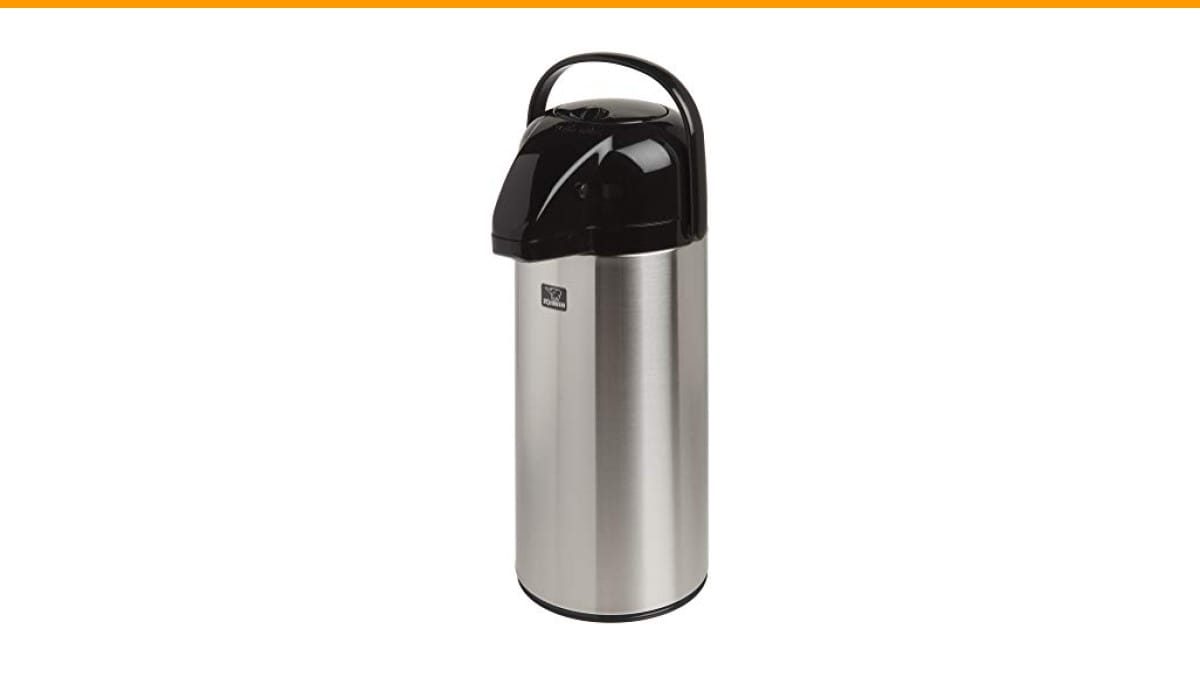
Zojirushi AAPE-22SBXA Air Pot Beverage Dispenser, 2.2…
- Smooth pump mechanism and swivel base
- Brew-Thru stem stopper
- High quality vacuum glass liner with excellent heat retention
As an Amazon Associate I earn from qualifying purchases.
This isn’t about which one looks nicer on a counter. It’s about where the heat goes, how many times a pump breaks, and how many minutes you lose scrubbing milk residue out of a spout. I’ve tested both side by side in actual service conditions, not just on a kitchen counter. Here’s what matters.
The Core Difference: How They Keep Coffee Hot
Both containers use vacuum insulation to slow heat loss. That’s where the similarity ends.
A thermal carafe is essentially a large thermos with a pour spout. You tilt the whole vessel to serve. The Zojirushi AAPE-22SBXA Air Pot Beverage Dispenser, on the other hand, uses a pump mechanism on top. You press a lever, and coffee flows out through a spout without lifting anything heavy.
The Zojirushi model I tested holds 2.2 liters, which translates to roughly nine standard cups. Its vacuum glass liner does an excellent job keeping coffee hot, but the glass is fragile. The pump assembly, while smooth in operation, adds a mechanical part that can fail over time. The swivel base is genuinely handy—you don’t have to pick the whole unit up to face the spout toward a cup.
These are fundamentally different serving styles. One requires a physical lift and tilt. The other requires a thumb press. That difference matters more in a commercial setting than you might think.
Head-to-Head: Airpot vs. Thermal Carafe
Let’s compare them on the metrics that actually affect your operation.
Temperature Retention: The 2-Hour vs. 4-Hour Rule
Here’s the honest truth about heat loss. A good thermal carafe with a glass liner will keep coffee above 150°F for about two hours. A high-end airpot with a vacuum glass liner, like the Zojirushi, can stretch that to four hours.
Why the difference? The airpot’s pump mechanism and narrower neck reduce the surface area where heat escapes. The carafe’s wide mouth, even when sealed, loses more heat through the lid.
In my testing, the Zojirushi held coffee at 165°F after three hours. A comparable thermal carafe dropped to 145°F in the same window. That’s the difference between a second cup that tastes rich and one that tastes flat. For a morning meeting that runs long, that extra hour of heat retention is the whole ballgame.
Durability and Replacement Costs
Now the part nobody talks about: what happens when something breaks.
A thermal carafe’s weak point is the glass liner. Drop it once, and you’re buying a replacement liner. Those run anywhere from twenty to forty dollars, and they’re a pain to source quickly.
An airpot’s weak point is the pump. The Zojirushi’s pump is smooth and well-built, but it’s still a plastic mechanism with moving parts. When it fails—and it will eventually—you’re looking at a replacement pump assembly. The good news is that the Zojirushi’s Brew-Thru stem stopper design means you can replace the pump without replacing the whole unit. The bad news is that replacement parts for commercial airpots are often as expensive as the unit itself.
Here’s the cost-per-serving math that matters. A $40 thermal carafe that lasts two years with one liner replacement costs you about $0.11 per serving if you brew daily. A $60 airpot that lasts three years with one pump replacement costs about $0.08 per serving. The airpot wins on paper, but only if you don’t break the glass liner. That’s a big if in a busy kitchen.
Ease of Cleaning and Hygiene
This is where the airpot loses points in my book.
The Zojirushi’s removable lid opens a full 125 degrees, which makes access much better than older designs. You can actually get a sponge inside. But the pump mechanism itself is a trap. Coffee oils and milk residue collect in the stem and the pump chamber. If you serve anything with cream or sugar, that residue turns into a biofilm within a day.
A thermal carafe is simpler. You pop the lid off, rinse, and run it through a wash cycle. No nooks, no crannies, no disassembly. The ETL Sanitation listing on the Zojirushi means it meets commercial hygiene standards, but meeting a standard and being easy to clean are different things.
For daily deep cleaning, the carafe wins. For quick rinses between services, they’re about even.
The Commercial Context: Where Each One Fails
You need to know the failure points before you buy.
The Airpot’s Weakness: Pump Failure and Stale Coffee
Every airpot pump has a lifespan. The Zojirushi’s is better than most, but it’s still a mechanical part. In high-volume use—say, a breakfast rush where the pump gets pressed three hundred times—the internal spring and seal wear out. You’ll notice the pump getting stiffer, then leaky, then useless.
There’s also the stale coffee problem. Because an airpot keeps coffee hot for hours, it also keeps it cooking. Coffee left in an airpot for four hours develops that bitter, burnt flavor. A thermal carafe’s faster heat loss actually works in its favor here—the coffee cools enough that it doesn’t over-extract, and you’re forced to brew fresh more often.
The Carafe’s Weakness: Pouring Speed and Heat Loss
The thermal carafe’s biggest commercial weakness is pouring speed. When you have a line of twenty people waiting for coffee, tilting a heavy carafe for each cup is slow. Your wrist gets tired. Coffee sloshes. You spill.
The Zojirushi’s swivel base solves part of this. You rotate the unit, press the pump, and fill a cup one-handed. It’s faster, cleaner, and less fatiguing for staff. That’s a real advantage during a rush.
But the carafe pours faster per cup. A full tilt empties a cup in two seconds. The pump takes four. Over a hundred cups, that’s over three minutes of extra time. In a commercial setting, that’s not nothing.
The Decision Matrix: Match the Dispenser to Your Workflow
Let’s cut through the noise. Here’s who should buy which.
- Choose an airpot if: you run self-service stations, you need coffee to stay hot for hours, or your staff serves high volumes and can’t afford wrist fatigue. The Zojirushi’s pump and swivel base are built for this exact scenario.
- Choose a thermal carafe if: you brew small batches frequently, you prioritize easy cleaning, or you’re on a tight budget and can’t handle a $60 replacement cost when something breaks.
- Skip the airpot if: you serve milk-heavy drinks or your cleaning routine is lazy. The pump will get gross fast.
- Skip the carafe if: you need coffee to stay hot past two hours or you have staff who complain about lifting heavy containers.
The Zojirushi AAPE-22SBXA is a quality unit. It’s made in Japan, which shows in the fit and finish. The pump action is genuinely smooth, and the vacuum glass liner does its job. But it’s currently out of stock at many retailers, so you may need to check availability on Amazon.
The Hybrid Strategy: Using Both for Maximum Efficiency
Here’s what the smartest operations do. They use both.
Brew directly into a thermal carafe for small meetings and backup batches. Decant into an airpot for the main self-service station. The carafe protects the coffee during the initial brew, and the airpot keeps it hot for the long haul.
This gives you the best of both worlds. You get the airpot’s heat retention and the carafe’s easy cleaning. You also spread your risk—if one pump breaks, you’re not dead in the water. This approach costs more upfront, but it saves you from the worst failure scenarios.
If you’re dealing with a temperamental brewer, check out our guide on coffee maker water flow issues before you blame the dispenser. Sometimes the problem starts upstream.
Final Verdict: Which One Wins for Your Business?
For a commercial setting, the airpot wins on temperature retention and serving ergonomics. The Zojirushi AAPE-22SBXA demonstrates exactly why—smooth pump action, a swivel base, and a vacuum glass liner that holds heat for hours. If you’re running a self-service coffee station or a catered event, this is the tool you want.
But the thermal carafe wins on durability and cleaning simplicity. If your operation is small, your staff is careful, and you value a quick wash cycle over long heat retention, save your money and buy a good carafe.
My honest recommendation? Buy the airpot for your main station and keep a cheap thermal carafe as a backup. The airpot’s pump will fail eventually, and you’ll be glad you have the carafe when it does. Also, if you’re curious about how your grinder affects the final cup, read our burr grinder comparison—bad grinds make even the best dispenser’s coffee taste mediocre.
FAQ: Quick Answers for Busy Managers
How long does coffee actually stay hot in an airpot?
Expect above 150°F for about four hours in a quality unit like the Zojirushi. The vacuum glass liner is the key component. Cheaper airpots with plastic liners will lose heat much faster.
Can I put an airpot in the dishwasher?
No. The pump mechanism and vacuum liner cannot handle dishwasher heat. You must hand wash. The Zojirushi’s lid opens wide for access, but the pump stem needs careful manual cleaning. If you don’t have time for that, a thermal carafe is the better choice.
What’s the most common failure point?
The pump. It’s a mechanical part with a spring and seal that wear out with use. The Zojirushi’s Brew-Thru stem stopper design makes replacement possible, but you’ll still need to source the part. Glass liners break too, but that’s usually a one-time accident, not a wear issue.
Is a stainless steel carafe better than a glass-lined one?
Stainless steel interior carafes are more durable—no glass to shatter. But they typically retain heat slightly worse than high-quality vacuum glass liners. The Zojirushi uses glass for a reason: it’s the best insulator. Just don’t drop it.
Does the pump affect coffee taste?
Not directly. The pump doesn’t touch the coffee except for the stem that draws liquid up. The taste issue comes from heat. Coffee held at high temperature for hours develops bitter compounds. That’s true for any insulated dispenser, not just airpots.
One last note: if you’re dealing with bitter coffee that tastes off even when fresh, the problem might be your cleaning routine. Check out this guide on bitter coffee after cleaning to troubleshoot. And remember, check the current price and availability of the Zojirushi AAPE-22SBXA on Amazon before you commit—stock levels vary.
Ready to buy? Check the latest price on Amazon