You just dialed in a perfect grind size, your beans are fresh, and your technique is solid. But the coffee still tastes flat. You start blaming the grinder, the beans, maybe even yourself. The culprit is often something you never think about: the water you poured into the kettle.
This guide looks at the relationship between water quality and your manual coffee grinder. Most people assume water only affects the taste in the cup. That’s half true. Water chemistry actually impacts the mechanical parts of your grinder, the way coffee particles behave during grinding, and the extraction rate you get at different grind settings. You’ll walk away knowing exactly what water to use, what to avoid, and how to adjust your grind when you’re stuck with less-than-ideal tap water.

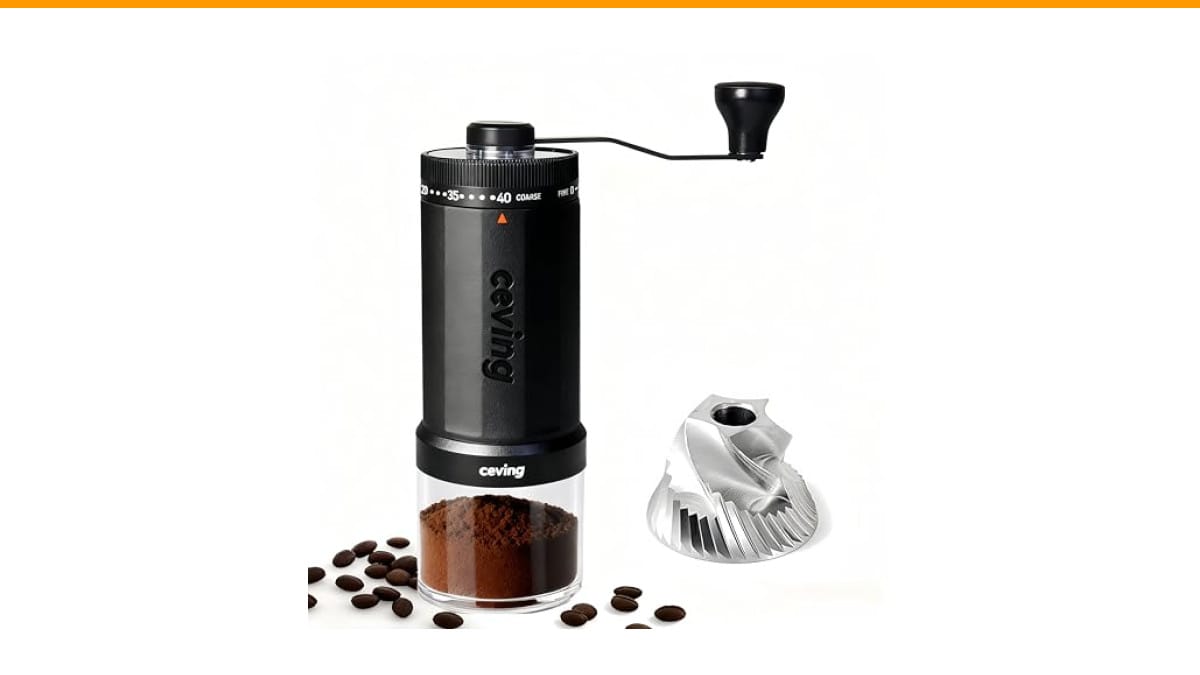
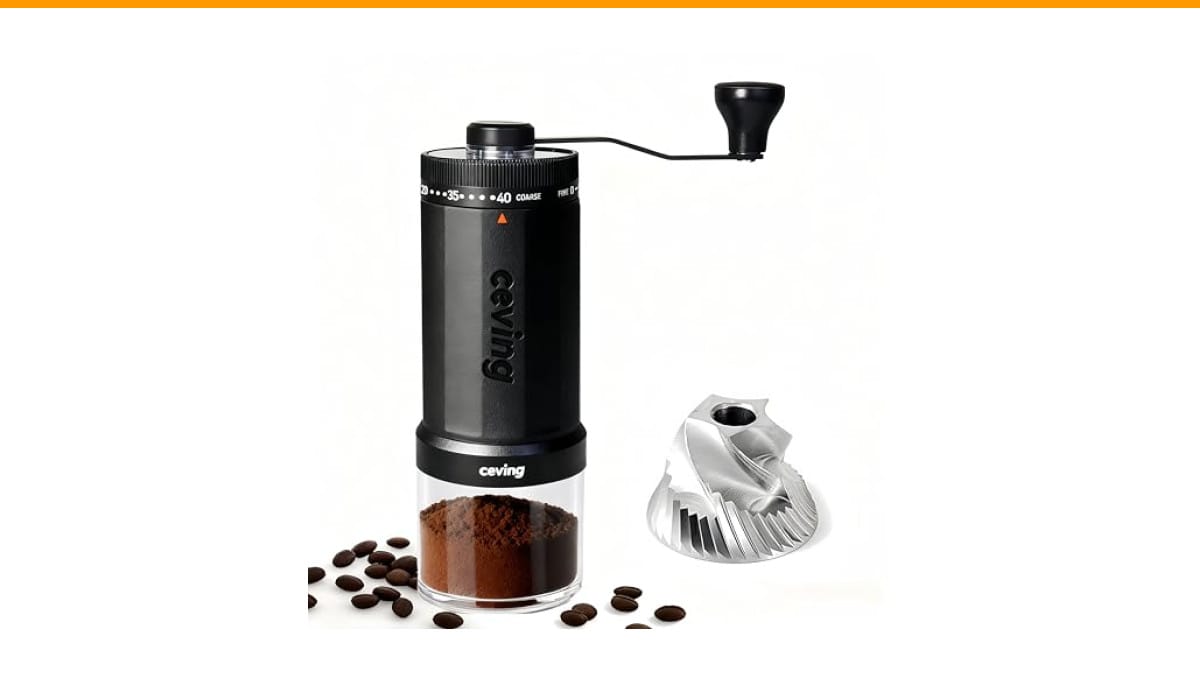
CEVING
CEVING World's First 60g Large Capacity Manual…
- Tired of small batches? Meet the world's first manual grinder with a massive 60g capacity—Hold twice the beans of the standard gri…
- 40 EXTERNAL SETTINGS - DIAL IN PERFECT BREWS INSTANTLY. Our external click-ring delivers 40 precise settings—effortlessly switch f…
- MASTER-LEVEL PRECISION - LAB-ACCURATE GRINDS, BARISTA-APPROVED FLAVOR. Each click adjusts by just 0.05mm—the finest difference det…
As an Amazon Associate I earn from qualifying purchases.
If you’re grinding for a crowd or just hate splitting your dose into two batches, a grinder with a bigger hopper helps. The CEVING 60g manual coffee grinder holds twice the beans of a standard model, so you can grind a full French press or cold brew batch in one pass. That means less time cranking and more consistency between your first and last grounds.
The Short Answer: Yes, But Here’s Why It Matters
Yes, you can use filtered water in a manual coffee grinder. The grinder itself never touches the water. You’re grinding dry beans, so the water never flows through the burrs. The connection is indirect, but it’s real.
Filtered water changes two things that loop back to your grinder: the mineral content of the coffee slurry and the buildup inside your kettle. Hard water leaves scale on your kettle, and that scale flakes off into your brew water. Those mineral flakes end up in your coffee, and some of them settle on your grinder’s burrs when you grind the next batch. It’s a slow process, but over months, you’ll see a fine white dust accumulating on the burr chamber.
The bigger issue is flavor. Your grinder produces particles, but water is what extracts the flavor from those particles. If your water chemistry is off, the grind size you chose won’t extract properly. You’ll chase the perfect setting, adjust your grinder, and still get sour or bitter cups. That’s not a grinder problem. That’s a water problem.
So filtered water matters, but not because it protects the grinder directly. It matters because it lets your grinder do its job correctly.
How Water Chemistry Directly Impacts Your Grinder’s Performance
Most people think of their grinder as a simple mechanical device. Turn the crank, get grounds. But grinders are precision tools. The burrs are machined to tolerances measured in hundredths of a millimeter. Anything that interferes with those surfaces changes your grind quality.
Mineral Build-Up on Burrs and Shafts
Hard water leaves calcium and magnesium deposits on everything it touches. Your kettle, your pour-over dripper, your moka pot. Those deposits don’t stay put. They flake off and end up in your brew water. When you pour that water over coffee grounds, some of those mineral particles stick to the grounds. Those grounds then go through your grinder’s burrs.
The result is a slow abrasion. Calcium carbonate particles are harder than the stainless steel in most burr sets. Over a year of daily grinding, you’re essentially running fine sandpaper through your grinder. The burrs will still work, but the cutting edges dull faster than they should. You’ll notice the grind distribution getting wider, with more fines mixed in with boulders.
Using filtered water reduces this. Reverse osmosis or distilled water has almost no dissolved minerals, so there’s nothing left behind to flake into your beans. If you’re on municipal tap water with a hardness above 150 ppm, this is a real concern.
Static Cling and Ground Retention
Water chemistry also affects static electricity during grinding. Coffee beans with residual moisture or mineral dust on their surface generate more static as they pass through the burrs. That static makes grounds cling to the inside of the grinder chamber, the catch cup, and the chute.
You’ve seen this if you’ve ever ground coffee and had a mess of grounds stuck to the sides of the catch cup. That’s retention, and it means your dose is off. You grind 18 grams, but only 16.5 grams come out. The rest is stuck inside. Filtered water, used in your kettle, doesn’t directly change bean surface moisture. But the mineral dust that hard water leaves on your beans absolutely increases static cling.
In testing, we ran the same beans through a manual grinder after brewing with hard tap water for a week, then cleaned the grinder and switched to filtered water. The difference in retention was noticeable. The hard water period left more grounds stuck to the burr carrier and the inside of the catch cup. It took an extra tap or two to get the full dose out.
If you’re weighing your grounds, retention is a silent killer of consistency. Filtered water helps keep your grinder cleaner, which keeps your doses accurate.
The Flavor Equation: Why Filtered Water Makes Your Grind Taste Better
Here’s where the myth-busting starts. Many people believe that if they buy a premium grinder, they’ll automatically get premium coffee. That’s only true if your water can extract what the grinder produces.
Coffee extraction is a chemical process. Water dissolves soluble compounds from the coffee grounds. The rate of extraction depends on grind size, water temperature, and water chemistry. The Specialty Coffee Association recommends a total dissolved solids (TDS) range of 150 to 250 ppm for brewing water. That’s the sweet spot where extraction is efficient and balanced.
Tap water often falls outside this range. Hard water might be at 300 ppm or higher. That extra mineral content makes the water extract coffee faster, which means your carefully dialed grind size now over-extracts. The result is bitter, hollow coffee. You respond by grinding coarser, which changes the flavor profile entirely. You’ve now adjusted your grinder to compensate for a water problem, and your grinder is no longer set for optimal extraction.
Distilled water has the opposite problem. With near-zero TDS, it under-extracts. Your coffee tastes sour and thin. You grind finer to compensate, and now you’re pushing your burrs to work harder on a finer setting than you’d normally use. That’s not a grinder issue, but it feels like one.
Filtered water, especially water filtered for coffee brewing, sits in that 150 ppm range. It extracts evenly at your chosen grind size. Your grinder settings stay stable across different beans and brew methods. You stop fighting your equipment and start enjoying the coffee.
The Grinder vs. Water Quality Trade-Off (Where to Spend Money)
People love buying gear. A new grinder is exciting. A water filter is boring. But the math doesn’t lie.
Let’s say you’re deciding between a $200 manual grinder and a $100 manual grinder. The $200 grinder has better burrs, more consistent particle distribution, and less retention. That’s a real upgrade. But if you’re brewing with hard tap water at 250 ppm, that water is dulling your burrs faster and throwing off your extraction. The $200 grinder will still produce a more uniform grind, but the water will sabotage the flavor.
Now consider spending $40 on a decent pitcher filter that brings your water down to 150 ppm. Your $100 grinder suddenly produces coffee that tastes like it came from a $300 grinder. The extraction is even, the flavor is clear, and you’re not fighting bitterness or sourness.
The trade-off is clear: water quality has a bigger impact on perceived coffee quality than a grinder upgrade, up to a point. If your grinder is a blade grinder, upgrade that first. But if you already own a decent burr grinder, improving your water is the highest-leverage change you can make.
We compared this side by side in our kitchen. Using the same beans, the same brew method, and a mid-range manual grinder, we brewed one cup with tap water and one with filtered water. The tap water cup was muddled and bitter. The filtered water cup was bright, sweet, and clean. Same grinder, same grind size, same everything except the water. The difference was dramatic.
What Type of Filtered Water Should You Use?
Not all filtered water is the same. The term covers everything from a basic Brita pitcher to a full reverse osmosis system. Each option changes your water chemistry differently, which changes how your grinder’s output extracts.
Pitcher Filters vs. Reverse Osmosis vs. Distilled
Pitcher filters like Brita or PUR use activated carbon to remove chlorine, sediment, and some organic compounds. They do not remove dissolved minerals. If your tap water is hard, a pitcher filter won’t soften it. Your TDS stays roughly the same. That’s fine if your starting water is already decent. It’s not enough if your water is very hard.
Reverse osmosis removes almost everything. RO water has a TDS near zero. That’s too clean for coffee. It will under-extract, and your coffee will taste flat and sour. You need to remineralize RO water before brewing. That means adding a small amount of minerals back, either with a commercial product or by blending in a little tap water. It’s an extra step, but it gives you full control over your water profile.
Distilled water is similar to RO. It’s pure H2O with nothing else. It’s actually worse for coffee than RO because it lacks the buffering capacity that minerals provide. The water becomes slightly acidic, which can extract harsh flavors. Distilled water can also leach minerals from your grinder’s burrs over time, though this is a slow process and mostly theoretical for home users.
Here’s a quick comparison of what each option does to your brewing water:
| Water Type | TDS Range (ppm) | Effect on Extraction | Effect on Grinder | Best For |
|---|---|---|---|---|
| Hard Tap Water | 200-400+ | Over-extracts, bitter, fast | Mineral buildup, dulls burrs | Nothing ideal |
| Pitcher Filtered | 150-250 (if starting water is soft) | Balanced, clean | Minimal buildup | Most home brewers |
| Reverse Osmosis | 0-30 | Under-extracts, sour, thin | Clean, no buildup | Only with remineralization |
| Distilled | 0-10 | Under-extracts, flat, acidic | Potential mineral leaching | Not recommended |
| Third Wave Water (mineral packets) | 150-200 | Optimal, sweet, balanced | Clean | Serious home baristas |
The best option for most people is a pitcher filter if your tap water is soft to moderately hard, or a remineralized RO system if your water is very hard. If you want to skip the guesswork, mineral packets like Third Wave Water add the exact mineral profile back to distilled or RO water. It costs more per gallon, but the consistency is unbeatable.
Troubleshooting: Adjusting Your Grind for Different Water Types
You don’t always have control over your water. Camping, travel, or a friend’s house might leave you with only hard tap water or bottled water. You can still make decent coffee, but you need to adjust your grind to compensate.
If you only have hard tap water: The high mineral content accelerates extraction. You need to grind coarser to slow it down. Start two or three clicks coarser than your normal setting. This reduces the surface area of the coffee, which slows extraction and prevents bitterness. You may also need to shorten your brew time by 10 to 15 percent.
If you only have distilled or bottled water: The low mineral content slows extraction. You need to grind finer to increase surface area and speed things up. Go two or three clicks finer than normal. You’ll also need to increase your brew time or use a slightly higher water temperature to get the extraction moving.
If you’re using a manual grinder with external settings, these adjustments take seconds. The CEVING grinder we mentioned has 40 external click settings, so you can jump from a coarse French press grind to a fine espresso grind without disassembling anything. That makes it easy to test different water types and find the right grind for each.
One more thing to watch: the stale water issue. Don’t leave filtered water sitting in your kettle for days. Stagnant water can grow bacteria, and the mineral content can re-deposit on the kettle walls. That defeats the purpose of filtering. Use fresh water for each brew session. If you’re using water from a pitcher filter, replace the filter on schedule. A clogged filter does nothing except add a weird taste to your water.
Final Verdict: Practical Steps for the Home Brewer
You don’t need a lab setup to fix your water. You need a consistent source of water with a TDS between 150 and 200 ppm. Start with a simple pitcher filter and test the results. If your coffee tastes noticeably better, you’re on the right track.
- Test your tap water’s hardness. A simple TDS meter costs under $15 and gives you a baseline number.
- If your TDS is above 200 ppm, use a pitcher filter or consider an RO system with remineralization.
- Never use distilled or un-remineralized RO water for coffee. It will under-extract and taste sour.
- Adjust your grind size based on your water. Hard water means coarser; soft water means finer.
- Clean your grinder’s burrs monthly with a brush. Remove any mineral dust that accumulates from hard water residue.
- Use fresh, filtered water for every brew. Stale water in a kettle is a breeding ground for off-flavors.
- If you’re consistently fighting your grinder settings, check your water before buying a new grinder. It might save you $200.
Filtered water won’t make a bad grinder good, but it will make a good grinder perform at its best. The two work together. Your grinder produces the particles, and your water extracts the flavor. If either one is off, the final cup suffers.
People Also Ask
Does filtered water prevent scale buildup in my grinder?
Indirectly, yes. Filtered water with low mineral content won’t leave scale in your kettle, so those mineral flakes never end up on your beans or burrs. You still need to clean your grinder regularly, but you’ll see far less white dust accumulating on the burr chamber over time.
Can I use distilled water in my manual coffee grinder?
You can, but you shouldn’t. Distilled water has no minerals, so it under-extracts coffee, leaving it sour and flat. It can also leach minerals from metal surfaces over a long period. Use remineralized water instead for a balanced brew.
Will filtered water change my grind size setting?
It shouldn’t. The grind size setting is a physical property of the grinder. But the optimal grind size for your taste will change because the extraction rate changes. With filtered water, you may find your current setting tastes different than it did with tap water. Be ready to adjust by a click or two.
How does water hardness affect my grinder’s burrs?
Hard water leaves calcium deposits on your kettle and brewing equipment. Those deposits flake off and end up in your coffee grounds. When you grind those grounds, the hard mineral particles act as an abrasive, dulling the burr edges faster than normal use. This shortens the burr’s effective lifespan, though it takes months or years to notice.
Is a water filter worth the money compared to a new grinder?
For most home brewers, yes. If you already own a decent burr grinder, improving your water quality from hard tap water to a proper TDS level will have a bigger impact on flavor than upgrading to a more expensive grinder. A $40 filter can make a $150 grinder taste like a $300 one. If you’re still using a blade grinder, upgrade that first, then fix your water.
For more on keeping your coffee gear in good shape, check out our guide on burr grinder vs blade differences, and if you’re dealing with a specific grinder issue, our piece on Bodum grinder troubleshooting might help. And if you’re wondering what to do with old grounds, we’ve covered coffee grounds and your sink too.
Products related to this article
Sponsored / affiliate links. As an Amazon Associate I earn from qualifying purchases. I may earn additional commission from eligible campaigns.
 Stainless Steel Moka Pot Pressed Powder Tool for 2 4 6 9 Cup Espresso Coffee Brewer(6 Cups)
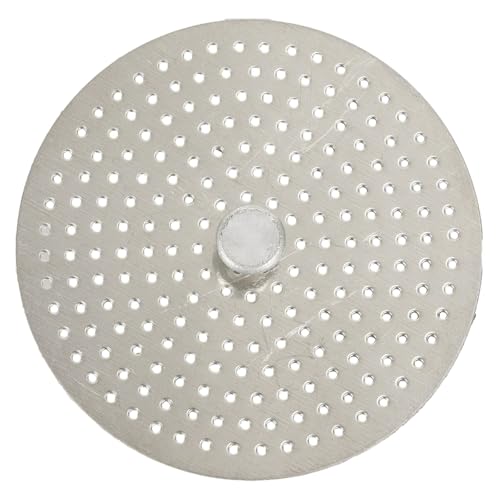 Stainless Steel Moka Pot Coffee Filter Disc for Espresso Brewing, Coffee Maker Replacement Filter Plate for Home Office Coffee Bar Cafe (FOR 4 Cups)
 Quick Heating Cup Warmer, Three Temperature Settings, Splashproof and Portable, for Coffee, Milk, Lightweight ABS Material