You bought a French press, maybe because you wanted better coffee without a machine taking over your counter. Then you scooped in some grounds, poured hot water, waited four minutes, and got a cup that tasted like weak tea or bitter mud. The problem isn’t your press. It’s the amount of coffee you put in it.
Most people guess. That works for scrambled eggs, not for coffee. The difference between a great press pot and a mediocre one is usually 5 grams of coffee. This article walks you through exact measurements for every common press size, how to adjust for roast type, and what to do when your coffee tastes off. You’ll never scoop blindly again.
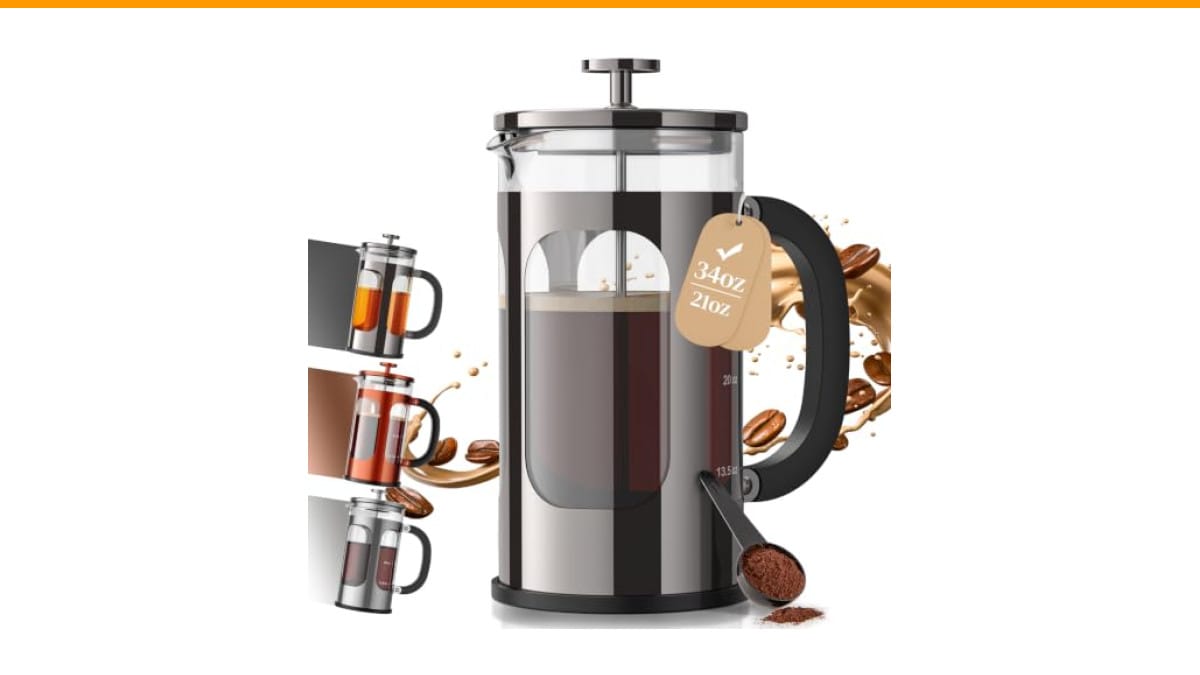
If you’re using a standard 34-ounce press like the Check Price on Amazon, the measurements below apply directly. That size holds about 8 cups of brewed coffee, and the glass carafe handles hot and cold brews equally well.
The Golden Ratio: Why 1:15 Works (and When to Break It)
The coffee-to-water ratio every specialty shop starts with is 1:15. That means one gram of coffee for every 15 grams (or milliliters) of water. Water weighs 1 gram per milliliter, so 300 ml of water needs 20 grams of coffee.
Why 1:15? It sits in the sweet spot between extraction strength and flavor clarity. At 1:12, you get a heavy, syrupy cup that can taste bitter unless your beans are dialed in. At 1:17, you get a lighter cup where subtle notes shine through, but it can taste thin. The 1:15 ratio gives you enough body to feel substantial while letting the coffee’s origin flavors come through.
You should break this rule when your beans demand it. Dark roasts have more surface area per gram because they’re less dense. They extract faster and can turn bitter at 1:15. Light roasts are denser and need a bit more coffee to hit the same strength. Treat 1:15 as your starting point, not a law.
Here’s a simple analogy: think of it like salt in pasta water. The right amount makes everything taste better. Too little and you notice nothing. Too much and you ruin the dish. Coffee ratio is the same — it’s the difference between a pleasant morning ritual and a grimace.
Your altitude and water hardness also matter. If you live above 5,000 feet, water boils at a lower temperature, which extracts less from the beans. You’ll need about 10% more coffee to compensate. Hard water (high mineral content) extracts more aggressively, so drop to 1:16 to avoid bitterness. Soft water extracts weakly, so bump up to 1:14.
French Press Sizes and Exact Measurements
Press pots are labeled by cup count, but those aren’t real cups. An 8-cup press makes about 34 ounces, which is four standard 8-ounce cups. A 3-cup press makes about 12 ounces, and a 12-cup press makes about 50 ounces. Always check your carafe’s actual capacity in milliliters — it’s printed on the bottom.
Here’s the chart you need. It assumes a 1:15 ratio and a coarse grind.
| Press Size | Water Volume | Coffee (grams) | Coffee (tablespoons) | Brewed Cups (8 oz) |
|---|---|---|---|---|
| 3-cup | 350 ml | 23 g | 4.5 tbsp | 1.5 |
| 4-cup | 500 ml | 33 g | 6.5 tbsp | 2 |
| 8-cup | 1000 ml | 67 g | 13 tbsp | 4 |
| 12-cup | 1500 ml | 100 g | 20 tbsp | 6 |
Those tablespoon numbers are approximations. A tablespoon of whole-bean coffee weighs between 5 and 7 grams depending on the roast. Dark roasts are lighter, so a tablespoon holds fewer grams. Light roasts are denser and weigh more. If you’re not using a scale, start with the lower tablespoon count and adjust from there.
3-Cup Press
A 3-cup press is perfect for one person who drinks a full mug or two smaller cups. Use 23 grams of coffee and 350 ml of water. That gives you about 12 ounces of brewed coffee. If you like it stronger, push to 25 grams. If you prefer a lighter morning cup, drop to 20 grams.
8-Cup Press
This is the most common size, and the Veken 34-ounce press falls in this range. Use 67 grams of coffee and 1000 ml (1 liter) of water. That makes four standard mugs. For a stronger brew, go to 70 grams. For a milder cup, 60 grams works. This size also handles cold brew well — see the cold brew section below.
12-Cup Press
A 12-cup press serves a household or a small gathering. Use 100 grams of coffee and 1500 ml of water. That’s six full mugs. If you’re entertaining, add 10 grams to ensure the last cup doesn’t taste weak. The larger volume means the extraction happens a bit slower, so a slightly higher dose helps.
How Bean Type and Roast Change Your Coffee Amount
Roast level changes more than flavor — it changes weight and volume. Dark roasts lose more moisture during roasting, so they’re less dense. A scoop of dark roast weighs less than the same scoop of light roast. This matters when you measure with spoons.
If you use a scale, you don’t need to adjust the gram amount for roast type. 30 grams of dark roast and 30 grams of light roast have the same amount of coffee solids. The extraction speed differs, though. Dark roasts are more porous and extract faster, so you might drop to a 1:16 ratio to avoid bitterness. Light roasts are denser and extract slower, so a 1:14 ratio gives you the strength you want without sourness.
Bean origin also plays a role. African coffees like Ethiopian Yirgacheffe are lighter and more tea-like. They benefit from a slightly higher dose to bring out body. Indonesian coffees like Sumatra are heavy and earthy — they can handle a lower dose because they’re already bold. This isn’t a hard rule, but it’s a useful starting point when you try a new bag.
Pre-ground coffee from the grocery store is usually ground finer than what a French press needs. If you’re using pre-ground, reduce your coffee amount by 10% because the finer grind extracts faster. Or better yet, buy whole beans and grind them yourself. A burr grinder set to coarse gives you consistent particles, which is the single biggest upgrade you can make. If you need grinder cleaning tips, our grinder maintenance guide has you covered.
Grind Size: The Silent Ratio Killer
You can use the perfect 1:15 ratio and still get bad coffee if your grind is wrong. French press needs a coarse grind — roughly the size of kosher salt or coarse breadcrumbs. If you grind too fine, the water extracts too much too quickly, and you get bitter, muddy coffee. If you grind too coarse, the water flows through fast and under-extracts, leaving you with sour, weak coffee.
Here’s the catch: your ratio and your grind interact. A slightly finer grind (still coarse, but on the smaller end) extracts faster. To balance that, use a touch less coffee — about 5% less. A very coarse grind extracts slower, so you can add 5% more coffee without going bitter.
Most blade grinders produce an uneven mix of fine powder and coarse chunks. That’s the worst case for a French press because the fines over-extract and the chunks under-extract. If you only have a blade grinder, pulse it in short bursts and shake the grinder between pulses. It’s not perfect, but it’s workable.
Steeping time also matters. The standard is 4 minutes. If you grind slightly finer, reduce steeping to 3.5 minutes. If you go extra coarse, extend to 5 minutes. Adjust the time before you adjust the ratio — it’s easier to change one variable at a time.
Step-by-Step Brewing with the Correct Ratio
Here’s the full process, with exact numbers for an 8-cup press. Adjust the coffee amount if your press is a different size.
- Boil 1000 ml of water. Let it sit for 30 seconds after boiling — you want it around 200°F, not 212°F. Boiling water scorches the grounds.
- Weigh out 67 grams of whole beans. Grind them coarse, just before brewing.
- Add the grounds to the press. Pour in about 200 ml of hot water, just enough to saturate the grounds. Stir gently. Let it bloom for 30 seconds. Fresh coffee releases CO2 during this step, which helps extraction.
- Pour in the remaining 800 ml of water. Start a timer for 4 minutes.
- At 3 minutes, break the crust — the layer of grounds floating on top — with a spoon. Stir gently to settle the grounds.
- At 4 minutes, press the plunger down slowly. Apply even, steady pressure. Don’t force it; if it resists, your grind is too fine.
- Pour the coffee immediately into cups or a thermal carafe. Leaving it in the press continues extraction, which turns bitter.
That last step is the one most people skip. The coffee keeps brewing in the press, so the last cup you pour is significantly more bitter than the first. Decant it all right away. Your future self will thank you.
How to Adjust the Ratio for Your Taste
Maybe 1:15 isn’t your jam. That’s fine. Here’s how to dial it in without a scale, using your spoon and your taste buds.
Start with your current brew. Taste it. If it’s bitter, your dose is too high or your grind is too fine. Reduce coffee by 1 tablespoon (about 6-7 grams) and keep everything else the same. If it’s sour or weak, increase coffee by 1 tablespoon. Make one change at a time, and taste again the next day.
If you want a bolder cup without more caffeine, you can’t extract more from the same grounds. You need more coffee. A 1:12 ratio (about 83 grams for a liter) gives you a heavy, intense cup. It’s not for everyone, but if you like your coffee to feel like a meal, this is it.
For a lighter, more delicate cup, try 1:17 (about 59 grams per liter). You’ll taste more floral and fruity notes, but the body will be thinner. This works well with light roasts that have complex flavors worth highlighting.
Here’s a quick reference for your preferred strength:
- Strong/bold: 1:12 ratio (83 g per liter)
- Standard: 1:15 ratio (67 g per liter)
- Light/mild: 1:17 ratio (59 g per liter)
Troubleshooting: Fixing Bitter, Sour, or Muddy Coffee
Bad coffee has specific causes, and each one has a specific fix. Here’s a matrix to diagnose your problem.
| Symptom | Most Likely Cause | Fix |
|---|---|---|
| Bitter, astringent | Water too hot, grind too fine, or steeped too long | Drop water temp to 195°F, use coarser grind, cut steep time to 3 min |
| Sour, sharp | Under-extracted — grind too coarse or steep too short | Grind finer, extend steep to 5 min, or add 5% more coffee |
| Weak, watery | Not enough coffee | Increase dose by 10% (about 1 tbsp per liter) |
| Muddy, sludge in cup | Grind too fine, or filter not sealing | Grind coarser, press slower, check plunger mesh alignment |
| Metallic taste | Dirty equipment or poor water | Clean the press thoroughly — see our cleaning guide for the full process |
One more thing: if your coffee tastes bitter every single time, check your water temperature. Most people pour straight from a boiling kettle. Water at 212°F scalds the grounds and extracts harsh compounds. Let it rest 30 seconds before pouring. That small pause fixes more bitter coffee than any ratio adjustment.
And if your press is hard to plunge, the mesh filter might be clogged with fine particles. That’s a sign your grind is too fine, not that the press is broken. Clean the filter assembly after every use to keep it flowing.
Cold Brew French Press: A Different Ratio
Cold brew uses a much higher ratio because cold water extracts slowly and mildly. You need more coffee to get the same strength. Use a 1:8 ratio — that’s 125 grams of coffee per liter of cold water. That’s roughly 8 tablespoons per cup of water.
The method is simple: add coarse grounds to your press, pour in cold or room-temperature water, stir, and put the whole thing in the fridge. Steep for 12 to 18 hours. The longer you steep, the stronger and more chocolatey it gets. After 18 hours, press the plunger and pour. The concentrate is strong — dilute it with water or milk at a 1:1 ratio, or drink it straight if you’re brave.
Cold brew from a French press is a great way to use the same gear for two very different drinks. The Veken press works well for this because the glass carafe handles cold temperatures without cracking, and the 4-level filter keeps the sediment out of your glass.
One note: cold brew concentrate lasts up to two weeks in the fridge, so make a full press and you’ve got coffee for days.
Why a Kitchen Scale Beats a Spoon (and How to Use It)
I’ll say it plainly: if you’re serious about consistent coffee, buy a $15 kitchen scale. Spoons vary. A heaping tablespoon of dark roast might weigh 5 grams; a level tablespoon of light roast might weigh 7 grams. That 40% difference changes your brew from balanced to bitter.
Using a scale is simple. Put your press on the scale, tare it to zero, add your beans, and note the weight. Then pour water and watch the grams climb. When you hit your target (67 grams of coffee, then 1000 grams of water for an 8-cup press), stop. That’s it. No math, no guessing.
The scale also helps you reproduce your favorite cup. When you find the ratio you love, write it down. Next time, you hit it exactly. With a spoon, you’re chasing a moving target.
If you don’t want to buy a scale, here’s a visual guide: a level tablespoon of whole-bean coffee is about 6 grams. So for a liter of water at 1:15, you need about 11 level tablespoons. That’s a lot of scooping. If you’re making a full press, use a measuring cup instead — a standard 1/4 cup holds about 24 grams of whole beans. Two and three-quarters of a 1/4-cup scoop gets you to 67 grams. Close enough, but not exact.
Your press and your grinder need regular care to keep producing good coffee. Old coffee oils go rancid and make everything taste stale. Check our regular cleaning guide for a schedule that keeps your gear fresh.
Your French Press Cheat Sheet
Here’s everything from this article condensed into a quick reference you can act on tomorrow morning.
- Use a 1:15 coffee-to-water ratio as your baseline. That’s 67 grams of coffee per liter of water.
- For a 3-cup press, use 23 grams of coffee and 350 ml of water. For an 8-cup press, use 67 grams and 1000 ml. For a 12-cup press, use 100 grams and 1500 ml.
- Grind coarse, like kosher salt. Fine grind makes bitter, muddy coffee.
- Water temperature matters: let boiling water rest 30 seconds before pouring. Aim for 200°F.
- Steep for 4 minutes, break the crust at 3 minutes, and plunge slowly.
- Pour all the coffee out immediately after plunging. Don’t let it sit in the press.
- Buy a kitchen scale. It’s the cheapest upgrade that makes the biggest difference.
Get the ratio right once, and you’ll never go back to guessing. Your mornings will taste noticeably better.
Products related to this article
Sponsored / affiliate links. As an Amazon Associate I earn from qualifying purchases. I may earn additional commission from eligible campaigns.
 HomeBeyond Espresso Coffee Maker 12 Cups, Classic Stovetop Espresso Maker, 600ml / 20oz Coffeemaker for Gas & Ceramic Stovetops (Silver)
 Belly Moka Coffee Maker Stovetop Espresso Maker 9 Cup Aluminum Moka Pot Percolator 15oz 450ml Easy Brewing for Electric Ceramic Stoves Home Camping Italian Cuban Café Classic Black
 Belly Moka Coffee Maker Stovetop Espresso Maker 6 Cup Aluminum Moka Pot Percolator 10oz 300ml Easy Brewing for Electric Ceramic Stoves Home Camping Italian Cuban Café Classic Silver