You bought a bag of specialty beans, watched a few latte art videos, and now you’re staring at a wall of espresso machines. Most of them promise café-quality results. A third of them have steam wands that barely produce foam. Another third cost more than your monthly grocery bill. The right choice depends less on price and more on how you take your coffee.
This guide focuses on the milk-first buyer. We’ll sort out the real differences between frother types, break down what pressure ratings actually mean, and help you match a machine to the drinks you make daily. You’ll leave knowing exactly which features matter, which ones are marketing noise, and what it really costs to own one of these things over three years.

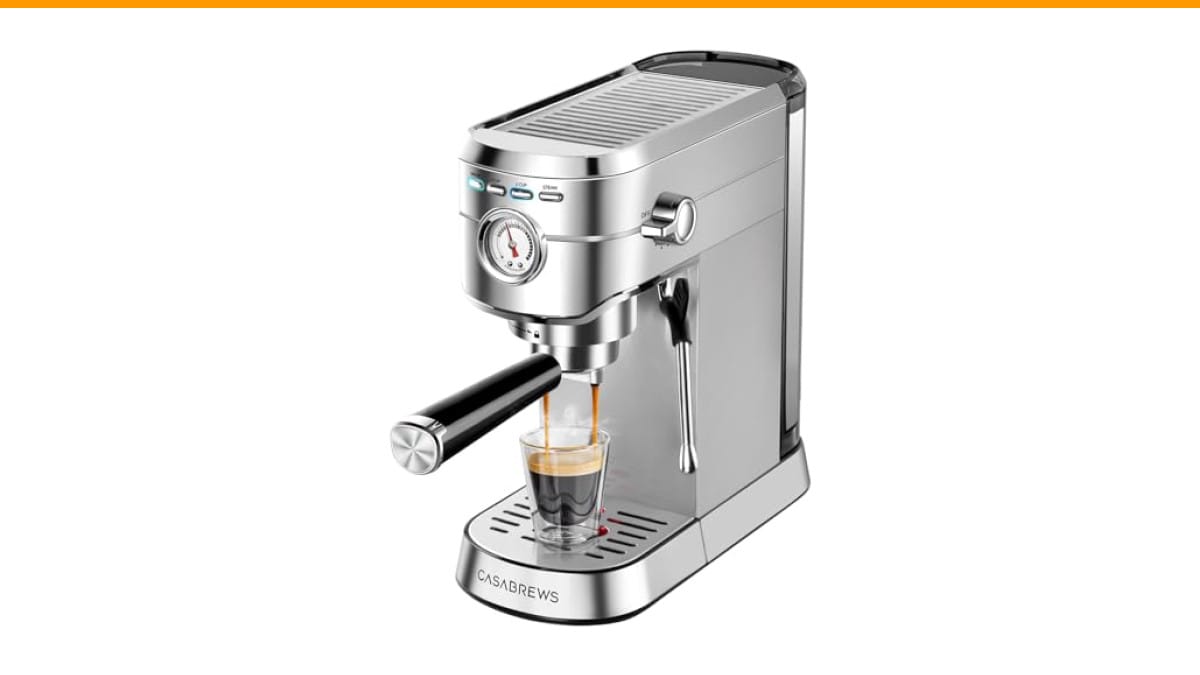
CASABREWS
CASABREWS CM5418 Compact Espresso Machine with Milk…
- Make Your Favorite Espresso Coffee At Home: The CASABREWS coffee machine with milk frother allows you to prepare all your favorite…
- Professional 20 Bar Pressure System: Semi-Automatic 2-in-1 Espresso Maker, with 20 bar professional Italian pump and 1350 W powerf…
- Milk Frothing System: Our espresso machine with milk frother has a powerful steam wand, so you can texture creamy, rich microfoam…
As an Amazon Associate I earn from qualifying purchases.
If you want a compact option that handles both espresso and milk drinks without taking over your counter, the Check Price on Amazon is worth a look. It packs a 20-bar pump and a steam wand into a small stainless steel frame, which makes it a practical starting point for anyone short on space but not on ambition.
The 3 Types of Milk Frothers: Which Matches Your Coffee Style?
Not all steam wands work the same way. The frother type determines how much control you have over milk texture, and that directly affects what drinks you can make well.
Manual Steam Wand
This is the classic metal wand you see on commercial machines. You hold a pitcher of milk, angle the wand, and move it up and down to stretch and spin the milk. It offers total control over texture, from tight microfoam for latte art to airy foam for cappuccinos. The catch is technique. Expect a learning curve of a few weeks before you consistently get silky results. The CASABREWS CM5418 uses this type, which means you can grow your skills without upgrading hardware.
Automatic Frother
Super-automatic machines often include a one-touch cappuccino system. You press a button, and the machine heats, froths, and dispenses milk automatically. These are convenient but usually produce uniform foam. You get one texture, regardless of whether you’re making a flat white or a macchiato. If you only drink cappuccinos and don’t care about latte art, this saves time. If you want variety, it limits you.
Dedicated Electric Frother
These are separate devices that whisk milk in a small pitcher. They’re cheap and easy to clean, but they heat milk in a way that creates large bubbles rather than fine microfoam. The texture collapses quickly in espresso. They’re fine for instant coffee drinks but not for serious espresso-based beverages.
The manual wand wins for anyone who wants barista-quality results at home. The trade-off is practice, but the payoff is control over every drink you make.
The Real Difference Between 9, 15, and 20 Bars of Pressure
Every espresso machine advertises its pump pressure. More bars sounds better, but that’s not how extraction works.
The golden number for espresso extraction is 9 bars. That’s the pressure at which water forces through coffee grounds to pull out the oils and solubles that create crema and flavor. Most pumps rated at 15 or 20 bars only reach that peak briefly during pre-infusion, then settle down to around 9 bars during the actual shot. A 20-bar pump doesn’t give you a stronger shot than a 9-bar pump. It gives you headroom to maintain pressure even when the machine is older or the coffee is ground slightly too fine.
What matters more than the peak rating is whether the machine can hold stable pressure through the whole shot. A cheap 15-bar machine with a weak pump will fluctuate. A well-built 9-bar machine with a quality pump will stay steady. The CASABREWS CM5418 includes a pressure gauge on the front, so you can see what’s happening during extraction and adjust your grind accordingly. That’s a feature usually found on machines twice its price.
Don’t filter machines by pressure alone. Look for stable extraction and adjustability. The gauge helps with that, but so does a decent grinder, which we’ll touch on later.
How to Match a Machine to Your Milk-Based Drink Preferences
The drinks you make most often should dictate your machine choice. Here’s the breakdown:
- Latte: Lots of steamed milk with a thin layer of foam. You need a wand that can heat milk without creating excessive froth. A manual wand gives you the control to keep the foam layer thin and silky.
- Cappuccino: Equal parts espresso, steamed milk, and thick foam. The foam should be stiff enough to hold a spoon. You need a wand with strong steam pressure to create that volume quickly.
- Flat white: Double shot of espresso with velvety microfoam, very little visible foam. This requires precise wand control to create fine bubbles. A dual boiler machine with stable steam pressure helps, but a skilled hand with a single boiler works too.
- Macchiato: A shot of espresso with a dollop of milk foam. You barely need a frother at all. Any wand will do.
If you’re a cappuccino person, you need a machine with a powerful steam wand that can froth milk quickly. If you prefer flat whites, you need control over microfoam texture. The CASABREWS CM5418’s steam wand is capable of producing microfoam, but it requires you to master the technique. That’s the trade-off for the price point.
Think about your daily routine. A machine that takes five minutes to heat up might be fine for weekend brewing but frustrating on a workday morning. Single boiler machines switch between brewing and steaming, which adds a wait. Dual boilers do both at once but cost more.
Key Features That Actually Matter (and What to Skip)
Marketing materials love jargon. Here’s what deserves your attention and what you can safely ignore.
Heating Systems: Thermoblock vs. Single vs. Dual Boiler
The heating system controls how fast the machine heats water and how stable the temperature stays during extraction.
Thermoblock: Heats water on demand as it passes through a metal block. It’s fast and cheap to manufacture, which keeps machine prices low. The downside is temperature stability. The first shot might be fine, but the second one can run cooler or hotter. This matters for milk drinks because temperature affects how well the milk froths and how the espresso extracts.
Single boiler: Heats a small tank of water. Temperature is more stable than a thermoblock, but you can’t brew and steam at the same time. You pull your shot, then wait for the boiler to heat up for steam. It adds a minute or two to each drink. Fine for one or two drinks, tedious for more.
Dual boiler: Two separate boilers, one for brewing and one for steaming. You can pull a shot and froth milk simultaneously. Temperature stability is excellent. This is the professional standard, and the price reflects it. Most home machines under $500 don’t offer this.
For most home users, a single boiler with a decent thermoblock is enough. The CASABREWS CM5418 uses a 1350W boiler, which heats up reasonably fast. Just remember to let it cool down between steaming and brewing, as the manual notes.
Portafilter Size and Its Impact on Milk Drink Quality
Standard portafilters are 58mm. That’s the industry norm for a reason. It allows for a consistent, level bed of coffee, which leads to even extraction. Smaller portafilters, like 51mm or 54mm, are common on budget machines. They’re harder to distribute coffee evenly, which can cause channeling and bitter or sour shots.
This matters for milk drinks because the espresso base determines the flavor. A bad shot covered in milk still tastes bad. Look for a 58mm portafilter if you can. The CASABREWS CM5418 uses a 51mm portafilter, which is a compromise at its price point. It works, but you’ll need to be more careful with your tamping technique.
The Hidden Costs: Maintenance, Cleaning, and Longevity
Machines fail for predictable reasons. Scale buildup clogs boilers. Milk residue clogs steam wands. Replacing parts costs money.
Descaling frequency depends on your water hardness. Hard water means descaling every month. Soft water might stretch to every three months. Use a descaling solution designed for espresso machines. Vinegar works in a pinch but can leave a residue that affects taste. We have a detailed guide on descaling your machine that covers the process step by step.
Steam wand cleaning is non-negotiable. Wipe it after every use and purge it for a second to clear milk from the tip. Milk that dries inside the wand will clog it within weeks. If that happens, you’ll need to soak the tip in warm water and use a pin to clear the hole.
Replacement parts matter too. A $200 machine with a proprietary portafilter will be hard to fix if it breaks. A machine that uses standard 58mm accessories has a thriving aftermarket. Check if the manufacturer sells replacement gaskets, baskets, and wands before you buy. The CASABREWS CM5418 is a budget machine, so don’t expect a long lifespan compared to a $1,000 model. But with proper cleaning, it should last a few years of daily use.
A Simple Decision Matrix for Your Kitchen and Budget
| Your Situation | Recommended Type | Key Feature to Prioritize | Budget Range |
|---|---|---|---|
| Daily single drink, tight counter space | Compact semi-automatic | Small footprint, quick heat-up | $150–$300 |
| Daily multiple drinks, varied menu | Semi-automatic with PID | Temperature stability, strong steam | $400–$800 |
| Weekend hobbyist, wants latte art | Dual boiler or HX machine | Simultaneous brew and steam | $800–$1,500 |
| Convenience over control | Super-automatic | One-touch cappuccino | $500–$2,000 |
| Plant-based milk drinker | Manual wand with strong pressure | Adjustable steam control | $300–$700 |
Your skill level matters. A beginner shouldn’t start with a dual boiler. The complexity and cost are wasted if you’re not pulling consistent shots yet. Start with a semi-automatic like the CASABREWS CM5418, learn the fundamentals, and upgrade when you hit its limits.
Troubleshooting Common Milk Frothing Problems
Milk frothing fails in predictable ways. Here’s how to fix the most common ones.
Burnt milk: You heated it above 150°F. Milk proteins denature and the sugars scorch. The sweet spot is 140–145°F. Use a thermometer until you can judge by feel. The pitcher should be too hot to hold comfortably but not burning.
Watery foam: You introduced too much air at the start. The wand tip should sit just below the surface, not above it. You want a gentle hissing sound, not splashing. Submerge the tip deeper once the milk expands by about 25%.
Weak steam: The wand isn’t producing enough pressure. Check for clogs first. Purge the wand before you start. If the machine has a single boiler, it might not have reached full steam temperature. Wait another 30 seconds after the indicator light changes.
Large bubbles: Your wand tip is too high in the milk. Lower it to create a vortex that pulls bubbles down and breaks them into smaller ones. Tilt the pitcher slightly to create that spinning motion.
Plant-based milks behave differently. Oat milk froths well with a bit of technique. Almond milk separates easily and produces thin foam. Soy milk needs a specific brand to work. Don’t blame the machine if your almond milk fails; try barista blends designed for steaming.
Frequently Asked Questions About Milk Frothing Espresso Machines
Can I use a steam wand to heat non-dairy milk?
Yes, but results vary. Oat and soy barista blends are formulated to steam well. Almond and coconut milks are harder to froth because they lack protein and fat. Look for products labeled ‘barista blend’ and keep the temperature below 140°F to avoid separation.
How often should I clean the steam wand?
Every single use. Wipe the wand with a damp cloth immediately after steaming. Purge it for two seconds to clear milk from the tip. Do a deep clean with a wand cleaner solution once a week if you use milk daily.
Is a 20-bar espresso machine better than a 15-bar one?
Not automatically. Both settle to around 9 bars during extraction. The pump rating is about peak capacity, not consistent performance. A well-built 15-bar machine can outperform a cheap 20-bar model. Look for pressure stability and a gauge to monitor it.
What’s the ideal milk temperature for a latte?
Between 140°F and 145°F. At this range, milk is sweet and the foam is stable. Above 150°F, the milk starts to taste cooked and the foam breaks down quickly. Use a thermometer until you can judge by touch.
Do I need a separate grinder for milk-based drinks?
Yes. Pre-ground coffee goes stale within days. A burr grinder lets you dial in the right particle size for your machine, which directly affects extraction quality. A bad grind ruins even the best machine. Budget for a grinder before you buy a more expensive espresso machine. Check our comparison of automatic vs semi-automatic machines to understand the workflow differences.
Final Verdict: The Best Machine for Your Home Barista Journey
Choosing an espresso machine with a milk frother comes down to three questions: What drinks do you make most? How much counter space do you have? And how much maintenance are you willing to handle?
- Start with a manual steam wand. It offers the most control and the best path to learning proper milk texture.
- Ignore peak pressure ratings. Look for stable extraction and a pressure gauge if possible.
- Match the heating system to your daily volume. A single boiler works for one or two drinks; a dual boiler is for serious hobbyists.
- Budget for a grinder. It matters more than the machine itself.
- Plan for cleaning. Descaling and wand maintenance are non-negotiable for longevity.
- Consider the CASABREWS CM5418 if you want a compact, budget-friendly starting point that won’t overwhelm your kitchen.
- Check the maintenance guide before you buy to understand what ownership really involves.
Your first machine won’t be perfect. Mine wasn’t. But with the right frother type and realistic expectations, you’ll be making better milk drinks than most cafés within a few months. That’s the goal.
Products related to this article
Sponsored / affiliate links. As an Amazon Associate I earn from qualifying purchases. I may earn additional commission from eligible campaigns.
 Coffee Espresso Machine Handle Replacement Parts, Cafe Bracket Handle for Lidl Silvercrest CM4621 CM4218 KF5002 KF500S Barista (for 51mm Portafilter Basket - Not included)
 Linnkyfloa Coffee Espresso Maker Handle Replacement for Stovetop Moka Pot or Percolator, Black Plastic for Spare Part Compatible with Italian(9-12 Cup)
 Wrenmor Replacement Handle For Coffee Espresso Moka Stove Pot, Black Plastic Accessory Compatible With 1/3/6/9/12 Cup Sizes For Easy Installation And Long-Lasting Use(1 Cup)