You set up your pour-over station, fill the kettle, and press the button. Nothing happens. Or it heats for two minutes and clicks off before the water is even warm. Or it boils, but the auto shutoff won’t trip, so you stand there watching steam billow like a scene from a low-budget horror film.
Electric gooseneck kettles are simple machines, but simple doesn’t mean immune to failure. Most issues trace back to a handful of root causes: bad electrical contact, a stuck thermostat, or mineral scale interfering with the heating element. You don’t need to be an appliance repair tech to fix most of these. You need a systematic approach and the patience to test one thing at a time.

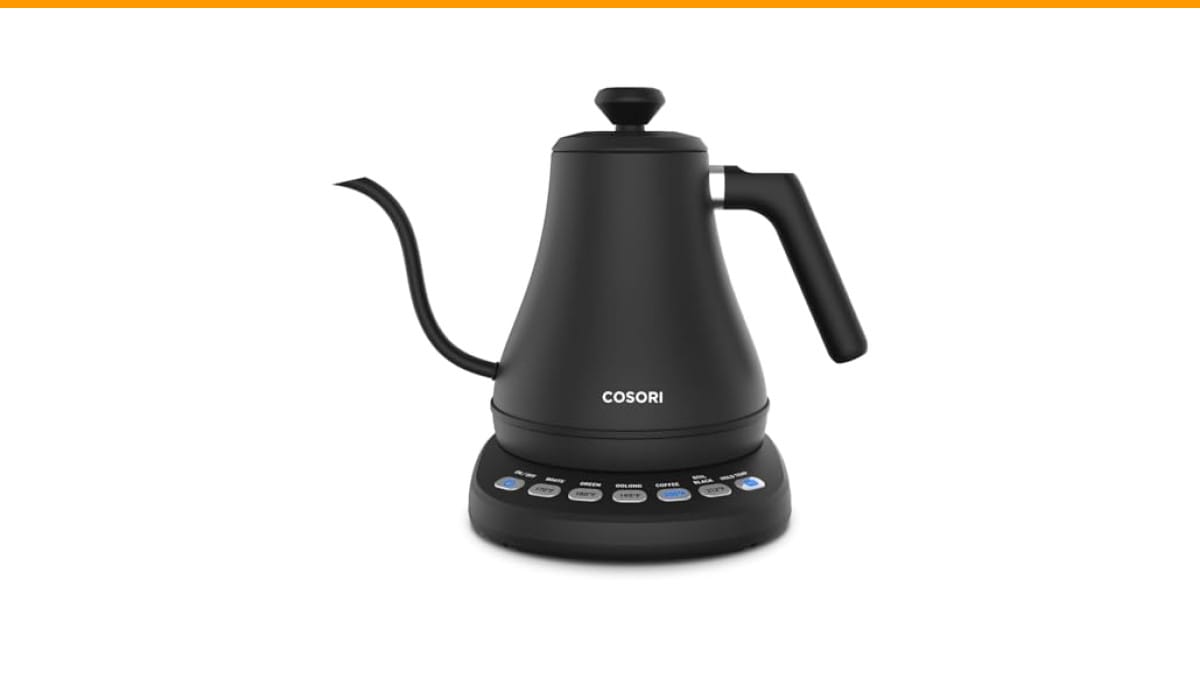
Cosori
Cosori Gooseneck Electric Kettle with Temperature Control,…
- 5 𝑶𝑵𝑬-𝑻𝑶𝑼𝑪𝑯 𝑷𝑹𝑬𝑺𝑬𝑻𝑺: Your Gooseneck Electric Kettle features 5 precise temperature presets. These accurate presets make brewing co…
- 1-𝑯𝑶𝑼𝑹 𝑲𝑬𝑬𝑷 𝑾𝑨𝑹𝑴: Use the HOLD TEMP function to keep the contents of your kettle warm for up to 1 hour so that you can enjoy your…
- 𝑬𝑹𝑮𝑶𝑵𝑶𝑴𝑰𝑪 𝑫𝑬𝑺𝑰𝑮𝑵: Refined ergonomic design allows for precise water flow control for perfect pour-over brewing
As an Amazon Associate I earn from qualifying purchases.
This guide walks you through the common failure modes, what causes them, and how to fix each one. You’ll also learn when a repair isn’t worth the effort and you’re better off replacing the kettle.
If you’re in the market for a replacement because your current kettle is beyond saving, the Cosori Gooseneck Electric Kettle is a solid choice. It has five one-touch temperature presets and a hold-temp function that keeps water within 5°F of your target for up to an hour. The 304 stainless steel interior means no plastic taste, and the precise spout gives you the control you need for pour-over brewing.
Start With the Obvious: Power and Connections
Before you take anything apart, check the basics. A dead kettle is often just a dead outlet or a loose base connection.
Plug the kettle into a different outlet. If it works there, your original outlet is the problem. Test the outlet with a phone charger or a lamp to confirm it’s live.
Inspect the power base. The kettle sits on a circular connector with a center pin. That pin can get pushed down and stuck, especially if you’ve dropped the kettle onto the base a few times. Unplug the base and gently pull the center pin up with your fingers or a pair of needle-nose pliers. A stuck pin breaks the circuit and the kettle won’t heat.
Check the kettle’s bottom for debris. Coffee grounds, dust, or dried water spots can interfere with the contact between the kettle and the base. Wipe both surfaces with a dry cloth.
If the kettle has a detachable power cord, examine both ends. Bent prongs or a frayed cord mean you need a replacement cord. Don’t try to bend prongs back into shape repeatedly; they’ll snap off eventually.
Slow Boiling or Not Heating at All
Your kettle turns on, the light glows, but the water takes forever to heat. Or it never heats at all. This points to one of two things: mineral scale or a failed heating element.
Mineral scale is the most common culprit. Hard water leaves calcium and magnesium deposits on the heating element. These deposits act as an insulator, so the element gets hot but can’t transfer that heat to the water efficiently. You’ll notice the kettle taking twice as long to boil, and you might hear a popping or crackling sound as the element heats up.
To descale, fill the kettle halfway with equal parts white vinegar and water. Bring it to a boil, then let it sit for 30 minutes. Pour it out, rinse thoroughly, and boil fresh water twice to remove any vinegar taste. For heavy buildup, use a descaling solution with citric acid and follow the manufacturer’s instructions.
If descaling doesn’t help and the kettle still won’t heat, the heating element itself may be burned out. This happens when the kettle is turned on with no water in it. The element gets hot enough to melt its own internal components. There’s no DIY fix for a dead element. You’ll need a new kettle.
Kettle Shuts Off Before Boiling
This is the most frustrating failure mode. You press the button, the water heats to maybe 150°F, and the kettle clicks off. You press it again, and it clicks off even sooner.
The cause is almost always the steam thermostat or the boil-dry sensor. These are the two safety mechanisms that cut power when the kettle gets too hot. If either one trips prematurely, it kills the power even though the water isn’t boiling.
The steam thermostat sits near the top of the kettle, often in the handle. It detects steam rising from the boiling water and shuts the kettle off. If it’s covered in mineral scale or gunk, it can trip at a lower temperature than it should. Clean the interior of the lid and the area around the steam vent with a vinegar-soaked cloth.
The boil-dry sensor is in the base of the kettle, near the heating element. It detects when the element gets dangerously hot, which happens when there’s no water. If the sensor is faulty, it might think the kettle is dry when it’s actually full. This is a more serious issue. Some kettles have a reset button on the bottom. Press it and see if that helps. If not, the sensor is likely defective.
Another possibility: the lid isn’t sealed properly. If the lid is loose or misaligned, steam escapes before it reaches the thermostat, so the kettle never gets the signal to shut off. This causes the opposite problem — the kettle boils indefinitely. Make sure the lid clicks into place securely.
Kettle Won’t Turn On After Cleaning
You just cleaned your kettle, and now it’s dead. This is a common one, and the fix is usually simple.
Water got into the electrical contacts. If you submerged the kettle or the base in water, or if you ran water over the base while rinsing, the moisture can short the circuit. Let everything dry completely for 24 to 48 hours. Place the base in a warm, dry area, and leave the kettle upside down.
If it still doesn’t work after drying, check the center pin on the base again. Cleaning can push it down. Gently pull it up and try again.
One more thing: some kettles have a thermal fuse that trips when the kettle overheats. This is a one-time fuse. If it blows, the kettle is dead permanently. This usually happens after a boil-dry event. There’s no reset for a thermal fuse, so you’d need a new kettle.
| Symptom | Likely Cause | Fix | Time to Fix |
|---|---|---|---|
| No power at all | Dead outlet, stuck center pin, or bad cord | Test another outlet, pull up the center pin, replace the cord | 5 minutes |
| Heats slowly | Mineral scale on the heating element | Descale with vinegar or citric acid | 30-45 minutes |
| Shuts off before boiling | Faulty steam thermostat or boil-dry sensor | Clean the steam vent; press the reset button; replace the kettle if the sensor is bad | 15 minutes to 1 hour |
| Boils indefinitely | Loose lid or failed thermostat | Reseat the lid; replace the thermostat if accessible | 10 minutes |
| Dead after cleaning | Moisture in electrical contacts | Dry for 24-48 hours, then retry | 1-2 days |
When to Stop Fixing and Start Replacing
Not every problem has a solution. If the heating element is burned out, the thermal fuse is blown, or the control board is fried, you’re looking at a repair cost that exceeds the price of a new kettle. Most gooseneck kettles cost between $30 and $100. Replacement parts like a new base or heating element are rarely available for purchase, and when they are, they cost nearly as much as the kettle itself.
A good rule of thumb: if the kettle is more than two years old and the issue involves the heating element or the main control board, replace it. If it’s a contact issue, a stuck pin, or mineral scale, fix it. Those are cheap and quick.
Also consider the safety angle. A kettle that fails to shut off is a fire hazard. A kettle that shuts off prematurely is just annoying. Don’t live with a kettle that boils dry. That’s how you start a fire.
Why does my electric gooseneck kettle take so long to boil?
Mineral scale is the most common reason. Hard water deposits insulate the heating element, slowing heat transfer. Descaling with vinegar or citric acid usually restores normal boil times. If you’ve descale recently and it’s still slow, check the wattage. A 1000-watt kettle will boil slower than a 1500-watt one.
Is it safe to use a kettle that keeps shutting off early?
It’s safe in the sense that it won’t cause a fire, but it’s not safe for your coffee. The water won’t reach the right temperature for proper extraction. The underlying issue — a faulty thermostat — can get worse over time. It’s best to fix it or replace the kettle.
Can I put my gooseneck kettle in the dishwasher?
No. The electrical components in the base and the heating element will be ruined by water. Hand wash the exterior with a damp cloth and descale the interior. Never submerge the kettle or its base in water.
How often should I descale my electric kettle?
It depends on your water hardness. If you have hard water, descale once a month. If you have soft water, every two to three months is fine. If you see white flakes in your water or the kettle boils slowly, it’s time to descale.
Why does my kettle make a loud popping noise when heating?
That’s the sound of mineral scale heating up and expanding. The deposits crack and pop as they get hot. Descaling will eliminate the noise. If the noise continues after a thorough descale, the heating element may be damaged and could fail soon.
What to Do Next
- Always unplug the kettle before inspecting the base or the center pin.
- Descale monthly if you have hard water; it prevents most heating issues.
- Never run the kettle dry. That’s the #1 cause of permanent failure.
- Test the outlet first. It’s the cheapest fix and the most overlooked.
- If the kettle is over two years old and the heating element is dead, replace it. Don’t sink money into repairs.
- Keep the base dry and clean. Wipe it after every use.
- If you replace your kettle, look for one with a stainless steel interior and a reliable auto shutoff.
Regular maintenance goes a long way. A clean kettle is a reliable kettle. If you’re dealing with scale buildup in your coffee gear, check out our guide on coffee maker cleaning frequency to keep everything in top shape. And if you’re troubleshooting other kitchen appliances, our steam wand cleaning guide covers a similar set of problems for espresso machines. For those times when you need to reset a tricky appliance, our Breville Dual Boiler guide might help.
Products related to this article
Sponsored / affiliate links. As an Amazon Associate I earn from qualifying purchases. I may earn additional commission from eligible campaigns.
 Coffee Mug Warmer & You are Awesome Mug Set, Electric Cup Warmer for Desk
 SOLUSTRE Electric USB Coffee Cup Warmer with Temperature Settings Portable Milk and Beverage Heating Coaster for Office Desk Small Lightweight Design Easy to Clean Surface Multi Functional
 Coffee Espresso Machine Handle Replacement Parts, Cafe Bracket Handle for Lidl Silvercrest CM4621 CM4218 KF5002 KF500S Barista (for 51mm Portafilter Basket - Not included)