Most people start their coffee journey with a blade grinder. It’s cheap, it’s small, and it does the job. Then they taste coffee from a friend’s house, brewed with beans from a proper burr grinder, and something clicks. The difference isn’t subtle. It’s the difference between a muddy, bitter cup and one with clarity and sweetness.
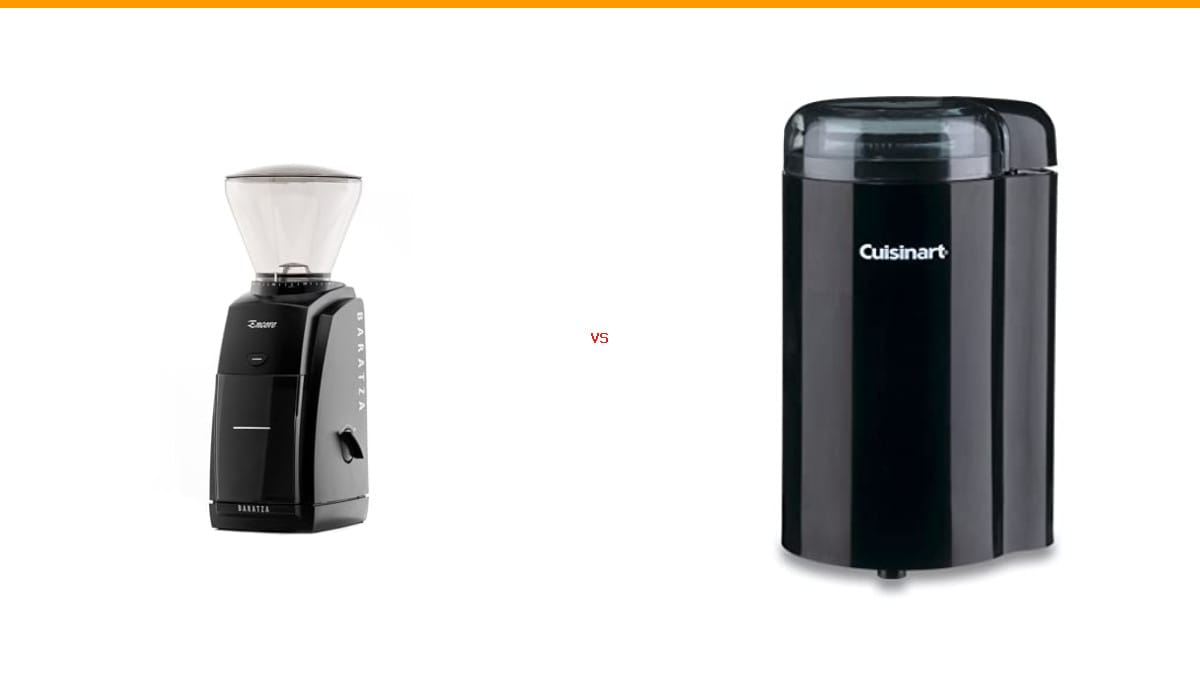
This comparison puts the Baratza Encore (a 40-setting conical burr grinder) against the Cuisinart DCG-20BKN (a classic stainless steel blade grinder). These two products represent opposite ends of the coffee grinding spectrum. The Cuisinart is often the first grinder a home user buys. The Baratza is usually the last one they need.
The short answer: if you care about the taste of your coffee, the burr grinder wins. But I’ll explain exactly why that is, what it costs you over time, and when a blade grinder might still make sense.
The 30-Second Answer: Which Grinder Wins?
The Baratza Encore wins for anyone who drinks coffee daily and wants a better cup. It produces a uniform grind size, which directly improves extraction and flavor. The Cuisinart blade grinder chops beans unevenly, leaving both large chunks and fine dust in the same batch.
That unevenness is the core problem. Fine particles over-extract and taste bitter. Large chunks under-extract and taste sour. You get both in the same cup with a blade grinder. The Encore eliminates this issue almost entirely.
But the Cuisinart costs a fraction of the price. If you only brew occasionally, use a French press, or just need something for a camping trip, the blade grinder is a reasonable stopgap. Just know what you’re buying.
The Core Difference: Crushing vs. Cutting
A burr grinder works by crushing beans between two abrasive surfaces. The Baratza Encore uses 40mm commercial-grade conical burrs. The gap between those burrs is adjustable, which gives you 40 distinct grind settings. The beans pass through once, and every particle comes out roughly the same size.
A blade grinder works like a blender. Two stainless steel blades spin at high speed and chop the beans into whatever size they happen to break into. The Cuisinart has a one-touch control and a safety interlock lid. You hold the button, the blades spin, and the beans get chopped randomly.
You can pulse a blade grinder to control the average particle size, but you cannot control the distribution. There will always be fines mixed with boulders. That is physics, not a quality problem.
Why Grind Consistency is the #1 Factor in Your Cup
Coffee extraction depends on water contacting every particle evenly. Uniform particles extract at the same rate. Mixed particles extract unevenly, which creates a harsh, muddy flavor profile.
Think of it like cutting vegetables for a stir-fry. If you cut the carrots into thick chunks and thin slices, they won’t cook at the same speed. Some will be raw, some will be mush. Grind consistency works the same way.
The Baratza Encore delivers that consistency. The Cuisinart does not. That single fact drives every other difference in this comparison.
Burr Grinders: The Precision Tool
The Baratza Encore is the entry-level standard for specialty coffee. It has a small footprint and a simple front-mounted pulse button plus an on/off switch. The 2026 update kept the same trusted internals with a sleeker exterior.
In testing, the Encore handled everything from espresso to French press without complaint. The 40 grind settings let you dial in your brew method precisely. You can move from a fine setting for a V60 to a coarse setting for a French press in seconds.
The motor is a powerful DC unit that runs quietly and doesn’t overheat. The burrs are hardened alloy steel, manufactured in Liechtenstein. They are replaceable, which means this grinder can last for a decade or more with basic maintenance.
It’s not perfect. The plastic housing feels utilitarian, and the grind bin creates some static cling. But those are minor complaints against the performance. The Encore is the grinder I recommend to anyone who asks where to start.
Conical vs. Flat Burrs: What’s the Difference?
The Encore uses conical burrs. They are quieter than flat burrs and tend to produce fewer fines. They are also easier to clean and replace. Flat burrs, found in higher-end machines, offer even more uniformity but cost significantly more.
For a home user, conical burrs are the right choice. They offer the best balance of performance, price, and longevity. The Encore’s burrs are proven in thousands of cafes and homes worldwide.
Blade Grinders: The Chaotic Chopper
The Cuisinart DCG-20BKN is a capable little appliance if you accept its limitations. It has a 2.5-ounce stainless steel bowl, enough for 12 cups of coffee. The one-touch control is simple: press the top, and the blades spin.
The safety interlock is a nice touch. The grinder won’t operate unless the lid is securely closed, which prevents accidents. The cord storage underneath keeps the counter tidy.
But the grinding results are chaotic. In my side-by-side test, the Cuisinart produced a mix of fine powder and whole bean fragments, even after 30 seconds of grinding. That inconsistency translates directly into a bitter, uneven cup.
There is also the noise. The blade grinder screams at a high pitch that rattles the kitchen. The Encore hums at a much lower volume. If you grind coffee early in the morning, that difference matters.
Cleaning is easier on the Cuisinart because the bowl and lid are removable. But you have to wipe out the oily residue after every use, or the next batch will taste stale.
Head-to-Head: Burr vs. Blade Comparison Table
| Feature | Baratza Encore | Cuisinart DCG-20BKN |
|---|---|---|
| Grinding Mechanism | 40mm conical burrs | Stainless steel blades |
| Grind Settings | 40 adjustable settings | None (pulse control only) |
| Capacity | 8 oz hopper | 2.5 oz / 70g bowl |
| Consistency | Uniform particle size | Uneven, mixed sizes |
| Noise Level | Moderate hum | High-pitched scream |
| Warranty | 1 year, world-class support | 18-month limited |
| Replaceable Parts | Yes (burrs, hopper, bin) | No (throw away) |
| Best For | All brew methods | Occasional use, French press |
The Brewing Matrix: Matching Grind to Method (with Ratios)
Here is where the Encore’s 40 settings shine. Each brew method needs a different particle size. The Encore lets you dial in precisely. The Cuisinart gives you a guess.
- Espresso: Fine, like table salt. Encore setting 8-12. Ratio: 1:2 (18g coffee to 36g water). Blade grinder: impossible to get fine enough without clogging.
- Pour-over (V60): Medium-fine, like sand. Encore setting 15-20. Ratio: 1:15 (20g coffee to 300g water).
- Chemex: Medium-coarse, like kosher salt. Encore setting 20-25. Ratio: 1:16.
- French Press: Coarse, like sea salt. Encore setting 28-32. Ratio: 1:12 (30g coffee to 360g water).
- Aeropress: Medium-fine, like sand. Encore setting 14-18. Ratio: 1:14.
With the Cuisinart, you pulse for a few seconds and hope. The result will always be a mix of sizes, which means your French press will have sludge at the bottom and your pour-over will stall.
The Real Cost: Price, Longevity, and Maintenance
The Cuisinart is cheaper upfront. You can check the current price on Amazon, but it is typically a budget-friendly purchase. The Baratza Encore costs several times more.
But the total cost of ownership tells a different story. The Encore is built to last. The burrs are replaceable, and Baratza sells every part individually. If a switch fails in five years, you can buy a new one for a few dollars. The Cuisinart has no replaceable parts. When the motor burns out, the whole unit goes in the trash.
Then there is the coffee waste. An inconsistent grind means you lose flavor. You might use 10% more coffee to compensate for the bitterness, or you might just drink worse coffee. Over a year, that adds up to real money.
The Encore also holds its resale value. Used Encores sell for close to their new price because they are reliable and in demand. A used blade grinder is worth nothing.
The Blade Grinder “Hack”: How to Improve a Bad Grind
If you already own a blade grinder and aren’t ready to upgrade, there is a technique that helps. It’s called the “tap and shake” method.
Grind your beans in short pulses of 2-3 seconds. After each pulse, pick up the grinder and shake it vigorously. This redistributes the beans and knocks the fine particles off the blades. Then pulse again.
The result isn’t perfect, but it reduces the worst of the unevenness. You’ll get a more balanced cup than a straight 15-second blast. It takes more effort, but it’s free.
Another trick: sift the ground coffee through a fine mesh strainer. Remove the fine dust before brewing. This eliminates the bitter over-extraction. It’s tedious, but it works.
The Upgrade Path: When to Switch from Blade to Burr
Switch to a burr grinder when you start noticing the flaws in your coffee. If you’re buying good beans and still getting bitter cups, the grinder is the bottleneck.
Here is a simple test. Brew the same beans with your blade grinder, then buy a small bag of pre-ground coffee from a local roaster (ground on a burr grinder). Brew both side by side. If the pre-ground coffee tastes noticeably better, you need a burr grinder.
The Baratza Encore is the natural next step. It’s the entry-level burr grinder that doesn’t require a second upgrade. It will handle everything you throw at it for years.
Common Mistakes and How to Fix Them
Mistake: Grinding too fine for French press. This creates a muddy, over-extracted cup. Fix: use the Encore’s coarse settings (28-32) and steep for exactly 4 minutes.
Mistake: Not cleaning your grinder. Stale coffee oils go rancid and ruin fresh beans. Fix: wipe down the Cuisinart bowl after each use. For the Encore, brush out the burr chamber weekly.
Mistake: Grinding too much at once. Coffee goes stale within minutes of grinding. Fix: grind only what you need for each brew. The Encore’s hopper holds plenty, but you should still grind fresh.
Mistake: Ignoring water quality. A great grinder can’t fix bad water. Fix: use filtered water for the best extraction.
Frequently Asked Questions
Is a blade grinder ever good enough?
Yes, for some people. If you drink coffee with milk and sugar, or if you only brew occasionally, the Cuisinart will do the job. But if you drink black coffee or want to taste the origin notes of your beans, you will be disappointed.
How long does the Baratza Encore last?
With regular cleaning and occasional burr replacement, the Encore can last 10 years or more. The motor is robust, and Baratza sells every replacement part. That’s why it’s the standard recommendation for home users.
Can I grind spices or nuts in the Cuisinart?
Yes, and that’s a good reason to keep one around. The blade grinder is excellent for spices, nuts, and even making small batches of sugar. Just don’t use it for coffee after grinding spices, or your coffee will taste like cumin.
Does the Encore do espresso?
It can grind fine enough for espresso, but it lacks the micro-adjustments of dedicated espresso grinders. It works for a beginner espresso setup, but you may find yourself wanting more control later. For pour-over and French press, it’s excellent.
Final Verdict: Buy Once, Buy Right
The Baratza Encore is the better grinder, and it’s not close. It costs more upfront, but it delivers a consistently better cup of coffee every single day. It lasts longer, holds its value, and has replaceable parts.
The Cuisinart blade grinder is a fine budget tool for someone who doesn’t care about coffee nuance. It’s also useful as a second grinder for spices. But as a primary coffee grinder, it is a bottleneck that limits everything you brew.
If you’re serious about coffee, skip the blade and start with the burr. The Encore is the buy-once, buy-right choice. It’s the grinder I still use daily, and the one I recommend to everyone who asks.
For more on getting the most from your setup, check out our coffee category for brewing guides. And if you need help keeping your gear clean, our cleaning maintenance tips will keep your grinder in top shape for years. You can also browse our how-to guides for step-by-step instructions.