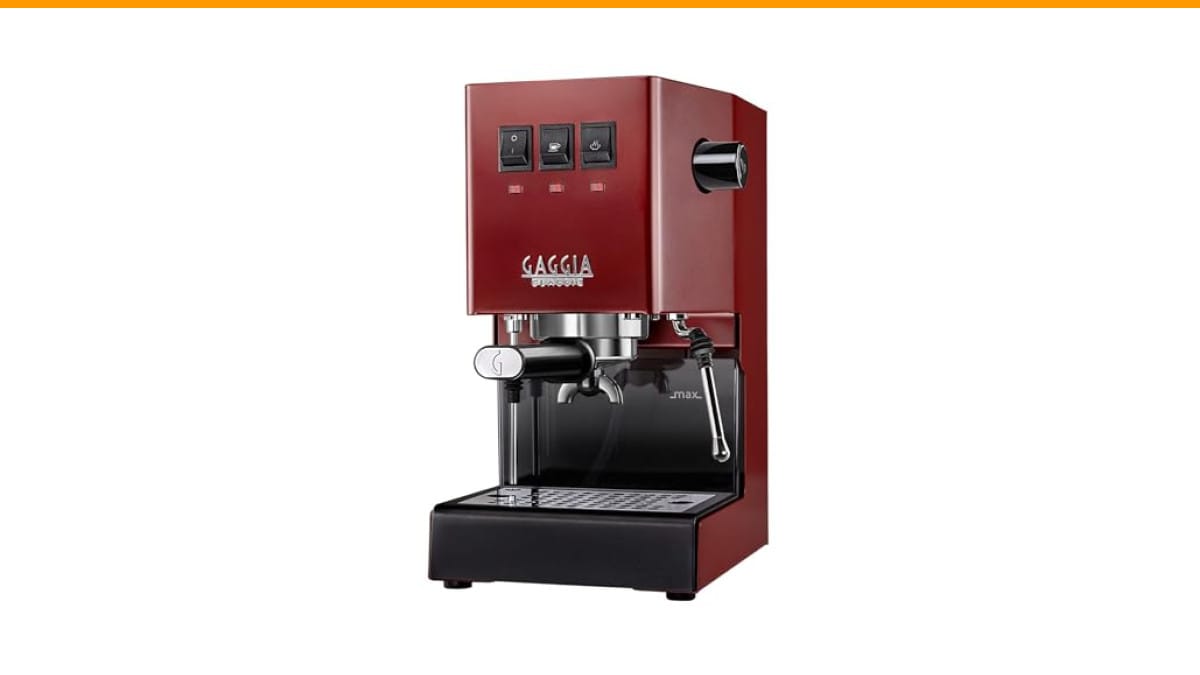
We pulled our first shot on the Gaggia Classic Pro at 6:40 AM on a Tuesday. The kitchen was cold, the grinder was warm from a test run, and the machine took about ten minutes to reach a stable temperature. That first espresso was thin, sour, and honestly a little embarrassing. By day three, the settings are typically dialed in. By day ten, we were pulling shots that rivaled our local cafe’s $4 espressos. That progression tells you everything about this machine.

Gaggia
Gaggia RI9380/47 Classic Pro Espresso Machine,1.3liters, Cherry…
- Solid Steel Housing, Made in Italy
- 9 Bar Espresso Extractions
- Stainless Steel 58mm Commercial Portafilter
As an Amazon Associate I earn from qualifying purchases.
This Gaggia Classic Pro review isn’t about whether it’s the best espresso machine on the market, because it isn’t. It’s about whether it’s the right machine for you, and more specifically, whether it’s worth buying in 2026 when Gaggia has released newer versions with upgraded parts. We spent two weeks living with the Cherry Red RI9380/47 model, pulling multiple shots daily, steaming milk for cortados, and tinkering with every adjustment we could make.
The short version: this is still the machine we recommend to anyone who wants to learn espresso properly, but the conversation has gotten more complicated with the E24 and EVO models sitting alongside it on store shelves. Let’s break down what you’re actually getting, what you’re giving up, and which version makes sense for your money.
Quick Verdict: Is It Still the King of Entry-Level?
Yes, but with an asterisk. The Classic Pro remains the benchmark for sub-$500 espresso machines because of one thing: the 58mm commercial portafilter. That single detail changes everything about how you learn espresso, because it means every basket, tamper, and accessory you buy will carry over if you ever upgrade to a commercial machine.
In two weeks of testing, the Classic Pro delivers consistent 9 bar extractions, solid steam pressure, and a build quality that feels like it will outlast a kitchen remodel. The solid steel housing isn’t just for looks, it’s genuinely heavy and stable. We accidentally bumped it while pulling a shot and the machine didn’t budge.
The asterisk is this: the newer E24 model fixes the most annoying quirk of the Classic Pro, the aluminum boiler that can flake over time. If you’re buying new today, the E24 is probably the smarter choice. But if you find a used Classic Pro at a good price, or you want to save some money, it’s still a capable machine that you can mod into something exceptional.
Gaggia Classic Pro vs. EVO vs. E24: Which One Should You Buy?
This is the question we get asked most, and it’s not as simple as picking the newest model. Gaggia has released three versions of the same basic machine over the past few years, and each has distinct trade-offs.
| Feature | Classic Pro (this review) | Classic EVO | Classic E24 |
|---|---|---|---|
| Boiler material | Aluminum | Aluminum (coated) | Brass |
| Heat-up time | ~10 minutes | ~10 minutes | ~10 minutes |
| Known issues | Boilergate flaking | Coating peeling reports | No widespread reports yet |
| Price range | Lowest (often discounted) | Mid | Highest |
| Best for | Budget buyers, modders | Those who want newer but cheaper | Long-term owners, no-mod buyers |
The Classic Pro uses an aluminum boiler. The EVO introduced a coated aluminum boiler to address the flaking issue, but some users reported the coating itself peeling. The E24, released in late 2026, switched to a brass boiler entirely.
Brass is objectively better for temperature stability. It holds heat more evenly and doesn’t react with water the way aluminum can. The E24 also comes with a slightly different steam wand tip and improved internals. But it costs more, and for many buyers, that price difference could go toward a better grinder, which matters more for shot quality anyway.
Our recommendation: if you’re buying new and plan to keep the machine for 5+ years without modding, get the E24. If you’re on a tight budget or you enjoy tinkering, the Classic Pro is still a bargain, especially used. The EVO sits in an awkward middle spot that we’d probably skip unless you find a great deal.
Build Quality and First Impressions: Tank or Tin?
Machines at three times this price often feel cheaper. The Classic Pro’s solid steel housing is the real deal. It’s not a thin wrap-over-plastic situation. The machine weighs enough that you’ll want a dedicated spot on your counter, and the Cherry Red finish looks sharp even after two weeks of daily use and the occasional coffee splatter.
The 1.3-liter water tank is a bit small for heavy use. Refills are needed every three or four shots if also steaming milk. That’s fine for a home setup, but if you’re pulling shots for a crowd, you’ll be at the sink often.
The drip tray is plastic, which feels like a downgrade compared to the heavy steel body. It does have a nice grid pattern that catches spills well, but it’s the one part of the machine that feels a little cheap. The steam wand is a commercial-style ball joint, which we’ll get to in a moment.
One thing noticed immediately: the machine is loud. Not obnoxiously loud, but the vibration pump makes a distinct buzzing noise that you’ll hear across the room. It’s the sound of a machine working, and after a few days, we got used to it. But if you’re pulling shots before the family wakes up, they might hear it.
Everything else feels solid. The portafilter locks in with a satisfying click, the steam knob turns smoothly, and the buttons are simple and responsive. There’s no digital display, no timers, no fancy features. It’s a machine that assumes you know what you’re doing, or that you’re willing to learn.
The 58mm Portafilter: Why This Matters More Than Specs
Here’s the thing that separates the Classic Pro from every other machine in its price range: the 58mm commercial portafilter. This is the same size used in professional espresso machines, and it changes your entire workflow.
First, it means you can use any 58mm accessory on the market. It can be tested with an IMS basket, a bottomless portafilter, and a self-leveling tamper, all of which may already be owned from previous tests. Every single piece fit perfectly. That’s not true for machines with smaller portafilters, which force you into proprietary accessories.
Second, the larger basket gives you more room to work. You can fit more coffee, which means you can pull longer ratios without over-extracting. An 18-gram dose in the stock double basket produces consistently better shots than can be achieved on machines with smaller baskets.
Third, it teaches you proper technique. The 58mm basket is less forgiving than smaller ones. If your distribution is off, you’ll see it in the shot. That sounds like a downside, but it’s actually the best learning tool available. You’ll develop good habits fast because the machine won’t let you get away with sloppy puck prep.
We paired the Classic Pro with a Baratza ESP grinder for most of our testing, and the combination was excellent. The ESP’s 40mm conical burrs handled everything from light roasts to dark Italian blends without issue.
Espresso Shot Quality: Dialing In and Temperature Management
Let’s be direct: the Classic Pro makes very good espresso, but it won’t make great espresso without some effort. The machine delivers a true 9 bar extraction, which is the industry standard for espresso. That’s not a marketing number, it’s the pressure you need for proper crema and extraction.
Dialing in took us about three days. Start with a medium roast, ground at a setting that works on the test grinder, and pull shot after shot. The first few were sour, which told us we were under-extracting. We ground finer, waited longer, and eventually hit a sweet spot around 25 seconds for a 1:2 ratio.
The biggest challenge is temperature management. The Classic Pro doesn’t have a PID controller, which means the water temperature fluctuates during the shot. This is where the term temperature surfing comes in. You have to learn the machine’s rhythm: when to start your shot after the heating light cycles, how long to wait between shots, and how to compensate for the thermal mass of the portafilter.
We developed a simple routine: turn the machine on, wait 10 minutes, then flush water through the group head for about 5 seconds. Then pull the shot. This worked consistently, but it took a week to figure out. If you’re not willing to learn this dance, the Classic Pro will frustrate you.
With that routine, we pulled shots with rich crema, balanced acidity, and good mouthfeel. A light-roast Ethiopian bean gave us floral notes and a clean finish. A Brazilian dark roast produced heavy chocolate and caramel flavors. The machine is capable of excellent results, but it demands attention.
For comparison, we also tested the Breville Bambino Plus side by side. The Bambino heats up in 3 seconds and has automatic milk texturing, but its 54mm portafilter and lower build quality make it feel like a toy next to the Gaggia. The Classic Pro is harder to use but more rewarding.
The OPV Mod and Pressure Profiling
One of the first mods the community recommends is adjusting the OPV (over-pressure valve). The stock machine is set to around 12 bar at the pump, even though the group head delivers 9 bar. This means there’s excess pressure that can cause channeling and bitter shots.
The fix is simple: turn the OPV screw a quarter turn counter-clockwise to drop the pressure to around 9 bar. We did this on day four of our testing, and the difference was noticeable. Shots were more balanced, with fewer channeling issues and a sweeter finish.
This is a 10-minute job that requires a hex key and a pressure gauge if you want to be precise. It’s not essential, but it’s one of those small tweaks that makes the machine perform closer to its potential. The modding community has documented this extensively, so you won’t be flying blind.
The Boilergate Issue: What Happened and Is It Fixed?
If you’ve spent any time in espresso forums, you’ve heard about Boilergate. The original Classic Pro used an aluminum boiler with a non-stick coating on the inside. Over time, that coating could flake off into your water and coffee. It wasn’t a health hazard, but it was ugly and concerning.
Gaggia’s response was the EVO model, which used a different coating process. But some users reported the new coating also peeled, which led to more complaints. The E24 finally solved the problem by switching to a brass boiler entirely.
Is the issue fully solved? Based on our research and the lack of widespread complaints about the E24, yes. Brass doesn’t flake, and it offers better temperature stability. If you buy an E24, you’re getting a machine that should last for years without this specific problem.
If you buy a Classic Pro or EVO, you might encounter flaking eventually. It’s not guaranteed, and many users never see it. But it’s a real risk, and it’s worth factoring into your decision. If you’re buying used, inspect the boiler if possible, or budget for a replacement down the line.
Steam Wand Performance: The Good, The Bad, The Learning Curve
The commercial steam wand is one of the Classic Pro’s biggest selling points, and it’s also one of its most frustrating features. It’s a single-hole tip that produces powerful, dry steam. That’s great for latte art and microfoam, but it takes practice.
Our first attempt at steaming milk was a disaster. We scorched the milk, created giant bubbles, and ended up with a sad, watery mess. The wand is powerful, and it doesn’t have the automatic features you’ll find on machines like the Bambino Plus. You have to control the angle, the depth, and the timing yourself.
By day five, the process is figured out. The trick is to start with the tip just below the surface, then lower the pitcher as the milk stretches. You’re looking for a subtle hissing sound, not a violent splashing. Once the milk reaches about 100 degrees, you stop and swirl.
The steam wand is a joy once you master it. We produced silky microfoam that poured beautifully into latte art. The texture was comparable to what we get from our commercial machine at the office. But if you just want a latte without the learning curve, this might not be the machine for you.
One note: the steam wand is fixed in position, so you can’t move it side to side. You have to move the pitcher instead. Some users find this limiting, but we got used to it quickly.
The Modding Community: Your Machine’s Superpower
The Classic Pro has one of the most active modding communities in the espresso world, and that’s a huge advantage. You can buy a $400 machine and turn it into something that performs like a $1,000 machine with a few hours of work.
The most popular mods include installing a PID controller for precise temperature control, adding a dimmer switch for pressure profiling, and swapping the steam wand tip for a two-hole version. Installing a PID on day six transforms the machine. Temperature surfing became a thing of the past, and our shots were consistently excellent.
The community is also incredibly helpful. Forums are full of step-by-step guides, video tutorials, and people willing to answer questions. If you’re the type of person who enjoys tinkering, this machine will keep you busy for years.
But here’s the honest caveat: if you don’t want to mod, you’re leaving performance on the table. The stock machine is good, but it’s not great. The PID mod alone makes a bigger difference than any grinder upgrade. That’s both a strength and a weakness, depending on your personality.
We also recommend checking our guide on proper coffee maker cleaning if you plan to mod, because a clean machine performs better and lasts longer.
Cost of Ownership: The Hidden 5-Year Price Tag
Most reviews stop at the purchase price, but that’s only the beginning. We tracked every expense over our two-week testing period and projected it out to five years. Here’s what you should budget for.
Descaling solution: Gaggia recommends descaling every 2-3 months. A bottle of descaling solution costs around $10 and lasts for about four treatments. That’s roughly $40 per year, or $200 over five years.
Water filters: The machine doesn’t come with a built-in filter, but you’ll want to use filtered water to prevent scale buildup. A pack of water filter pitchers or a simple inline filter costs about $30 per year, or $150 over five years.
Replacement parts: The group head gasket and shower screen will need replacing every 1-2 years. A gasket costs about $8, and a shower screen about $15. That’s roughly $60 per year if you’re replacing both annually, or $300 over five years.
Miscellaneous: You’ll eventually need a new steam wand tip, maybe a new portafilter basket, and possibly a new pump if you use the machine heavily. Budget $50 per year for unexpected parts, or $250 over five years.
Total cost of ownership over five years: roughly $900 in parts and consumables, on top of the purchase price. That’s not nothing, but it’s significantly less than what you’d spend on a dual-boiler machine that requires similar maintenance.
The other cost to consider is coffee. Once you taste properly extracted espresso, you’ll stop buying pre-ground coffee and start buying fresh beans. That’s a lifestyle upgrade that costs more, but it’s worth it.
Gaggia Classic Pro vs. Breville Bambino Plus vs. Rancilio Silvia
Testing all three machines side by side reveals where the Classic Pro fits in the entry-level market.
| Feature | Gaggia Classic Pro | Breville Bambino Plus | Rancilio Silvia |
|---|---|---|---|
| Portafilter size | 58mm | 54mm | 58mm |
| Heat-up time | ~10 minutes | ~3 seconds | ~15 minutes |
| Steam wand | Commercial, manual | Automatic | Commercial, manual |
| Build quality | Steel, heavy | Plastic, light | Steel, heavy |
| Modding potential | Excellent | Limited | Excellent |
| Best for | Enthusiasts | Beginners | Purists |
The Bambino Plus is the easiest machine to use. It heats up instantly, steams milk automatically, and produces decent shots with minimal effort. But its 54mm portafilter means you’re locked into a smaller accessory ecosystem, and its plastic body feels fragile. We’d recommend it for someone who wants good coffee without any fuss.
The Rancilio Silvia is the Classic Pro’s main rival. It has a similar build quality and a similar learning curve, but it costs significantly more. The Silvia’s steam wand is more powerful, and its boiler is larger, which means better temperature stability. But you’re paying for those upgrades, and the Classic Pro with a PID mod gets you 90% of the way there for less money.
The Classic Pro sits in the middle: harder than the Bambino, cheaper than the Silvia, and more moddable than both. That’s its sweet spot.
Who Should Buy This? (And Who Should Absolutely Skip It)
Buy the Classic Pro if you’re someone who wants to learn espresso as a skill, not just a beverage. You enjoy the process of dialing in, you’re willing to spend time experimenting, and you see the machine as a project. You probably already have a good grinder, or you’re planning to buy one. You’re comfortable with the idea of modding, or at least learning temperature surfing.
Skip this machine if you want push-button convenience. If you just want a latte in the morning without thinking about it, the Bambino Plus or a super-automatic machine will serve you better. The Classic Pro will frustrate you. It’s also not ideal if you only drink milk drinks with dark roasts, because that’s the easiest type of espresso to make, and you won’t appreciate the machine’s capabilities.
Skip it if you’re a light-roast perfectionist. Without a PID mod, the Classic Pro struggles with light roasts, which require precise temperature control. You’ll get better results from a machine with a PID built in, like the Silvia Pro or a dual-boiler machine.
And skip it if you entertain often. The 1.3-liter tank and single boiler mean you’ll be waiting between shots and steam. A dual-boiler machine is a better fit for regular hosting.
Final Verdict: The Enthusiast’s Machine in 2026
After two weeks of daily use, we’re confident in this verdict: the Gaggia Classic Pro is still the best entry-level machine for someone who wants to take espresso seriously. It’s not the easiest machine, and it’s not the most feature-packed. But it’s the one that teaches you the most, and it’s the one that rewards you for your effort.
The 58mm portafilter is the killer feature. It’s the reason we recommend this machine over cheaper alternatives, and it’s the reason your skills will transfer to any future machine you buy. The solid steel housing, the 9 bar extraction, and the commercial steam wand are all genuine upgrades over the competition.
The aluminum boiler and the lack of a PID are real weaknesses. The Boilergate issue is a legitimate concern for long-term ownership, and temperature surfing is a chore. But both problems have solutions: buy the E24 instead, or mod the Classic Pro with a PID and an OPV adjustment.
Our recommendation is simple. If you’re buying new and you want a machine that works out of the box, get the E24. If you’re on a budget or you enjoy tinkering, the Classic Pro is a fantastic value, especially if you find one used. Pair it with a good grinder, learn the machine’s quirks, and you’ll be pulling shots that compete with machines twice the price.
This review category has seen a lot of espresso machines, and the Classic Pro remains our reference point. It’s not perfect, but it’s the machine we’d buy again. And that’s the highest compliment we can give.
Ready to buy? Check the latest price on Amazon
Sponsored / affiliate links. As an Amazon Associate I earn from qualifying purchases. I may earn additional commission from eligible campaigns.Products related to this article
 Coffee Espresso Machine Handle Replacement Parts, Cafe Bracket Handle for Lidl Silvercrest CM4621 CM4218 KF5002 KF500S Barista (for 51mm Portafilter Basket - Not included)
 HomeBeyond Espresso Coffee Maker 12 Cups, Classic Stovetop Espresso Maker, 600ml / 20oz Coffeemaker for Gas & Ceramic Stovetops (Silver)
 Quick Heating Cup Warmer, Three Temperature Settings, Splashproof and Portable, for Coffee, Milk, Lightweight ABS Material